Twosome funnel
Clitocybe metachroasyn. Agaricus metachrous, Clitocybe metachrous, Omphalia metachroa, Clitocybe gilva var. metachroa
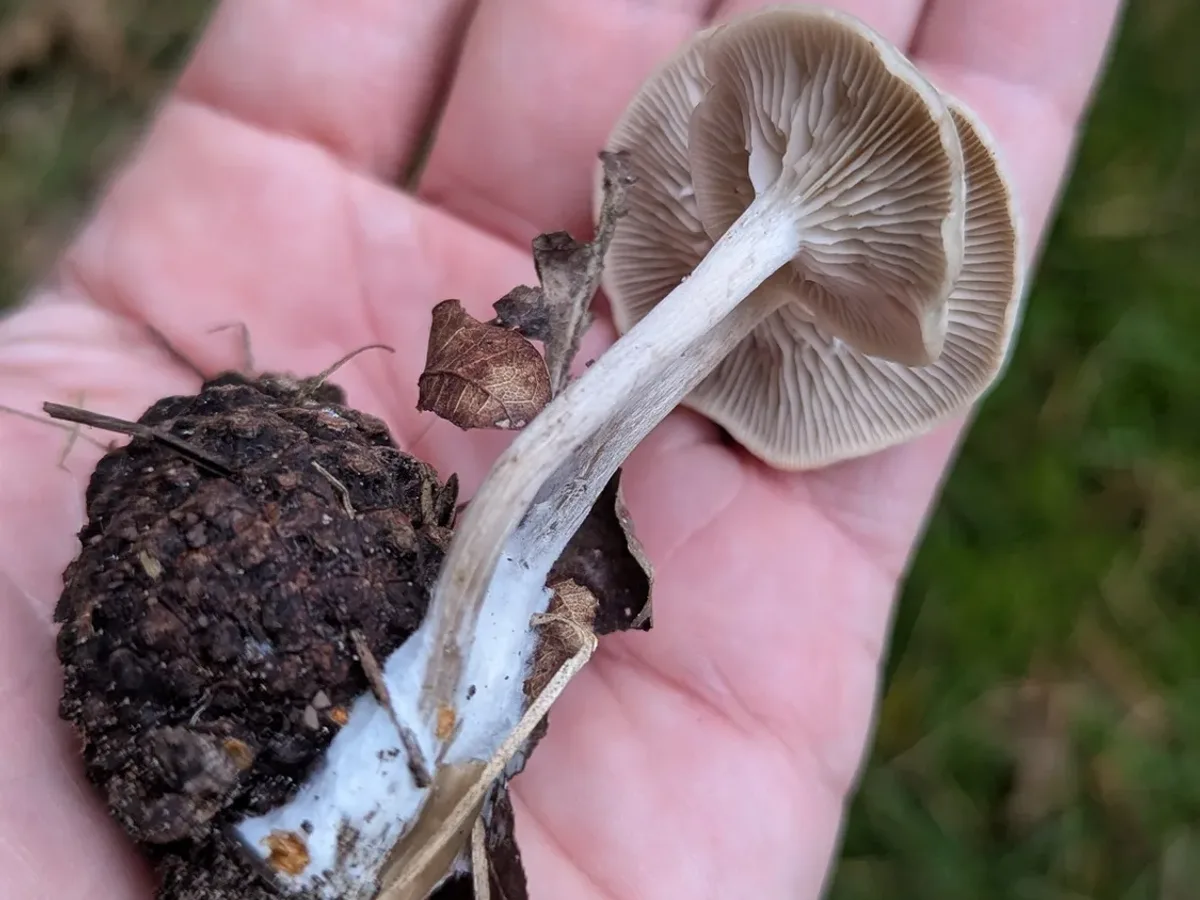 © Michel Langeveld (CC BY)
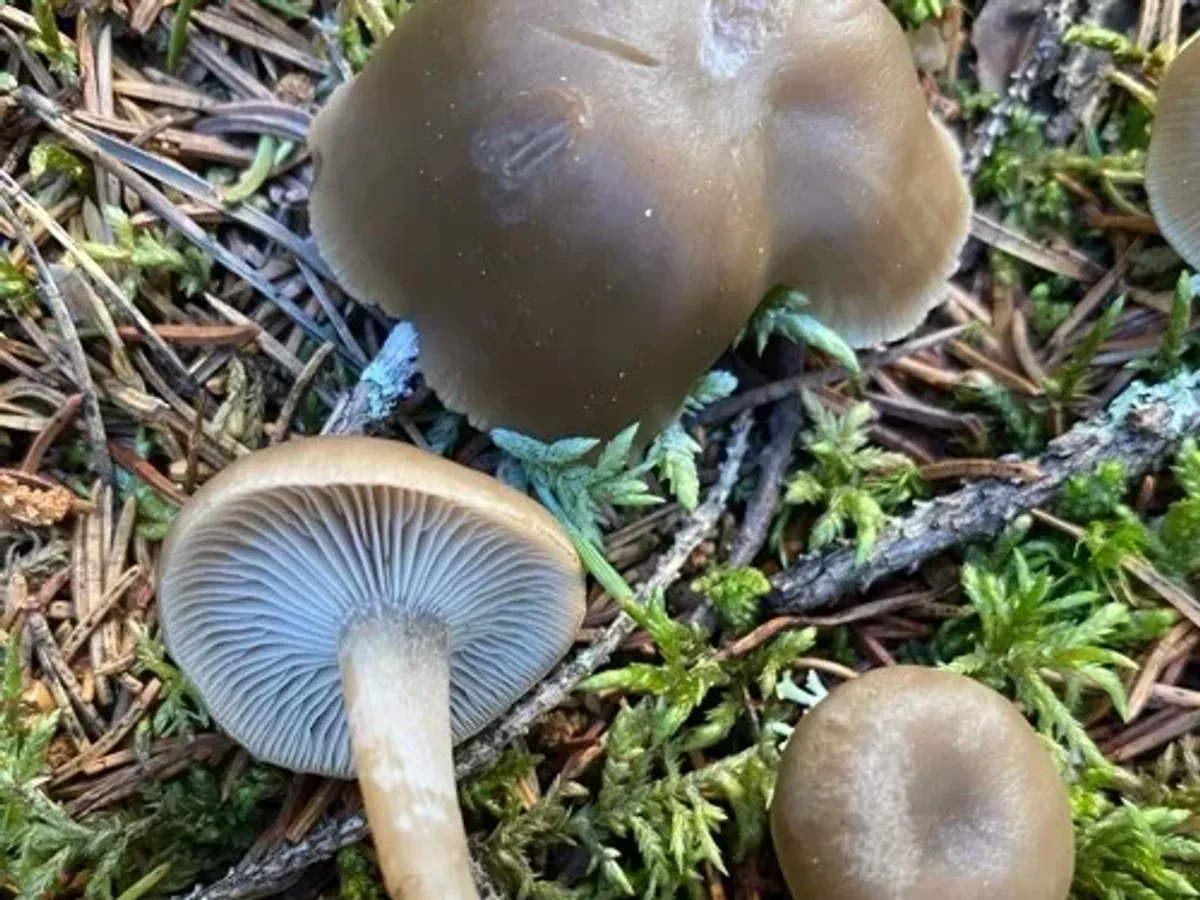 © Anne Marit Strøm (CC BY)
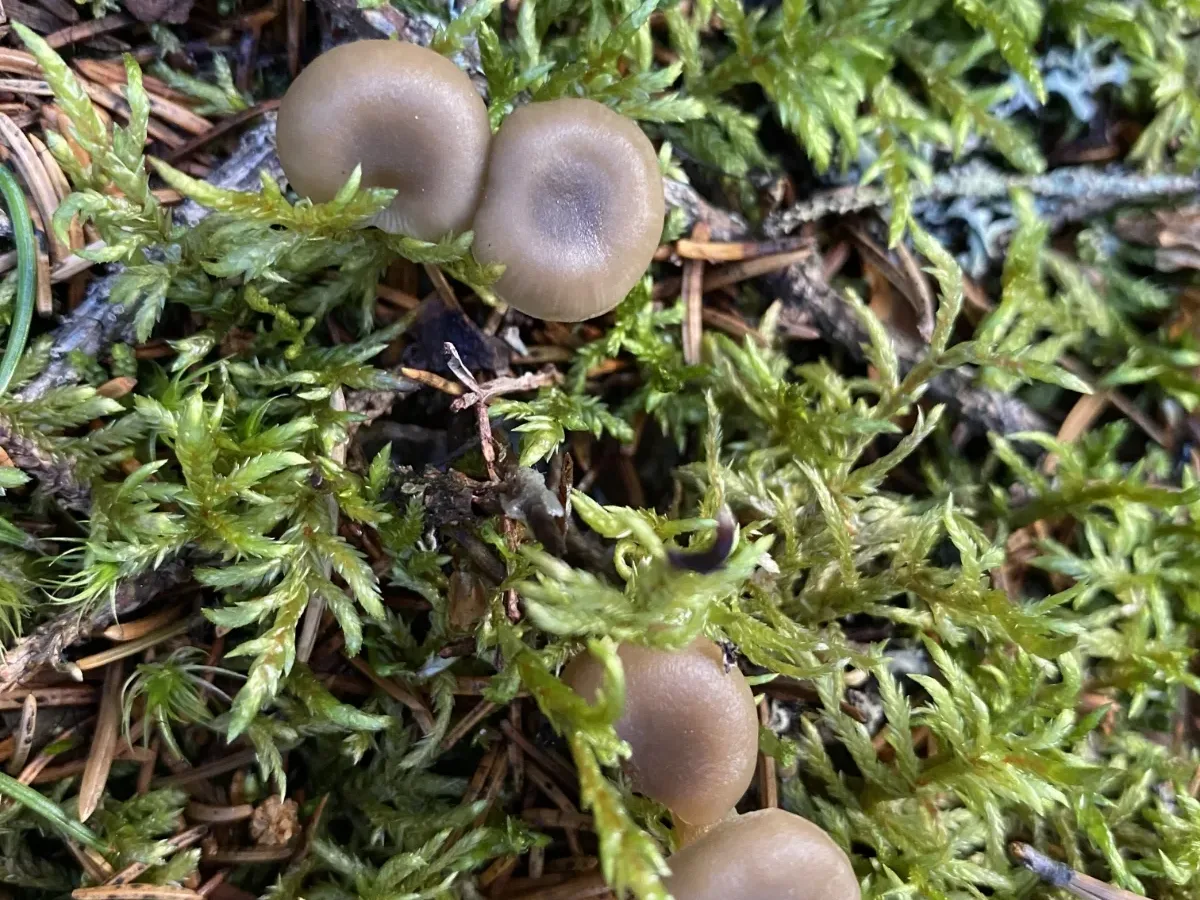 © Anne Marit Strøm (CC BY)
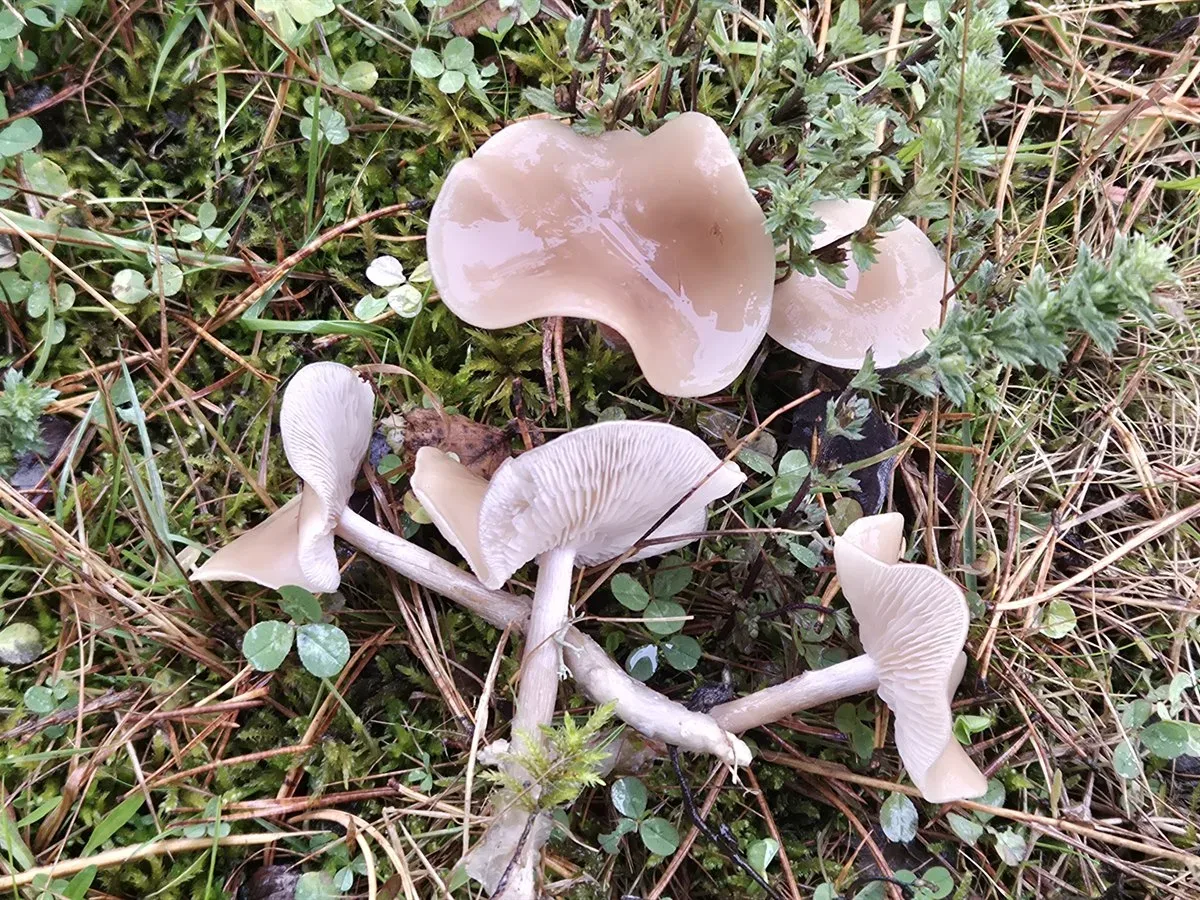 © Inger Kristoffersen (CC BY)
 © Hallvard Holtung (CC BY)
 © Hallvard Holtung (CC BY)
 © Rob van Kruining (CC BY)
 © Michel Langeveld (CC BY)© Michel Langeveld (CC BY)© Anne Marit Strøm (CC BY)
Edible only with the right preparation - or safe for some people but not others. Learn the caveats first.
Never eat a mushroom you are not 100% sure of - check the look-alikes below, and always cook wild mushrooms.
How to recognise it
Cap
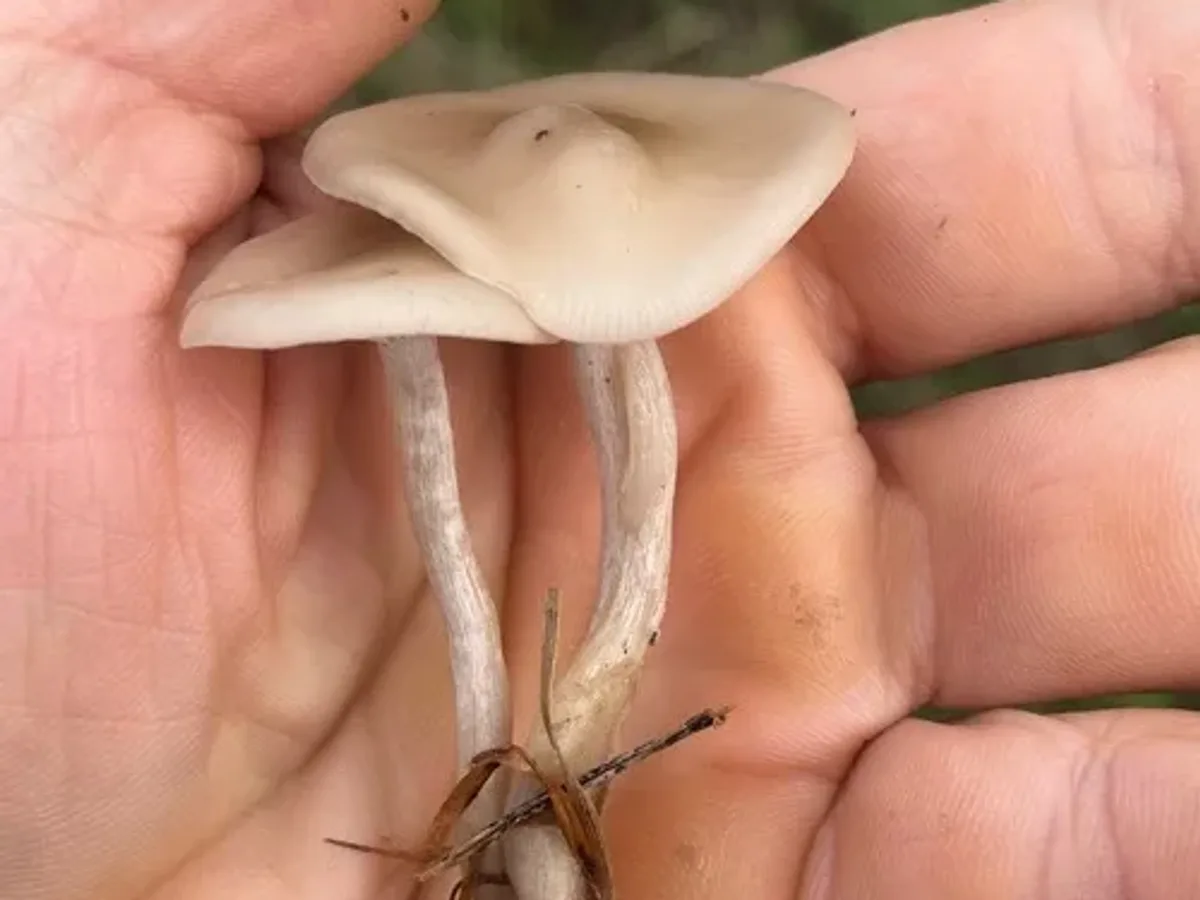
Clitocybe metachroa is a slender, quietly understated funnel cap whose most interesting character is written right into its name: metachroa means 'changing colour', and this is exactly what it does.
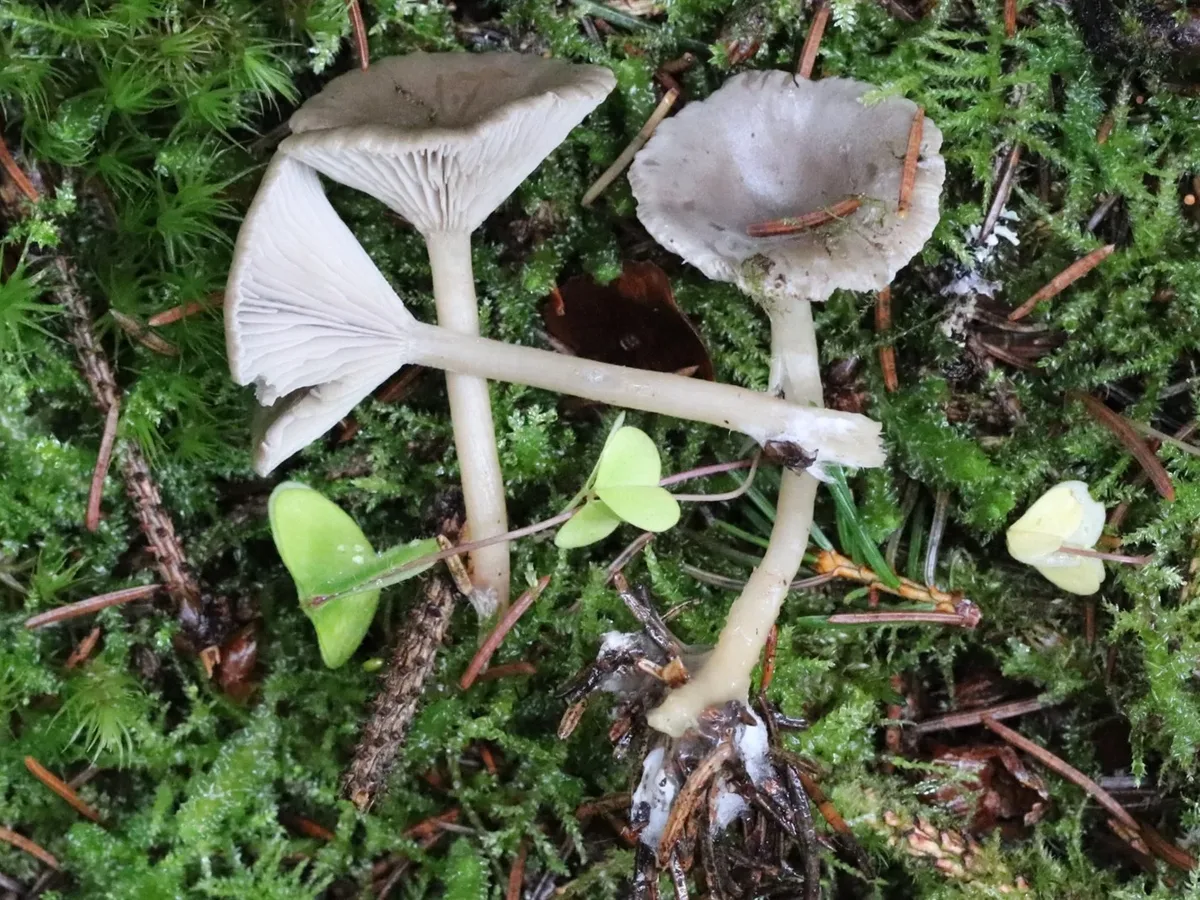
When freshly emerged or rain-wet, the cap is a dark grey-brown or smoky grey-buff. As it dries it fades outward from the centre, leaving a pale ochraceous-cream or almost whitish disc still framed by a darker, damp margin - a clearly bicoloured effect that can shift noticeably over the course of a single afternoon.
The cap is typically 3-7 cm, progressing from convex to broadly depressed and finally forming a proper funnel.
Gills
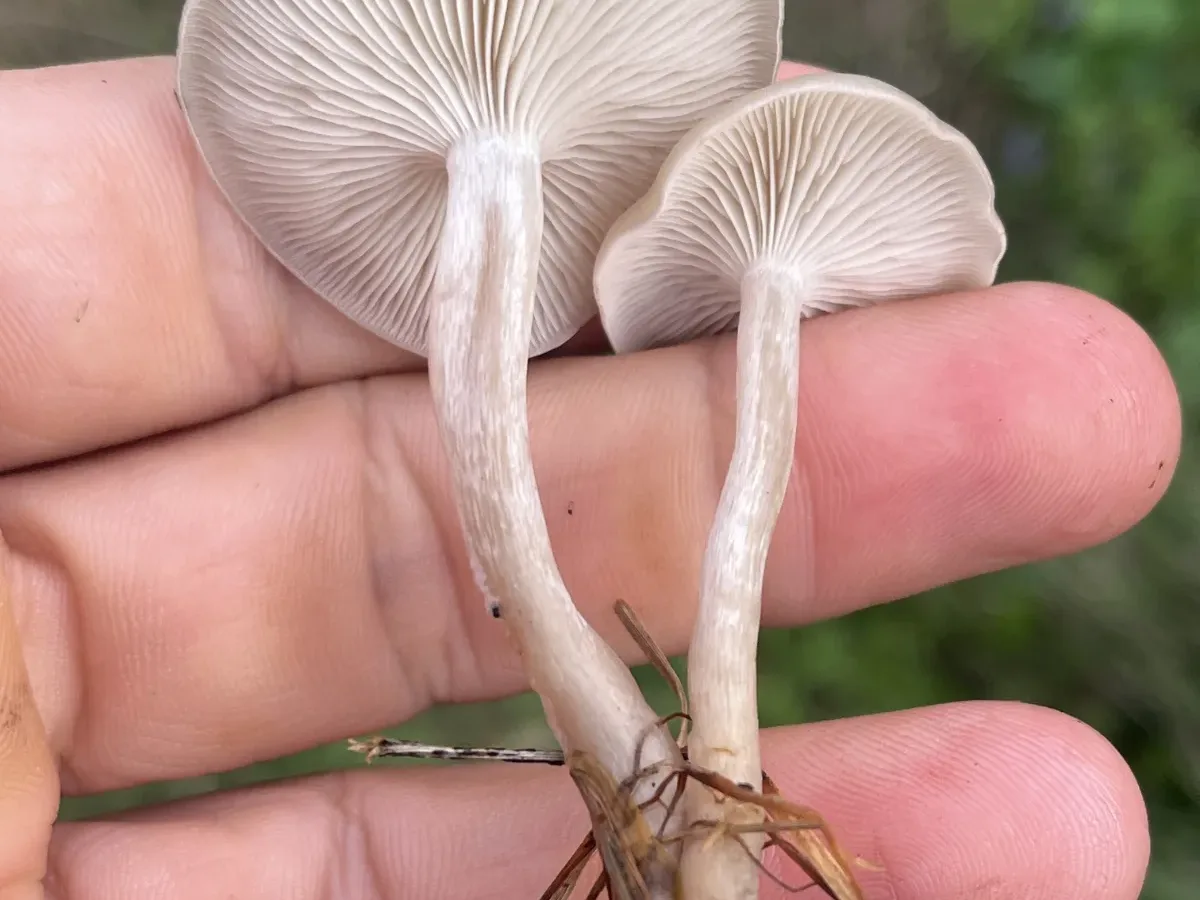
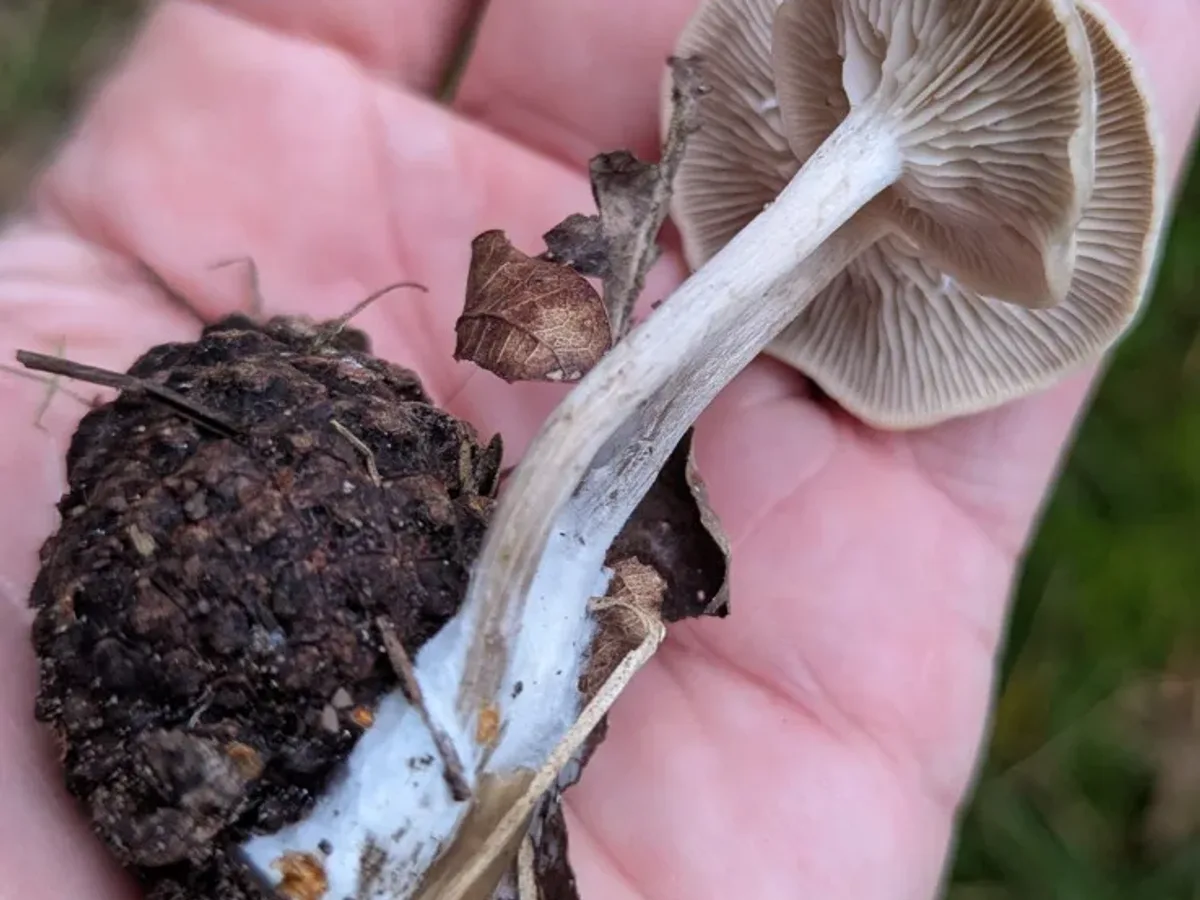
The pale, crowded gills run well down the slender, fibrous stem (decurrent attachment), and the whole spore print is white.
Stem
The stem is slim and unornamented.
Flesh
Flesh is thin and when scratched carries only a mild, faint mealy smell - nothing distinctive.
That slender build and thin flesh separate it immediately from the much more robust Infundibulicybe geotropa, and the hygrophanous bicolouration remains the most useful single field mark.
Where & when it grows
Habitat
This species makes its living breaking down the accumulated leaf litter of closed-canopy woodland - it has no mycorrhizal partnership with living roots and is answerable only to organic matter and moisture.
It shows up most reliably in the deeper leaf accumulations under beech, oak and hornbeam, particularly in shaded, hollow ground and along the sheltered edges of woodland paths where litter builds up undisturbed.
Unlike some relatives that announce themselves in sweeping fairy rings, C. metachroa appears as single fruit bodies, pairs or small loose groups - the scattered 'twosome' habit is genuinely characteristic.
It occasionally ventures into scrub and dense hedgerows but rarely into open, short-grazed grassland.
When
Fruiting is concentrated in the main autumn window from late August through October, with the peak typically September to mid-October in temperate western Europe.
Flushes follow cool, wet spells as summer heat breaks and soils stay reliably damp - the species responds well to the first proper autumn rains.
It is not one of the very last funnels of the year and will generally finish before the great late-autumn flush of Clitocybe nebularis or the Trooping Funnel.
How it grows
Saprotrophic, breaking down dead leaf material and woody debris in the litter and upper humus layers.
Unlike some funnel species that build long-lived perennial rings, C. metachroa does not form persistent circular structures. Fruit bodies appear wherever litter and moisture are adequate, returning to productive spots in successive autumns but scattered rather than ring-forming.
Individual fruit bodies are slender and appear in modest numbers rather than dense troops.
Fruiting conditions
A moderate autumn flush species responding to the first significant autumn rains as soil temperatures drop below 16 °C. Flushes are modest in size; the species does not form large perennial rings so site recurrence is less predictable than in Infundibulicybe geotropa. Fruiting finishes before the hard frosts of November in most temperate European locations.
Handle with care
Toxin
Clitocybe metachroa itself does not contain recognised toxins at significant levels.
The caution classification reflects the extreme risk of confusion with muscarine-containing species, principally Clitocybe rivulosa (Ivory Funnel) and Clitocybe phyllophila (Frosty Funnel). Both belong to the same functional guild and share almost all macroscopic features with C. metachroa.
Symptoms
If muscarinic poisoning occurs through misidentification of a deadly lookalike, onset is rapid - typically within 15-60 minutes of ingestion.
Symptoms are those of the SLUDGE/DUMBELS cholinergic syndrome:
- excessive salivation
- lacrimation
- urination
- defecation
- gastric cramping
- emesis (vomiting)
- bradycardia
- hypotension
- miosis
- bronchospasm
Severe cases can cause respiratory failure and are potentially fatal.
Medical emergency: seek immediate hospital treatment; atropine is the antidote.
Look-alikes
The most dangerous confusion is with the muscarine-containing small white and grey funnel caps of autumn woodland - particularly the Ivory Funnel (Clitocybe rivulosa / C. dealbata complex) and the Frosty Funnel (C. phyllophila). Both contain muscarine at concentrations sufficient to kill, and share a closely similar habitat, season, gill arrangement and spore print colour.
The bicoloured hygrophanous cap of C. metachroa is a useful distinguishing feature when clearly visible, but a dry, pale specimen can lose that character entirely.
Other lookalikes are separated as follows:
- Clitocybe suaveolens - has a stronger, sweeter aniseed-like smell.
- Trooping Funnel (Infundibulicybe geotropa) - far larger, buff-ochre rather than grey-brown, with a massive swollen stem, a central umbo within the funnel, and never shows the same hygrophanous bicolouration.
- Clouded Funnel (Clitocybe nebularis) - substantially larger, grey but not hygrophanous, with a very strong mealy-sickly smell.
None of these size or smell differences are reliable enough to eat by: when in doubt, leave all grey funnels alone.
Why it matters
The danger from this species is primarily through misidentification. The small grey autumn funnel guild contains both harmless and lethally muscarinic species that are visually very similar to each other.
Do not attempt to separate C. metachroa from C. rivulosa or C. phyllophila in the field for culinary purposes - the consequences of error are potentially fatal.
DEADLY - contains muscarine. White to whitish-cream funnel cap, 3-8 cm, with a frosty or felty surface; grows in needle and leaf litter in both deciduous and conifer woodland, making it a direct habitat overlap with C. metachroa. Slightly larger and paler, less hygrophanous, with a faint sweet or faint mealy smell, but these differences are subtle and unreliable. White spore print. Never eat any pale funnel in leaf litter without absolute expert certainty.
DEADLY - contains muscarine. Ivory-white to pale grey cap 2-5 cm, often with a zonate or frosty surface. Grows mainly in grassy habitats, lawns and path edges rather than deep leaf litter, but habitats overlap. Cap is typically less hygrophanous and less grey-brown than C. metachroa; smell faint to mealy. The overlap in appearance is close enough that safe separation of the two in the field cannot be guaranteed. Never eat grey-brown funnel caps from this size range found in autumn.
Not toxic. Distinguished immediately by a strong, unmistakable sweet aniseed smell and blue-green to sea-green cap colour when fresh. Cap fades to grey-buff when dry, at which point the smell remains the decisive character. C. metachroa has a mild, faintly mealy smell, never aniseed, and is grey-brown rather than blue-green.
Edible with caution only. Substantially larger (6-25 cm cap), grey but not hygrophanous bicoloured, with a strong distinctive mealy-sickly or sweetish-rancid smell and a cream (not white) spore print. The size difference is marked and the smell is unmistakable. C. metachroa is slim and much smaller with a faint, unremarkable odour.
Edible and choice. Much larger (cap 6-25 cm), buff-ochre rather than grey-brown, not hygrophanous, with a tall massive swollen stem and a persistent small umbo (boss) at the centre of the funnel. Grows in large troops and fairy rings. The size difference alone - C. metachroa is a small, slender fungus - is immediately apparent when the two are side by side.
In the kitchen
Picking & cleaning
This species is generally not collected for the table, and for good reason:
- the flesh is thin;
- the flavour is unremarkable;
- and, critically, the general morphology (slender funnel, decurrent pale gills, white spore print, litter habitat in autumn) overlaps dangerously with a suite of muscarine-containing Clitocybe species that include deadly poisonous ones.
The risks of confusion far outweigh any nutritional or culinary benefit.
If you encounter it, study it as an identification exercise, not as food.
Cooking
Clitocybe metachroa has no culinary use and should not be brought into the kitchen. The flesh is thin and the flavour mild and mealy - entirely without culinary interest.
The species has no tradition of use as food anywhere in European mycology; it appears in no forage guides as an edible and no regional cuisine has found a role for it.
More critically, heat does not neutralise the muscarine toxins found in its deadly lookalikes. Muscarine is heat-stable: if a specimen of Clitocybe rivulosa (Ivory Funnel) or Clitocybe phyllophila (Frosty Funnel) has entered the pot alongside what was thought to be C. metachroa, cooking will not protect you.
The full lethal dose remains chemically intact through frying, boiling, stewing or any other preparation.
The combination of zero culinary reward and a realistic, potentially fatal misidentification risk makes this a species that belongs only in a field notebook, never in a pan. Discard any grey-brown autumn funnel cap that cannot be identified with absolute expert certainty.
Good to know
Do not eat this mushroom.
Although Clitocybe metachroa is not itself known to be toxic, it belongs to a morphological group (small-medium autumn funnel caps with decurrent gills and white spore prints) where the price of a misidentification is muscarinic poisoning - a potentially fatal cholinergic crisis causing profuse salivation, lacrimation, sweating, vomiting, bradycardia and bronchospasm.
The deadly Ivory Funnel (Clitocybe rivulosa) and Frosty Funnel (C. phyllophila) grow in exactly the same habitat, season and niche, and are impossible to distinguish from poisonous relatives without microscopy in some conditions.
A hygrophanous grey-brown funnel with a thin cap in autumn leaf litter should be presumed dangerous unless expertly confirmed.
This app treats the species as 'caution' because even if the individual is correctly identified, the identification itself requires excluding deadly lookalikes that are visually very similar.
A reference guide - never an edibility guarantee. When in doubt, leave it out.