Shining funnel
Clitocybe candicanssyn. Agaricus candicans, Omphalia candicans, Omphalina candicans, Clitocybe candicans var. minor, Melanotus candicans
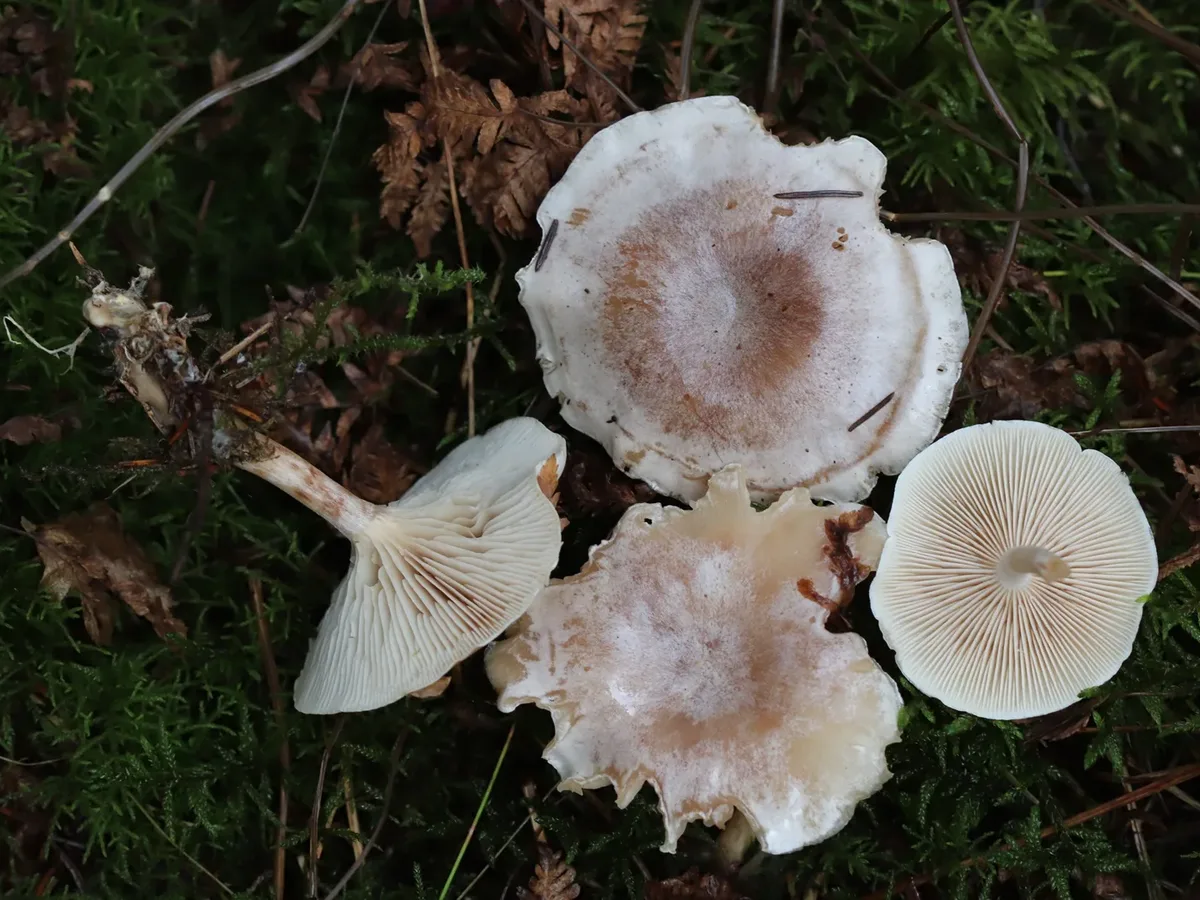 © Rob van Kruining (CC BY)
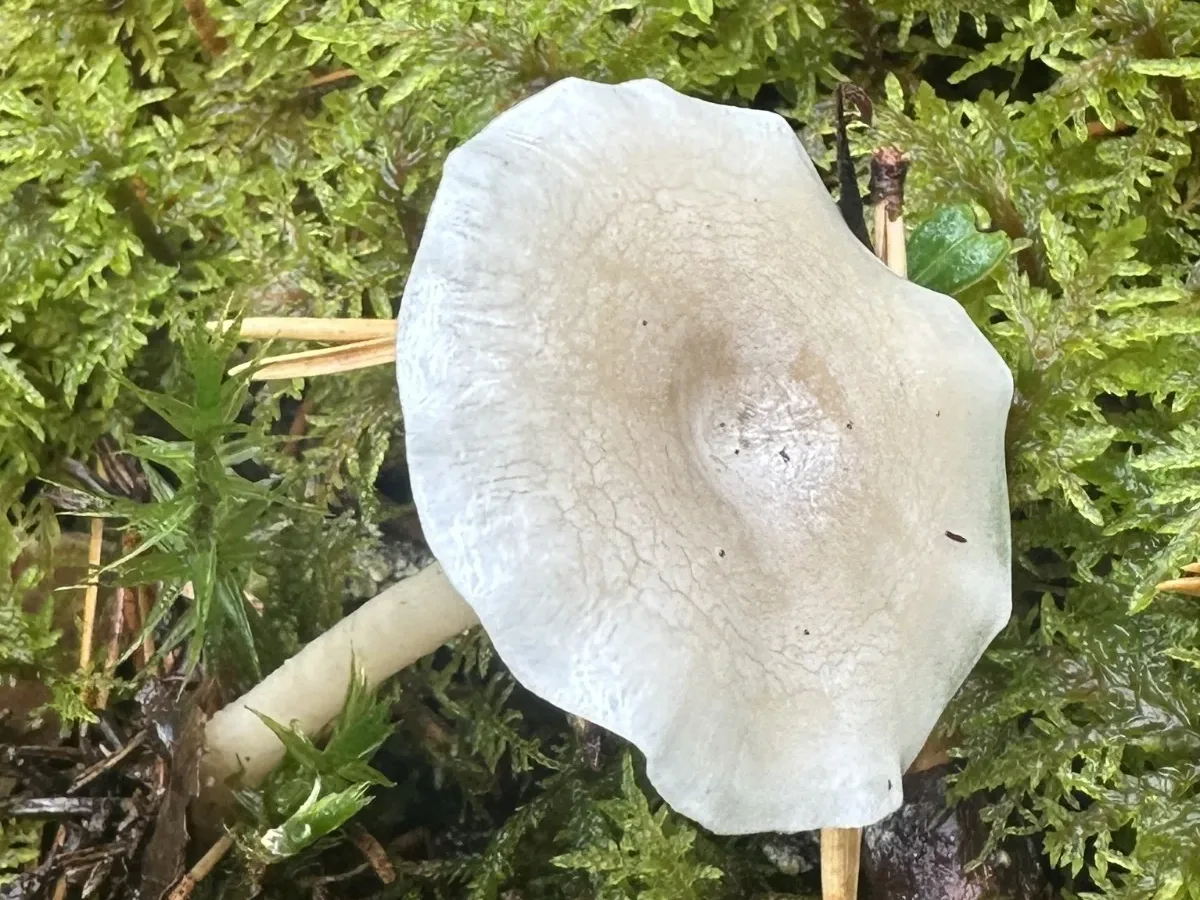 © Ola Vestre (CC BY)
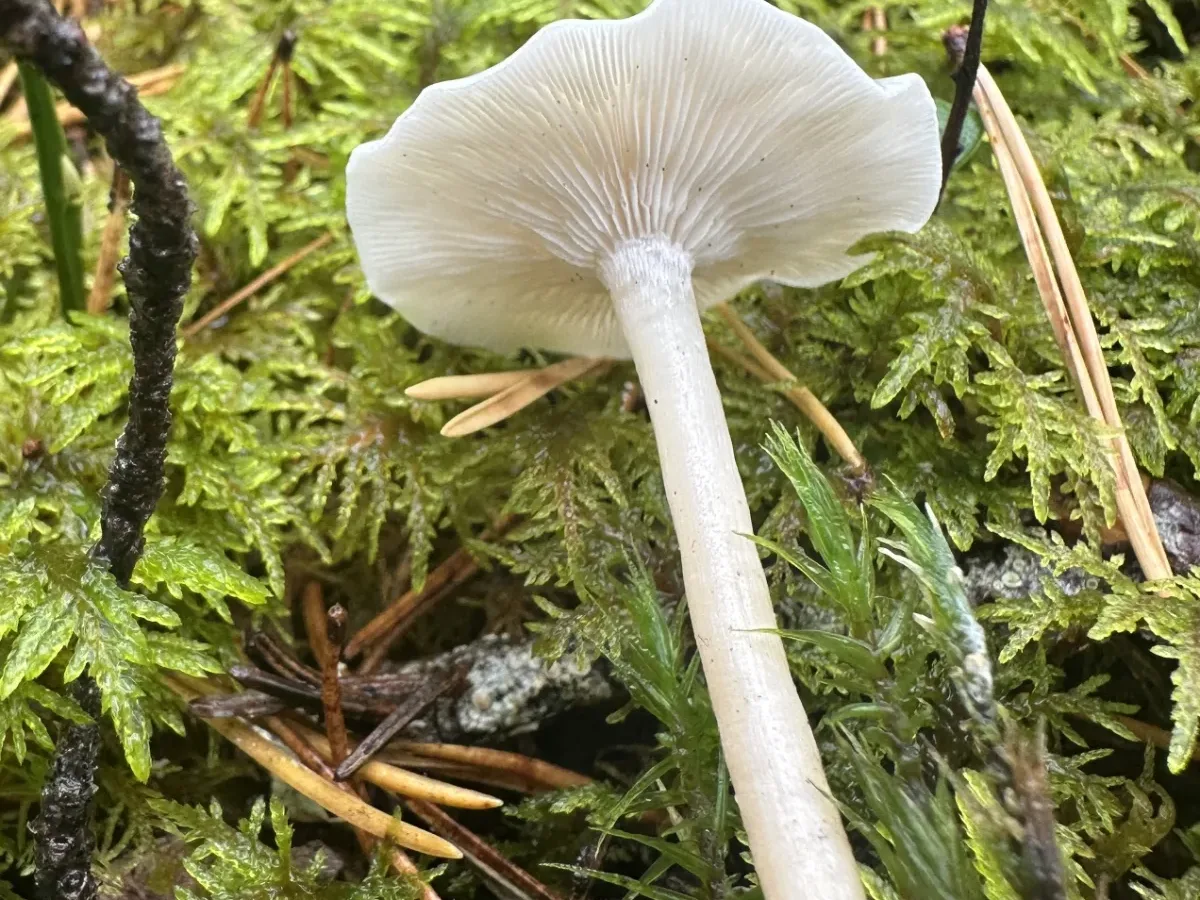 © Ola Vestre (CC BY)
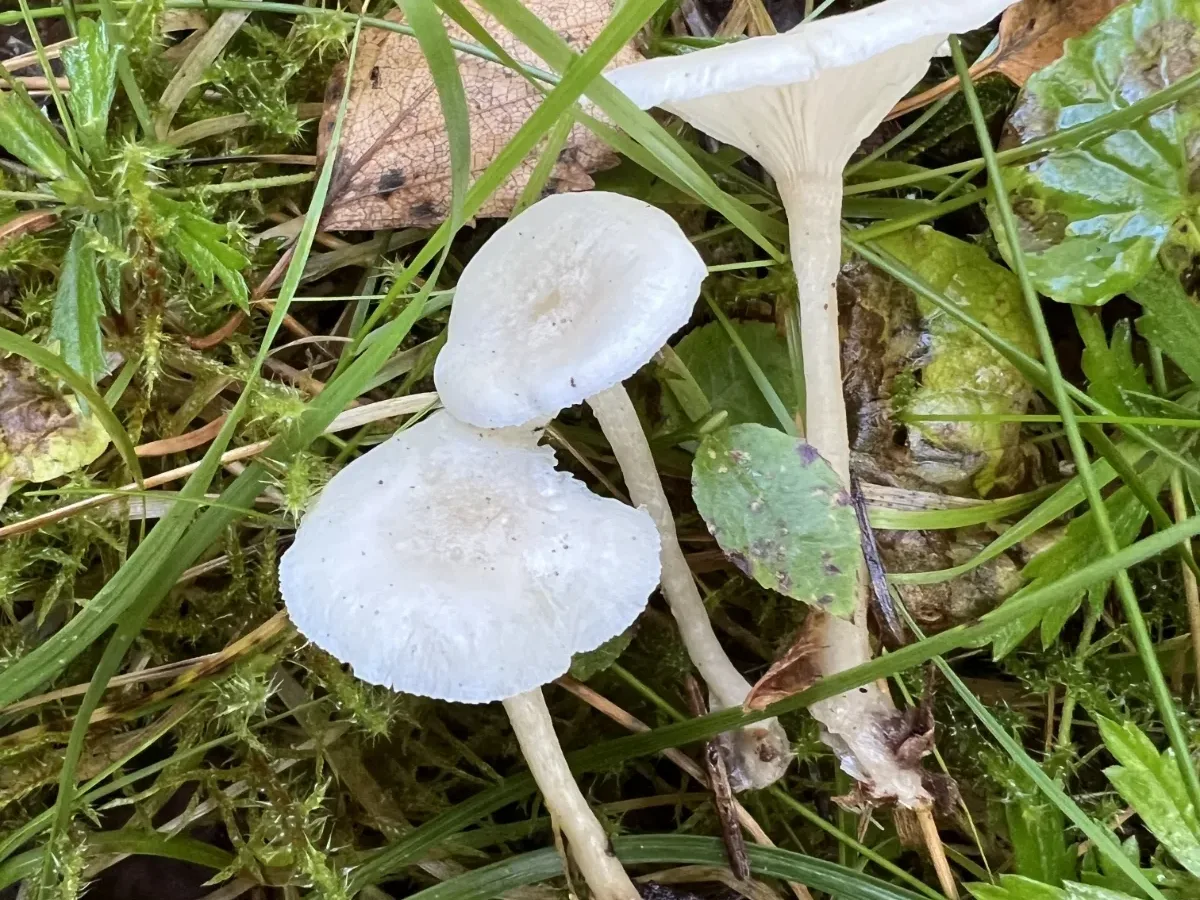 © Else Landsem (CC BY)
 © Else Landsem (CC BY)
 © Per Marstad (CC BY)
 © Johan Sirnes (CC BY)
 © Johan Sirnes (CC BY)© Rob van Kruining (CC BY)© Ola Vestre (CC BY)
Edible only with the right preparation - or safe for some people but not others. Learn the caveats first.
How to recognise it
Clitocybe candicans belongs to a group of small, entirely white funnels that look deceptively plain - and that plainness is precisely the problem, because several close relatives share the same blank-white appearance while carrying very different risk profiles.
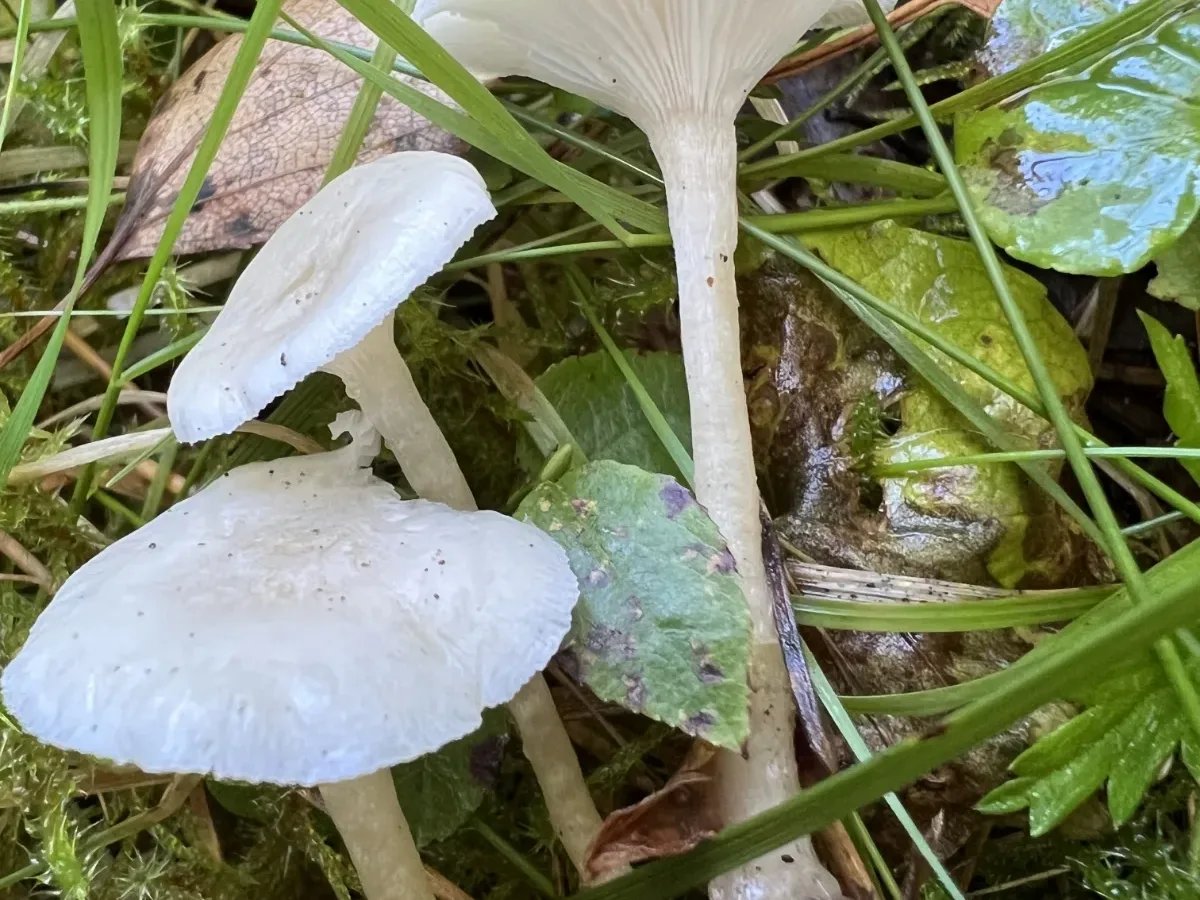
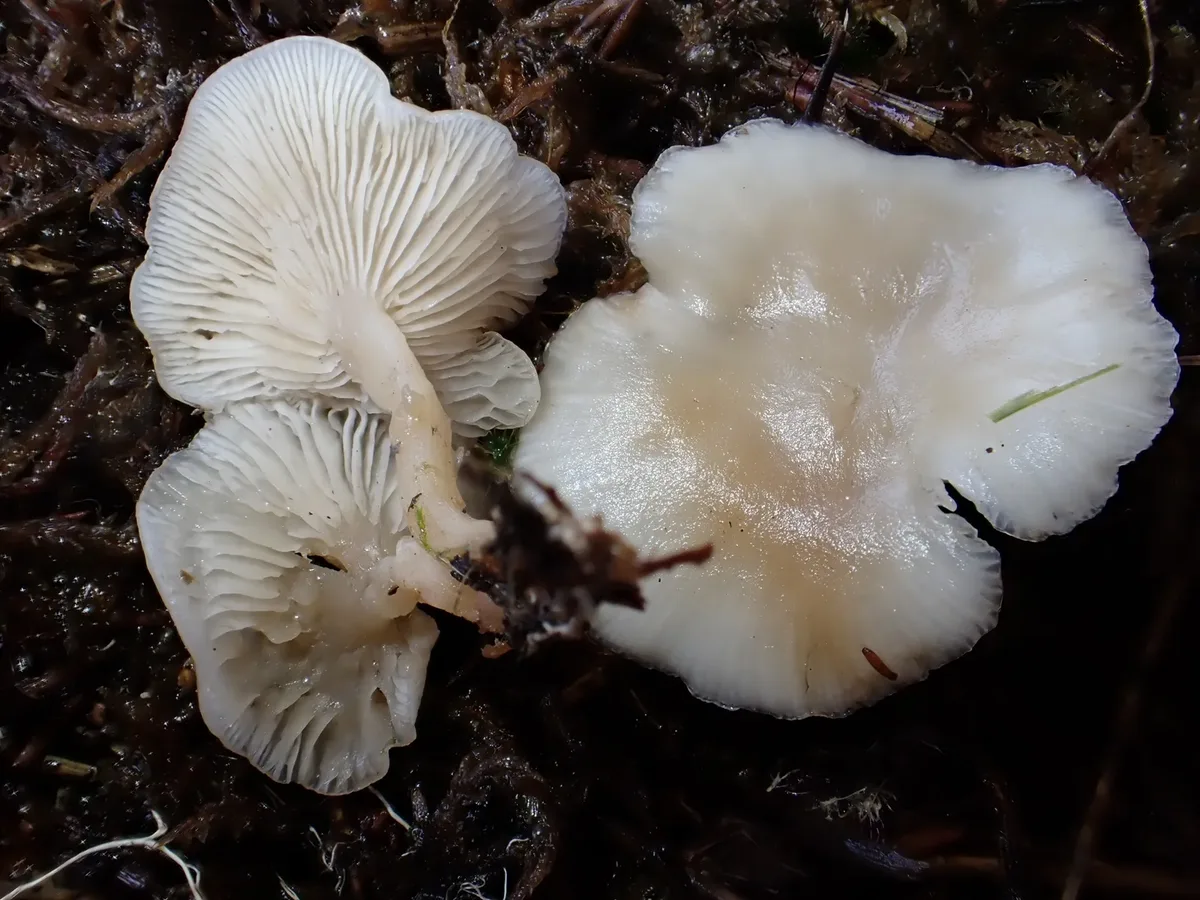
Colour is white throughout: cap, gills, stem and flesh are all white or very pale cream-white, with none of the buff, pink, lilac or bluish tints that would indicate a different species.
Cap
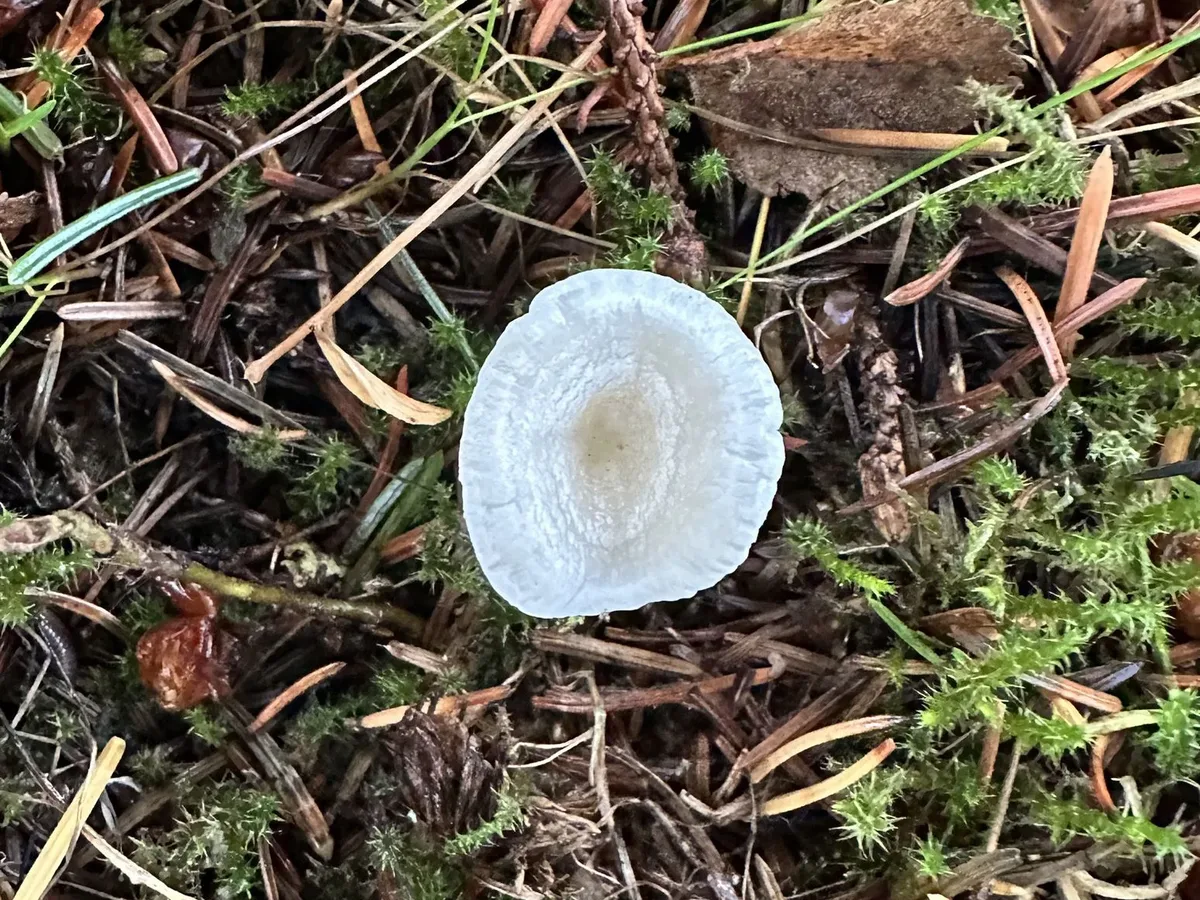
The cap starts convex and fairly flat, then progressively depresses centrally until it is clearly funnel-shaped or vase-like. When you find a colony with fruitbodies of different ages, you can watch this transformation in miniature, from young domed caps to mature ones that have opened into small cups.
The cap surface is smooth and carries a characteristic sheen when dry - the gleaming quality encoded in both the Latin epithet (candicans = gleaming white) and the English common name.
Gills
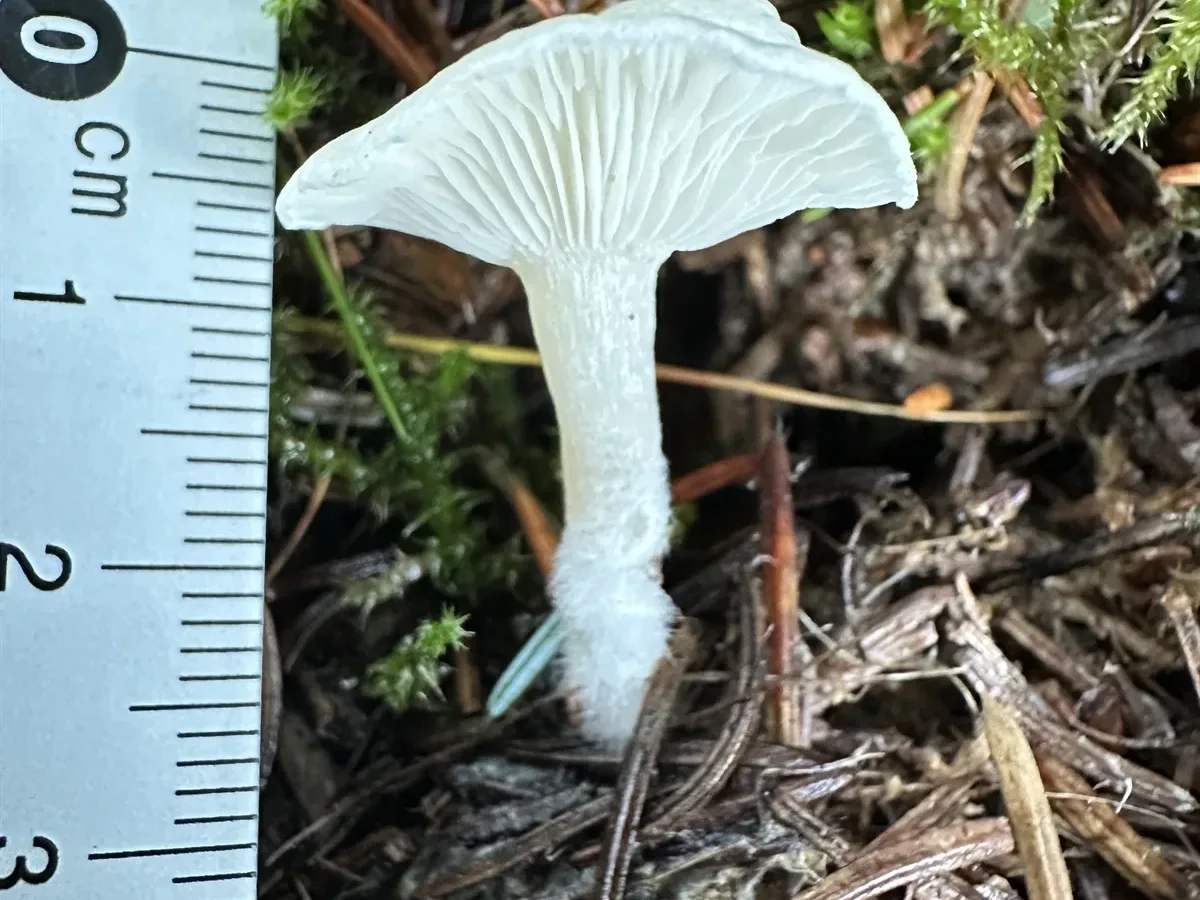
The gills are very crowded and clearly decurrent, producing a fine, regular, pleated look at the junction with the stem.
Any tinge of pink in the gills immediately rules out C. candicans and should prompt a serious reconsideration of identification.
Stem
The stem is slender and lacks a ring or skirt of any kind.
Why it's dangerous
The danger of C. candicans is primarily due to the stability and potency of muscarine combined with the ease of misidentification. Because the toxin is heat-stable, there is no safe cooking method.
The risk is elevated because this species grows in habitats and seasons where edible fungi are actively being collected, and it can pass unnoticed in a mixed basket.
In healthy adults muscarine poisoning is rarely fatal given access to modern medical care, but the atropine antidote must be available and the patient must be assessed promptly.
Vulnerable individuals (elderly, young children, those with heart conditions) face a higher risk of serious cardiac and respiratory complications.
The European mushroom poisoning literature consistently lists small white Clitocybe species - this complex - as among the more frequently encountered toxic mushrooms.
Toxin
Clitocybe candicans contains muscarine, a potent cholinergic alkaloid that acts as an agonist at muscarinic acetylcholine receptors.
Muscarine is heat-stable and not destroyed by cooking - there is no preparation method that renders this mushroom safe.
The toxin stimulates the parasympathetic nervous system, leading to an exaggerated 'rest and digest' response across multiple organ systems.
Muscarine poisoning from small white Clitocybe species is one of the classic and well-documented syndromes in European mycotoxicology.
Symptoms
Muscarine poisoning produces a characteristic SLUDGE or PSL syndrome (Salivation, Lacrimation, Urination, Defaecation, Gastrointestinal distress, Emesis - or alternatively: Perspiration, Salivation, Lacrimation).
Symptoms typically begin within 15-30 minutes of eating (short latency is characteristic and diagnostically important - it distinguishes muscarine poisoning from the delayed amatoxin syndromes).
The affected person develops:
- Profuse sweating, excessive salivation, tearing, runny nose
- Abdominal cramps, nausea, vomiting and diarrhoea
- Vision may blur (miosis, narrowing of the pupils)
- Heart rate typically slows (bradycardia) and blood pressure may fall
In severe cases - particularly in elderly patients, young children or those with underlying cardiac disease - the bradycardia and bronchoconstriction can become life-threatening.
Symptoms usually peak within 1-2 hours and resolve within 6-24 hours with supportive care.
Staying safe
Clitocybe candicans is a muscarinic-toxic species and must not be eaten.
It belongs to a group of small white funnels - along with C. dealbata and C. phyllophila - that have caused a significant number of muscarine poisonings in Europe, particularly because they can be mistaken for the edible fairy ring champignon (Marasmius oreades) or other small white edible agarics by inexperienced foragers.
The muscarine content is substantial and symptoms can be severe, particularly in individuals with pre-existing cardiac or respiratory conditions.
Foragers working in autumn woodland should be especially cautious:
- Take time to examine each white funnel mushroom individually.
- Check gill spacing (crowded decurrent = danger).
- Take a spore print.
- Never eat anything you are not entirely certain of.
All-white, small, funnel-shaped woodland mushrooms should be treated as suspect by default.
Where & when it grows
Habitat
This is a decomposer of accumulated leaf litter and humus, dependent on a rich substrate of decomposing organic matter in woodland.
It is most commonly encountered under deciduous trees - beech and oak woodland are classic haunts - but also turns up under mixed conifers, in hedgerow bases and along woodland margins where organic debris accumulates.
It fruits as scattered individuals or small loose troops across the litter, occasionally forming incomplete arcs.
Its preference for shaded, humid woodland floor conditions overlaps substantially with the edible Marasmius oreades (fairy ring champignon, which prefers open grassy areas) and with other small white Clitocybe species that share the same habitat, making it essential to look at the whole context before concluding what you have found.
When
Clitocybe candicans is an autumn species, with the main fruiting period running from August through to November in temperate Europe.
The flush builds as summer heat subsides and autumnal rains begin to penetrate the litter layer, usually peaking in September and October.
It can persist well into November in mild seasons but is generally finished by the arrival of consistent hard frosts.
Unlike some fungi, it does not reliably form fairy rings whose position can be predicted from year to year - the mycelium lives unseen through the litter year-round, and where it pushes fruitbodies up shifts subtly from season to season as it works its way through the available organic matter.
How it grows
The mycelium of C. candicans lives through the leaf-litter layer and incorporated woody debris year-round, quietly breaking down dead plant material as a saprotrophic decomposer - doing the essential woodland work of returning nutrients locked in fallen leaves and debris back to the soil.
It does not form large persistent fairy rings as reliably as Marasmius oreades or Infundibulicybe geotropa, but the mycelial network can produce loose sweeping arcs of fruitbodies when conditions align.
Fruitbodies emerge relatively quickly after suitable autumn rainfall and may persist for one to two weeks before the caps deteriorate.
Because the mushroom is small and easily overlooked in deep litter, and because it grows amongst grass or at woodland margins as well as on bare forest floor, it is particularly at risk of being picked alongside edible fungi during a casual sweep of the ground.
Fruiting conditions
Flushes in response to autumn rainfall as soil temperatures drop; peak fruiting coincides with the main autumn litter-decomposer flush in September-October.
Look-alikes
The most important lookalike concern is the group of small white Clitocybe species that are mutually similar and collectively dangerous.
- Ivory Funnel (Clitocybe dealbata / Clitocybe rivulosa) - almost indistinguishable from C. candicans without microscopy and equally muscarinic; both grow in similar habitats and have the same size range, white colour and crowded decurrent gills.
- Frosty Funnel (Clitocybe phyllophila) - also white, muscarinic and similarly shaped, but tends to be slightly larger (up to 8 cm) with a more frosted or pruinose cap surface, and grows especially in deep leaf litter under conifers and beech.
Collectively, these three species form a dangerous complex of small white funnels that field mycologists treat as a single identification challenge.
On the safer side:
- Marasmius oreades (Fairy Ring Champignon) - edible, with some superficial resemblance in size and white-buff colour, but its gills are widely spaced (not crowded), the cap has a distinct central boss, the smell is sweet-almondy, and it consistently forms proper fairy rings in grass - not in woodland litter.
- Calocybe gambosa (St. George's Mushroom) - edible, far larger (up to 15 cm), stocky, with a strong mealy smell, and fruits in spring (April-May), not autumn.
- Clitopilus prunulus (the Sweetbread Mushroom) - also white and funnel-shaped but decidedly larger (5-12 cm), with a strong mealy-floury smell, pinkish mature spore print, and associated with open woodland margins and grassland edges; its gills eventually turn pinkish with spore maturation.
Any white funnel-capped mushroom in woodland litter in autumn must be subjected to a careful gill examination and spore print before consumption is considered.
An edible species often growing nearby, but distinguishable by several clear features: gills are widely spaced and free to nearly free (not crowded and decurrent), cap retains a central boss or umbo, smell is sweetly almondy (not mealy), and it forms well-defined fairy rings in short grass and lawns rather than in woodland litter. The gills are the most reliable single character: if they are crowded and run down the stem, it is not M. oreades.
A third muscarinic white funnel, marginally larger (up to 8 cm) with a more pruinose or finely frosted cap surface and a preference for deep leaf litter under beech and conifers. The distinction from C. candicans is academic in a safety context - both are toxic, both should be avoided.
Also toxic (muscarine) and virtually indistinguishable in the field from C. candicans without microscopy. Both are small, entirely white, funnel-shaped with crowded decurrent gills and a mealy smell; C. dealbata tends to occur more in grassy habitats (lawns, meadows) than woodland litter, but this distinction is not reliable. Treat all such small white funnels as the same hazard.
Edible and also entirely white, stocky and mealy-smelling - but fruits in spring (April-May around St. George's Day, 23 April), not autumn. The cap is larger (5-15 cm), the flesh thicker, the stem stouter. If you find a white mealy mushroom in autumn leaf litter, it is not C. gambosa.
Edible, but white and funnel-shaped so a potential confusion for inexperienced foragers. Distinguished by its substantially larger size (5-12 cm cap), very strong mealy-floury smell, and gills that eventually become distinctly pinkish as spores mature - giving a pinkish-buff spore print. C. candicans is smaller and yields a white spore print.
A reference guide - never an edibility guarantee. When in doubt, leave it out.