Woolly Pine Spike
Chroogomphus tomentosussyn. Gomphidius tomentosus Murrill, Gomphidius kauffmanii A.H.Sm., Chroogomphus kauffmanii (A.H.Sm.) O.K.Mill.
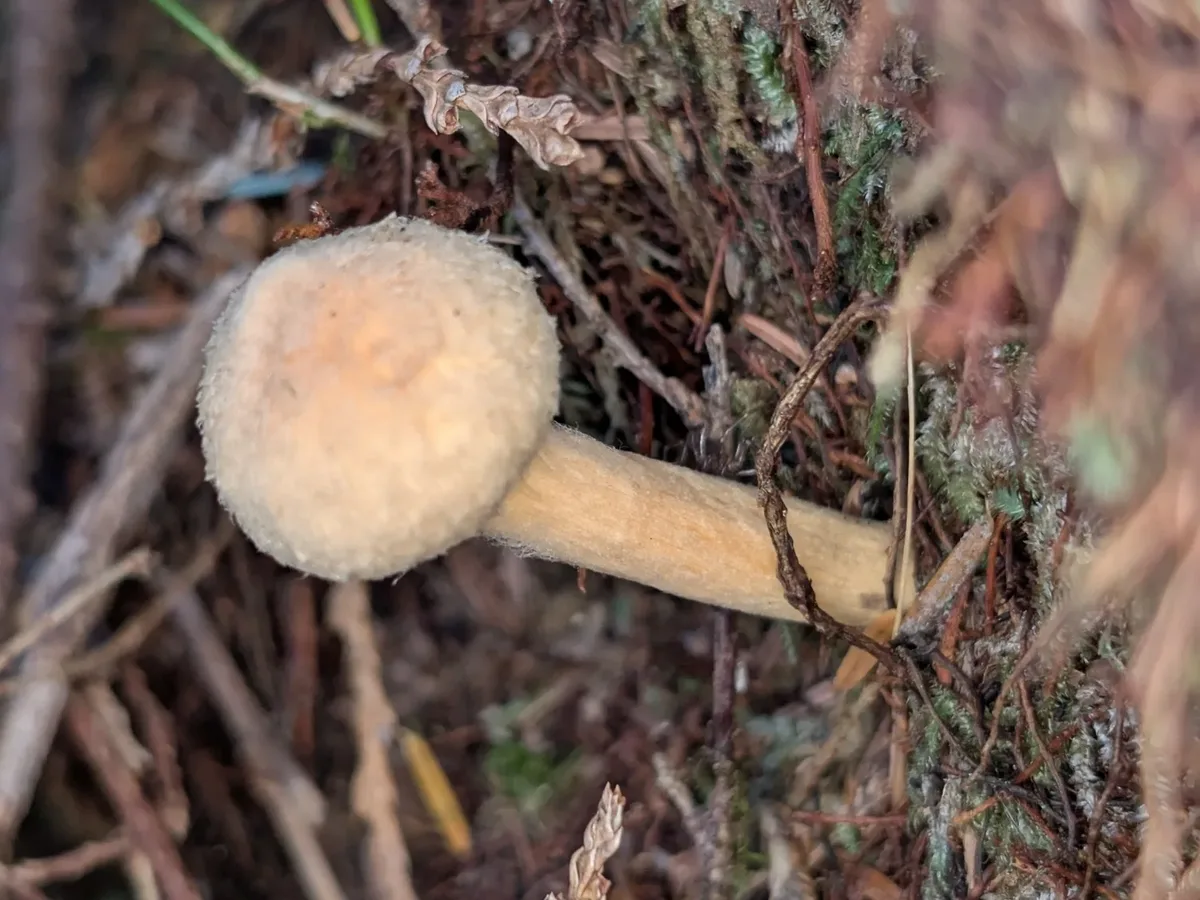 © Moe Meikle (CC BY)
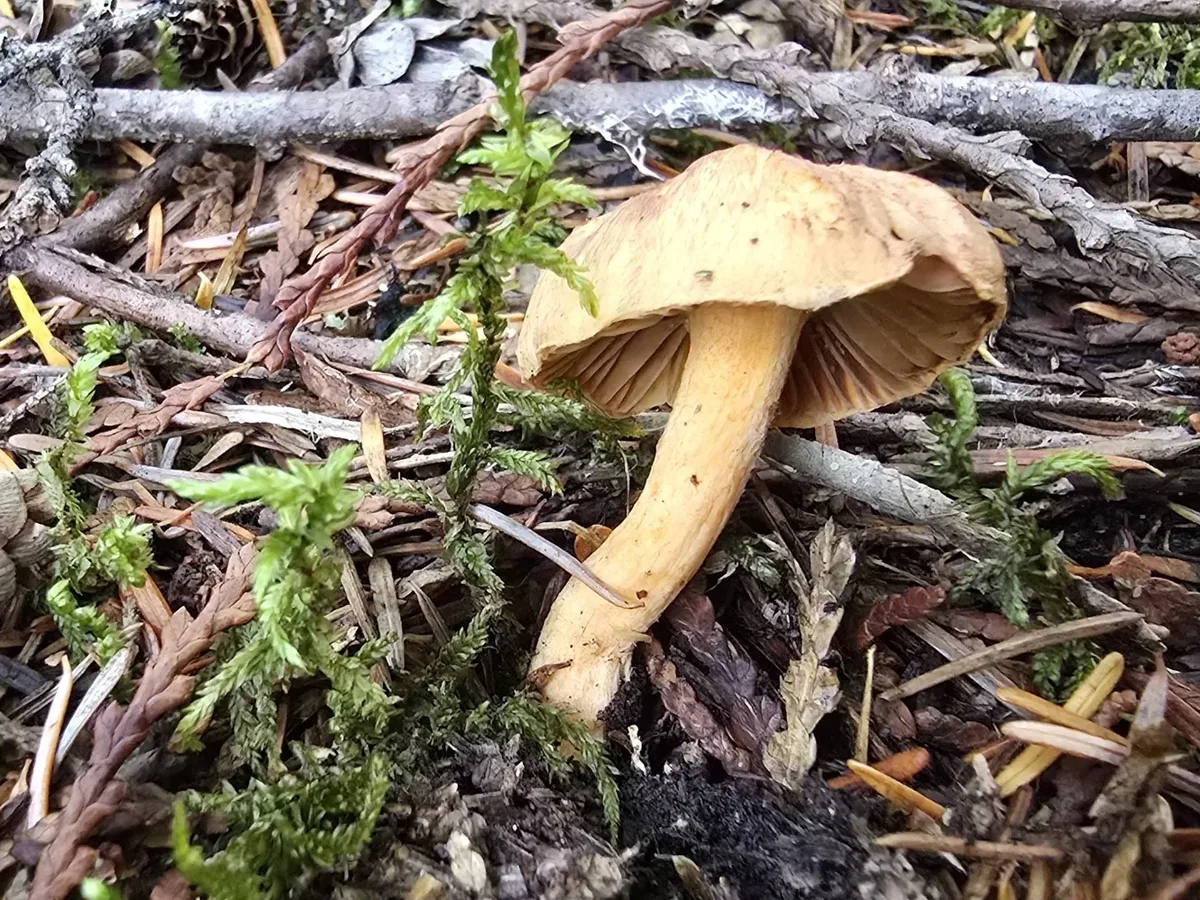 Leanne Stacy Reitan (CC0)
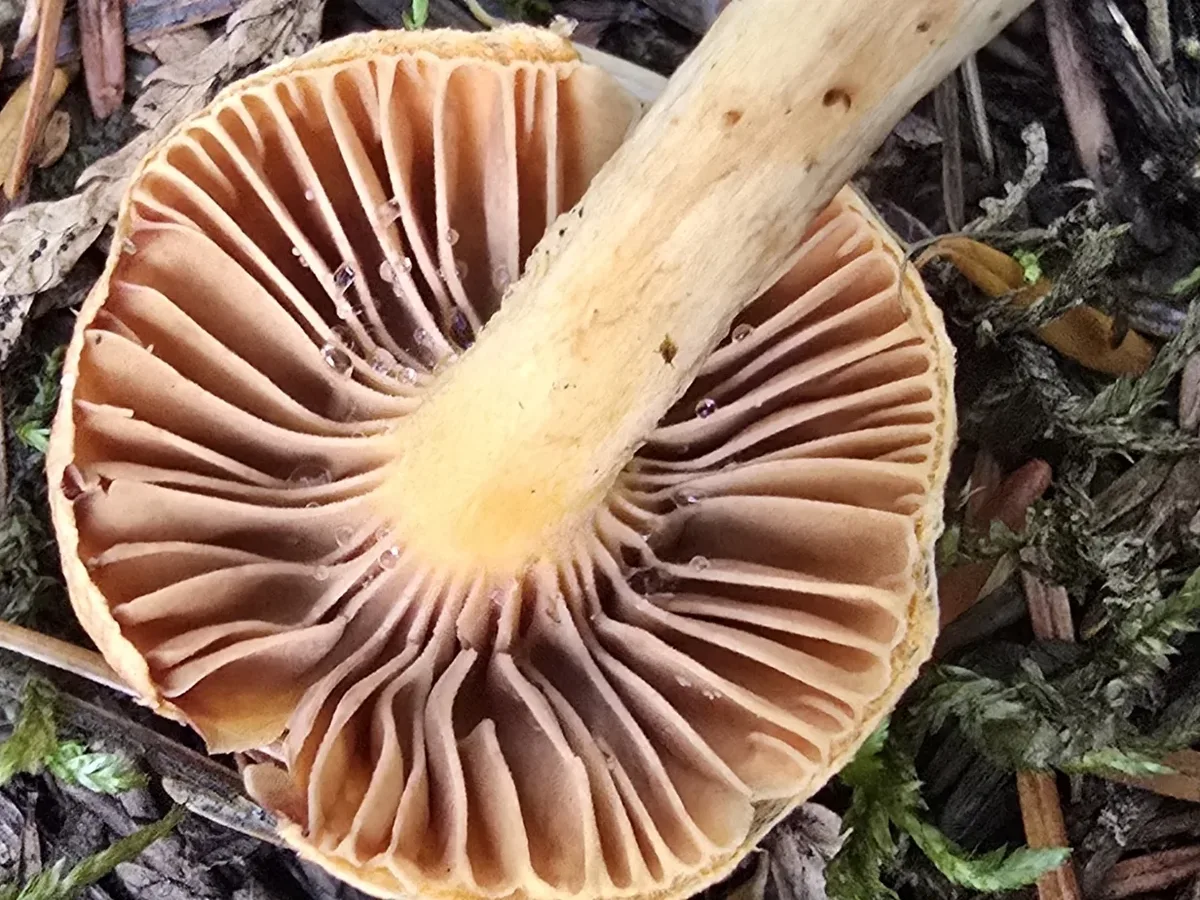 Leanne Stacy Reitan (CC0)
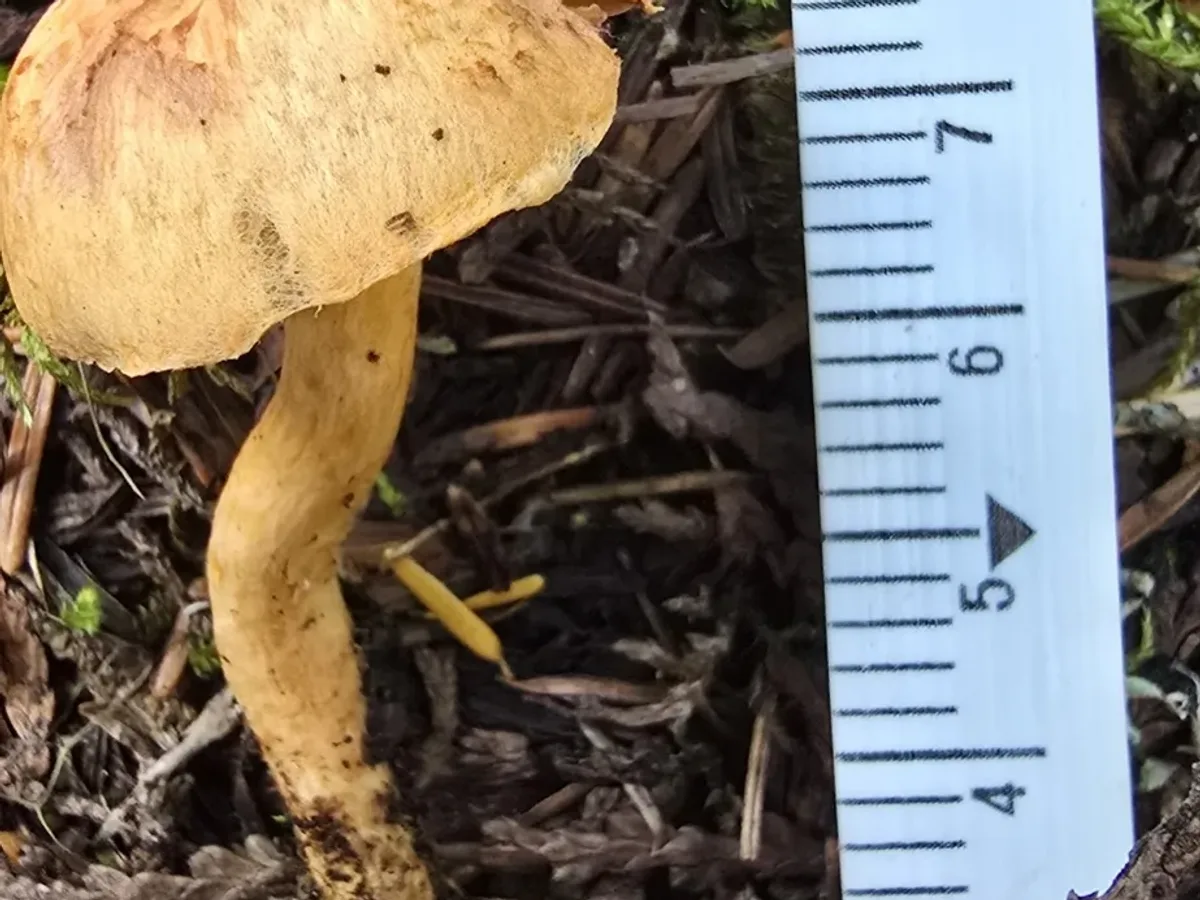 Leanne Stacy Reitan (CC0)© Moe Meikle (CC BY)Leanne Stacy Reitan (CC0)
Good to eat, once you have identified it with certainty and cooked it through.
How to recognise it
The woolly pine spike is one of the more textured and tactile mushrooms of Pacific Northwest pine forests.
Cap
What first catches the eye is the cap's distinctly fuzzy or shaggy surface - the species name 'tomentosus' is Latin for downy or woolly - a covering of erect, hair-like fibrils that makes it feel almost like felt or rough cloth.
The cap opens as a broad cone with a pointed central bump (umbo) that persists well into maturity, slowly flattening but never losing its characteristic spike shape entirely.
Colouration runs through warm ochre-orange, dull rust-brown, and grayish-tawny tones, always looking muted rather than glossy.
In very wet weather the surface becomes slightly tacky but never develops the thick, copious gluten of the related Gomphidius glutinosus - run a finger across it and you get a dry drag rather than a slimy smear.
Gills
Flip the cap and the gills are immediately different from any chanterelle: these are true, well-separated, knife-blade gills, not blunt ridges. They are thick and waxy-looking, decurrent (running some way down the stem), and coloured a warm pale ochre-buff when young, deepening to brownish-orange and finally dull smoky-grey as the dark spores mature.
A spore print on white paper comes out dark smoky-brown to near-black - a key identification checkpoint.
Stem
The stem continues the spike theme, tapering evenly toward the base rather than being club-shaped or bulbous, and carries no proper ring, only occasional fibrous wisps from a cobwebby cortina-like veil.
Flesh
The flesh inside is firm, pale yellow to faintly orangeish, and does not change colour on cutting.
Where & when it grows
Habitat
Chroogomphus tomentosus is a creature of 5-needle pines.
Its mycelium grows woven around the finest root tips of western white pine (Pinus monticola) and related 5-needle species, trading mineral nutrients scavenged from the soil for photosynthetically fixed carbon supplied by the tree - the same ancient ectomycorrhizal bargain that underlies most of the Pacific Northwest's forest ecology.
Because it depends on a living host, you will find it only where suitable pines grow:
- the subalpine and montane forests of the Cascades and Coast Ranges
- higher-elevation slopes where white pine mixes with true firs and spruce
- the moist coastal belt where 5-needle pines occur
It grows on the floor beneath its host trees - in the needle duff, mossy hummocks, and humus-rich soil within the drip-line - and it is not unusual to find it fruiting within a metre of a suillus or two, as both are pine mycorrhizal and favour the same root networks.
The species ranges from British Columbia through Washington and Oregon into northern California, and eastward into the Rocky Mountain pine forests of Idaho and Montana.
When
The woolly pine spike is primarily an autumn species in the Pacific Northwest.
Fruiting begins in earnest when the summer dry season breaks and the first sustained autumn rains arrive - typically September in most lowland to mid-elevation sites. At higher subalpine elevations the season can open in late July or August.
The peak in the Cascades and Coast Ranges generally falls in September through October, with some fruiting persisting into November in milder coastal areas.
The key trigger is the combination of soil rehydration after summer drought and cooling temperatures: the mycelium is dormant through the warm, dry Pacific Northwest summer and 'wakes up' only once moisture and cooler soil temperatures coincide.
A single significant rain event of 20-30 mm, followed by a week of mild, damp weather, often produces a reliable flush 10-14 days later as primordia push up through the duff.
How it grows
Grows singly or in loose scattered groups, rarely in dense clusters. Individual fruit bodies emerge from the needle duff or humus, often close to the base of the host pine or along the edge of the root zone.
The same patch of ground can produce mushrooms in the same locations year after year, reflecting the perennial and long-lived nature of the underlying mycelial colony.
Young fruit bodies push up as compact cones tightly wrapped in woolly hairs before the cap expands. Maturity is achieved over five to ten days under cool, moist conditions.
Older specimens gradually lose some of the cap's shaggy character as the hairs become pressed down or abraded, and the gills darken noticeably from ochraceous buff toward smoky-grey as spore production peaks.
The species co-occurs frequently with Suillus tomentosus and other 5-needle pine mycorrhizal boletes, and finding any of these is a good indicator that C. tomentosus may be present nearby.
Fruiting conditions
Fruits after the first significant autumn rains break the summer dry season; reliable flushes occur when 20 mm or more of rain accumulates over a 14-day window with cool soil temperatures of 5-15 °C. A flush lag of 7-14 days from the first significant rain event is typical. Fruiting ceases once hard frosts arrive or soil temperatures drop below approximately 3-4 °C.
Look-alikes
Chroogomphus tomentosus can be confused with several other pine-forest species, though none of the confusions involve dangerous lookalikes.
The most important misidentification risk is with the Pacific golden chanterelle (Cantharellus formosus), which shares the conifer forest habitat. Chanterelles are separated immediately by their blunt, forking, vein-like ridges (not true gills), their dry smooth cap surface without tomentum, their white to pale-yellow spore print, and their bright golden-yellow colour and fruity aroma.
The two are quite different once both features are observed; the confusion typically arises only at a distance or in a hasty glance.
Other pine-forest lookalikes, all edible or harmless:
- The closely related copper spike (Chroogomphus rutilus) is more uniformly coppery to vinaceous-rusty, has a smooth to only slightly fibrous cap (not the distinctly woolly texture of C. tomentosus), and is primarily associated with 2-needle pines (Pinus sylvestris and relatives) in Europe, or mixed pine in North America - edible and harmless.
- The slimy spike (Gomphidius glutinosus) shares the waxy, decurrent gills, thick stem, and dark spore print but is immediately separated by its copious grey-brown slime that engulfs the whole cap - C. tomentosus is never truly glutinous.
- The rosy spike (Gomphidius roseus) is much smaller and distinctly pink-capped.
- The woolly suillus (Suillus tomentosus) shares the woolly cap texture and pine habitat but is a bolete with a spongy pore surface (not gills), blues visibly when cut, and has a brown spore print rather than smoky-black.
Edible. Closely related and structurally similar - same thick decurrent gills and dark spore print - but distinguished by its smooth to only faintly fibrous cap (never the conspicuously woolly tomentum of C. tomentosus), more uniformly coppery-red to vinaceous cap colour, and primary association with 2-needle pines in Europe. In practice both are good edibles and the distinction matters mainly for identification thoroughness.
Edible. Shares the conifer forest habitat but is easily separated: chanterelles have blunt, forking, vein-like ridges (not true knife-blade gills), a smooth dry cap without woolly tomentum, a white to pale-yellow spore print, a fruity-apricot aroma, and bright golden-yellow coloration throughout. The woolly cap texture and dark smoky-black spore print of C. tomentosus are immediately different once checked.
Edible. Much smaller (cap 2-4 cm), distinctly rosy-pink to coral-pink in colour, and grows specifically in association with Suillus bovinus under Scots pine. The pink cap colour and small size separate it from C. tomentosus at a glance.
Edible. Similar overall form with decurrent waxy gills and dark spore print, but immediately separated by the thick, copious grey-brown slime covering the entire cap - C. tomentosus has a dry, woolly cap, never glutinous. The stem base of G. glutinosus is also characteristically bright yellow, lacking in C. tomentosus.
Edible. Also has a woolly-scaly cap surface and shares the 5-needle pine habitat, but is a bolete: it has a spongy pore surface (angular yellow pores) rather than true gills, and the flesh and pores stain blue-green when cut - C. tomentosus has true gills and flesh that does not blue. The bolete pore surface versus gilled underside is the definitive separator.
In the kitchen
Picking & cleaning
Select firm, young to medium-aged specimens with intact woolly caps; older specimens with very dark, nearly black gills are past their prime but not harmful.
Gently cut or twist from the base, leaving the soil and duff undisturbed.
Because the dark spore print can be misleading to beginners, it is good practice to verify the spore colour in the field on a white surface if uncertain - the smoky-black deposit, the woolly dry cap, and the decurrent true gills together form a reliable suite of characters.
The flesh is moderately firm and holds together well; brush away adhering pine needles and soil before packing.
The species is not particularly popular commercially, but it is a reliable autumn find in pine forests and worth collecting for the table when encountered in quantity.
Check for insect larvae in the stem - slice longitudinally in older specimens, though this species is generally less prone to heavy larval infestation than some related species.
Cooking
Chroogomphus tomentosus is an underrated edible, less widely used than the related copper spike but perfectly acceptable at the table. The flesh is firm and holds together well in cooking.
To clean and prepare:
- Brush off adhering pine needles; the woolly cap surface holds debris readily, so work systematically with a brush.
- Peel the cap cuticle if desired - it strips away more easily in young specimens.
Sauté in butter over medium-high heat until the moisture has cooked off and the mushroom takes on a little colour; add garlic, shallots, and herbs.
The flavour is mild and pleasant, somewhat earthy and faintly piney, less robust than chanterelle or porcini but a good supporting player in mixed mushroom dishes, soups, cream sauces, and stews.
The gills are somewhat thick and waxy; their texture softens fully with adequate cooking.
The species can be dried: slice thinly and dehydrate at 40-50 °C, which intensifies the flavour and makes for a useful pantry ingredient. Dried slices rehydrate well in hot water or stock and are suitable for risottos, pasta sauces, and grain dishes.
Good to know
Chroogomphus tomentosus is a safe, edible species with no documented toxins and no deadly lookalikes in its typical pine-forest habitat.
There are no known dangerous confusions. The species it most resembles (other Chroogomphus and Gomphidius species) are all edible and harmless, and the one habitat-sharing species sometimes mentioned as a confusion risk (the Pacific golden chanterelle) is also edible.
As with most wild mushrooms, it should be cooked before consumption - eating any mushroom raw can cause mild gastric irritation in some individuals, and Gomphidius-family species are traditionally cooked rather than eaten raw. Some older specimens develop a slightly bitter note that is diminished by cooking.
There is no risk of confusion with any amatoxin-containing or otherwise deadly species in its typical habitat; the combination of woolly dry cap, true decurrent gills, smoky-black spore print, and 5-needle pine host is distinctive.
Collect only from clean forest sites away from roadsides, old mining areas, or industrial zones, where ectomycorrhizal mushrooms can accumulate heavy metals from contaminated soil.
A reference guide - never an edibility guarantee. When in doubt, leave it out.