Shaggy Parasol
Chlorophyllum rachodessyn. Agaricus rachodes Vittad., Lepiota rhacodes (Vittad.) Quél., Macrolepiota rhacodes (Vittad.) Singer, Lepiota rhacodes var. rhacodes, Leucocoprinus rachodes (Vittad.) Locq.
 Riet van Oosten (CC0)
 © Julia Pawłowska (CC BY-SA)
 Riet van Oosten (CC0)Riet van Oosten (CC0)© Julia Pawłowska (CC BY-SA)
Edible only with the right preparation - or safe for some people but not others. Learn the caveats first.
Never eat a mushroom you are not 100% sure of - check the look-alikes below, and always cook wild mushrooms.
How to recognise it
Chlorophyllum rachodes is one of the larger and more visually dramatic mushrooms you are likely to encounter in woodland or park settings - a genuine parasol that lives up to its name.
Cap
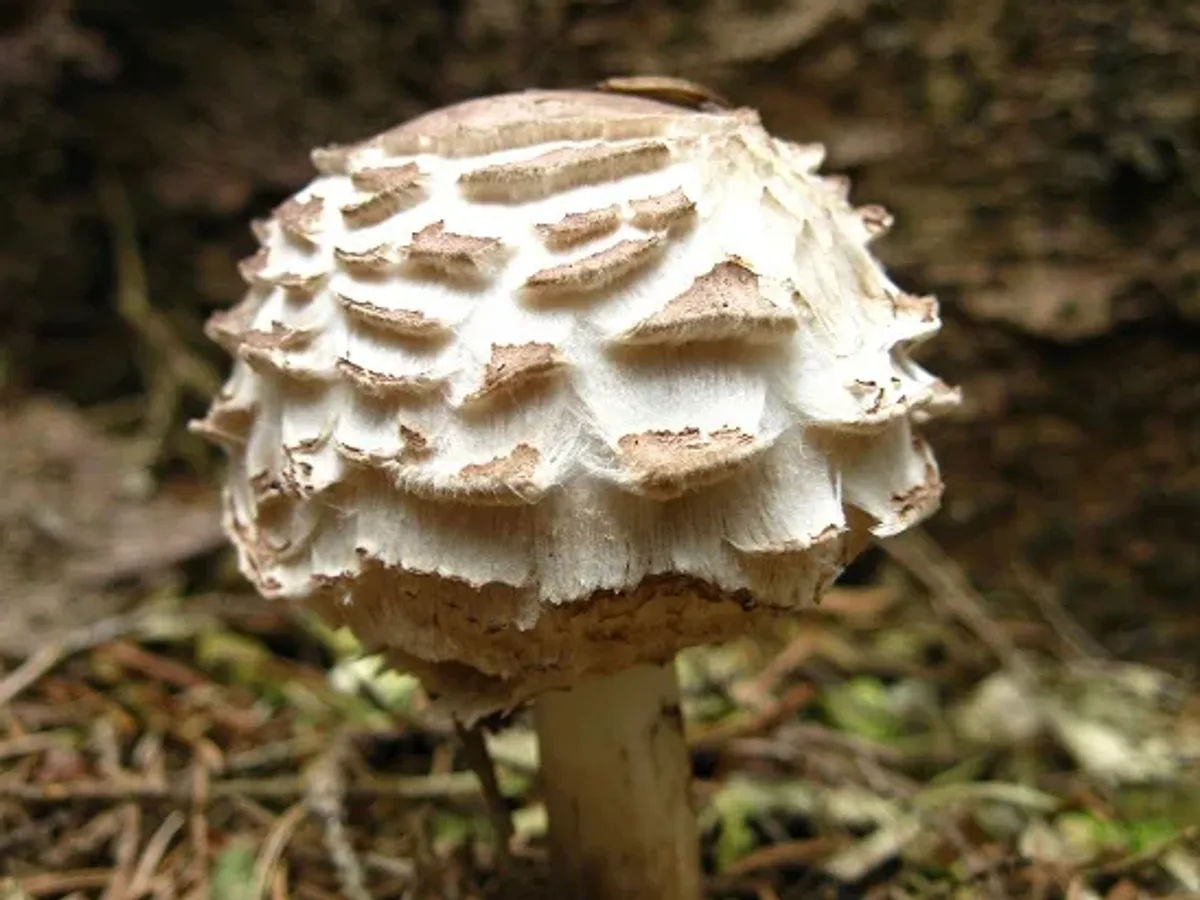
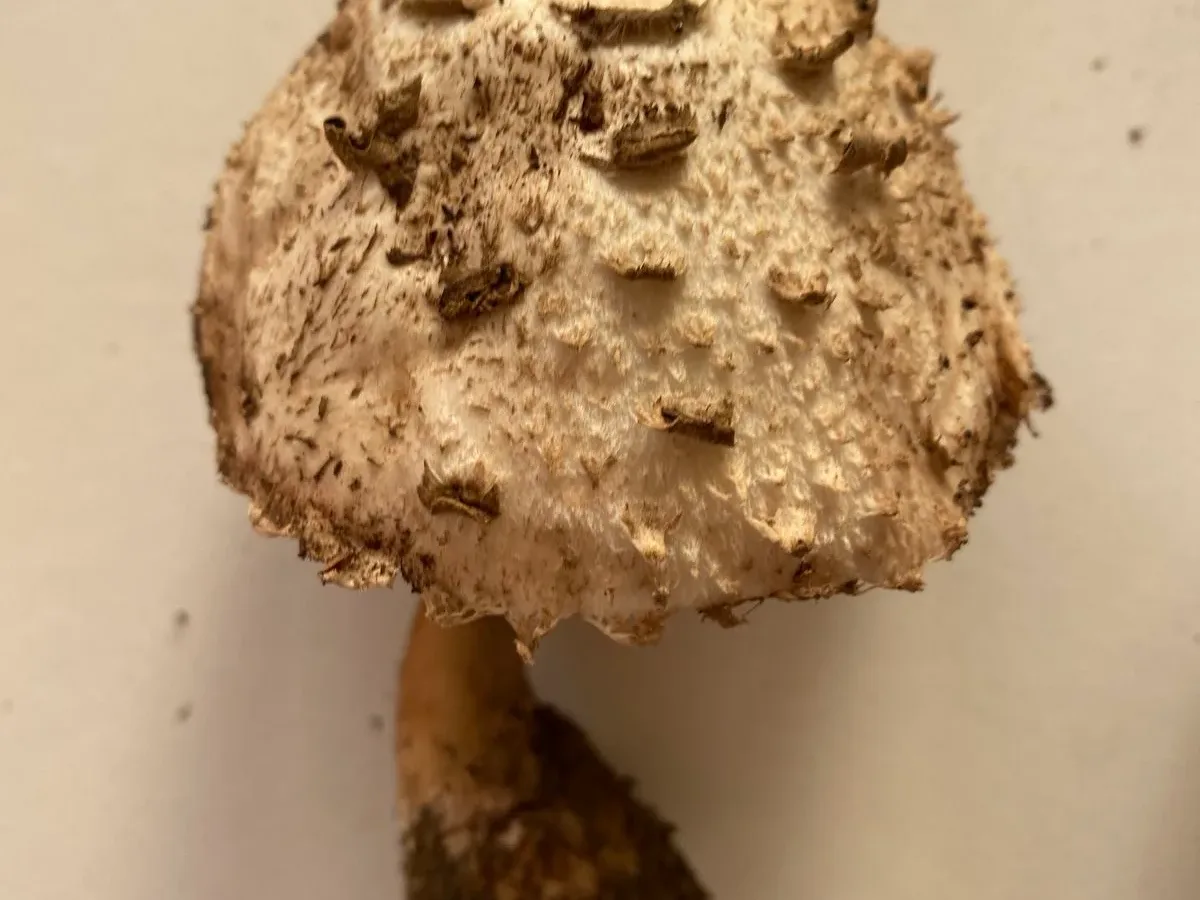
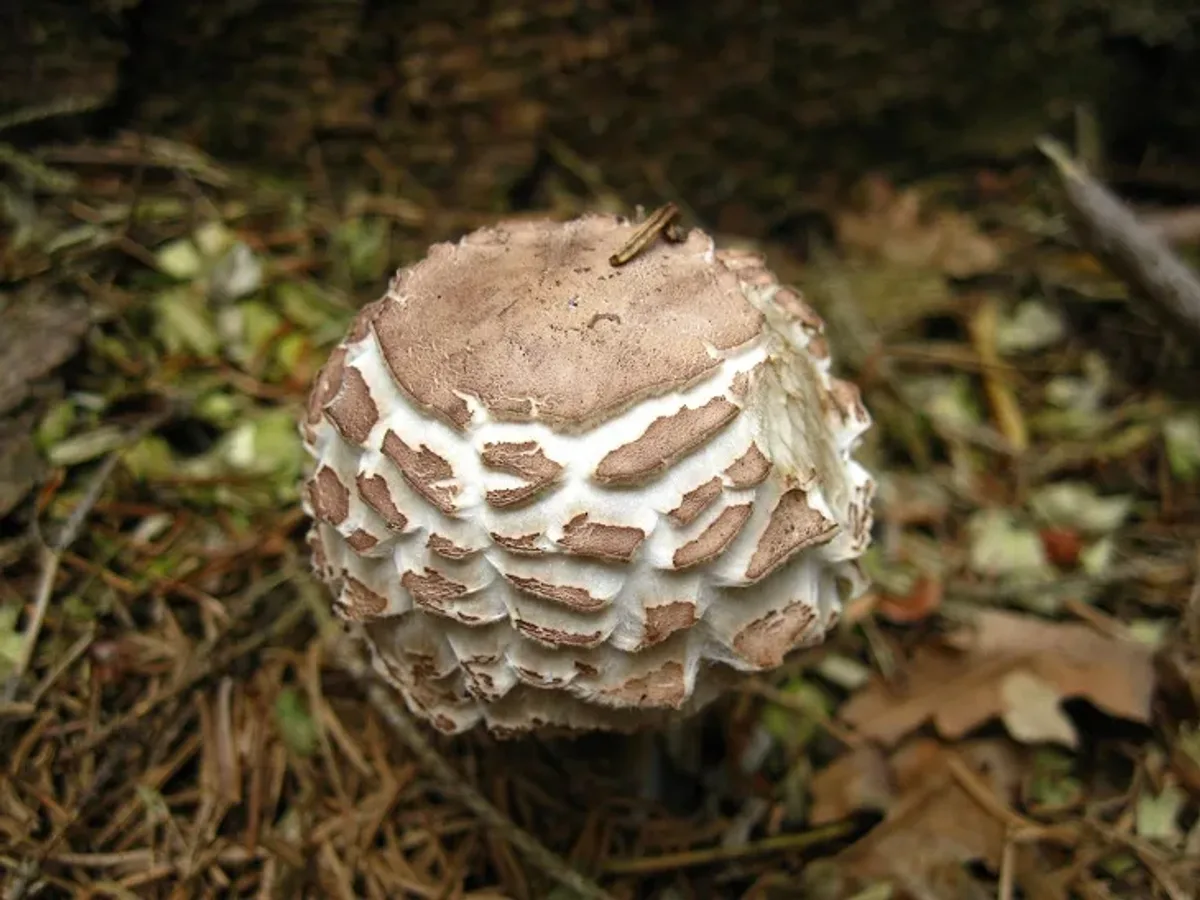
The young cap is a rounded, pale button, almost egg-like, before it expands to 8-20 cm, its dry white-to-buff surface breaking apart into coarse, dark-brown, upturned scales that give the cap its shaggy character.
These scales are noticeably ragged and irregular, more dishevelled than the neater plate-like scales of Macrolepiota procera, and the dark-brown central disc remains clearly visible throughout maturity.
Gills
The gills are free, crowded, broad, and white to cream - they stay pale at every stage of development.
Stem
The stem is robust and hollow, supported by a swollen base (less abruptly so than in the related Chlorophyllum brunneum), and carries a wide, fleshy, double-layered ring that slides freely along the stem when gripped - a structural detail that signals membership in the larger parasol genus, quite unlike the thin or fixed rings of the deadly small Lepiota species.
Flesh
The moment you cut the flesh - through cap or stem - white tissue turns a striking orange to saffron-red to brick-red within seconds. This reddening is immediate, vivid, and unmistakable; it deepens to brick-red or brownish-red over the next quarter-hour.
It is simultaneously the species' most reliable identification marker and a reminder that this mushroom is not an unconditionally safe edible.
Spore print is white.
Why it's dangerous
The principal dangers associated with C. rachodes are:
- 1Intrinsic GI toxicity causing illness in a large minority of consumers even after thorough cooking.
- 2Confusion with Chlorophyllum molybdites, a severely GI-toxic species that shares habitat, appearance, and the flesh-reddening character - the spore print is the critical excluder.
- 3Confusion with or accidental co-collection of deadly Lepiota species containing lethal amatoxins in small-specimen or button-stage situations.
- 4Confusion of young buttons with Amanita stages bearing lethal amatoxins.
The reddening flesh and mandatory white spore print are essential safety tests. Novice foragers should not collect this species.
Toxin
The GI-toxic compounds in Chlorophyllum rachodes have not been definitively isolated and characterised. Current evidence implicates heat-labile proteins - likely lectins or related glycoproteins - as the primary agents, since thorough cooking reduces (but does not consistently prevent) adverse reactions in susceptible individuals.
Research on the closely related C. rhacodes (older nomenclature) has identified proteinaceous fractions that cause GI irritation in animal models, supporting this hypothesis.
The vivid reddening of the flesh on cutting is caused by oxidative enzyme reactions and is entirely unrelated to the GI toxicity - it is a useful identification character but carries no toxicological significance in itself.
Symptoms
Gastrointestinal symptoms typically onset within 30 minutes to 3 hours of ingestion: nausea, vomiting, abdominal cramping, and diarrhoea.
Symptoms are self-limiting and generally resolve within 24-48 hours without specific treatment. No systemic toxicity or organ damage has been documented from C. rachodes poisoning alone.
Severity varies considerably between individuals - some tolerate it repeatedly without ill effect while others react strongly to small amounts.
If symptoms begin more than 6 hours after eating, or if they are severe or suggest organ involvement (jaundice, dark urine, confusion), seek emergency medical care immediately: this pattern would be consistent with amatoxin poisoning from a misidentified Lepiota or Amanita species, which is a life-threatening emergency.
Always preserve a specimen or photograph to aid identification in the event of poisoning.
Staying safe
Chlorophyllum rachodes occupies an awkward position in the forager's assessment: it has been eaten and valued by many people historically, it is correctly identified with manageable certainty by experienced foragers, and yet it causes gastrointestinal illness in a genuinely large fraction of consumers.
Contemporary studies and field reports consistently document nausea, vomiting, abdominal cramping, and diarrhoea in roughly 30-50% of people who eat it, even after thorough cooking.
The responsible compounds have not been fully characterised but appear to be heat-labile proteins - probably lectins or glycoproteins - as cooking reduces but does not reliably eliminate adverse reactions. Raw consumption is effectively guaranteed to cause illness.
Three additional hazards compound the intrinsic toxicity:
- 1C. rachodes can be confused with Chlorophyllum molybdites, which causes severe gastrointestinal poisoning and may not be reliably excluded without a spore print - always make one.
- 2Immature or small specimens could be confused with the small deadly Lepiota species containing lethal amatoxins - maintain strict size discipline.
- 3Young buttons can superficially resemble Amanita stages - always excavate the base.
For these reasons, most major modern European foraging guides now advise against eating C. rachodes.
If you choose to eat it regardless:
- Use only large, fresh, well-developed caps.
- Cook thoroughly at high heat.
- Eat a small test portion first.
- Never give it to guests who have not previously tolerated it.
Where & when it grows
Habitat
Chlorophyllum rachodes is primarily a woodland mushroom rather than a pure garden or compost species, a distinction that separates it ecologically from its close relative C. brunneum.
It favours:
- Deciduous and mixed woodland interiors
- Shaded forest clearings
- Conifer plantation edges
- Woodland paths where litter accumulates
- Hedgerow bases
- The shaded margins of parks and gardens near trees
It can appear in a range of situations where buried organic matter provides substrate, but the characteristic woodland preference - and the typically less abruptly swollen stem base - remains a useful contextual clue when distinguishing it from C. brunneum.
In sub-Saharan Africa, particularly South Africa, the species is an introduced plant that has established itself in urban and peri-urban green spaces: it turns up regularly in Cape Town parks, botanical gardens, shaded suburban lawns, and along the margins of planted pine and eucalyptus stands in the Western Cape and KwaZulu-Natal.
Its appearance in these settings underlines how successfully it colonises nitrogen-rich, disturbed ground, even far from its European origins.
Throughout its range - whether in a European beech wood or a Cape Town park - it fruits singly or in small scattered groups, occasionally forming partial arcs in areas of uniform substrate.
When
In Europe and the Northern Hemisphere, C. rachodes is an autumn species in the classic sense: the main fruiting window opens in August and runs through November, with the most productive period centred on September and October as the season's first significant rains follow summer's dry spell and soil temperatures begin to cool.
A flush can appear within 5-12 days of a substantial rainfall event when soil temperature lies between about 10°C and 20°C; warm wet autumns after hot summers tend to produce the most spectacular crops.
In the Western Cape of South Africa (Southern Hemisphere), the seasonal calendar is inverted: fruiting occurs mainly from February through May, with March and April the peak months, following late-summer and early-autumn rainfall.
At any individual site, fruitbodies can emerge rapidly - a button can reach full size in 48-72 hours under ideal conditions - so frequent visits during the season pay dividends.
How it grows
Saprotrophic; the mycelium decomposes buried litter, humus, dead roots, and decaying organic matter in the soil.
Fruiting bodies emerge singly or in small scattered groups, occasionally in partial rings or arcs in lawns or forest paths where the mycelium has expanded outward uniformly through the substrate.
Growth under warm, moist conditions is characteristically rapid: a button can reach full size in as little as two to three days. Daily or twice-daily visits during peak season capture specimens at their best - freshly opened caps before insect larvae (particularly dipteran) have bored extensively through the flesh.
Fruiting conditions
Fruiting is triggered by significant rainfall (roughly 20 mm or more over 14 days) when soil temperature lies between about 10°C and 20°C. In temperate Europe and North America this window typically opens in August-September, following the first substantive autumn rains after a summer dry period. In South Africa (Western Cape) the equivalent trigger arrives with late-summer and early-autumn rains in February-April. Under optimal warm-moist conditions fruitbodies develop within 5-12 days of a triggering rain event. Consecutive wet periods can generate multiple successive flushes from the same mycelium at established sites.
Look-alikes
Chlorophyllum rachodes shares its habitat and size class with several species that range from edible to deadly:
- 1Chlorophyllum molybdites (Green-spored parasol, False parasol) - the highest-priority lookalike concern and the reason that a spore print is absolutely mandatory before eating any shaggy parasol. C. molybdites closely resembles C. rachodes in overall form: a large scaly white cap, free white gills, double ring, similar size, and similar habitat preferences including parks, lawns, and woodland edges. The decisive differences are the spore print and gill colour: C. molybdites produces a distinctive olive-green to grey-green spore print, and the gills develop a dull grey-green to olive tinge as spores mature. C. rachodes always has a pure white spore print and cream-white gills. Both species share the reddening flesh character. Making an overnight spore print is non-negotiable before eating any shaggy parasol. C. molybdites causes severe gastrointestinal poisoning and is one of the most common causes of serious mushroom poisoning globally.
- 2Chlorophyllum brunneum (Garden parasol) - so similar that the two species were long treated as conspecific or as varieties. C. brunneum tends to have a more abruptly swollen and larger basal bulb, is more consistently found in pure compost/garden/wood chip habitats rather than woodland, and has microscopically larger spores. Both flush turn red immediately on cutting; both cause GI illness in a significant minority of consumers. The distinction between them has no practical safety significance - treat them identically from a foraging standpoint.
- 3Macrolepiota procera (Parasol mushroom) - a choice edible widely gathered across Europe, but distinguished from C. rachodes by one definitive test: the flesh of M. procera does NOT change colour when cut - it stays white throughout. M. procera also has a more regular, plate-like (not shaggy-ragged) scale pattern, more conspicuous zigzag snakeskin banding along the full length of the stem, typically attains larger cap sizes (15-30 cm), and grows preferentially in open pasture, clearings, and meadow edges rather than shaded woodland. The cut-flesh test is the fastest and most reliable separator.
- 4Deadly small Lepiota species (Lepiota brunneoincarnata, L. helveola, L. subincarnata, L. castanea, L. josserandii) - these contain lethal amatoxins (alpha-amanitin) identical to those of the death cap and cause fatal liver and kidney failure. They are MUCH SMALLER than C. rachodes: caps typically 2-5 cm, rarely reaching 6 cm, with a thin, fragile, fixed or absent ring, never the large double sliding ring of Chlorophyllum. The risk arises when small or immature C. rachodes specimens are picked without careful size assessment, or when mixed species end up in the same basket. NEVER collect any parasol-type mushroom with a cap under 6 cm, and never collect button-stage parasols whose ring has not yet freed itself from the cap margin.
- 5Amanita species (button stage) - young Amanita buttons still enclosed in their universal veil can superficially resemble parasol eggs. Always excavate the stem base carefully: Amanita species have a persistent sack-like volva at the buried base; C. rachodes has a swollen but naked bulb without any volva. The immediate red-orange flesh colour change on cutting is also diagnostic - Amanita flesh does not redden.
Much smaller (cap 2-5 cm, never approaching 8 cm+), with reddish-brown to flesh-pink colouring, a concentric rather than shaggy scale pattern, and a thin, fragile, fixed ring - never the large double sliding ring of C. rachodes. Contains lethal amatoxins (alpha-amanitin). Distinguished from C. rachodes by size alone: never collect parasol-type mushrooms with caps under 6 cm, and be especially vigilant not to mix sizes when picking.
Young death cap buttons enclosed in their universal veil can superficially resemble parasol eggs. Always excavate the buried stem base: Amanita phalloides has a persistent bag-like volva (sack) completely enclosing the bulbous stem base; C. rachodes has a swollen but naked bulb with no volva at all. Cutting any tissue of a young button and watching for the immediate orange-red flesh reddening (C. rachodes) versus no colour change (Amanita) provides rapid confirmation.
Small (cap 2-5 cm), with pinkish-brown fibrous scales, a thin fixed ring, and flesh that does not redden. Contains alpha-amanitin (lethal amatoxin). Risk arises from mixed baskets or when small shaggy parasols are not carefully size-checked. The large cap, reddening flesh, and double sliding ring of C. rachodes distinguish it unambiguously from a fully grown specimen - but immature buttons demand close attention.
Nearly identical; both redden immediately on cutting and both cause GI illness in a substantial proportion of consumers. C. brunneum tends to have a more abruptly swollen and pronounced basal bulb, is more consistently found in pure compost, wood chip, and manured-garden habitats rather than woodland, and has microscopically larger spores. The distinction carries no practical safety significance - treat identically.
The spore print is the decisive separator: C. molybdites produces a distinctly olive-green to grey-green spore print, and the gills turn dull grey-green as spores mature. C. rachodes always has a pure white spore print and cream-white gills. Both species share the reddening flesh character, making gill and spore print checks non-negotiable. Always take an overnight spore print before eating any shaggy parasol. C. molybdites causes severe gastrointestinal poisoning and is one of the most common causes of serious mushroom poisoning worldwide.
A choice edible, but unambiguously separated by one test: M. procera flesh does NOT redden or change colour on cutting - it remains white. M. procera also has a more regular, plate-like (not shaggy-ragged) scale arrangement, more vivid snakeskin banding covering the full length of the stem, typically larger cap sizes, and prefers open meadow, pasture, and woodland clearings over shaded forest. Cut the flesh immediately: reddening = C. rachodes; unchanged white = M. procera.
A reference guide - never an edibility guarantee. When in doubt, leave it out.