Asian False Parasol
Chlorophyllum neomastoideumsyn. Lepiota neomastoidea, Macrolepiota neomastoidea, Leucoagaricus neomastoideus
 Atlas of Living Australia (CC0)
 Atlas of Living Australia (CC0)
 さつまやまいもすけ (CC0)
 Atlas of Living Australia (CC0)Atlas of Living Australia (CC0)Atlas of Living Australia (CC0)
Edible only with the right preparation - or safe for some people but not others. Learn the caveats first.
Never eat a mushroom you are not 100% sure of - check the look-alikes below, and always cook wild mushrooms.
How to recognise it
Chlorophyllum neomastoideum is a large, handsome parasol-type mushroom that would look deceptively inviting to any forager familiar with edible Macrolepiota species.
Cap
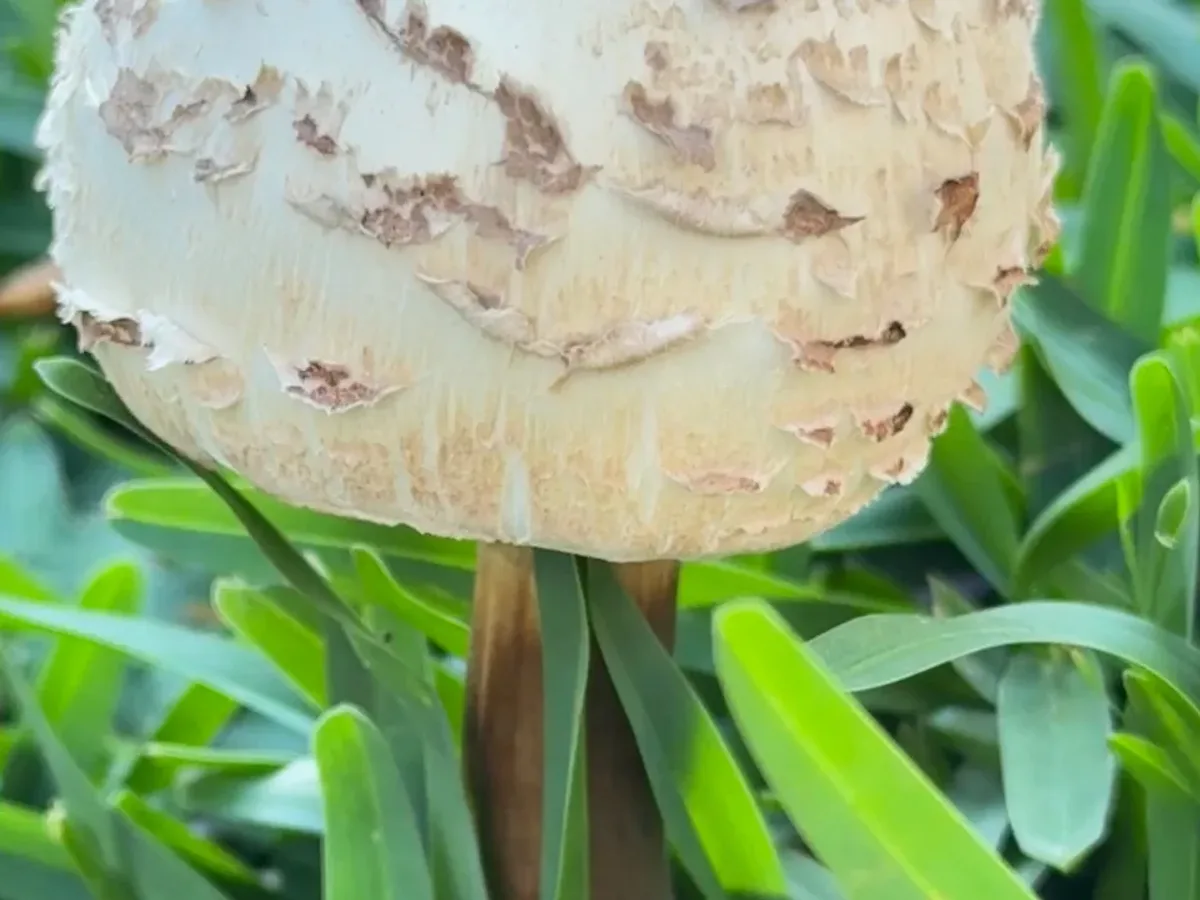
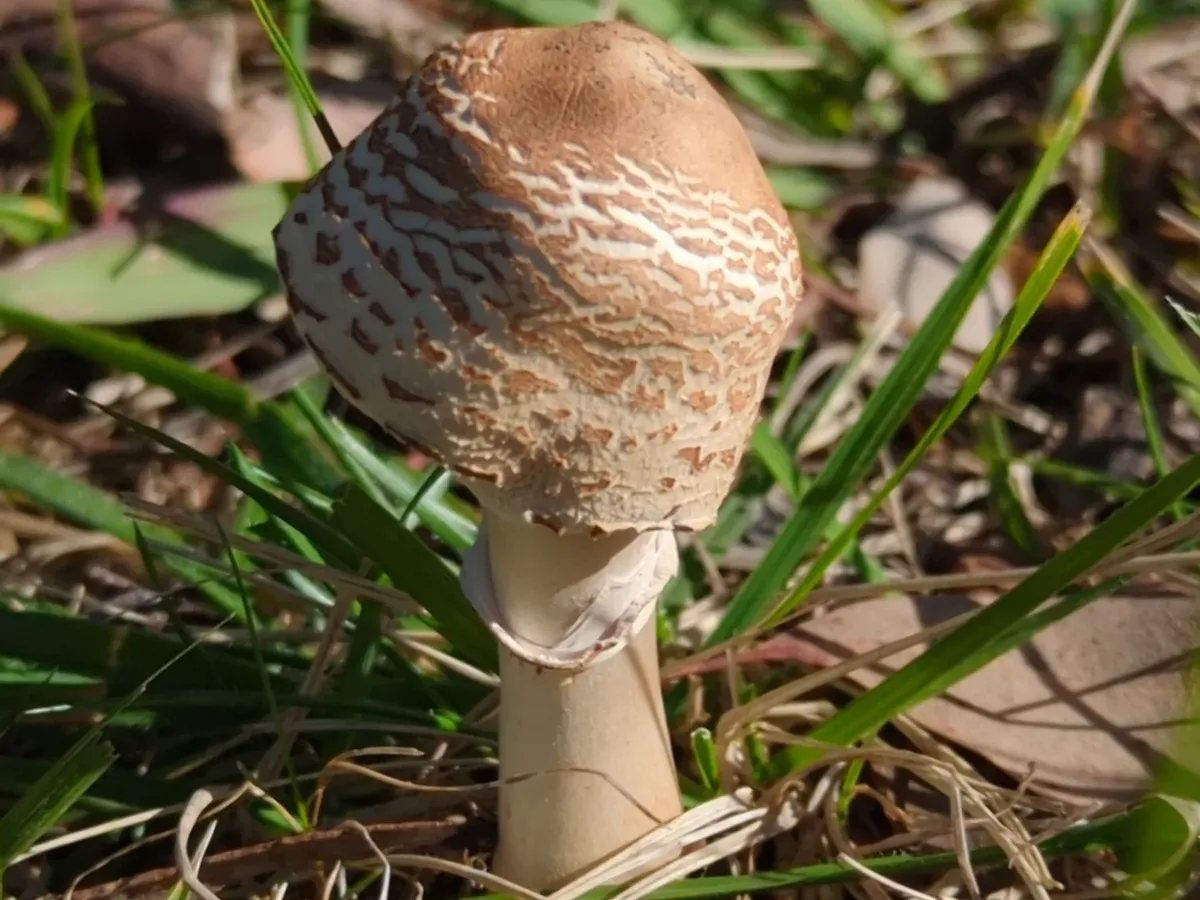
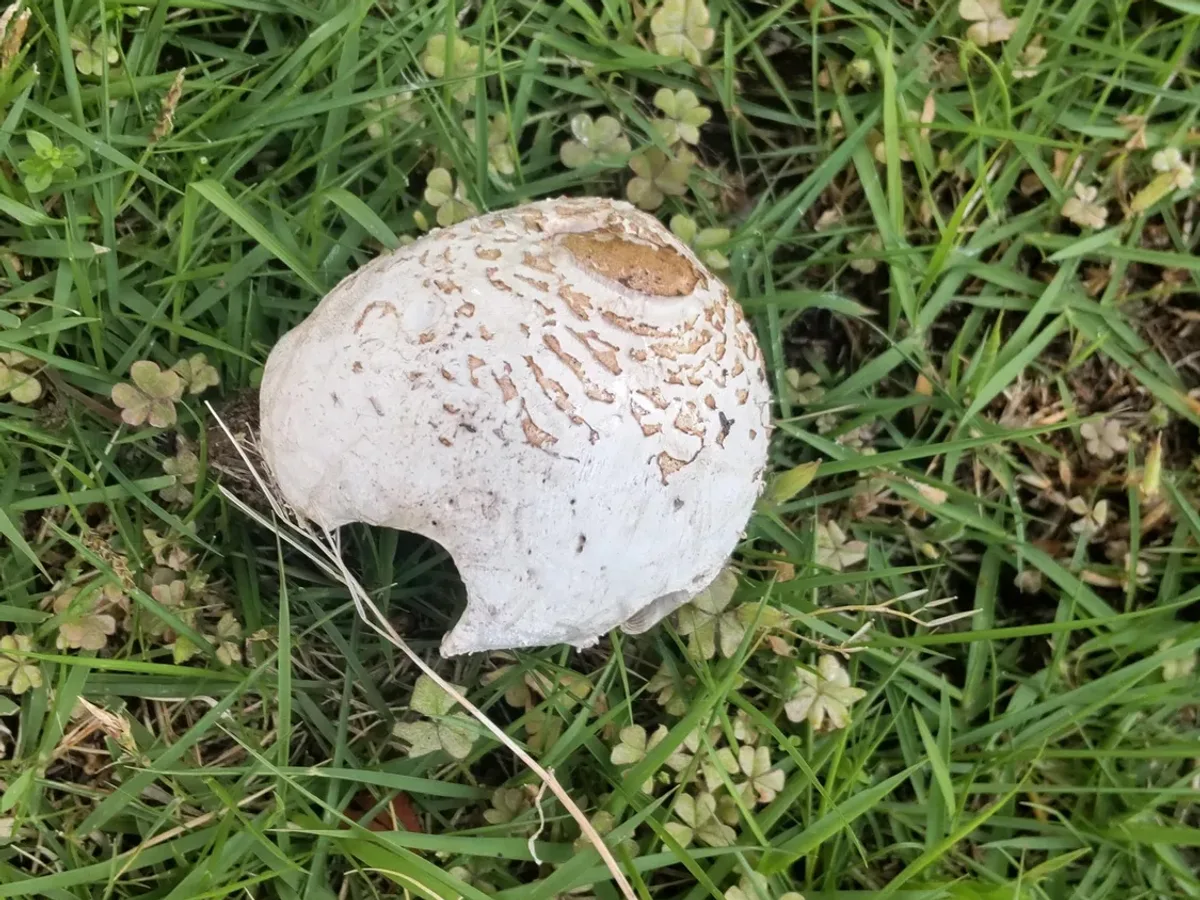
The cap begins as a rounded to ovoid button - pale buff to whitish - and expands through convex to nearly flat, reaching 70-180 mm across when fully open, with a persistent dark brownish central boss.
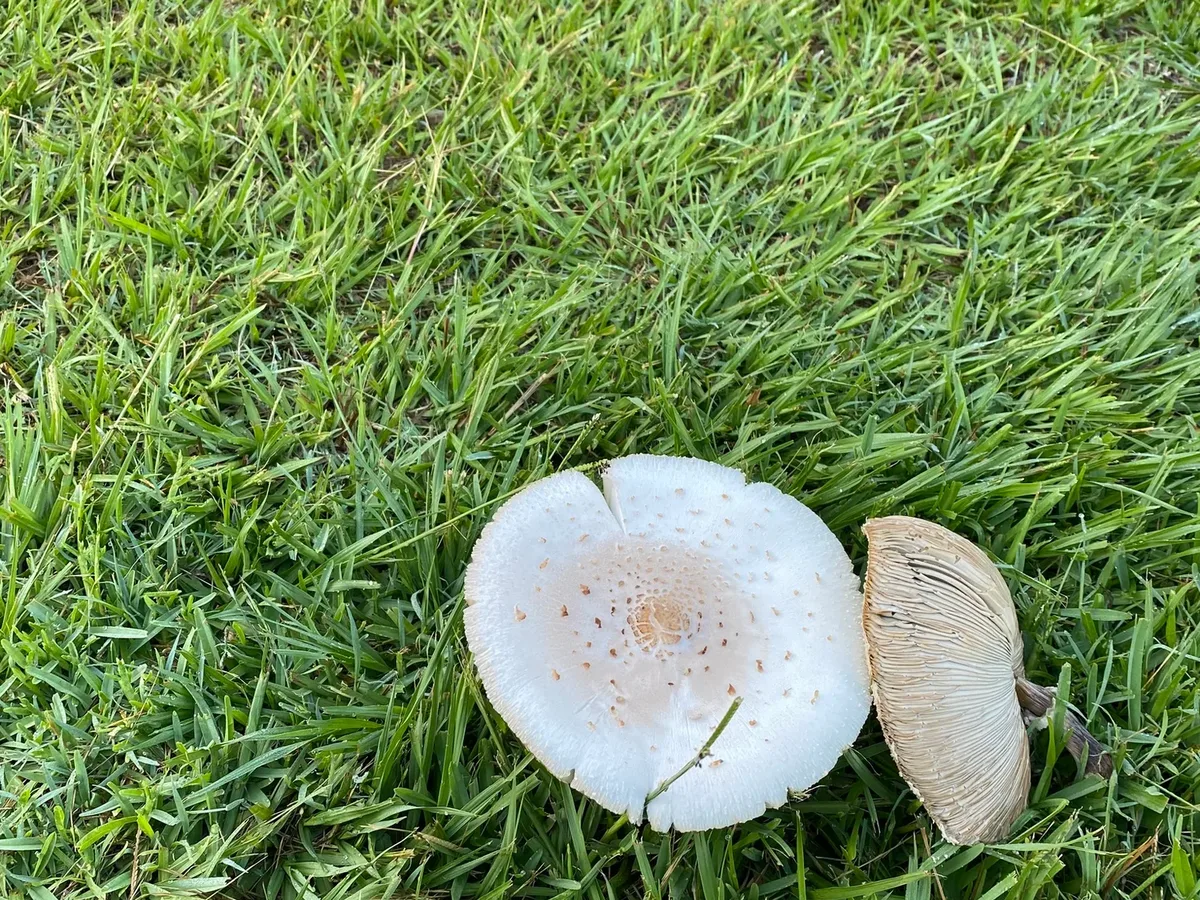
As it grows, the cap surface tears apart to form coarse, upturned brownish-grey scales over a pale background, radiating outward from the brown centre like a roughly patterned sun.
Gills
The gills underneath are free from the stem and initially white, which might suggest safety, but patience and attention reveal the critical clue: as the fruit body matures over hours to days, the gills gradually acquire a dull greyish-green to olivaceous tinge as the green spores ripen.
This is not always obvious in young or very fresh specimens, which is exactly what makes this species so dangerous - it can look entirely pale-gilled at the moment of picking.
Stem
The stem is sturdy, whitish to buff, hollow in maturity, and rises from a distinctly swollen basal bulb. A double, moveable ring sits on the upper stem.
Flesh
The flesh, when cut, stays white or turns only faintly yellowish - no rapid dramatic reddening as in the brunneum/rhacodes group.
Spore print
The spore print, made overnight on paper, is unambiguously greenish-grey to dull olive-green: take this single step before doing anything further with any large parasol-type mushroom collected in tropical or subtropical Asia.
Why it's dangerous
The principal dangers associated with Chlorophyllum neomastoideum are:
- 1Direct gastrointestinal toxicity causing vomiting and diarrhoea in anyone who eats it, with potential dehydration risk in vulnerable individuals.
- 2Confusion with edible Macrolepiota species, whose superficial similarity leads to poisonings across subtropical Asia each season.
- 3The diagnostic green spore print and green gills at maturity are absent or subtle in young specimens, meaning early-stage collection makes the most important field clue unavailable.
- 4The possibility of mixed baskets containing co-collected deadly Lepiota or Amanita species from the same habitat.
All large parasol-type mushrooms must be individually and completely identified before consumption, not assessed as a group.
Toxin
The specific toxic compounds in Chlorophyllum neomastoideum have not been completely characterised.
Research on the closely related Chlorophyllum molybdites - the most studied green-spored Chlorophyllum - has identified a range of heat-labile glycoproteins and polysaccharide-protein complexes that irritate the gastrointestinal lining directly. These are the most likely candidates in C. neomastoideum as well.
Critically, no amatoxins, orellanin, gyromitrin, or other systemic, organ-targeting toxins have been found in this species group; the toxicity is principally gastrointestinal.
Some evidence from the broader Chlorophyllum molybdites literature suggests a possible immunological component to severe reactions in susceptible individuals, though the mechanism remains under investigation.
Cooking does not reliably destroy the active compounds.
Symptoms
Gastrointestinal symptoms are rapid in onset - typically 30 minutes to 3 hours after ingestion - and can include:
- Nausea
- Vomiting (sometimes profuse)
- Abdominal cramping
- Diarrhoea
In most cases symptoms are self-limiting, resolving within 12-24 hours, and do not involve systemic organ toxicity.
However, in children, elderly individuals, or those who have ingested large quantities, dehydration and electrolyte imbalance from repeated vomiting and diarrhoea can require medical attention.
Severe or atypically delayed symptoms (onset after 6 hours) should prompt immediate medical evaluation to rule out the much more serious possibility of amatoxin poisoning from a co-ingested deadly Lepiota or Amanita species.
Retain a portion of the mushroom or a photograph for identification purposes if poisoning is suspected.
Staying safe
Chlorophyllum neomastoideum is a toxic species causing gastrointestinal poisoning; it should not be eaten under any circumstances.
Poisoning cases from this and closely related green-spored Chlorophyllum species are among the most commonly reported mushroom intoxications in subtropical East and Southeast Asia, particularly in China, where large parasol-type mushrooms are sometimes gathered by foragers unfamiliar with this species.
Symptoms typically begin within 30 minutes to 3 hours of ingestion.
The key safety rule in tropical and subtropical Asian foraging is simple and non-negotiable: always make an overnight spore print on white paper before eating any large parasol-type mushroom.
A white spore print does not guarantee safety (see C. brunneum), but any spore print showing even the faintest greenish or olive tint is an absolute contraindication to consumption.
Do not rely on gill colour alone in young specimens - the gills can appear pale and white in fresh, immature fruit bodies before the diagnostic green develops.
Two additional hazards attend this species in the field:
- The possibility of mistaking small specimens for edible Macrolepiota in a mixed basket.
- The co-occurrence in the same habitat with deadly Lepiota species and with volva-bearing Amanita species in forest-edge settings.
If any doubt exists about identity, do not eat the mushroom.
Where & when it grows
Habitat
This is a species of humankind's margins - the village edge, the garden border, the roadsides and park lawns where organic matter is disturbed and nitrogen is rich.
Though it can venture into secondary forest or bamboo grove, it is most at home wherever the soil has been enriched by compost, mulch, decaying plant debris, or accumulated organic waste.
Across southern China, Taiwan, Japan's warmer islands, and mainland Southeast Asia, it fruits readily in gardens, along trails through secondary growth, on grassy roadsides, and in clearings.
Elevation is typically low to middle (sea level to around 1,500 m), and the species is almost entirely absent from cool highland forest.
Its broad habitat tolerance means it appears in places where people spend time and forage, making correct identification especially important.
When
The fruiting season tracks the wet-warm season of subtropical and tropical Asia.
- Southern China and Taiwan: fruit bodies from May through October, with the richest flushes in June-September when monsoon rains keep the soil warm and moist.
- Japan (Kyushu, warmer Honshu, Shikoku): July through September accounts for most records.
- Tropical Southeast Asia: the exact window varies with local monsoon patterns, but broadly the mid-year wet season (May-November depending on location) is the time.
Fruiting responds rapidly to rainfall - fruit bodies can appear within days of significant rain events when soil has been warm.
How it grows
Saprotrophic; breaks down buried organic matter, compost, and humus-rich soil.
Fruit bodies emerge singly or in small scattered groups, sometimes in small rings or arcs in lawns and grassy areas where mycelium has spread through uniform substrate.
Growth is rapid in warm, humid conditions: a button can expand to a full-sized cap in 48-72 hours.
Because the gills are palest (and most deceptively white) on young specimens, the green gill colour and green spore print - the crucial safety characters - are most reliably observed on fully expanded, mature fruit bodies.
This is one reason collecting only fully open, mature specimens is important: it gives both more material and more of the tell-tale colouration to read.
Fruiting conditions
Warm wet-season fruiter; flushes follow substantial monsoon or summer rainfall when soil temperatures are 20-32 °C. In subtropical East Asia (southern China, Taiwan, Japan's warmer regions) the main window is June-September. In tropical Southeast Asia, fruiting broadly tracks wet-season months and can begin as early as May following early monsoon onset. Growth is rapid - a button can reach full size within 48-72 hours of emergence under humid, warm conditions.
Look-alikes
Chlorophyllum neomastoideum grows in a landscape shared with several edible Macrolepiota relatives and several deadly species, making correct identification genuinely important:
- 1Macrolepiota procera (Parasol mushroom) - the classic edible large parasol with which C. neomastoideum is most easily confused at first glance. M. procera has a white spore print (never greenish), white gills that remain white at all stages, a more regular and neater scale pattern on the cap (often plate-like rather than ragged), conspicuous snakeskin-patterned banding on the stem, and flesh that does not change colour on cutting. The spore print is the single definitive test. M. procera is widespread in temperate climates but uncommon in true tropical Asia; most large parasols encountered in tropical Southeast Asian gardens are NOT M. procera.
- 2Chlorophyllum molybdites (Green-spored Parasol) - the most closely related and toxicologically parallel species. Both share the greenish-grey to olive spore print and the capacity to cause severe gastrointestinal poisoning. C. molybdites has a broader global distribution (common in the Americas, sub-Saharan Africa, Australia, and parts of Asia) and is typically larger and more robustly built. In East and Southeast Asia, C. neomastoideum occupies much of the same niche. Both species are toxic and neither should be eaten; distinguishing them from each other has no practical safety significance - both are dangerous.
- 3Chlorophyllum brunneum and Chlorophyllum rhacodes (Shaggy parasols) - these temperate species rarely overlap in range with C. neomastoideum, but where they do (at higher elevations or in temperate pockets of its range), the immediate vivid saffron-red to brick-red reddening of cut flesh in C. brunneum and C. rhacodes is a clear differentiator; C. neomastoideum flesh stays white or becomes only faintly yellowish on cutting. C. brunneum and C. rhacodes also have white spore prints, not green.
- 4Macrolepiota mastoidea (Slender parasol) - an edible species of Europe and parts of Asia with a notably slender build and a pronounced conical umbo. It has a white spore print. While less abundant in the primary range of C. neomastoideum, the name 'neomastoideum' ('new mastoidea') directly references the morphological similarity to M. mastoidea. A spore print and careful examination of gill colour in maturity are essential.
- 5Deadly Lepiota species (Lepiota brunneoincarnata, L. subincarnata, L. helveola, L. josserandii) - these contain lethal amatoxins (alpha-amanitin) and have caused fatal poisonings across Asia and Europe. They are much smaller (cap 2-6 cm) than C. neomastoideum (7-18 cm) and typically show pink, reddish-brown, or flesh-toned scales on a pale background. The size difference is the primary safeguard - never collect any parasol-type with a cap below 6 cm, and always keep collected specimens separate from any other mushrooms to prevent cross-contamination.
Much smaller (cap 2-5 cm, never approaching 7 cm+), with reddish-brown to pinkish-flesh colouring, concentric scale rings, a thin fragile ring, and no green spore print. Contains lethal amatoxins (alpha-amanitin). The danger arises from mixed baskets or if immature C. neomastoideum buttons are not carefully size-checked. A hard rule - never collect any parasol-type with a cap under 6 cm - eliminates this risk.
Also small (cap 2-5 cm), with pinkish-brown to ochre fibrous scales over a pale background and a thin ring. Contains alpha-amanitin and has caused deaths. The risk, again, is from mixed-basket contamination or collection of immature specimens. Size (under 6 cm) is the key differentiator; never collect small specimens of any parasol-type in Asian forests.
The most closely related toxic species, sharing the greenish-grey to olive spore print and gastrointestinal toxicity. C. molybdites is generally larger, more robustly built, and has a wider global range including the Americas, Africa, and Australia. In areas where both occur (parts of tropical Asia), distinguishing them from each other has no practical safety significance - both are toxic and neither should be eaten.
The most important edible lookalike. M. procera has a white spore print (never greenish), gills that remain pure white at all stages, a more orderly and plate-like (not ragged) scale pattern on the cap, prominent snakeskin-patterned banding on the stem, and flesh that stays white when cut. The overnight spore print is the single definitive test: any hint of green excludes M. procera. M. procera is uncommon in tropical lowland Asia; most large parasols encountered in gardens and clearings in tropical Southeast Asia are not M. procera.
C. rhacodes flesh turns immediately vivid saffron-red to brick-red on cutting - this is absent in C. neomastoideum, which stays white or faintly yellows. C. rhacodes has a white spore print (not green). C. rhacodes is primarily a temperate European species; the overlap is limited to higher elevations or cooler pockets of C. neomastoideum's range.
M. mastoidea is an edible species from which C. neomastoideum takes part of its scientific name (neomastoideum = 'new mastoidea'). M. mastoidea is more slender and graceful, with a prominent conical central umbo, a more delicate ring, and - crucially - a white spore print and gills that remain white at all stages. The greenish-grey spore print of C. neomastoideum is definitive.
A reference guide - never an edibility guarantee. When in doubt, leave it out.