Dryad's saddle
Cerioporus squamosussyn. Polyporus squamosus, Melanopus squamosus, Boletus squamosus
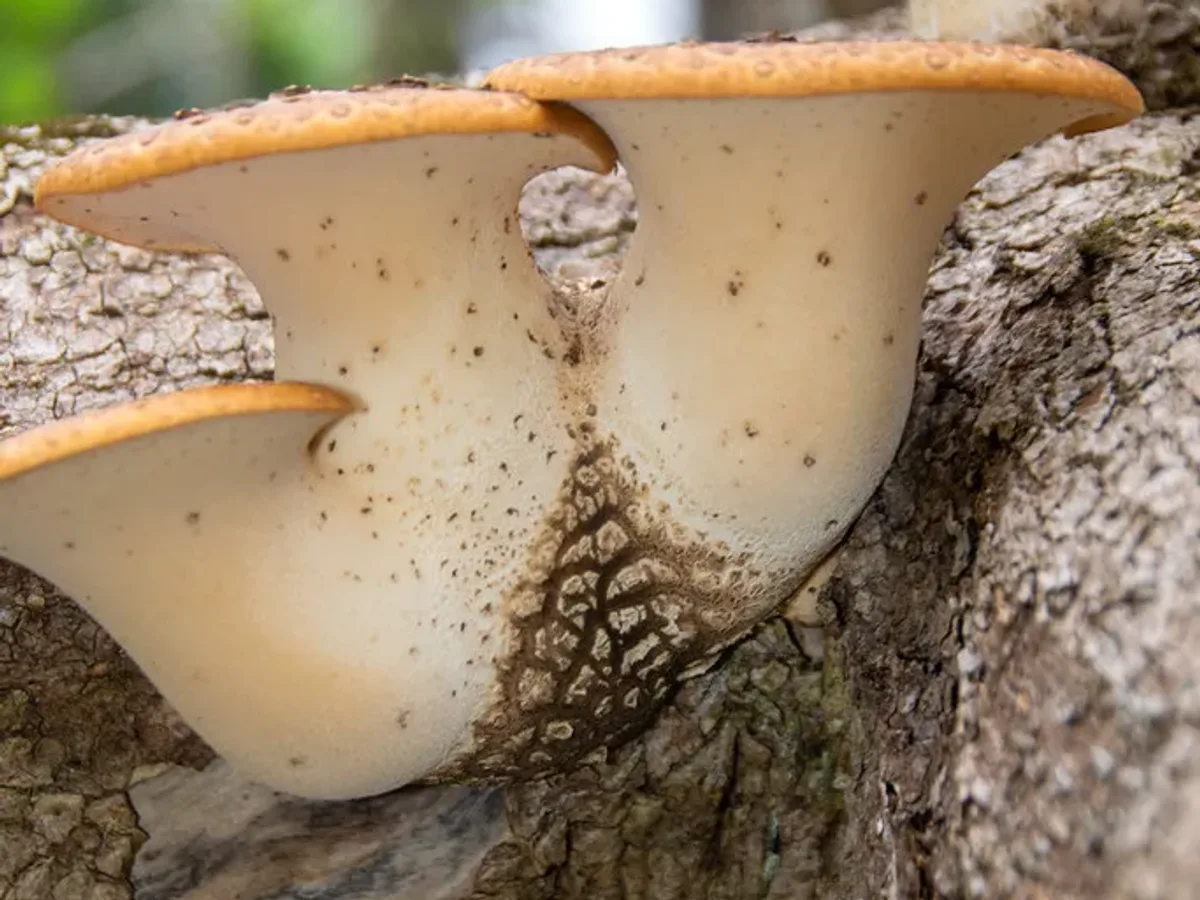 © Paul and Jill (CC BY 2.0)
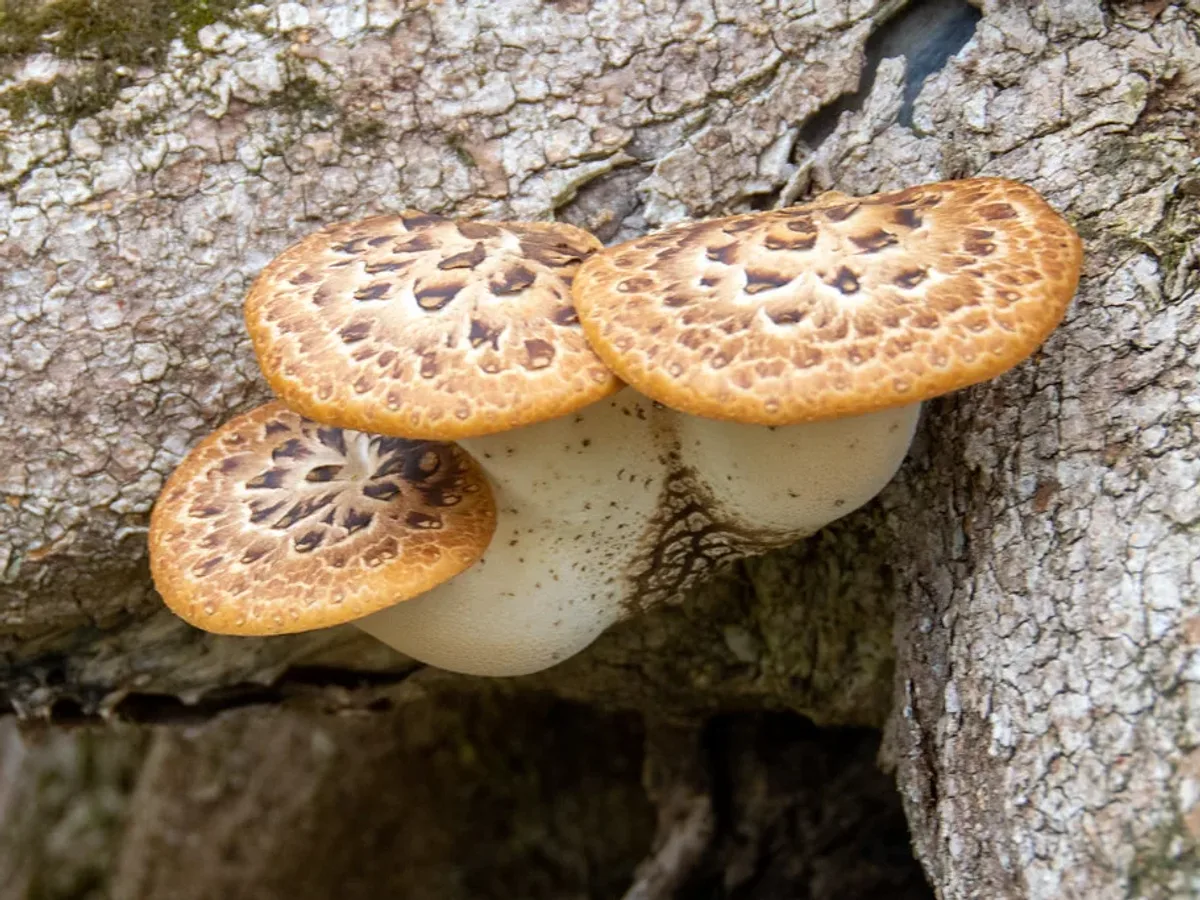 © Paul and Jill (CC BY 2.0)
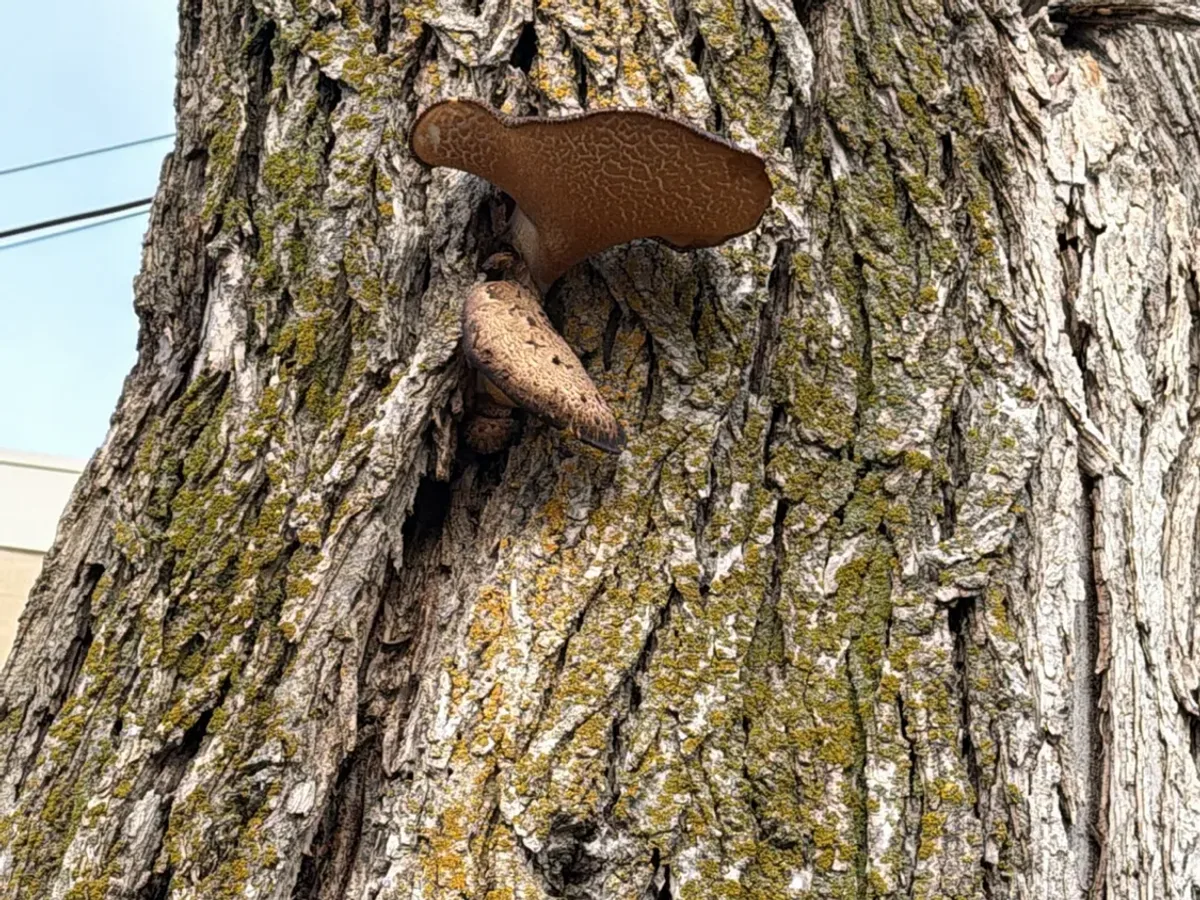 Nathan Oldridge (CC0)
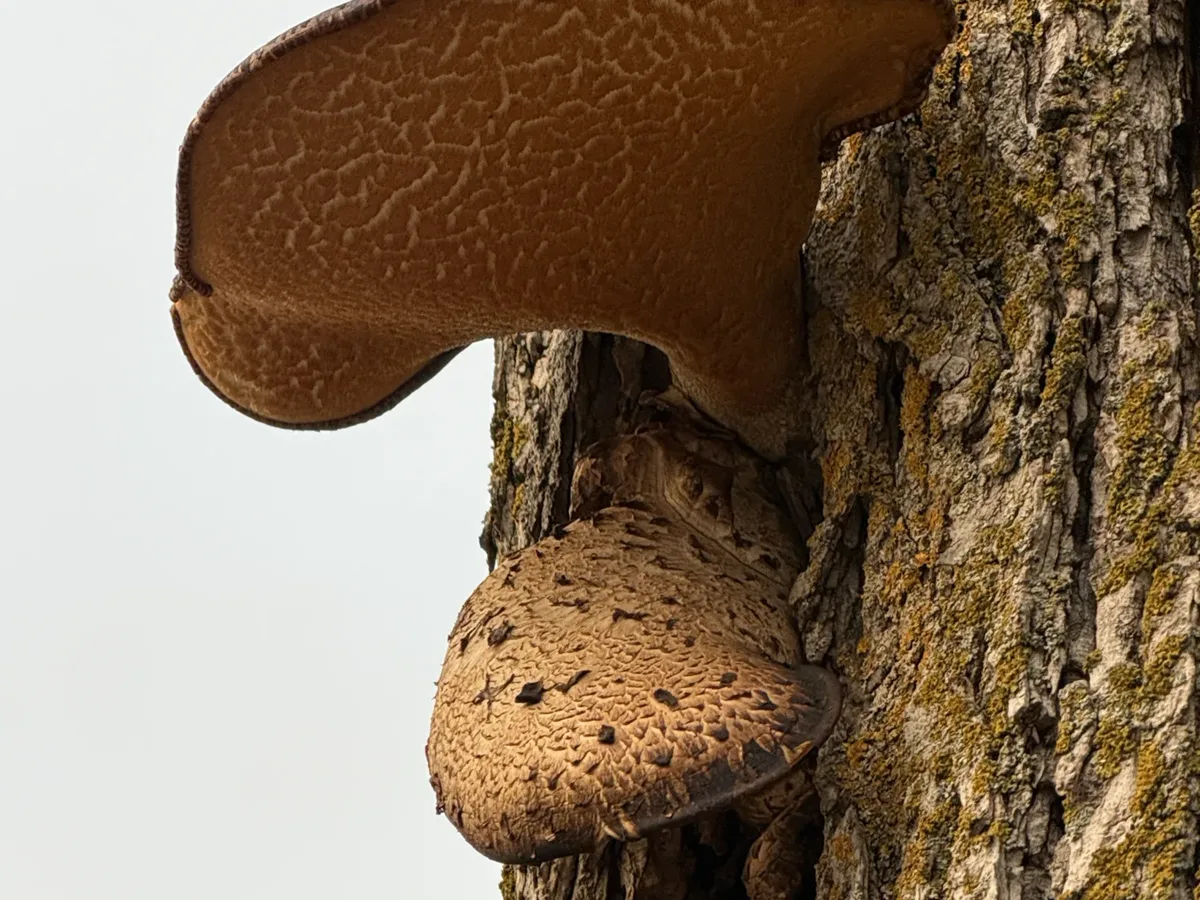 Nathan Oldridge (CC0)
 © Alissa Iverson (CC BY)
 © Alissa Iverson (CC BY)
 © Conway Hawn (CC BY)
 © Conway Hawn (CC BY)
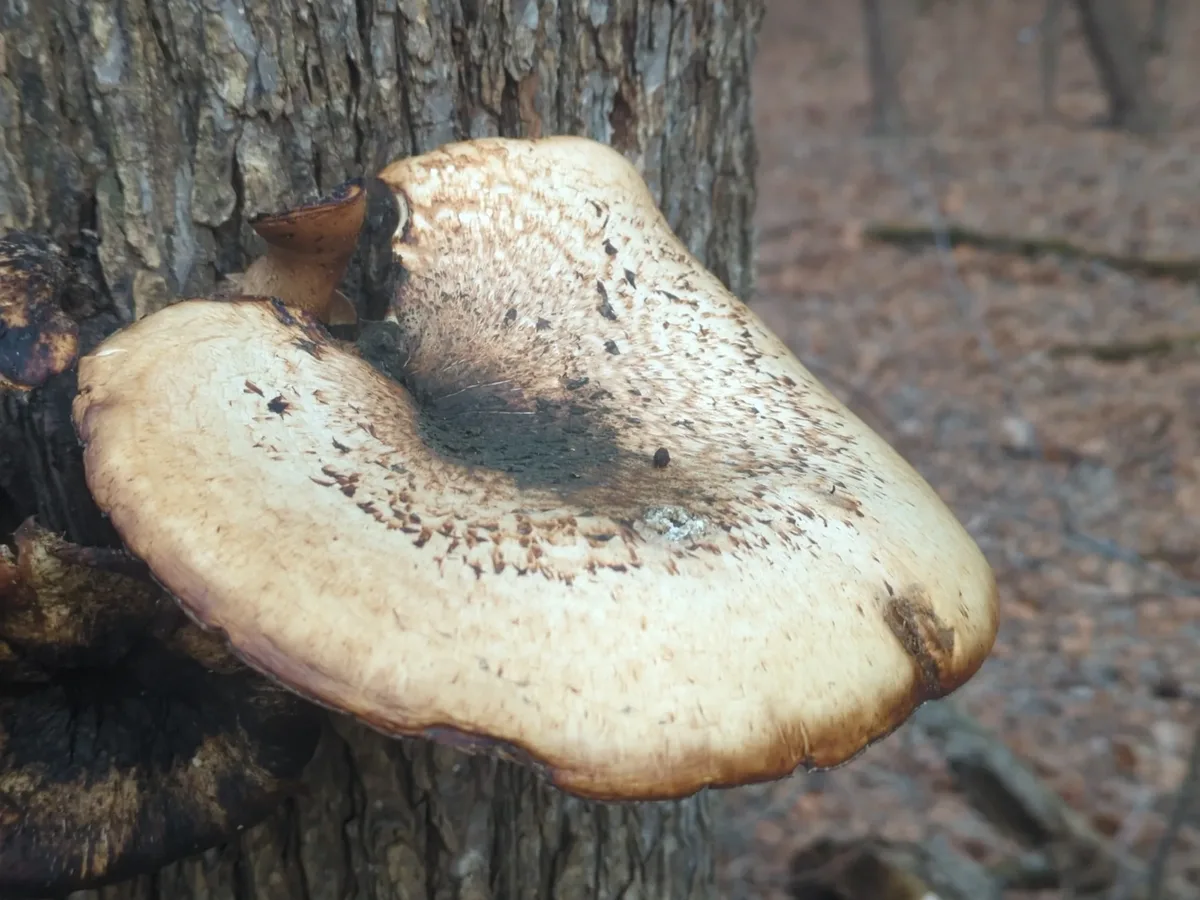 © Tom Field (CC BY)© Paul and Jill (CC BY 2.0)© Paul and Jill (CC BY 2.0)
Good to eat, once you have identified it with certainty and cooked it through.
How to recognise it
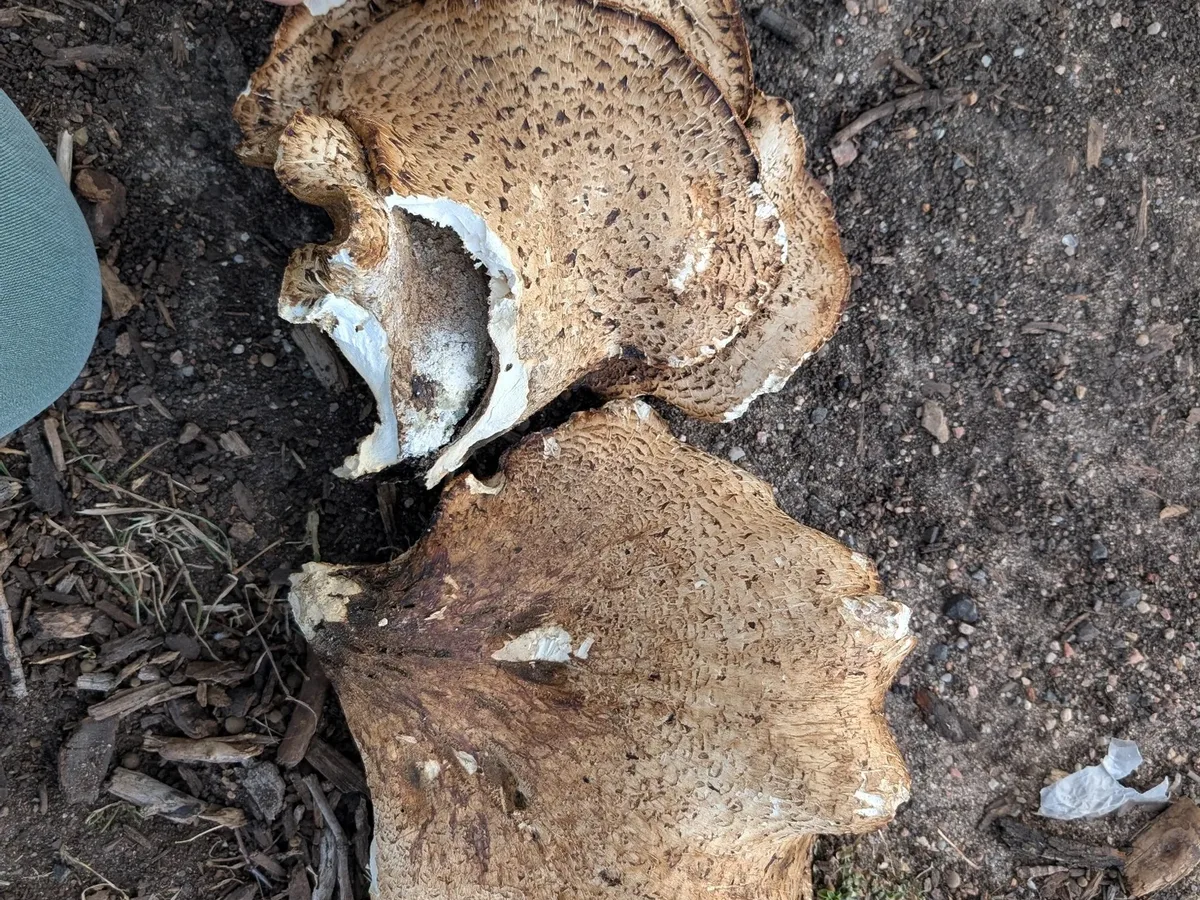
Dryad's saddle is one of the most immediately recognisable fungi in European and North American woodlands, both for its size and for its exquisitely patterned cap.
Cap
The bracket starts as a pale, rounded, slightly downy knob emerging from bark and expands rapidly into a shelf that can reach 60 cm or more across.
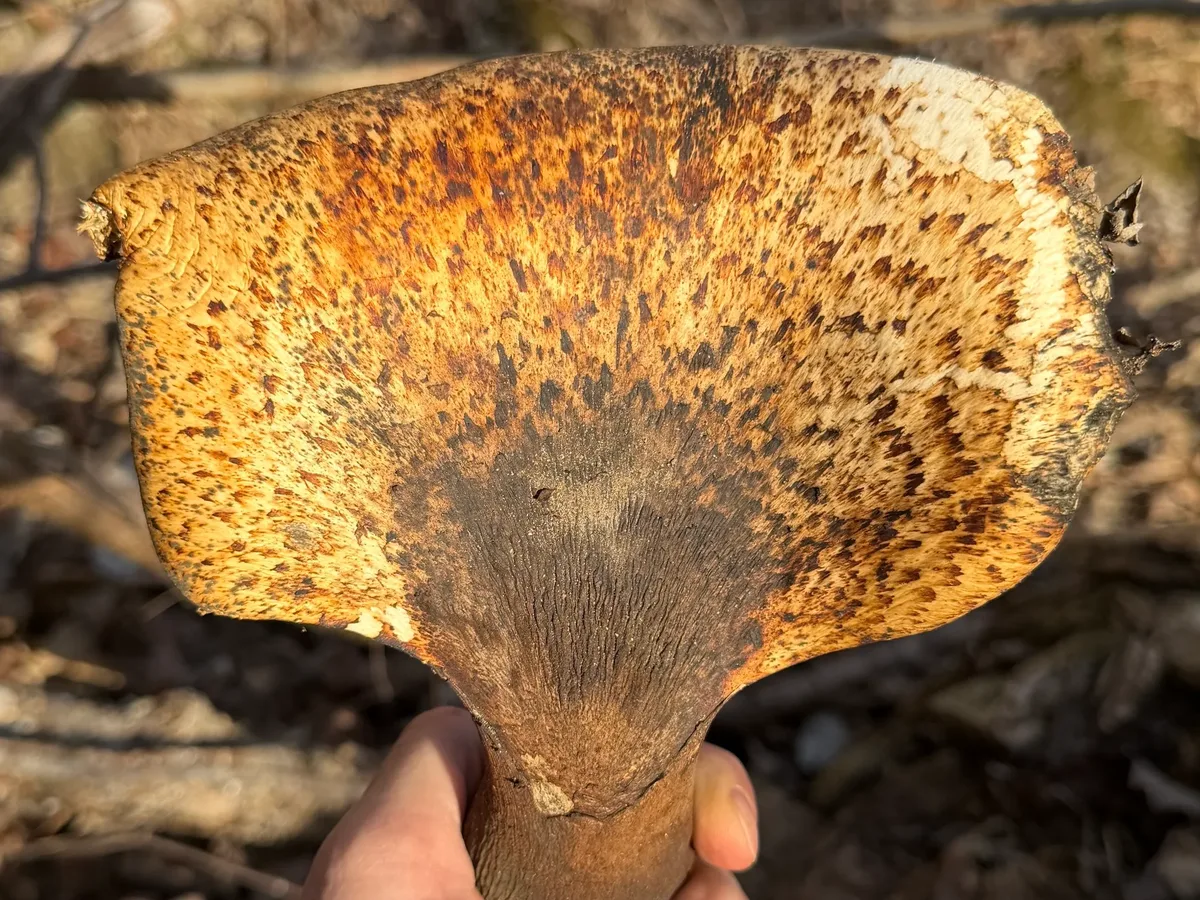
The upper surface is cream to buff-yellow overlaid with concentric rings of flat, dark brown, roughly diamond-shaped scales - the pattern closely resembles the back of a pheasant or the bark of some trees, providing excellent camouflage against mossy wood.
The margin remains thin and wavy, sometimes undulate.
Pores
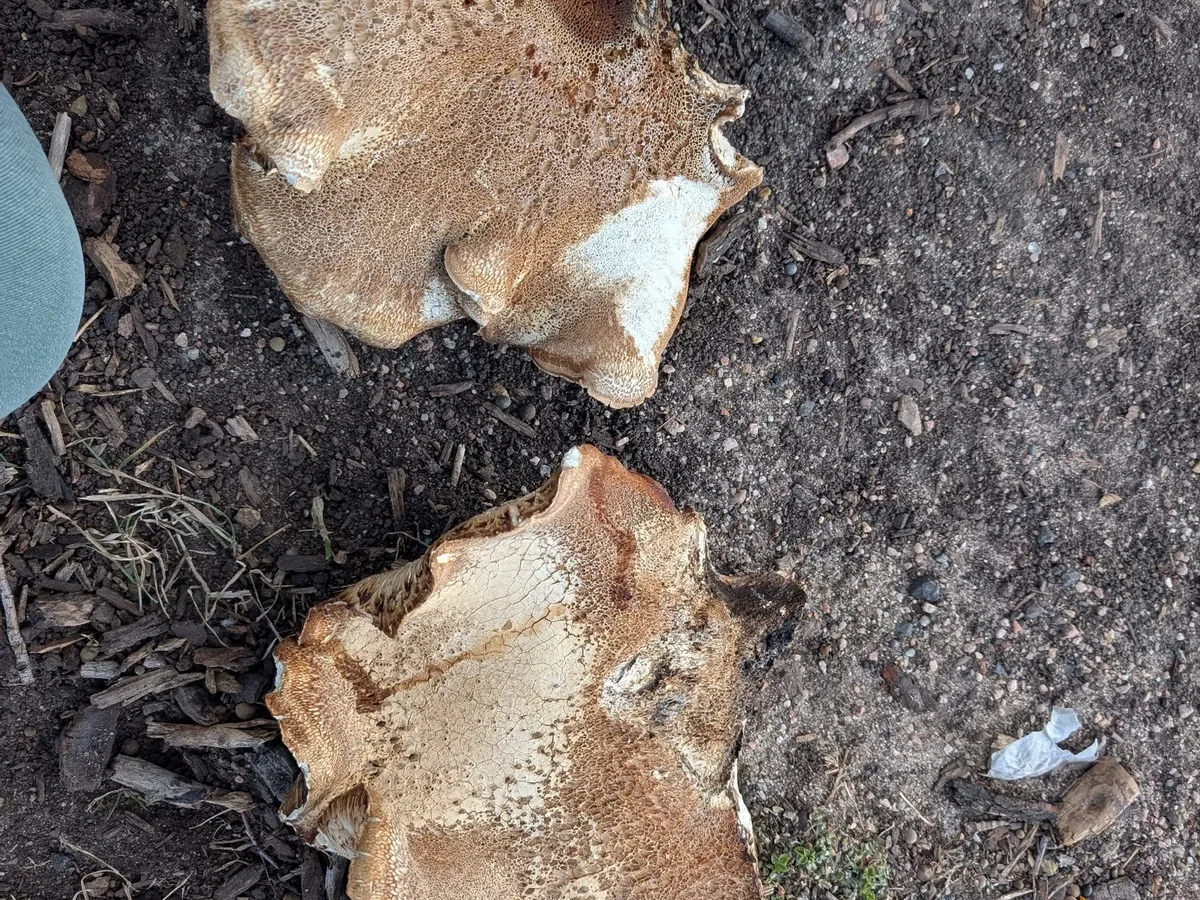
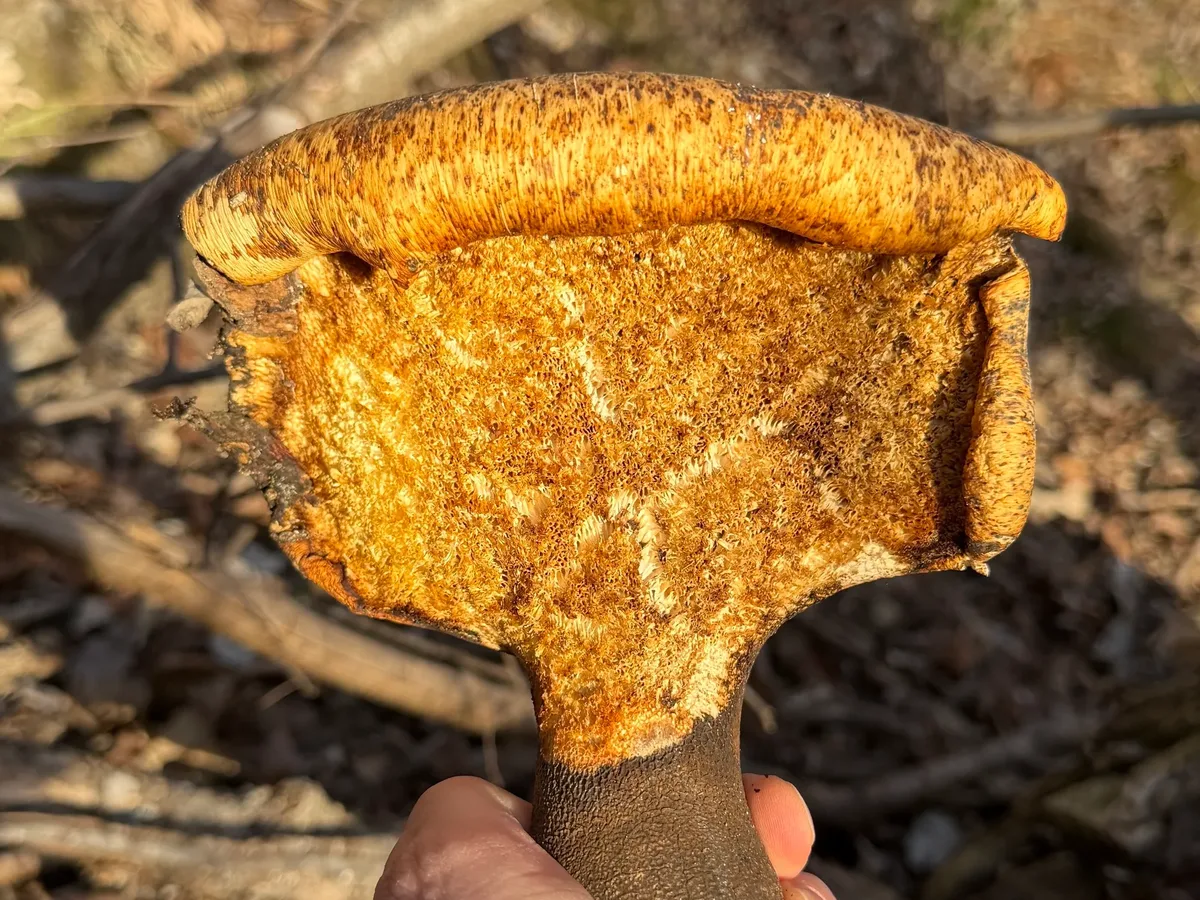
Beneath, the white-to-cream pore surface is remarkably fine (1-3 pores per mm), tubes descending slightly onto the short, dark-based lateral stem.
Flesh
The flesh is white throughout, firm and fragrant in youth, becoming tough and fibrous within days.
Smell & taste
The most memorable diagnostic character is the smell: powerfully of fresh watermelon rind or cucumber-melon - distinctive, unmistakable, and perceptible from several metres away on large fruiting bodies.
Where & when it grows
Habitat
A ubiquitous and conspicuous woodlander found wherever mature broadleaved trees grow. It is especially fond of large, veteran, or recently stressed trees in parks, churchyards, urban streets, and hedgerows, where elms, sycamores, and ashes provide ideal substrates.
In woodland it occurs on stumps, fallen logs, and butts of standing dead trees.
It is not a forest-interior specialist - it thrives in disturbed habitats and is among the most commonly encountered large brackets in European towns and cities. The same site will often produce brackets year after year from established mycelium.
In North America it ranges from the Pacific Northwest and Great Plains east to the Atlantic coast, commonly appearing on box elder, elm, and black walnut.
When
Spring is the primary season, making it one of the earliest large edible fungi of the year in northern Europe.
Brackets begin emerging as early as April in the British Isles and central Europe, reaching peak size and abundance through May and June. A secondary flush frequently occurs in late summer or autumn.
Unlike autumn mushrooms, dryad's saddle is best sought in spring, when new growth is still tender; once temperatures rise the flesh toughens rapidly.
Cool, moist conditions after a dry spell trigger new flushes. The same host tree may fruit every spring for decades.
How it grows
For most of the year this fungus is invisible, living as perennial mycelium threaded through the heartwood of its host - sometimes for decades.
Then, as spring temperatures rise, it can throw up a full-sized bracket in as little as 3-7 days, the cap expanding rapidly from a pale bud to a shelf spanning 30 cm or more.
Brackets emerge singly or in overlapping tiers of 2-6 from a common attachment point at the trunk base or along large branches. Each season's growth is fresh, though the mycelium beneath may have been working quietly in the same tree for years.
In doing so the fungus causes a white rot, gradually softening the heartwood. Spores are released from the fine pore surface and carried passively on the wind.
Fruiting conditions
Spring flush is triggered primarily by warming air and bark temperatures rather than rainfall, as the fungus draws on moisture already within the host wood. Autumn flushes are more rain-responsive. Brackets develop very quickly-4 to 7 days from bud to harvestable size in warm conditions.
Look-alikes
The combination of large size, pheasant-back scaling, white pore surface, short dark-based stem, and cucumber-watermelon smell makes dryad's saddle essentially unmistakable among European and North American fungi. No dangerous lookalike exists.
The only superficially similar species worth mentioning:
- Polyporus tuberaster (tuberous polypore) is much smaller (cap rarely exceeding 15 cm), has a central or nearly central stem, and grows from a buried sclerotium; it also has a cucumber scent but lacks the bold feather-patterned scales.
- Grifola frondosa (hen of the woods) grows as overlapping rosettes of smaller, grey-brown, tongue-like caps and lacks scales.
- Meripilus giganteus forms large overlapping tiers of brownish, smoother caps that bruise black and lack the patterned scales.
- Cerioporus varius (elegant polypore) is much smaller with a smooth tan cap and black stem base.
None of these are harmful.
Much smaller (cap rarely >10 cm), smooth tan cap without bold scales, slender stem with a distinctly black base; too tough to eat but not harmful.
Overlapping fan-shaped brackets with smoother, brownish-grey upper surface lacking dryad's saddle's bold scale pattern; flesh bruises black on injury; no cucumber scent.
Grows as overlapping rosettes of many smaller (5-12 cm), grey-brown tongue-like fronds from a central base; no bold feather-patterned scales; typically an autumn species.
Much smaller cap (rarely >15 cm), nearly central slender stem arising from a buried sclerotium, lacks the bold concentric brown scale pattern; also edible when young.
In the kitchen
Picking & cleaning
Harvest only young, fresh brackets where the flesh is still pure white, firm, and more than 1 cm thick.
The ideal window is when the cap edge is still rounded and the pores are white and tightly packed - usually within the first 3-5 days of emergence. Brackets larger than about 25 cm across are often already too tough to eat except for the very margin.
Cut brackets from the tree with a sharp knife at the stem junction; there is no benefit to leaving a 'stub'.
Do not harvest from trees near roadsides, industrial sites, or treated amenity trees where contamination is possible.
Very large, pale, fresh specimens found on elms or ash in spring are the highest-quality eating.
Cooking
Young, tender dryad's saddle has a mild, slightly mealy flavour with a pleasing firm texture reminiscent of abalone or chicken breast. The thin outer margin of even larger brackets can be palatable.
Slice caps 5-8 mm thick and sauté in butter over high heat until golden - the moisture evaporates and the flesh firms pleasantly. It pairs well with garlic, thyme, lemon, and cream sauces.
The flavour is delicate and does not stand up well to heavily spiced dishes.
Young caps can be:
- battered and fried
- added to risottos
- used as a pizza topping
Avoid steaming or boiling as this makes the texture rubbery.
Drying is possible but the texture becomes very tough; dried and powdered caps give a pleasant umami note to stocks and soups.
Discard any tough central zones.
Good to know
Cerioporus squamosus has no known toxins and no dangerous lookalikes. It is considered safe for most people when cooked thoroughly.
Occasional gastrointestinal upset has been reported from eating tough, old specimens or consuming very large quantities - always select only young, fresh growth and cook well.
There is no risk of confusion with any deadly species.
A reference guide - never an edibility guarantee. When in doubt, leave it out.