Swollen-stalked cat
Catathelasma ventricosumsyn. Catathelasma ventricosa (Peck) Singer, Biannularia ventricosa, Armillaria ventricosa Peck, Tricholoma ventricosum
 © Michael Tidwell (CC BY)
 © Michael Tidwell (CC BY)
 © Michael Tidwell (CC BY)
 © Michael Tidwell (CC BY)
 © Michael Tidwell (CC BY)
 © Michael Tidwell (CC BY)
 © Michael Tidwell (CC BY)
 © Michael Tidwell (CC BY)© Michael Tidwell (CC BY)© Michael Tidwell (CC BY)
Good to eat, once you have identified it with certainty and cooked it through.
Never eat a mushroom you are not 100% sure of - check the look-alikes below, and always cook wild mushrooms.
How to recognise it
Catathelasma ventricosum is a mushroom of presence: when you find a large, fully developed specimen in Pacific Northwest old-growth conifer forest, there is little else it can be mistaken for if you know what to look for.
Cap
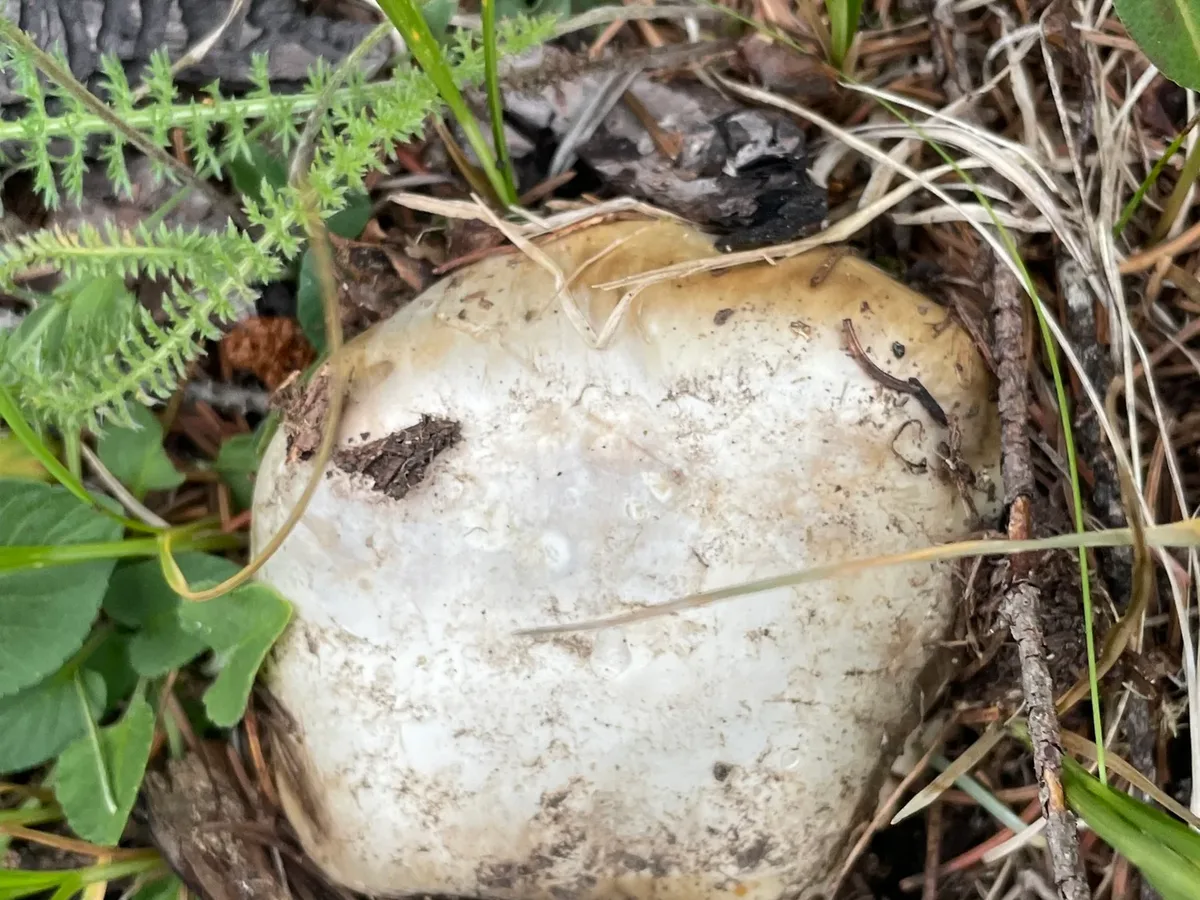
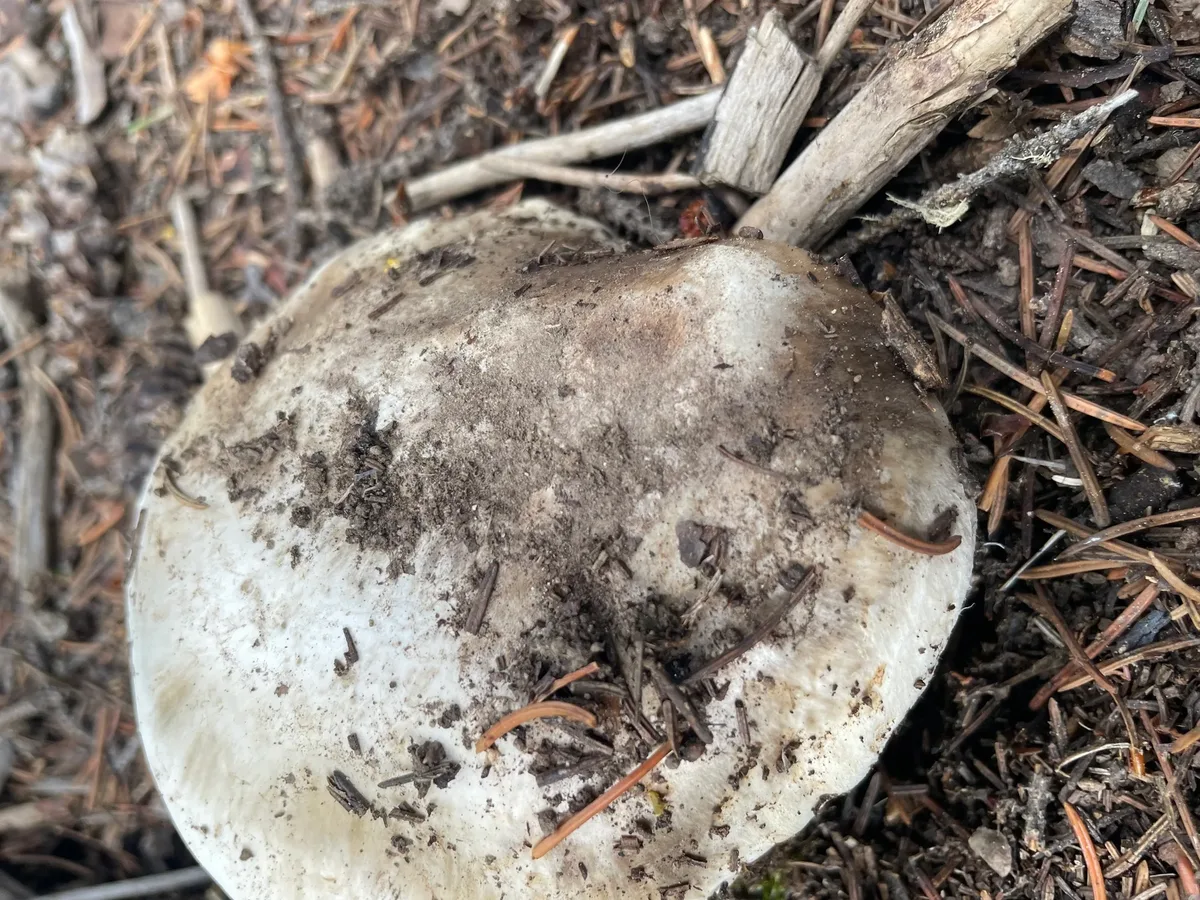
The cap starts as a tight, rounded dome, creamy white to pale grey, with the margin rolled tightly inward against the stem - a shape that can suggest a puffball to the unfamiliar eye at a distance.
As it matures the cap expands to a broad, flattened disc, sometimes 30 cm or more across, while remaining distinctly pale, almost bone-white, without the warm buff-brown tones of the related C. imperiale.
In wet weather, the cap surface becomes visibly viscid or glutinous - slightly slippery to the touch - a helpful diagnostic detail absent in drier conditions.
Gills
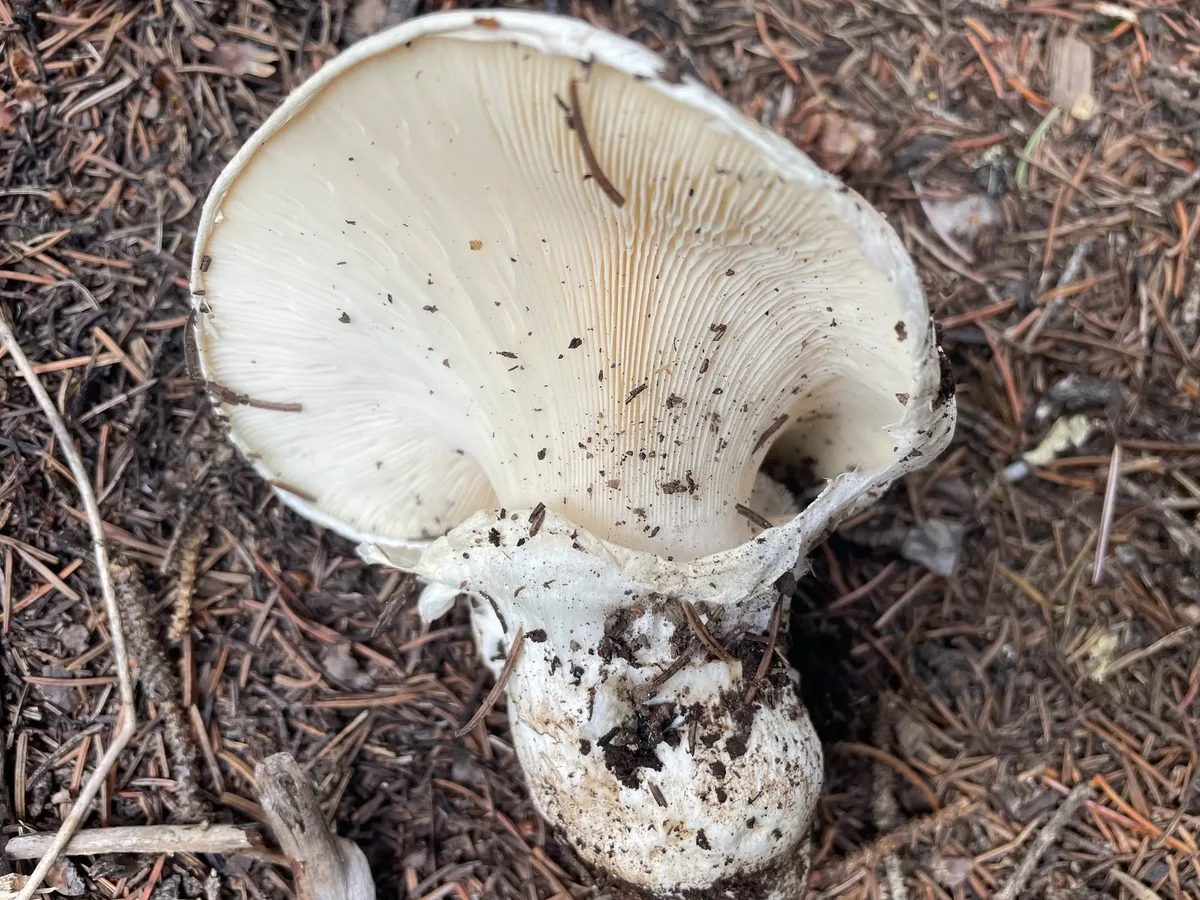
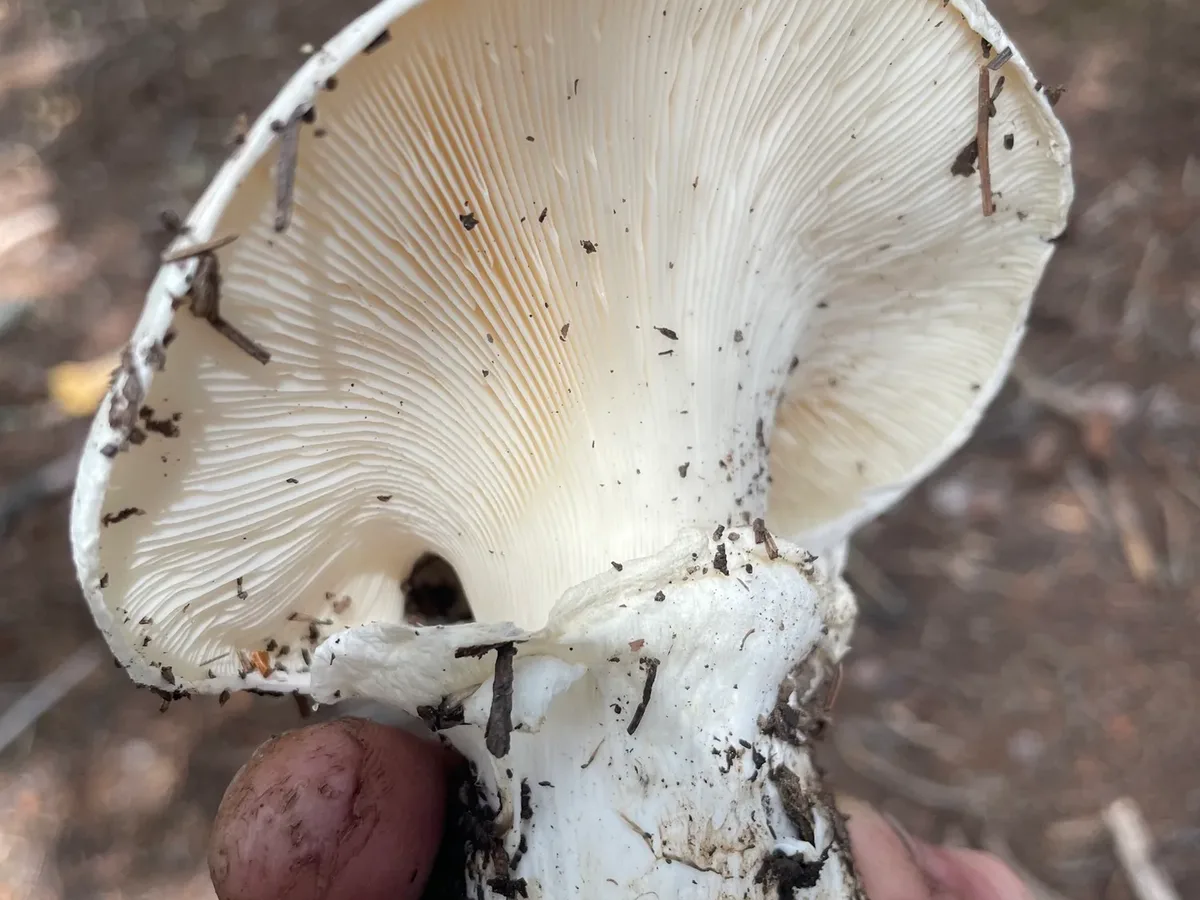
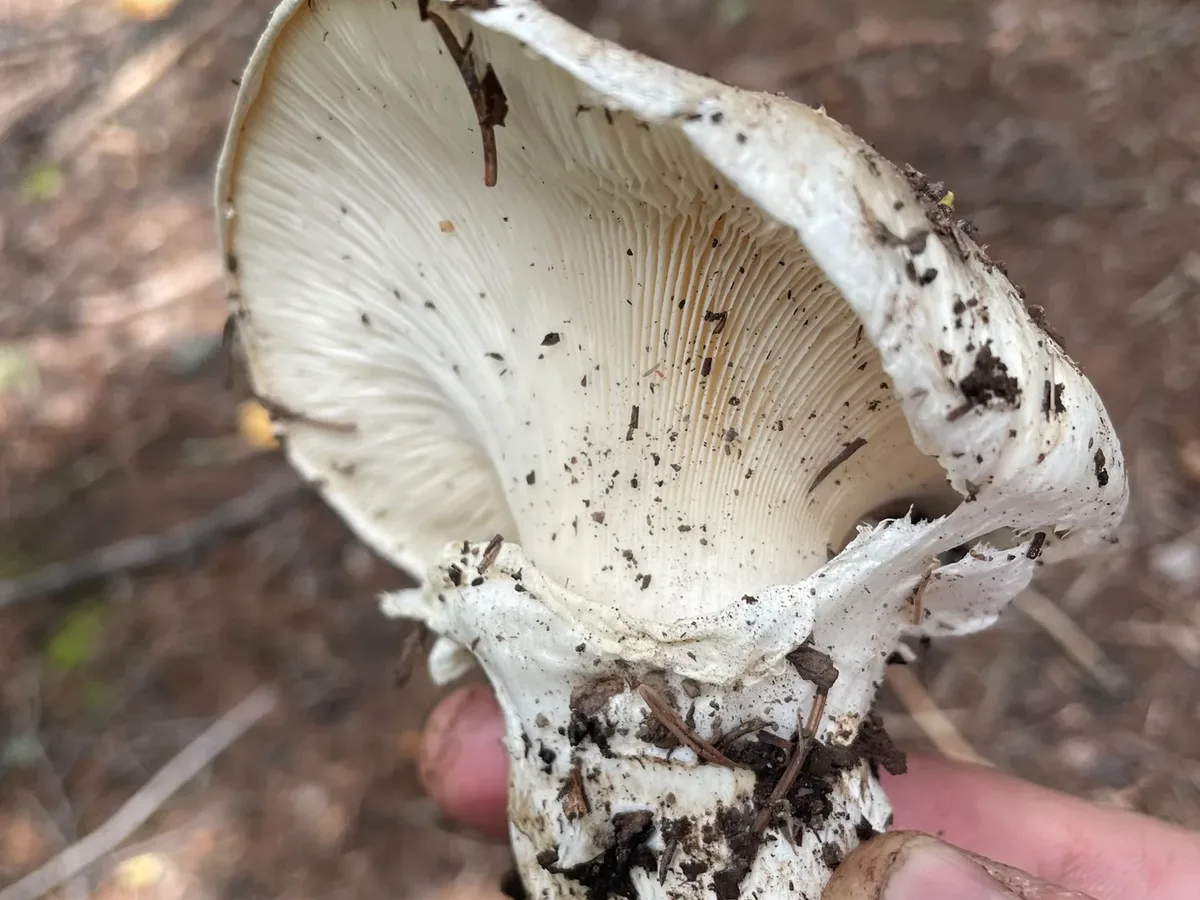
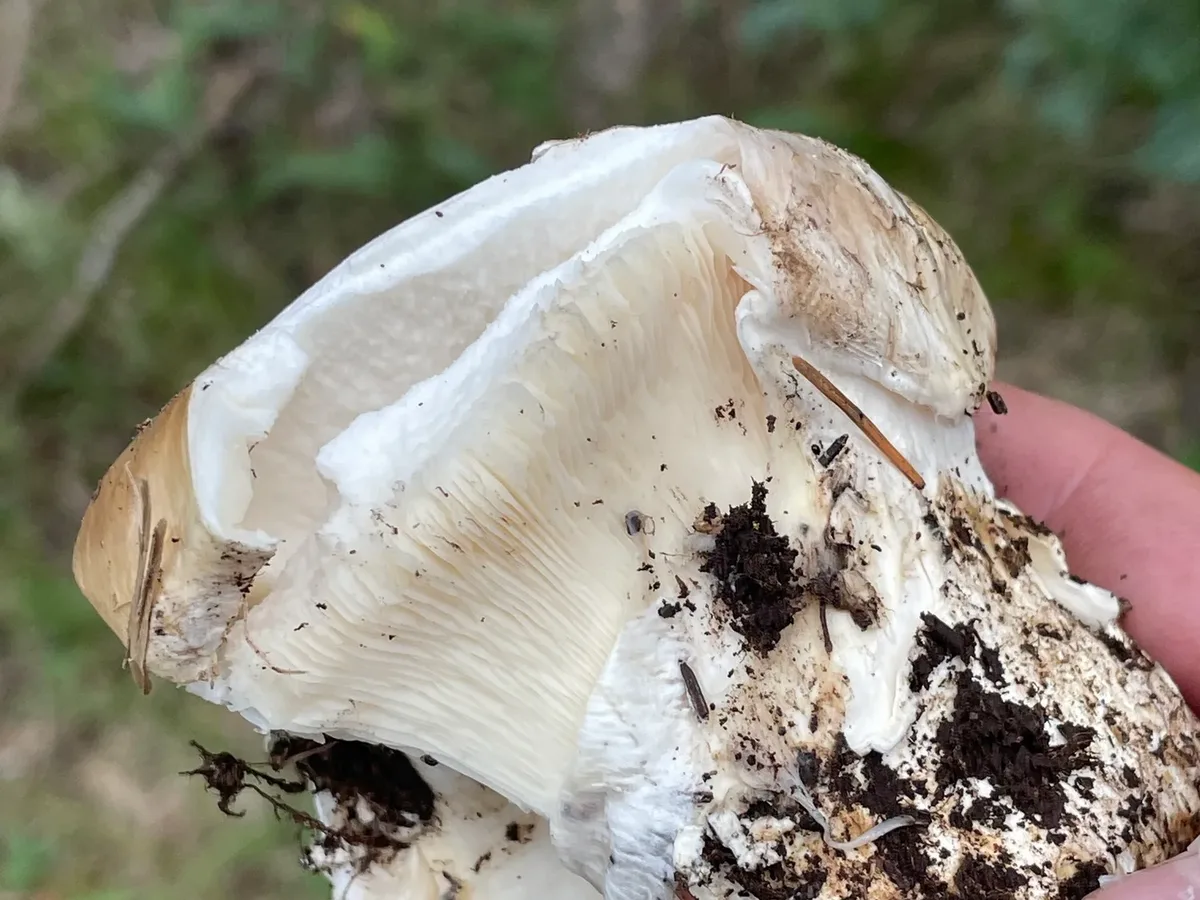
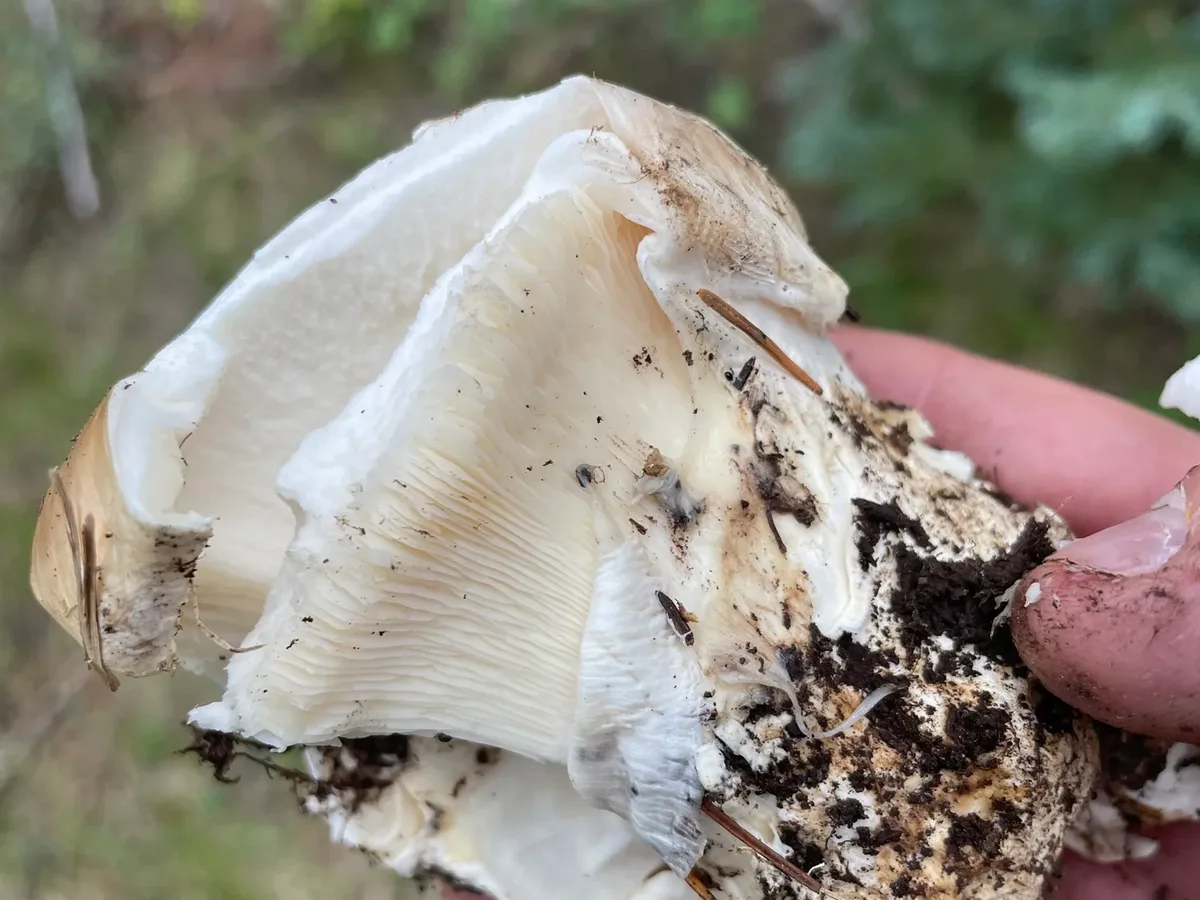
The gills demand attention: they are white, crowded, and decurrent, meaning they run clearly down the upper stem in a distinct tooth or short blade rather than ending at the stem junction. Decurrent gills on a white-capped, white-fleshed, large forest mushroom immediately narrow the identification considerably.
Stem
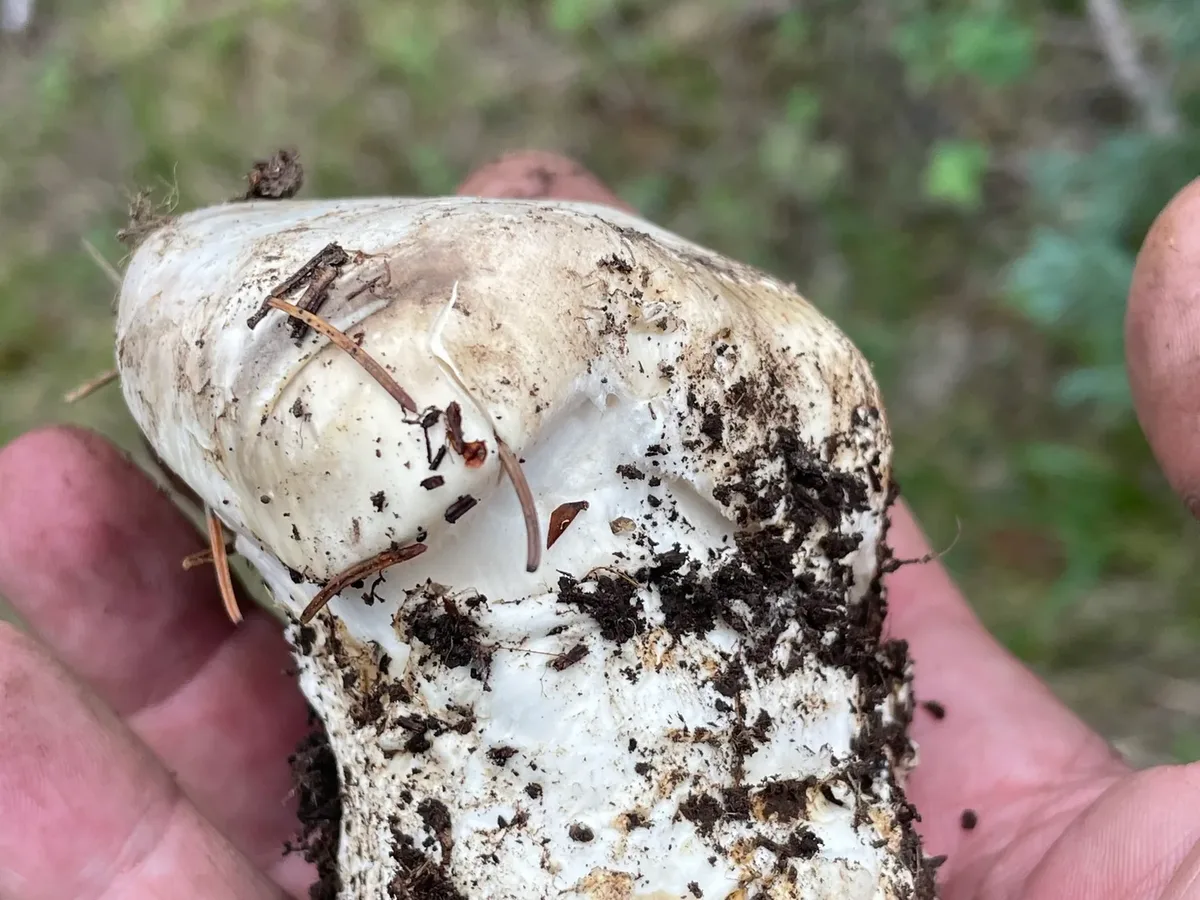
The stem is the defining structure. It is thick and solid, but unlike many large mushrooms it is not cylindrical: it swells in the middle section before tapering to a pointed, deeply buried base - a pronounced club-or-spindle shape that the name 'ventricosum' (Latin: swollen-bellied) describes exactly.
Most importantly, it bears two separate veil remnants at different heights: an upper, membranous, pendant ring and a lower, thicker, cotton-textured sheath of veil material. These two separate rings - the double annulus - are the genus Catathelasma's signature.
No other large, white-capped, white-gilled, decurrent-gilled conifer-forest mushroom in the Pacific Northwest shares this double-ring character.
Smell & taste
The smell is mealy or farinaceous - damp flour, grain, or a mild cucumber-like note - quite distinct from the spicy-aromatic odour of matsutake or any foul smell.
Flesh
The flesh is dense, white, firm as a boiled potato, and stays white when cut.
Where & when it grows
Habitat
C. ventricosum is a true forest specialist: it cannot survive or fruit without intact living conifer roots to form mycorrhizal unions with, and it is essentially absent from disturbed or second-growth forest.
Its preferred partners in the Pacific Northwest are true firs (Abies amabilis, A. grandis, A. lasiocarpa) and spruces (Picea sitchensis, P. engelmannii), though hemlocks and occasionally Douglas-fir also support it at some sites.
The habitat it favours is the quiet interior of mature montane forest - cool, shaded, with deep accumulated litter and humus, on slopes or valley floors where moisture lingers after rain.
Finding one specimen is often a sign that the mycelium is well-established at that site: look around within a few metres, excavating any suspicious ground-dome.
Because the fruit body is deeply buried with only the cap visible (or sometimes not even that), experienced foragers learn to read subtle signs - a slightly raised mound of litter, a pale disc just breaking the soil surface - before digging to uncover the full mushroom.
Elevation is a practical guide: most finds come from 600-2,000 m in the Pacific Northwest mountains, peaking around 900-1,500 m in stands of silver fir and mountain hemlock.
When
This is an autumn mushroom in the Pacific Northwest, fruiting after the summer drought breaks and autumn rains begin to penetrate the accumulated conifer litter.
The reliable season runs from late August at subalpine sites through October at mid-montane elevations, with a secondary extension into November possible at lower, milder sites. September and October are the best months across most of the range, corresponding to ISO weeks 35-43.
The fruiting trigger is the return of sustained rainfall - typically a minimum of 20-30 mm over two weeks - onto soils that have cooled from summer heat to the 8-15 °C range.
Because the species is mycorrhizal and deeply buried, it does not respond to rain as quickly as saprotrophic species: expect a lag of 10-18 days between significant rainfall and fruit body emergence.
A warm, wet September following a dry summer is the classic 'big year' for C. ventricosum in the Cascades, Olympics, and Coast Ranges.
How it grows
C. ventricosum grows singly or in small, scattered groups - never in the dense clusters typical of saprotrophic species like honey mushrooms.
Each fruit body is the reproductive organ of an extensive underground mycelial network linked to specific living conifer roots, a partnership that may be decades old.
The deeply buried stem base - sometimes 15-20 cm below the surface - anchors the mushroom firmly. Foragers must excavate to collect the whole fruit body and to properly confirm the tapered stem and double annulus.
This deep burial also means the mushroom is less vulnerable to surface-drying: it can remain in good condition underground for several days after the cap begins to push through the litter.
Sites that produce C. ventricosum in one suitable year will often produce it again, following the same trees; experienced Pacific Northwest foragers return to the same forest patches year after year.
Very large specimens can weigh well over a kilogram.
Fruiting conditions
Mycorrhizal autumn fruiter in Pacific Northwest montane conifer forest. Requires the return of autumn rains (≥25 mm over 14 days) after summer drought, with soil temperatures in the 8-15 °C range. Flush lag is longer than most saprotrophic species - 10-18 days from significant rainfall - reflecting the deeper burial and mycorrhizal signalling involved. Drought years or early-autumn cold snaps can suppress or delay fruiting significantly. Optimal conditions: a wet September following a moderately dry summer, with sustained soil moisture and gradual cooling.
Look-alikes
The combination of double annulus, decurrent white gills, ventricose white stem, and mealy smell is essentially unique among Pacific Northwest forest mushrooms, making confident identification achievable with practice. Nonetheless, several species merit specific comparison, one of which is deadly.
The most important and genuinely dangerous confusion is with Amanita species in the button stage. Young Amanita ocreata (Western destroying angel), A. smithiana, or A. phalloides in the Pacific Northwest can, at the earliest button stage before the cap has opened and the veil ruptured, appear as pale oval or rounded objects pushing up through forest litter - they could be hastily misidentified as very young C. ventricosum buttons.
The critical lifesaving difference is that Amanita buttons, when sliced vertically, reveal a miniature cap-and-stem structure enclosed within a sac-like universal veil (volva); the flesh is uniformly white but the gills - when they can be seen - are free (not decurrent); and the emerging mushroom smells faintly sickly-sweet or neutral, never mealy.
Do not harvest any pale button from conifer forest litter until you have excavated it fully and confirmed both the double annulus and the complete absence of a volva.
The congeneric Catathelasma imperiale grows in similar conifer forest and shares the double annulus and decurrent white gills. It differs in having a distinctly warmer buff to tan-brown cap (not pale grey-white), being most common at higher subalpine elevations and with stronger spruce/fir associations, and in having a more uniformly cylindrical stem rather than the pronounced mid-stem swelling of C. ventricosum. Both are edible and any confusion between them is culinary rather than dangerous.
Tricholoma magnivelare (American matsutake) grows in the same Pacific Northwest conifer forests and is sometimes encountered in the same season. It is distinguished by its powerful, unmistakable spicy-aromatic smell (cinnamon-spice-phenol), its fibrillose-scaly brownish cap, its single (not double) ring, and its adnate-to-sinuate gills that do not run down the stem.
Armillaria species (honey mushrooms) grow at the bases of or near trees in the Pacific Northwest, but always in dense tufts or clusters, have a single ring, often yellowish or spotted cap scales, and gills that may develop pale yellow tones; their clustering growth habit immediately rules out the solitary C. ventricosum.
Large white Amanita in the 'white egg' stage - before the universal veil breaks - are the only genuinely dangerous confusion and are addressed above.
Introduced and widespread in the Pacific Northwest under oaks and European trees. Typically greenish-yellow to pale olive cap, white gills, a pendant ring, and a prominent volva. Distinguished from C. ventricosum by: single ring only (not double), free gills (not decurrent), distinct volva at base, cap colour (usually distinctly greenish or yellowish, not pale grey-white), and no mealy smell. Any confusion is most possible in the button stage - always excavate and confirm the base before collecting anything pale from under conifers or oaks.
In the button stage, before the veil ruptures and the cap expands, young Amanita ocreata (and other white Amanita including A. phalloides and A. smithiana) push through conifer litter as pale ovals that could superficially suggest a very young C. ventricosum. Slice vertically: every Amanita button contains a miniature cap-and-stem structure enclosed in a sac-like universal veil (volva); the inner flesh is white but the gills are free (not decurrent) and white. No mealy smell. The volva persists at the base even of mature specimens as a cup-like sack - completely absent in C. ventricosum. The double annulus of C. ventricosum is also absent in Amanita, which have a single ring only. Never harvest any pale button-stage mushroom from conifer litter without excavating the full base and confirming: (1) double ring present, (2) no volva, (3) mealy smell.
Grows in the same Pacific Northwest conifer forests, often in the same season. Distinguished immediately by its powerful, distinctive spicy-aromatic odour - a blend of cinnamon, spice, and deep phenolic warmth unmistakable once encountered. The cap is fibrillose-scaly with brownish-ochre tones over a white background, not smooth-to-viscid and uniformly pale grey-white. A single partial veil leaves a single ring, not a double annulus. Gills are adnate to sinuate, not decurrent. A prized and expensive edible.
Pacific Northwest Armillaria species (A. ostoyae, A. mellea sensu lato) grow in dense tufts or clusters at the bases of trees or from buried roots - a habit entirely unlike the solitary growth of C. ventricosum. Armillaria have a single ring, caps often bearing small dark scales especially towards the centre, and gills that may develop creamy to yellowish tones. Smell is acidic-fruity rather than mealy. The clustering growth habit alone rules out C. ventricosum in every case. Note that some Armillaria species cause GI upset when undercooked; thorough cooking is always needed.
The most closely related species and the one most easily confused with C. ventricosum where their ranges overlap. Both share the double annulus, decurrent white gills, deeply rooting stout stem, mealy smell, and conifer-forest mycorrhizal habit. Distinguished by cap colour: C. imperiale is distinctly buff-brown to warm tan, whereas C. ventricosum is pale grey-white to ivory. Stem shape also differs: C. ventricosum has a pronounced ventricose (swollen mid-section) profile; C. imperiale has a more uniformly stout stem. Both are edible and any confusion between them is gastronomically inconsequential.
In the kitchen
Picking & cleaning
Excavate the whole fruit body carefully using a knife or small trowel - do not attempt to pull the cap, which will tear the stem and leave the rooting base (and the diagnostic tapered shape and lower ring) buried.
Loosen the soil around the base, working in gradually, until the full stem is exposed and can be lifted cleanly.
Before placing any specimen in your basket, examine three things in sequence:
- 1The double annulus - confirm two separate rings or ring-zones on the stem at clearly different heights.
- 2The gills - confirm they are white, crowded, and decurrent.
- 3The stem shape - confirm the ventricose (swollen mid-section tapering to a point) profile.
If all three are present, combined with the pale cap, mealy smell, and conifer forest habitat, identification is highly reliable.
Check also that there is no volva (sack) at the base - the complete absence of a volva distinguishes it from all Amanita species.
Clean the cap of litter and soil, trim the rooting base, and transport in a breathable basket. The dense flesh stores well in a refrigerator for two to three days.
Cooking
C. ventricosum is a valued Pacific Northwest wild edible prized for its impressive size, firm texture, and clean flavour. The flesh is dense and holds its structure well through prolonged cooking without becoming mushy - an asset in braises, soups, and slow-cooked preparations.
The mealy aroma is present but mild when compared to some Old World Catathelasma species; it mellows and becomes a pleasant background umami note during cooking rather than a dominant flavour.
For those who find the mealy character too pronounced in the raw or lightly cooked state, a five-minute blanch in salted boiling water followed by draining effectively reduces it without significantly harming texture.
Primary preparations:
- Slice thickly (1-2 cm) and pan-fry in butter or a neutral oil over high heat until lightly golden and cooked through - the firm flesh benefits from sustained heat.
- Excellent in risotto, creamy pasta, or mushroom-forward braises where it absorbs flavours while contributing body and texture.
- The caps can be grilled whole or as large slices, brushed with olive oil and seasoned, over medium-high heat.
- Drying is possible: thin slices dried at 50 °C reconstitute well and can be ground into mushroom powder for seasoning.
Do not eat raw or undercooked. The size of large caps means it is one of the Pacific Northwest's most satisfying foraging finds - a single specimen can serve several people.
Good to know
Catathelasma ventricosum is an established edible species with a good safety record when properly cooked. There are no known cases of serious toxicity attributable to correctly identified, thoroughly cooked C. ventricosum.
One practical safety note is important: the raw or undercooked flesh can cause gastrointestinal discomfort - nausea or stomach upset - in some individuals. This response is common to many firm-fleshed Catathelasma species and almost certainly attributable to partially denaturated proteins or cell-wall polysaccharides rather than classical toxins.
Thorough cooking - ensuring the flesh is cooked fully through, not merely warmed - eliminates this risk. The mealy flavour is prominent and may be reduced by blanching in salted water (discard the blanching water) before the main preparation.
When trying this species for the first time, eat a modest portion and wait before consuming more.
The critical safety discipline is in identification, not in the mushroom itself. Before consuming any specimen, confirm:
- the double annulus
- decurrent white gills
- ventricose white stem
- mealy smell
- total absence of a volva at the base
These confirmations take less than two minutes per fruit body and are non-negotiable. Never harvest 'in a hurry' from conifer litter - the presence of deadly Amanita in the same habitat demands full attention.
A reference guide - never an edibility guarantee. When in doubt, leave it out.