Imperial mushroom
Catathelasma imperialesyn. Agaricus imperialis, Biannularia imperialis, Armillaria imperialis, Catathelasma imperiale var. imperiale
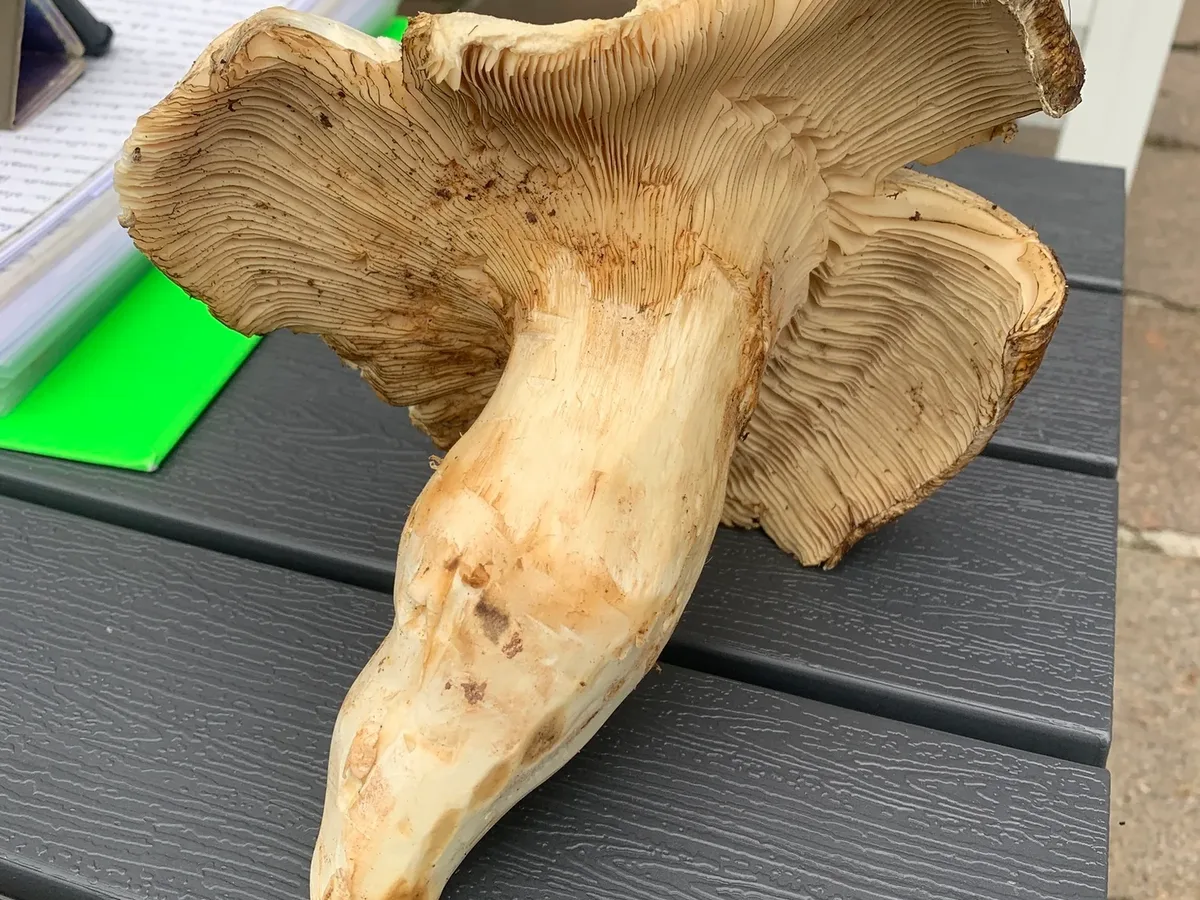 © Manuela Fiorini (CC BY)
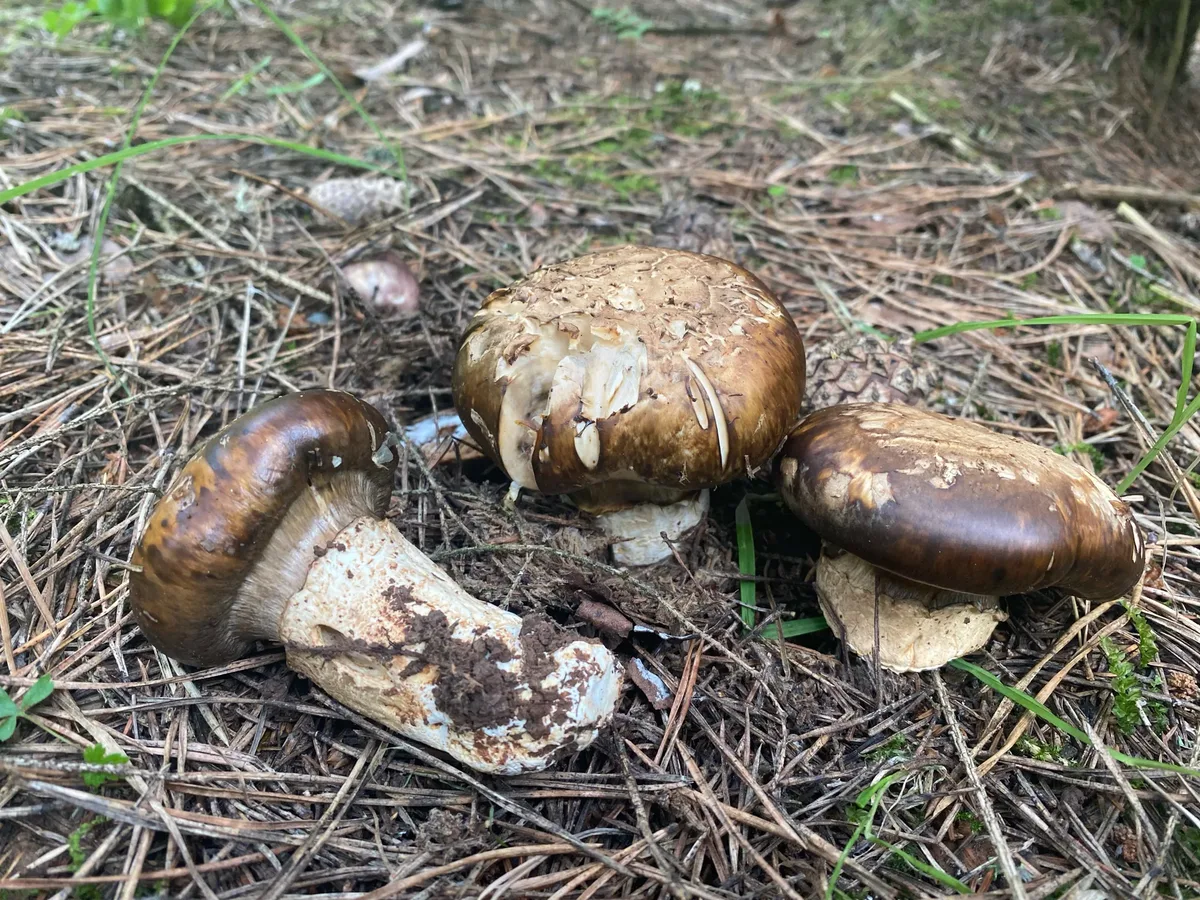 © Ирина Хохрякова (CC BY)
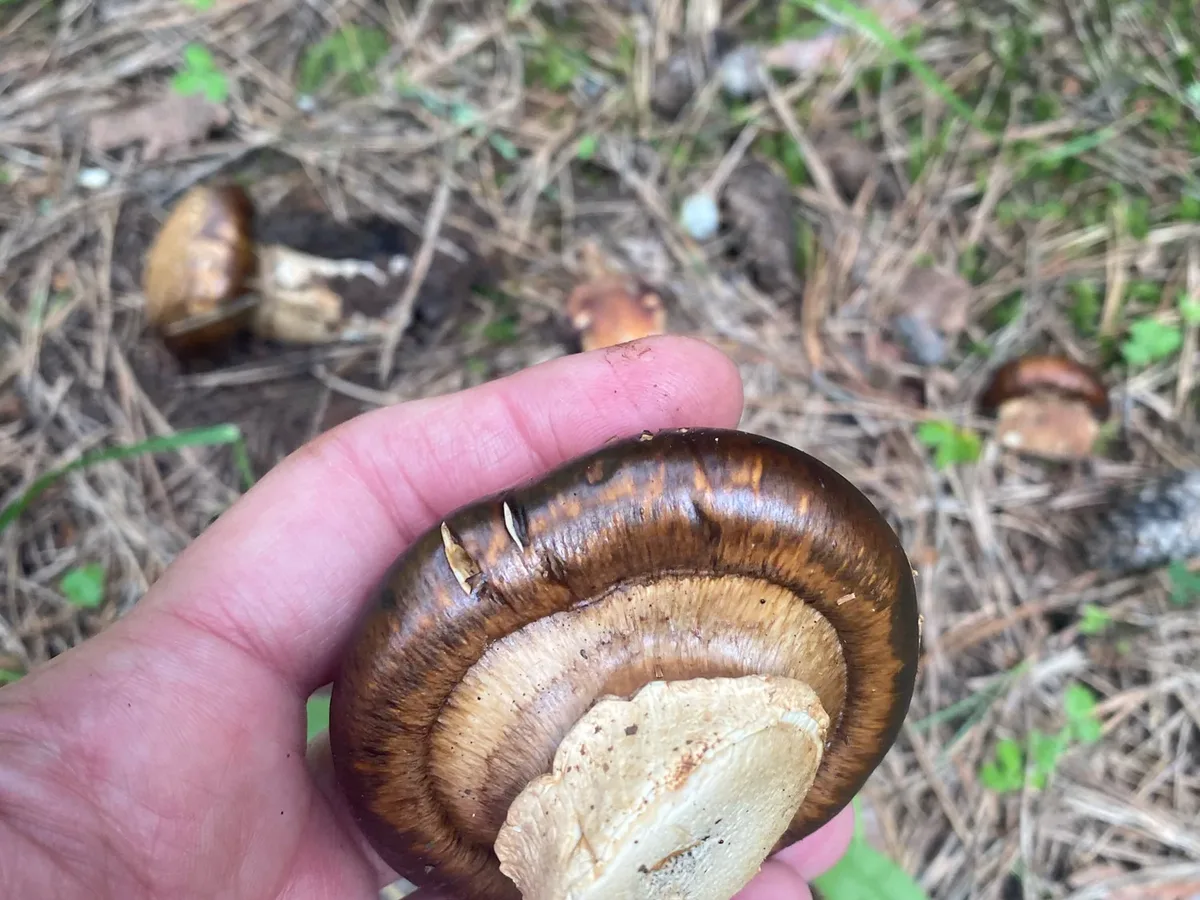 © Ирина Хохрякова (CC BY)
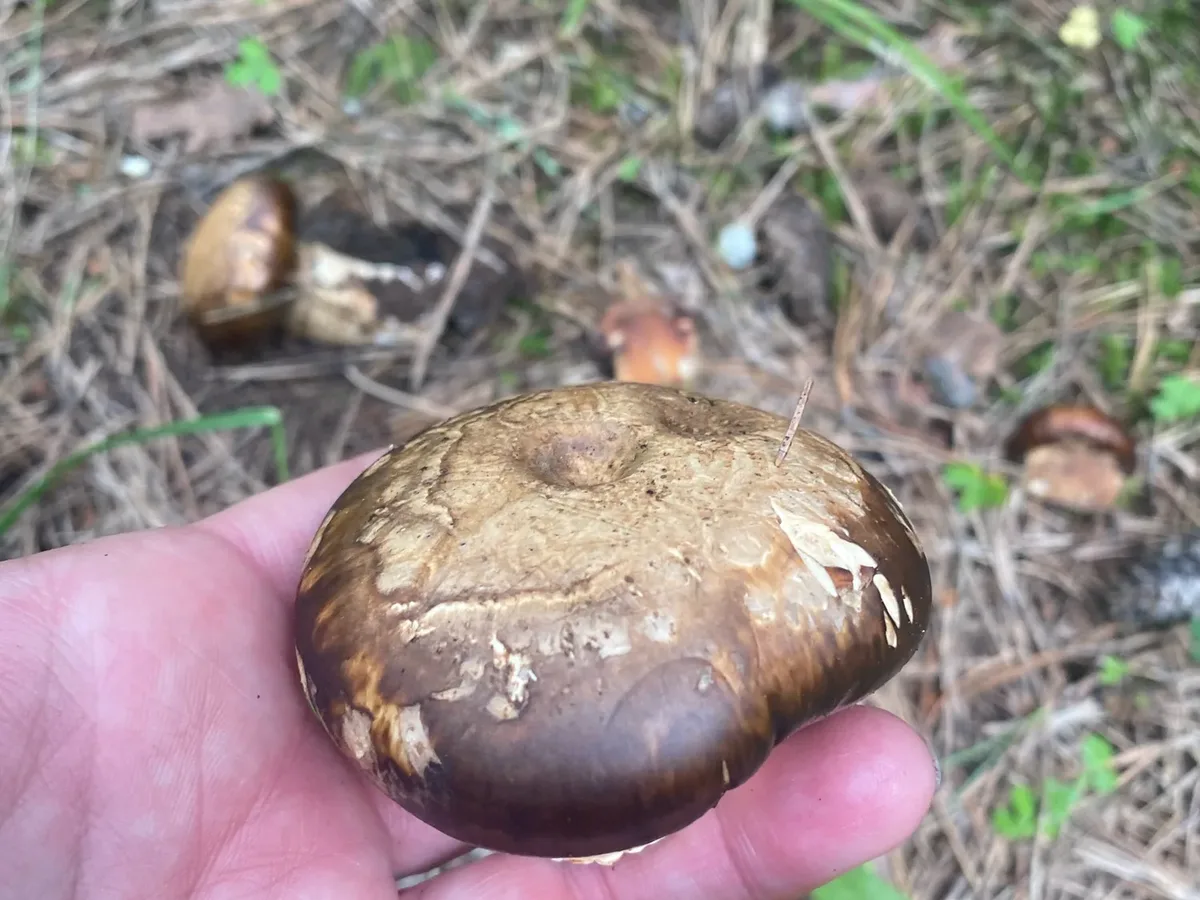 © Ирина Хохрякова (CC BY)
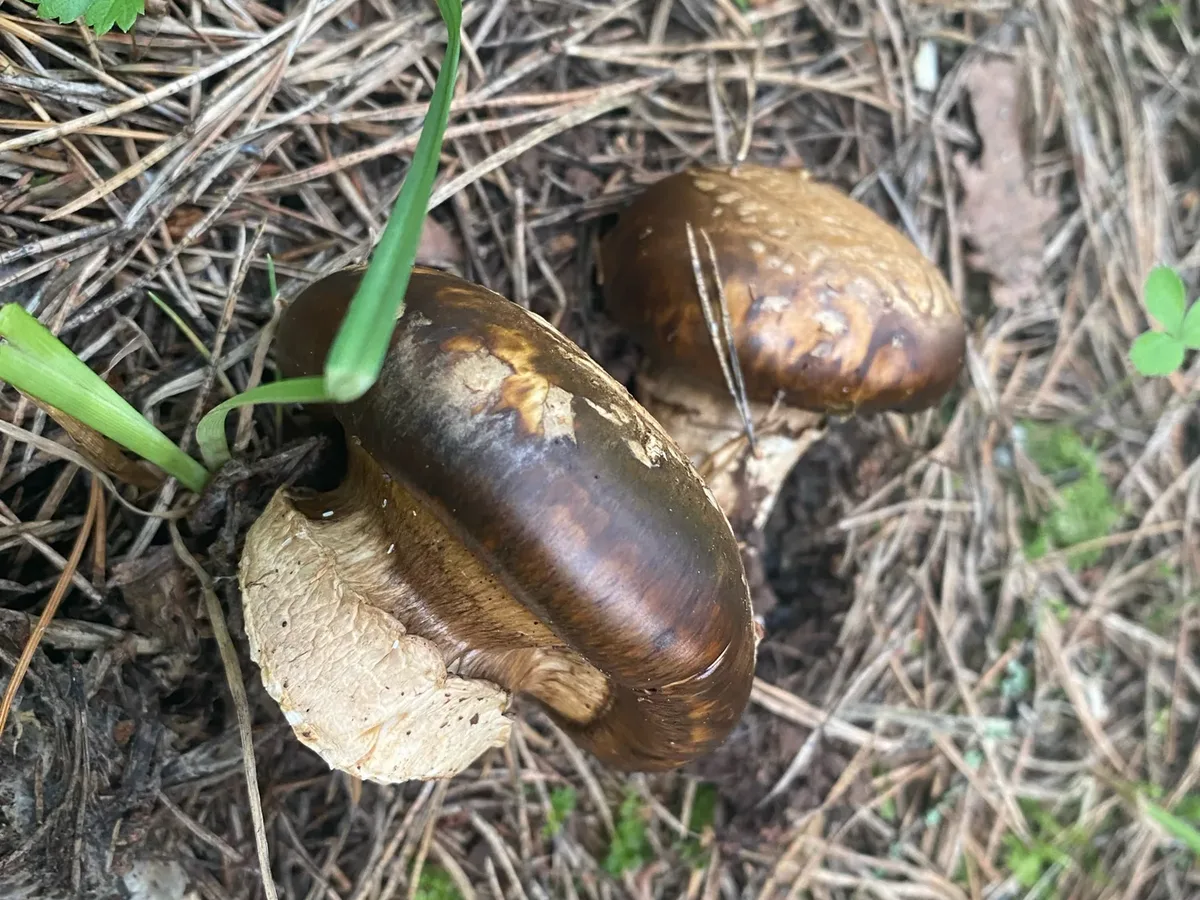 © Ирина Хохрякова (CC BY)
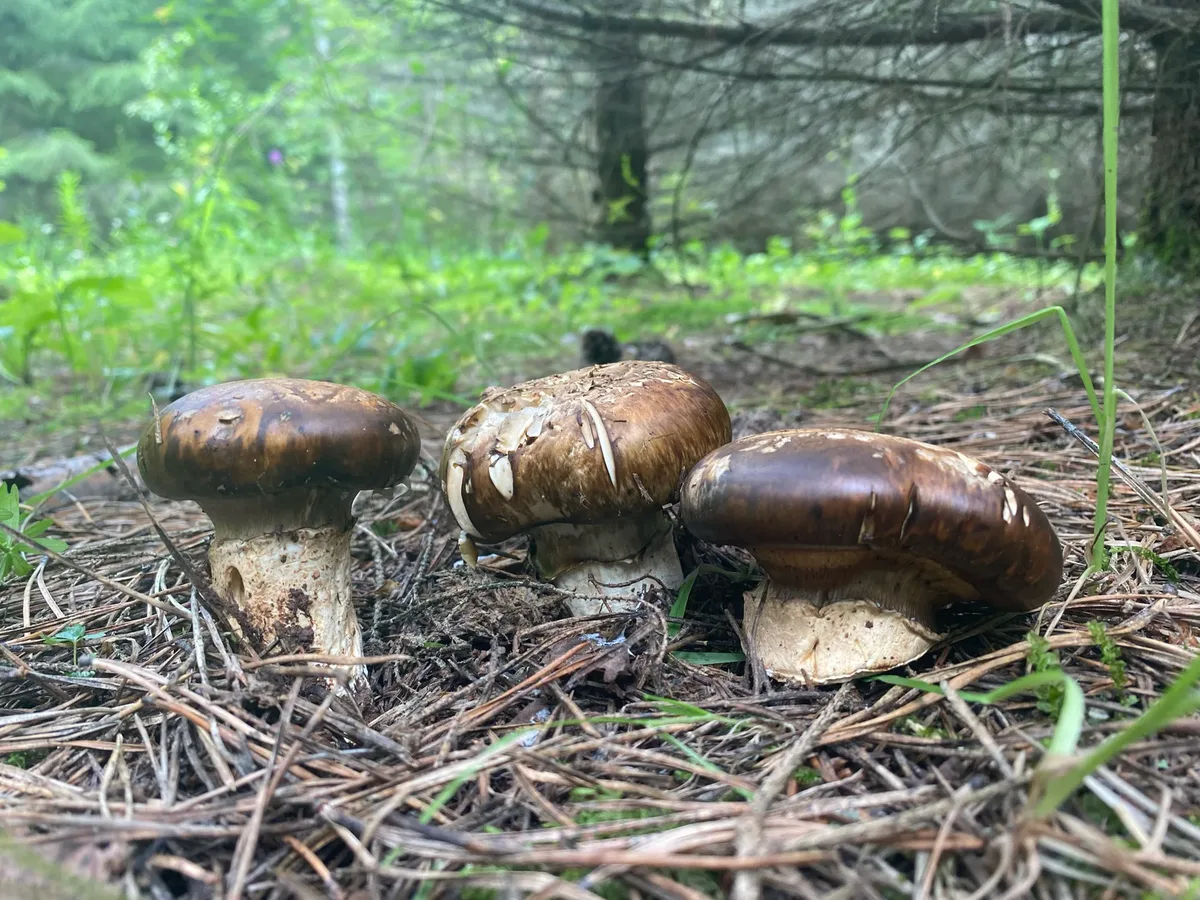 © Ирина Хохрякова (CC BY)
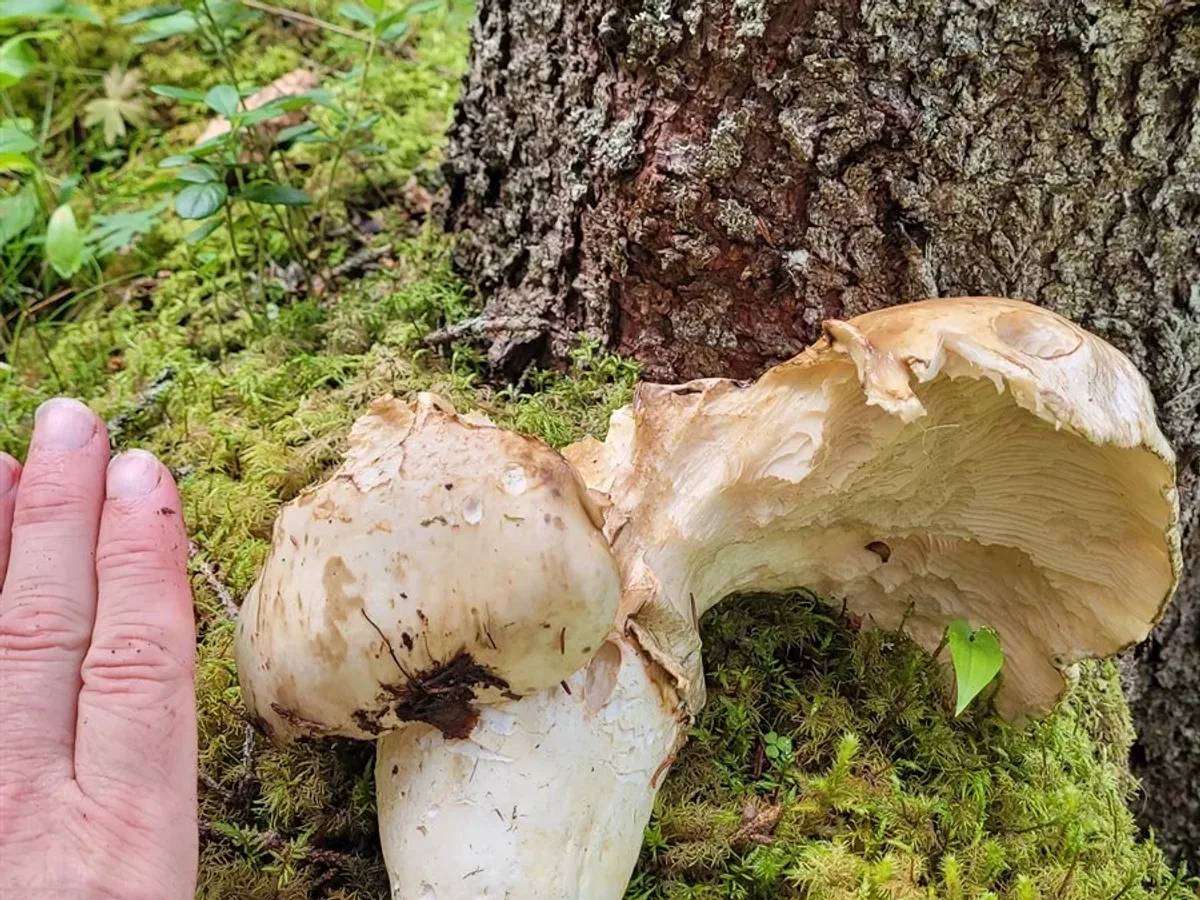 © Terje Bjerkan (CC BY)
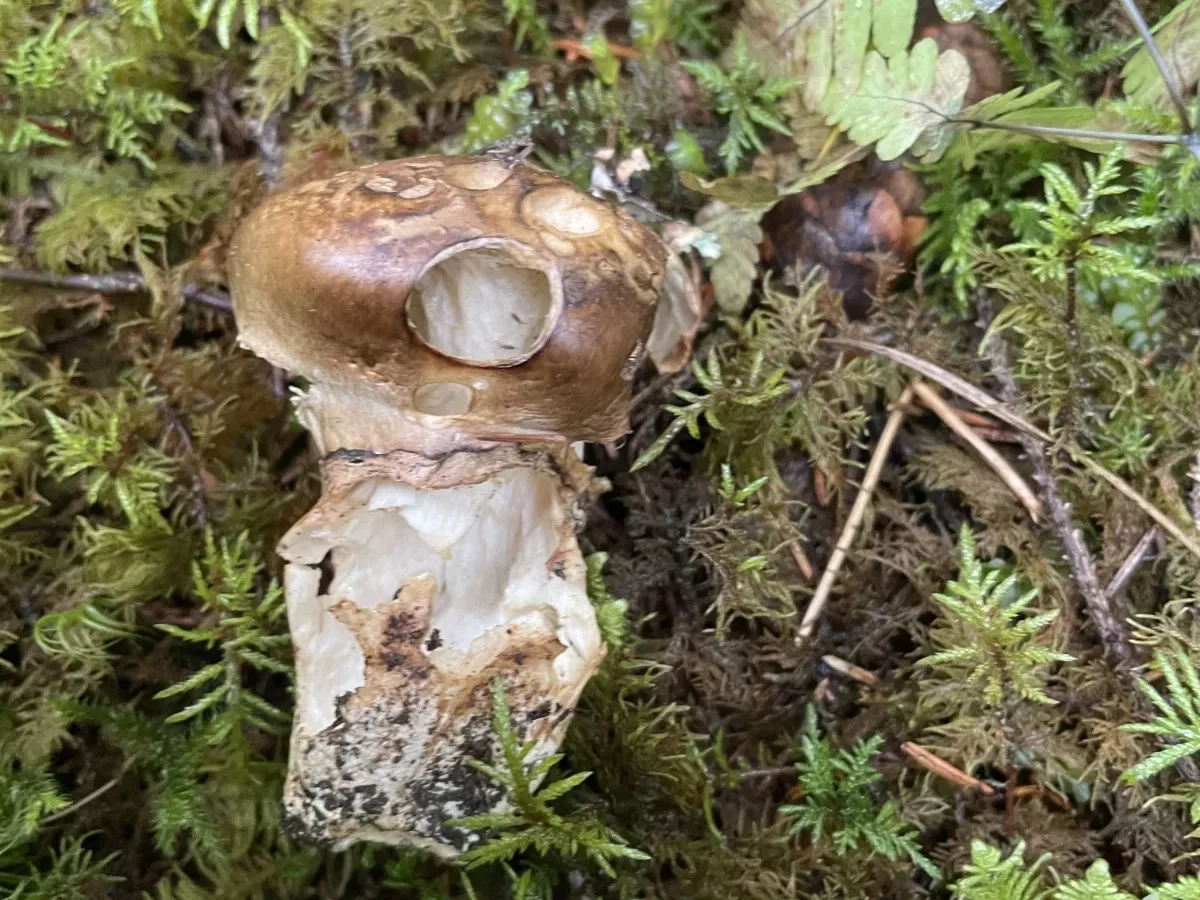 © Marte Kristoffersen (CC BY)
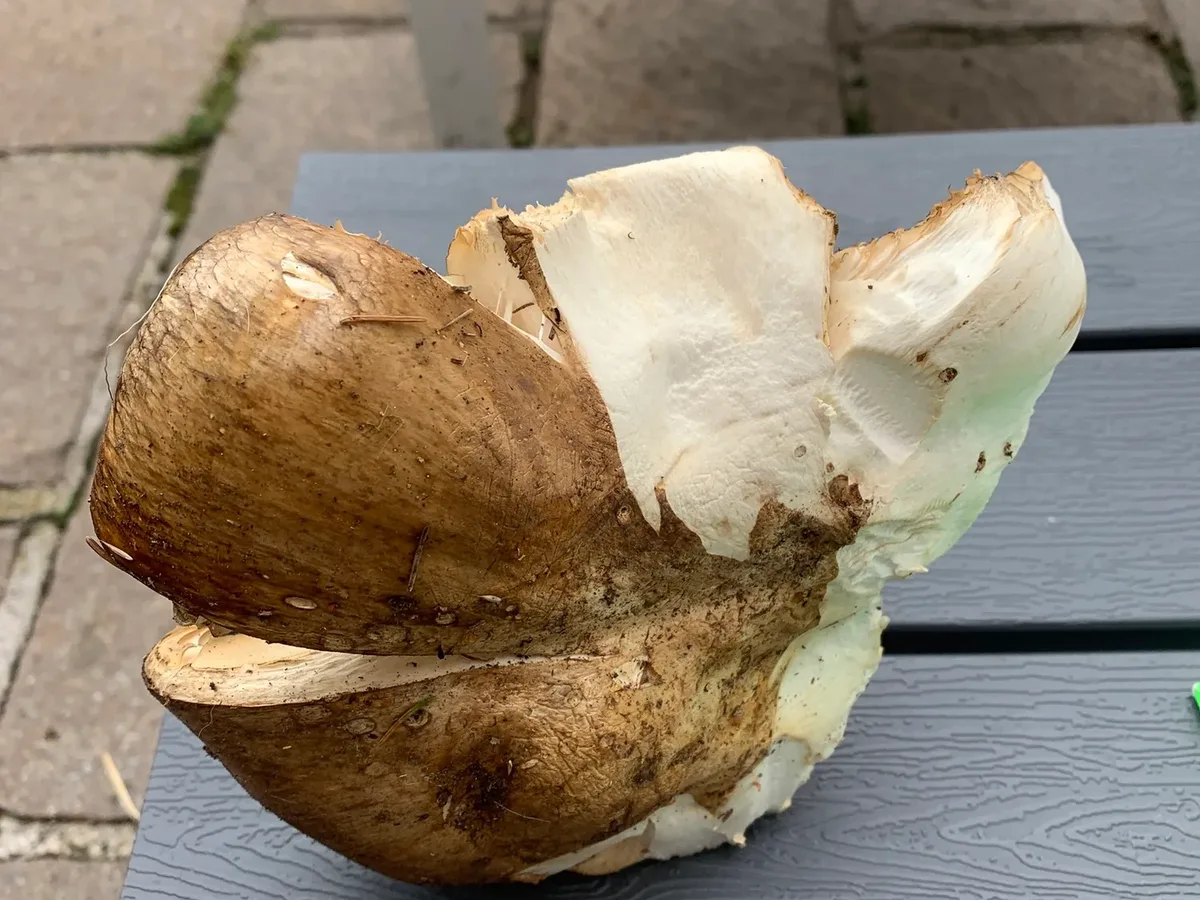 © Manuela Fiorini (CC BY)© Manuela Fiorini (CC BY)© Ирина Хохрякова (CC BY)
Good to eat, once you have identified it with certainty and cooked it through.
How to recognise it
Catathelasma imperiale announces itself by sheer scale: the cap can reach 30 cm or more across, making it one of the most massive gilled mushrooms a forager is ever likely to encounter in a temperate conifer forest.
Cap
Young fruit bodies are almost spherical or broadly domed, extremely firm, and pale greyish-brown to buff; at this stage the inrolled margin and thick veil wrap the gills completely.
As it expands the cap broadens to flat or faintly depressed, the margin straightens, and the characteristic ribbing near the cap edge appears.
The surface is dry in settled weather but turns distinctly viscid (slippery, almost glutinous) when wet - a useful recognition point.
Gills
The gills run noticeably down the stem (decurrent), are crowded and narrow, and stay white to cream.
Stem
The stem is the most diagnostic structure: deeply buried, rooting, stout, and carrying a double ring - two distinct rings at different heights, the upper one membranous and flaring, the lower one thicker and cottony - a feature unique to the genus Catathelasma among gilled mushrooms.
Flesh
The flesh is extraordinarily dense and thick, white, firm as a potato and slow to break down. Cut it: it stays white and does not change colour.
Smell & taste
The smell is unmistakably mealy, like fresh flour or damp wheat.
This combination - massive size, viscid buff cap, decurrent crowded white gills, deeply rooting stout stem with a double ring, mealy smell, and white non-changing flesh - identifies the species reliably.
Where & when it grows
Habitat
An upland forest specialist that forms mycorrhizal partnerships (underground root-tip fusions) with conifers, particularly spruces (Picea) and silver firs (Abies), in cool, moist subalpine conifer forests.
In East Asia it is most commonly found in the mountain forests of Japan (especially central and northern Honshu), and in the high-altitude conifer forests of Sichuan, Yunnan, Guizhou, Gansu, and Qinghai in China, and in similar montane habitats in Korea.
It favours elevations from roughly 1 500 to 3 000 m, where cool temperatures, deep humus, and reliable summer rainfall create ideal conditions for fruiting.
Outside Asia it also grows in the alpine zones of the European Alps and Apennines and in montane western North America.
Because it is deeply mycorrhizal, it cannot be cultivated; each fruit body is an extension of an underground fungal network that has been trading sugars with living conifer roots, sometimes for decades.
When
Catathelasma imperiale is a late-summer to early-autumn mushroom across its range.
In East Asian mountains, expect it from late July through September, with a peak in August and early September when subalpine soils have absorbed summer monsoon rains but the first autumn coolness is setting in.
At higher elevations or in late years fruiting can extend into October. In European Alpine locations the window is broadly August to October.
The trigger is sustained rainfall onto cool mountain soils: a week or more of rain after the heat of mid-summer cools the upper soil horizon is the classic prompt for fruiting.
Because it grows at altitude, seasons vary by year and elevation more than lower-altitude species, and a productive spot in one summer may yield nothing in a drought year.
How it grows
Grows singly or in small scattered groups, never in tight dense clusters.
Each fruit body is deeply anchored: the rooting stem base may extend 10-20 cm or more into the mineral soil or humus layer, making the stem appear shorter than it truly is when the fruit body is pulled free.
To appreciate the full size of a large specimen, dig gently around the base rather than pulling from above - the true rooting depth is impressive.
Productive sites recur near the same trees year after year when conditions allow, reflecting the persistent underground mycorrhizal network.
In Japan and China, knowledgeable mountain foragers keep the locations of Catathelasma imperiale spots as carefully guarded seasonal knowledge.
Fruiting conditions
Subalpine mycorrhizal fruiter requiring sustained summer rainfall onto cool mountain soils (8-16 °C soil temperature). Flush lag of 7-16 days after significant rain. Drought years at altitude can suppress fruiting entirely; optimal years follow wet summers that keep subalpine soils moist into late August.
Look-alikes
The main risks of confusion in East Asian and European conifer forests are with large, pale Tricholoma species (particularly T. magnivelare / matsutake and its relatives) and with certain large Amanita.
The double ring is the decisive separation from all look-alikes: no Tricholoma, Amanita (in the cap-matching size range), or other large pale conifer-forest mushroom has two distinct rings at different heights on the stem.
- Matsutake (Tricholoma matsutake) is the most realistic lookalike in East Asian forests: it has a fibrillose-scaly cap surface, a single ring, gills that become tan-brown with age, and a famously pungent spice-and-cinnamon odour - quite unlike the mealy smell of C. imperiale.
- Large Armillaria species (honey mushrooms) cluster densely at tree bases and have a single ring, often yellowing gills, and a fruity-sour smell.
- Amanita species have a volva (sac) at the base (absent in Catathelasma), and their ring is typically singular and non-double.
Although no deadly species is a realistic close mimic, any uncertainty should be resolved by positively confirming the double ring.
Large pale Amanita such as Amanita muscaria (white/pale variants) or Amanita pantherina could superficially suggest Catathelasma at a glance, but all Amanita have a sac-like volva at the base (entirely absent in Catathelasma), free gills (not decurrent), and only a single ring. Deadly Amanita (death cap, destroying angels) are smaller than a mature C. imperiale, have white gills that are free rather than decurrent, a singular ring, and the diagnostic buried volva. The rooting-stout-stemmed habit, double ring, and decurrent gills of C. imperiale are absent in all Amanita. Always excavate the base and check for a volva when in any doubt.
A close relative in the same genus, also with a double ring and similar conifer-forest habitat. C. ventricosum is typically whiter, with a white to pale grey cap (not warm buff-brown), a more obviously inflated (ventricose) stem base, and slightly smaller spores. Both are edible and not toxicologically distinct. Where the two species co-occur (mainly in western North America and to a lesser extent Europe) they are best separated by the cap colour: C. imperiale is distinctly buff-brown to tan, C. ventricosum is paler grey-white. The distinction is mainly taxonomic and both may be eaten.
Armillaria species grow at or near tree bases in dense clusters (not singly), have a single ring (not double), often have small scales on the cap, gills that may develop yellow-brown tones, and a somewhat fruity-sour smell quite unlike the mealy odour of Catathelasma. The dense clustering habit and single ring rule out Catathelasma in any case where several fruit bodies arise from the same base or from nearby root systems. Some Armillaria species cause mild gastrointestinal upset when under-cooked; thorough cooking is always recommended.
The most realistic confusion in East Asian subalpine conifer forest, where both species grow under similar trees. Matsutake has a single ring (not double), a fibrillose-scaly cap with brownish-ochre radial scales on a whitish background, gills that stain brown where handled, and a powerful, unmistakable spice-and-cinnamon aroma. Catathelasma imperiale has a smooth to very finely fibrillose viscid pale grey-brown cap, two distinct rings at different heights on the stem, gills that stay white, and a mealy (flour-like) smell. The double ring is the single most reliable separator.
In the kitchen
Picking & cleaning
Select firm, freshly expanded specimens where the cap has opened fully but gills remain white and dry.
Excavate the stem base with a knife rather than pulling, both to confirm the rooting habit and the double ring, and to avoid leaving broken fragments in the soil.
Because the fruit body is very firm and dense, it keeps well in a cool basket without bruising.
The double ring and deeply rooting stout stem are the crucial confirmatory details; examine them before eating any specimen.
Wipe the cap clean of debris; the viscid cap surface picks up pine needles and soil.
The flesh is thick enough to slice cleanly for drying.
Cooking
In Japan, Catathelasma imperiale (oots-ue-take, 'big staff mushroom') is prepared in ways that complement its mealy, floury flavour and firm, almost potato-like texture:
- Simmering in dashi broth
- Adding to nabemono hot pots
- Grilling with soy and sake
In China and Korea it appears in stir-fries and mushroom soups.
The very firm flesh can withstand long cooking without turning mushy, making it excellent for slow-simmered dishes.
Blanching in salted water for five minutes before the main cook reduces the strong mealy flavour for those who find it overwhelming, and the cooking water is discarded.
It dries well and the dried slices can be reconstituted for winter soups.
The flesh absorbs aromatic broths beautifully, and a piece of grilled C. imperiale brushed with soy and butter is a deeply satisfying mountain-forest flavour experience.
Good to know
Catathelasma imperiale is an established edible mushroom with no documented toxicity and a long tradition of consumption in Japan, China, and Korea, and by European mountain foragers. No credible reports of poisoning attributable to correctly identified C. imperiale are known.
The mealy flavour is strongly developed and may be reduced by blanching or parboiling. Due to its firm, dense texture it requires thorough cooking; eating it raw is not recommended.
Individuals with sensitivity to mealy-flavoured fungi (a category that includes Clitopilus prunulus and similar species) may find large quantities unpleasant. As with any wild mushroom, eat a modest amount for the first time to assess personal tolerance.
The only realistic safety concern is misidentification, which is mitigated by confirming the double ring on a firmly fleshed, deeply-rooting, mealy-smelling, white-gilled specimen found under subalpine conifers.
A reference guide - never an edibility guarantee. When in doubt, leave it out.