Yunnan chanterelle
Cantharellus yunnanensis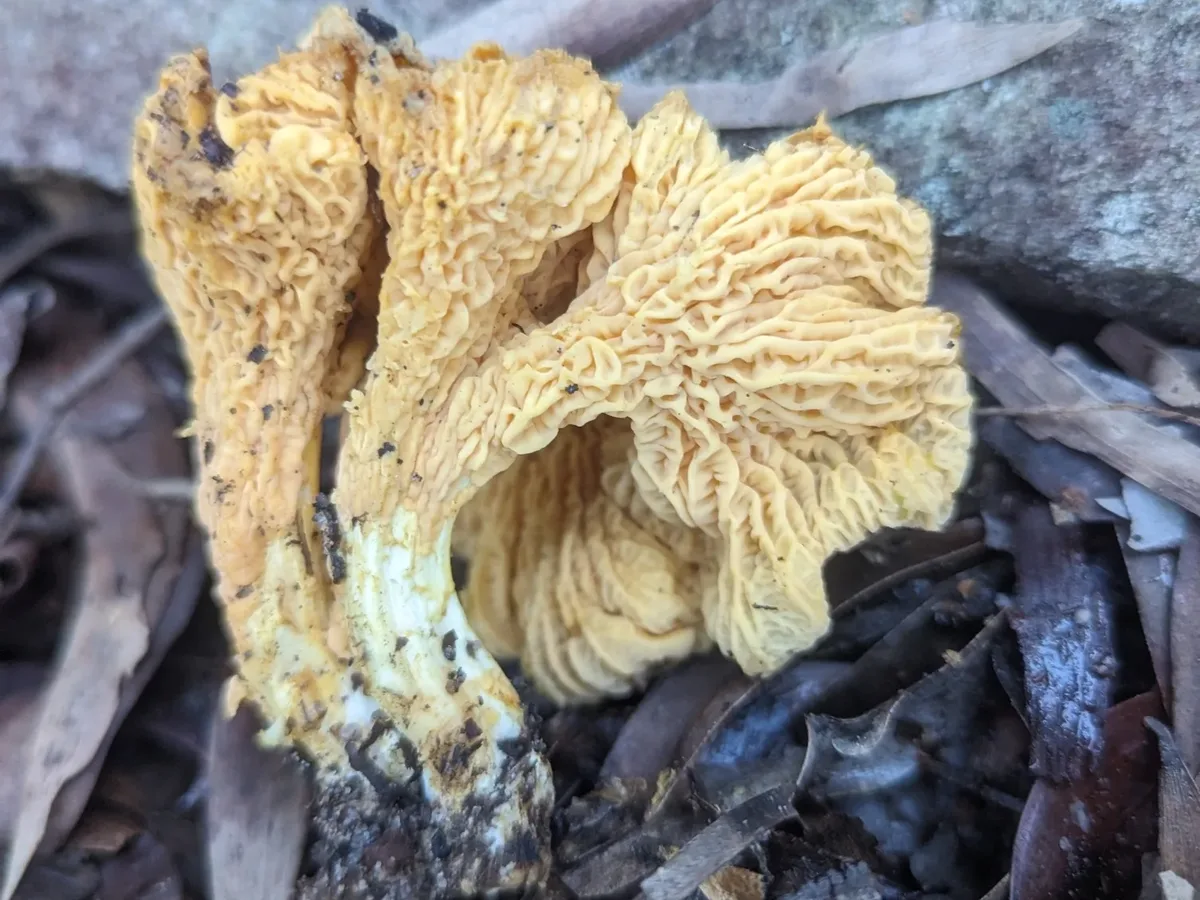 Atlas of Living Australia (CC0)
 Atlas of Living Australia (CC0)
 Atlas of Living Australia (CC0)Atlas of Living Australia (CC0)Atlas of Living Australia (CC0)
One of the best mushrooms you can bring home - once you are certain of the identification.
How to recognise it
Cantharellus yunnanensis is the dominant golden chanterelle of Yunnan and one of the most important commercial edible mushrooms in all of China, where it is traded by the tonne each season through markets in Kunming and throughout the province.
It has the classic chanterelle gestalt.
Cap
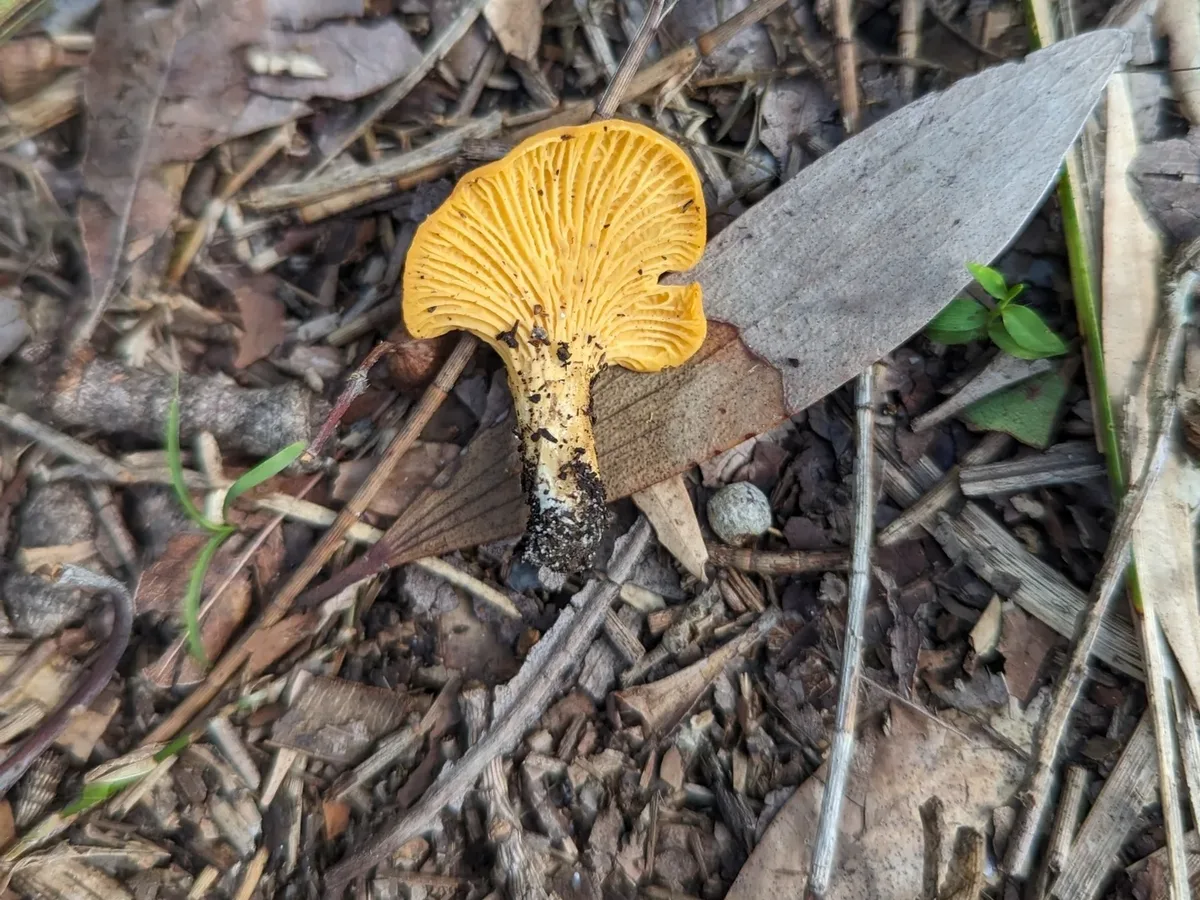
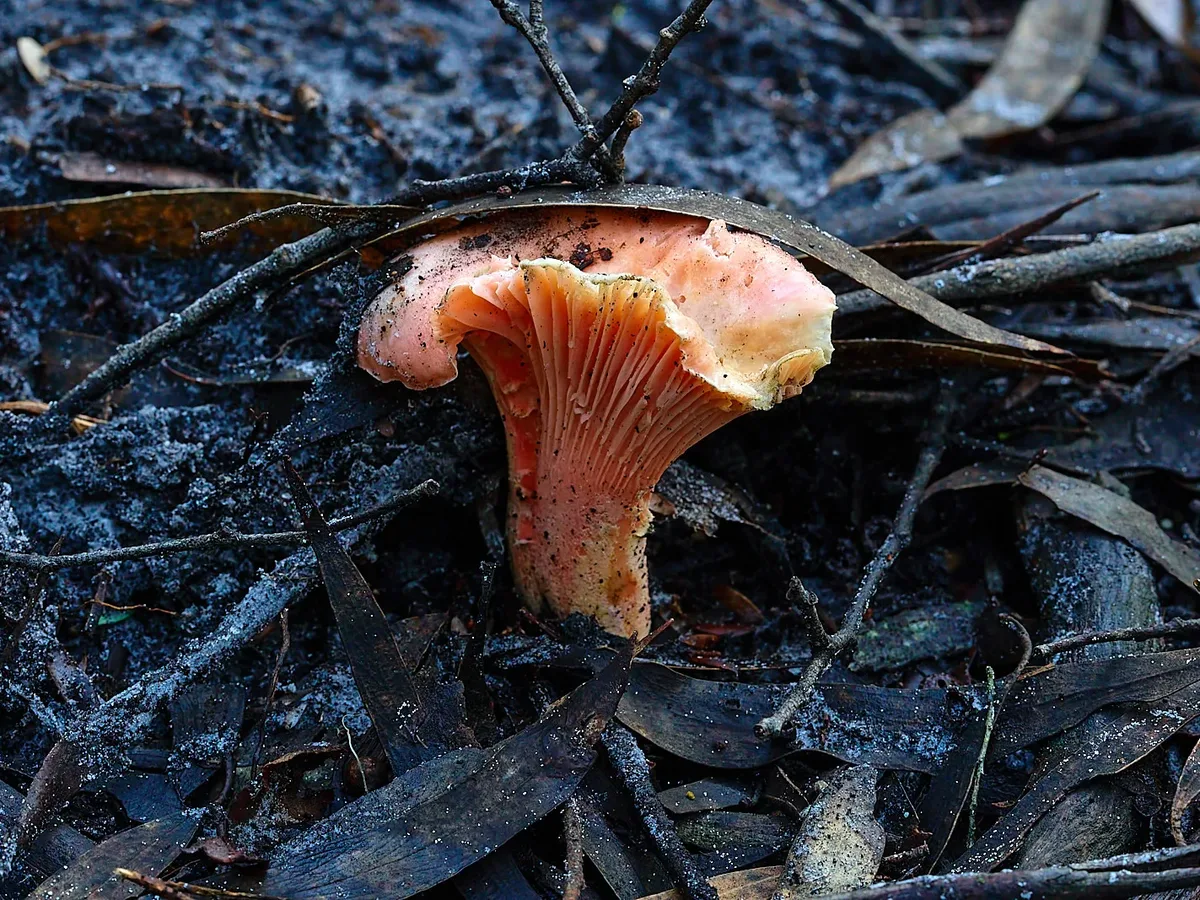
A smooth, convex-to-funnel-shaped cap in shades of bright golden-yellow to orange-yellow, measuring 3-10 cm across, with an incurved and wavy margin.
Gills / Pores
The defining and critically safety-relevant feature is the hymenium on the underside: rather than true blade-like gills, the cap underside bears blunt, rounded, repeatedly forking folds - called false gills or ridges - that run (decurrent) well down the stem.
These ridges are rubbery-firm, never fragile, and feel distinctly different from the thin, sharp, crowded gills of dangerous lookalikes. The colour of the ridges closely matches the cap surface.
Stem
The stem is solid, dry, and the same yellow as the cap.
Flesh
The flesh is white to pale yellowish and firm, not exuding any milky latex. The spore print is pale cream to whitish.
Smell & taste
When the flesh is broken, it releases a distinctive and pleasant fruity-apricot aroma - one of the most useful identification cues in the field.
Where & when it grows
Habitat
This species is ectomycorrhizal - it lives in a root-partnership with specific host trees, quietly threading the soil as mycelium before any fruitbody appears above ground.
That partnership also means it cannot be farmed on artificial substrates, so every specimen on a Yunnan market was wild-harvested.
The preferred habitat is montane and subalpine mixed forest on the Yunnan Plateau and surrounding mountain ranges at 1 500-3 500 m elevation, where Yunnan pine (Pinus yunnanensis), Armand's pine (Pinus armandii), and various oaks (Quercus spp.), chinkapins (Castanopsis), and stone oaks (Lithocarpus) form the canopy.
The species is particularly associated with well-drained, slightly acidic, iron-rich red soils typical of Yunnan.
It extends into similar montane forest ecosystems in northern Myanmar, Laos, Vietnam, and northeastern India wherever equivalent host trees and monsoon rainfall occur.
Because the mycorrhizal bond is deep and long-lived, the species returns reliably to the same ground year after year - which is why experienced local harvesters guard their productive patches carefully.
When
Cantharellus yunnanensis is intimately tied to the East Asian summer monsoon.
Fruiting typically commences in late June or early July when the monsoon rains reach Yunnan and elevate soil moisture, coinciding with soil temperatures in the range of 12-20 °C at depth.
The season peaks through July and August - the heart of the monsoon period - when consecutive wet days and warm overnight temperatures allow prolific flushes. Fruiting continues into September and sometimes October as the monsoon retreats.
Collectors working the same patches will observe multiple distinct flush events across the season, each triggered by a major rainfall event followed by a lag of several days before fruitbodies emerge.
Prolonged dry spells halt production entirely. Higher-elevation populations may fruit slightly later than lower-elevation ones, extending the overall seasonal window.
How it grows
Grows singly, scattered, or in loose non-clustered groups directly on forest soil - never from wood and never in tight clusters at tree bases.
Fruitbodies develop slowly and steadily over several days to a week once initiated.
This unhurried pace is part of what makes chanterelles so prized by professional harvesters: a productive patch can be revisited across multiple forays as new fruitbodies emerge, and specimens already grown hold their quality well rather than rotting overnight.
Because of the mycorrhizal bond, the same sites produce year after year under consistent forest conditions. Habitat degradation or tree removal permanently ends production in a given patch.
Fruiting conditions
Fruiting is driven by the East Asian summer monsoon. The threshold of approximately 30 mm rain over the preceding 14 days, combined with soil temperatures of 12-22 °C at 10 cm depth (characteristic of the Yunnan plateau in summer), reliably triggers flushes. The flush lag of 4-9 days reflects the moderately slow development of chanterelle fruitbodies. Drought or late monsoon onset delays the season; an early monsoon arrival in June accelerates it. Cool nights above 3 000 m elevation keep soil temperatures in the ideal range well into September, extending the season at altitude.
Look-alikes
The most dangerous realistic confusion in East Asian forests is with the jack-o'-lantern mushroom Omphalotus japonicus (syn. Lampteromyces japonicus), which is native to East Asia, can appear somewhat chanterelle-coloured, and causes severe gastrointestinal poisoning that is not typically lethal to healthy adults but can be very serious.
Omphalotus japonicus differs fundamentally in several ways:
- bearing true, sharp, blade-like gills rather than blunt chanterelle ridges
- growing in dense clusters at the base of dead or dying broadleaf trees or from buried wood
- having a more distinctly orange to orange-red overall colouration
Importantly, it may exhibit faint orange bioluminescence in total darkness - a dramatic difference from any Cantharellus.
A second significant risk is Hygrophoropsis aurantiaca (false chanterelle), which has deep, crowded, thin, repeatedly forking true gills, a more downy-fibrillose cap surface, and a more uniformly vivid orange colouring throughout; it causes gastrointestinal distress.
Within the Cantharellus yunnanensis complex itself, closely related species such as Cantharellus cibarius sensu lato and other regional species in the C. cibarius aggregate are all edible, so any confusion among chanterelle species themselves carries no safety consequence.
Several other Cantharellus species occur across East and Southeast Asia (including Cantharellus minor-like small forms and others in the C. cibarius aggregate). All are characterised by the same blunt forking ridges and fruity odour. Confusion among Cantharellus species carries no safety consequence; all known species in the genus are edible or at worst mildly indigestible for some individuals.
Omphalotus japonicus (also known as Lampteromyces japonicus) has true, sharp, thin, blade-like gills - never blunt ridges - and grows in dense, overlapping clusters at the base of dead or dying broadleaf trees or from buried root wood. Its overall colour tends toward vivid orange to orange-red, often darker at the centre. It causes severe gastrointestinal poisoning (intense cramping, vomiting, diarrhoea) and is considered the primary dangerous lookalike for chanterelles in East Asia. In darkness it may show faint orange bioluminescence. The clustered, wood-associated growth and true sharp gills are the decisive separation from Cantharellus yunnanensis.
Bears deeply crowded, thin, repeatedly forking true gills (not blunt ridges), a cap surface that is downy to almost velvety rather than smooth, and a more uniformly vivid orange colour throughout cap, gills, and stem. The stem is often slightly off-centre or curved. Lacks the fruity apricot odour of Cantharellus. Causes gastrointestinal distress and possibly neurological symptoms in some individuals. The downy cap texture and true gills are the key separation.
Cantharellus cibarius sensu stricto is the European golden chanterelle - also a choice edible. Both species belong to the broader Cantharellus cibarius aggregate and are virtually identical in the field. Any confusion between them carries no safety consequence, as all members of this complex are edible. Morphological separation is subtle and largely academic.
In the kitchen
Picking & cleaning
- Harvest by gently twisting and lifting the whole fruitbody clear of the soil, or cut near the base with a clean knife to leave the mycelium undisturbed.
- Transport in a basket or breathable cloth bag - never in sealed plastic bags, which cause sweating and rapid deterioration.
- In the Yunnan markets, chanterelles are typically sold unwashed and lightly dusted, which is ideal: clean in the field with a dry brush or dry cloth rather than washing.
- Refrigerate loosely wrapped in paper for up to 4-5 days.
Collect only specimens you can positively identify, and double-check every specimen for blunt ridges (not true gills) before placing it in your basket.
Cooking
Cantharellus yunnanensis has a richly flavourful, fruity, slightly peppery taste with a firm, meaty texture that holds up superbly to heat.
It is central to Yunnan cuisine, where it appears in dry-fried preparations, stir-fries with garlic and chilli, hearty soups, and as a component in the famous Yunnan mixian (rice noodle) broths.
The best Western preparation is to sauté in a wide, hot pan with butter or neutral oil over medium-high heat without crowding - allowing the fruitbodies to first release their moisture, then continuing to cook until that liquid evaporates and the ridges develop a light golden colour. Season with salt toward the end of cooking.
Excellent in pasta, risotto, egg dishes, and cream sauces; the apricot-fruity aroma pairs beautifully with thyme, garlic, shallots, and white wine.
Can be dried and stored: the flavour concentrates and becomes more intensely savoury, making dried Yunnan chanterelle a prized pantry ingredient.
Do not boil - this waterlogs the texture and dilutes the flavour.
Good to know
Cantharellus yunnanensis is a choice edible species with no known toxicity and a long history of safe consumption across Yunnan, Sichuan, and neighbouring regions.
The essential safety protocol for any chanterelle identification is the same worldwide:
- 1Confirm that the hymenium consists of blunt, rounded, forking ridge-like folds - NOT true knife-blade-sharp gills.
- 2Confirm a fruity, apricot-like odour.
- 3Confirm that the fruitbody grows singly or scattered on the ground, NOT in dense clusters at or near tree bases.
These three checks together reliably exclude Omphalotus japonicus and Hygrophoropsis aurantiaca.
If any specimen has true sharp gills, set it aside and do not eat it.
When consuming any wild mushroom for the first time, eat a small test portion and wait 24 hours before consuming more.
Pregnant individuals and children should exercise additional caution with novel wild foods.
A reference guide - never an edibility guarantee. When in doubt, leave it out.