Tabernacle chanterelle
Cantharellus tabernensis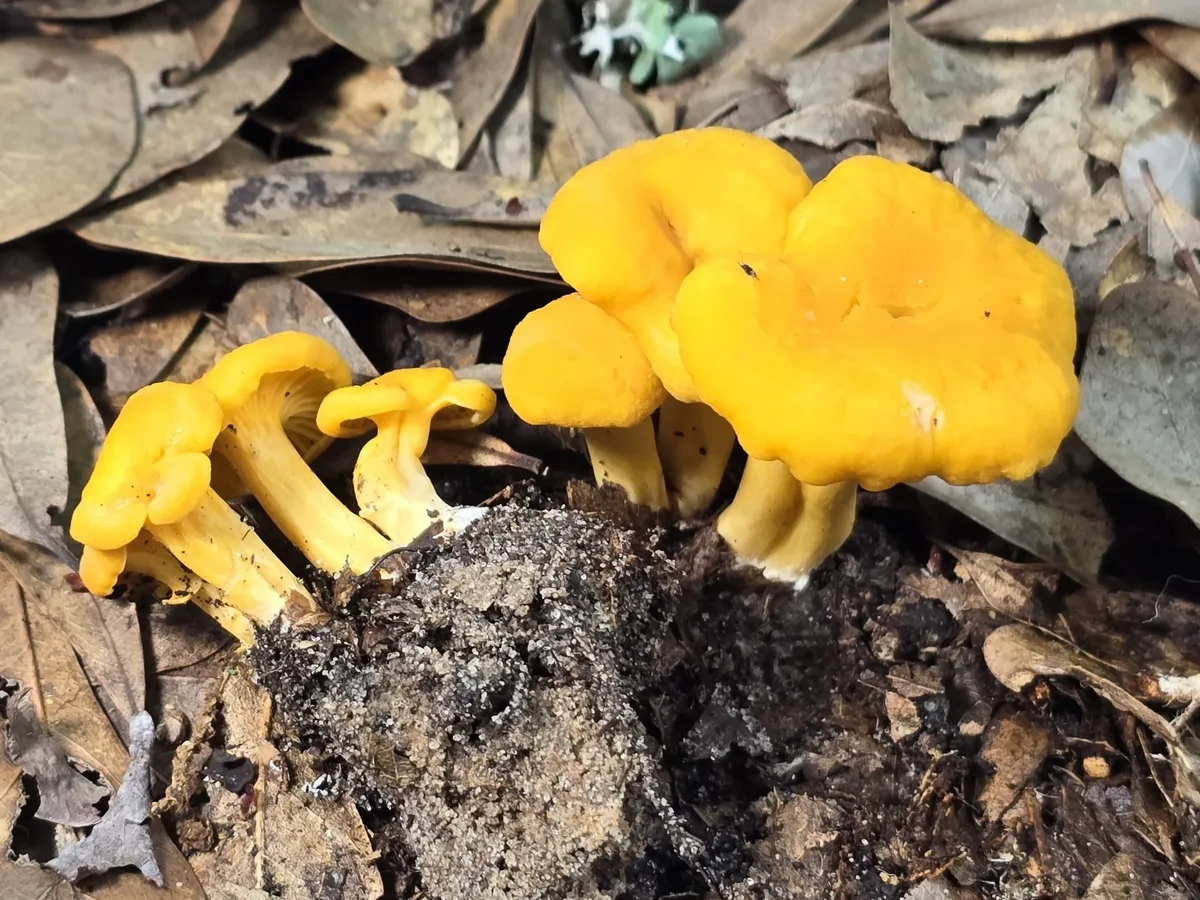 © Alan Rockefeller (CC BY 4.0)
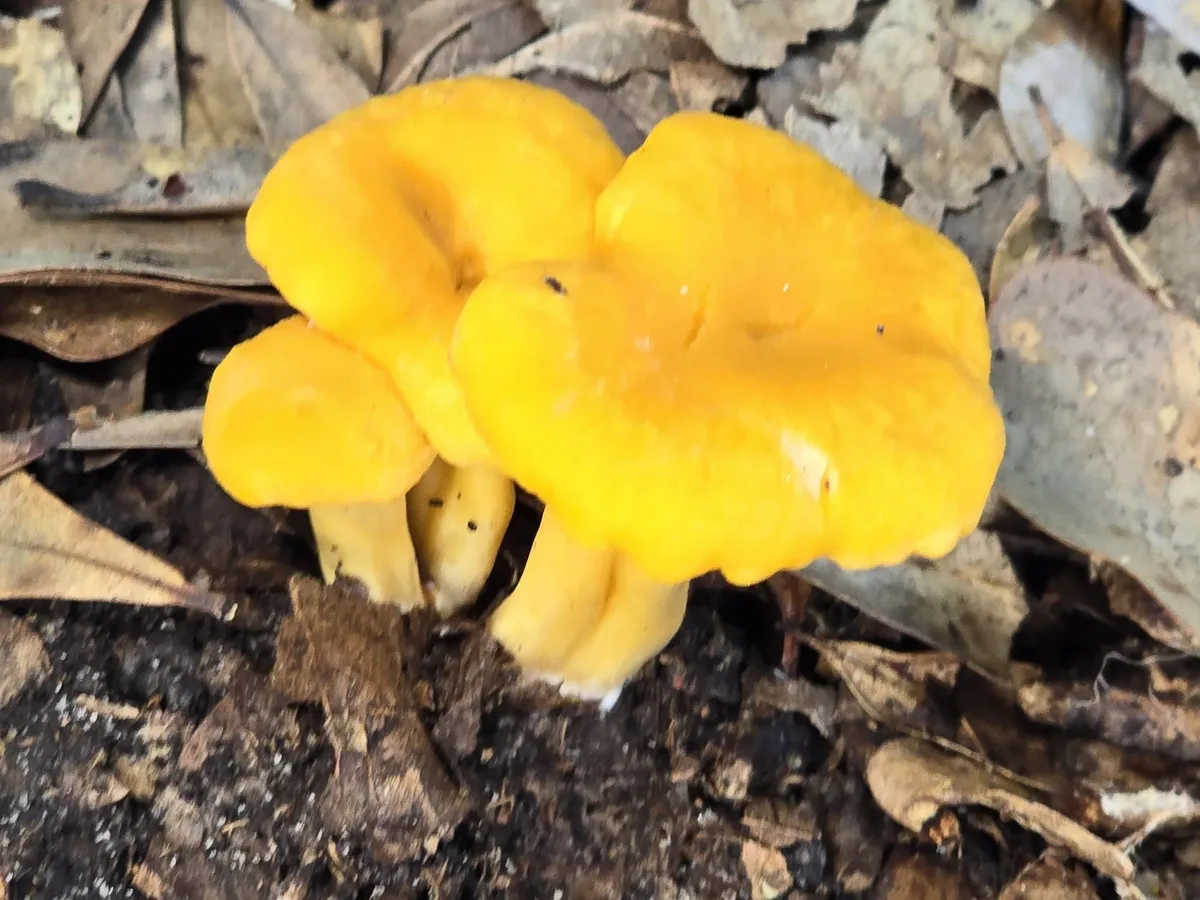 © Alan Rockefeller (CC BY 4.0)
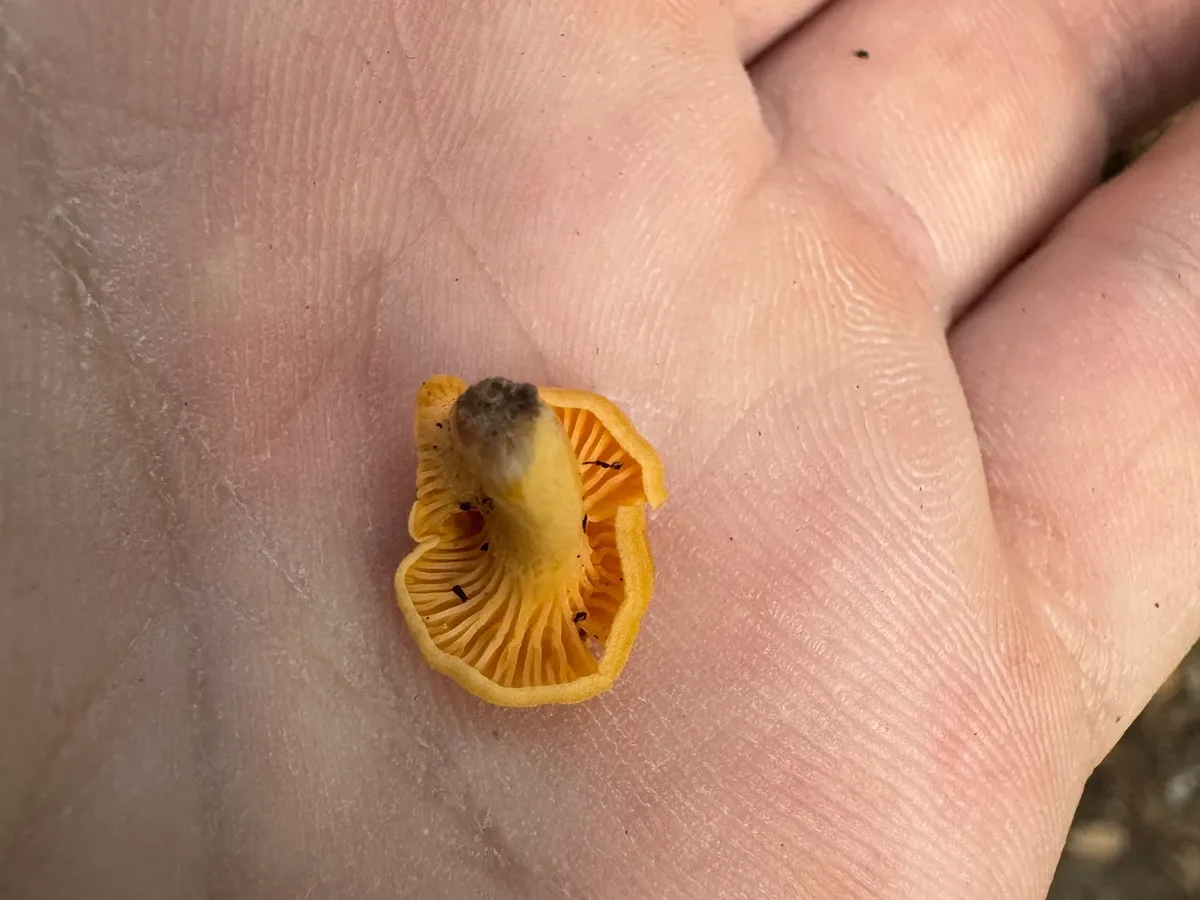 © Brandon Johnson (CC BY)
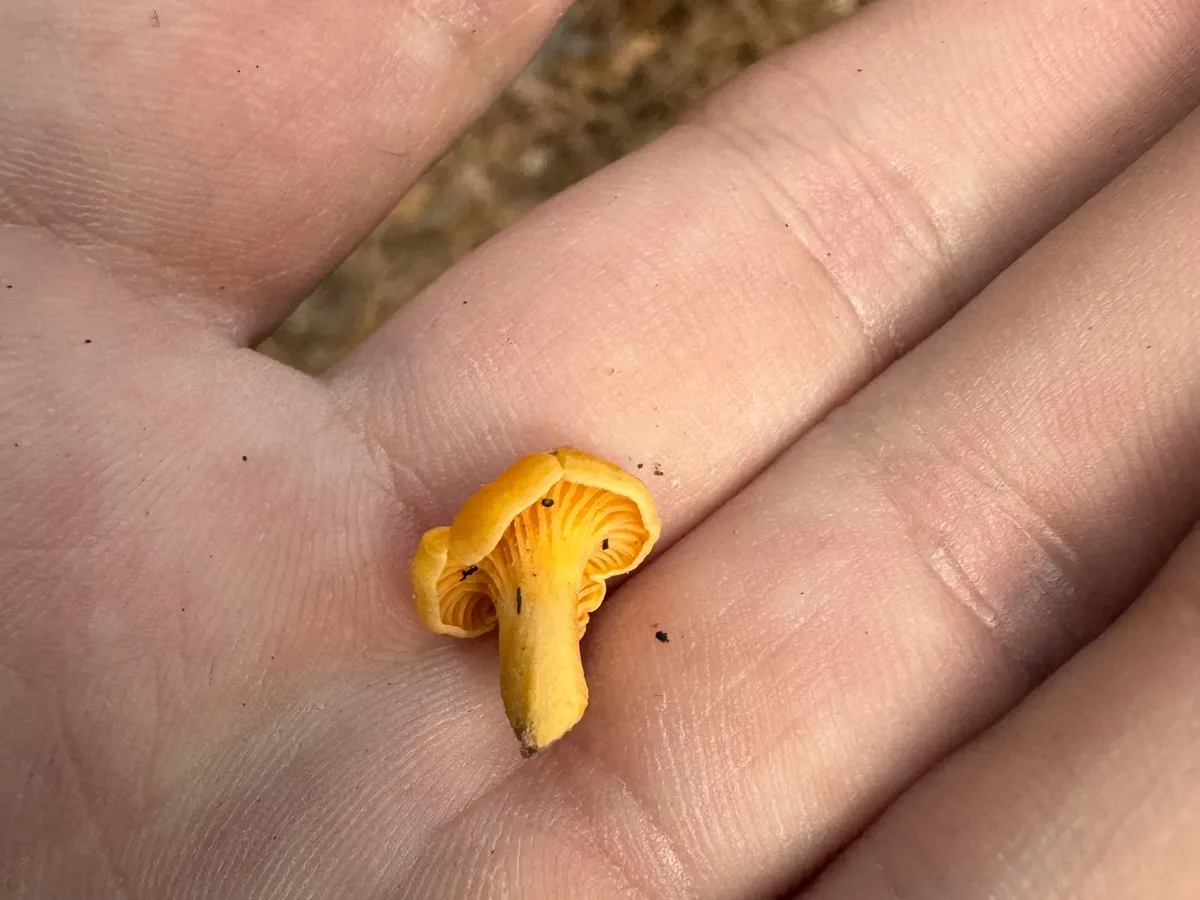 © Brandon Johnson (CC BY)© Alan Rockefeller (CC BY 4.0)© Alan Rockefeller (CC BY 4.0)
One of the best mushrooms you can bring home - once you are certain of the identification.
How to recognise it
Cantharellus tabernensis is a medium-sized chanterelle.
Cap
The cap is 3-8 cm across, starting convex and slowly opening into a broadly wavy, funnel-like shape with an irregularly lobed, undulating margin.
The color runs from pale lemon yellow through rich egg-yolk to yellow-orange - sometimes fading toward cream at the margin in dry spells.
Gills / Pores
The most important identification feature sits on the underside: instead of true sharp gills, the cap bears blunt, forking, decurrent ridges (often called false gills) that are the same color as the cap or slightly paler.
These ridges fork repeatedly and run down the stipe - a feature the dangerous lookalikes do not share.
The spore print is pale cream to pale yellowish-white - worth confirming if you have any doubt.
Flesh
Flesh is white to pale yellow, firm, and stays that color when cut.
Stem
The stipe is solid, roughly cylindrical to slightly tapered, pale yellow to whitish, 2-6 cm tall.
Smell & taste
The odor is pleasant and mild, faintly fruity or apricot-like, and fades to almost nothing in older specimens.
Where & when it grows
Habitat
A mycorrhizal species of eastern North American deciduous and mixed hardwood forests, most at home in the Coastal Plain and Piedmont of the southeastern United States - Alabama, Mississippi, Georgia, and the Carolinas.
It builds ectomycorrhizal partnerships principally with oaks (Quercus spp.) and hickories (Carya spp.), and has been recorded under American beech (Fagus grandifolia). These are long-running relationships: the same mycelium can thread the root zone of a single oak for decades, returning to fruit in the same spot year after year.
Look for it on gently sloping ground with acidic, sandy or loamy soils and a moderate layer of decomposing leaf litter - along stream drainages, ravine slopes, and shaded forest edges rather than in dense, dry upland forest.
When
Active from June through October, with peak fruiting in July, August, and September - coinciding with the warm humid rains of the southeastern summer.
Unlike western and northern chanterelles, which tend to wait for cooler autumn soils, Cantharellus tabernensis is built for heat: it fruits vigorously through the hottest months as long as rainfall keeps the soil moist.
A dry stretch in late summer will pause fruiting. A 10-20 mm rain event typically triggers a new flush within 7-14 days while soils remain above about 16 °C.
How it grows
Mycorrhizal and perennial in the way that matters most to foragers: productive patches come back to the same spot year after year, tied to the underground mycorrhizal network linking fungus and tree.
It fruits singly, scattered, or gregariously - often several specimens within arm's reach of each other, but not tightly packed.
Unlike saprophytic species, it does not grow from buried wood and is never found in dense, overlapping clusters.
Fruiting conditions
Summer-fruiting southeastern chanterelle; responds to warm summer rains with a 1-2 week lag while soils remain above 16 °C. Higher temperature ceiling than northern chanterelles - fruits vigorously through peak summer heat.
Look-alikes
The two most important lookalikes in the southeastern US are the eastern jack-o'-lantern (Omphalotus illudens) and the false chanterelle (Hygrophoropsis aurantiaca).
Omphalotus illudens is bright orange to yellow-orange but has true, sharp, knife-blade-thin gills - not blunt ridges - and grows in dense clusters at the base of trees or from buried roots, never singly from soil. Its gills are reported to glow faintly in the dark (bioluminescent). It causes severe gastrointestinal poisoning.
The false chanterelle (Hygrophoropsis aurantiaca) is more orange than yellow, has thin, crowded, forked but sharp true gills, a softer more flexible cap, and a more orange stipe. It can cause mild gastrointestinal upset.
Neither has the blunt, forking ridges of a true chanterelle, and this is the single most reliable field test: run your fingernail across the underside - ridges are blunt and do not snap off, while true gills are sharp and separate cleanly.
Other yellow woodland mushrooms (some Cortinarius, some Russula) are distinguishable by their lamellate gills, ring or veil remnants, and different ecology.
The two species are very similar and both edible; C. cibarius sensu stricto is a European species. In North America, C. tabernensis is distinguished by its more southeastern distribution, association with oaks/hickory, and summer (rather than late-summer/autumn) fruiting peak.
Bright orange, with true sharp gills (not blunt ridges), grows in dense clusters at the base of trees or from buried roots, and the gills faintly bioluminesce at night. Causes severe gastrointestinal poisoning but is not typically lethal.
More orange, softer cap, has true thin crowded forked gills rather than blunt ridges; can cause mild gastrointestinal upset.
In the kitchen
Picking & cleaning
Cut at the base with a knife rather than pulling, to leave the mycelium undisturbed. Brush off soil and leaf debris in the field.
The firm flesh and absence of true gills means this species travels and stores exceptionally well - it does not go slimy or deteriorate quickly. Collect only fresh, firm fruiting bodies; older specimens soften and can develop mold.
Because chanterelles bioaccumulate heavy metals at low levels, avoid collecting near roadsides, industrial sites, or historically contaminated land.
Cooking
Treats like any golden chanterelle. It is best dry-sautéed:
- 1Place in a hot dry skillet over medium-high heat with a pinch of salt until the released moisture has cooked off and the mushrooms start to color.
- 2Then add butter and aromatics - shallot, thyme, garlic.
The firm flesh holds up well in pasta sauces, risotto, egg dishes, and cream sauces.
Drying concentrates the flavor but the texture turns leathery; powdering dried specimens makes better use of them. Freezing after dry-sautéing preserves quality far better than freezing raw.
Good to know
Cantharellus tabernensis is a safe and rewarding edible for pickers who have mastered the fundamental chanterelle identification check: blunt, forking, decurrent ridges rather than true gills.
The safety record of chanterelles as a group is excellent. Serious poisonings attributed to them are essentially always due to misidentification with Omphalotus (jack-o'-lantern), which has true sharp gills.
Before eating any chanterelle, confirm:
- the ridge character
- the solid stem
- the lack of cluster growth
- the pale spore print
As always, start with a small portion if eating this specific species for the first time.
A reference guide - never an edibility guarantee. When in doubt, leave it out.