Peach chanterelle
Cantharellus persicinus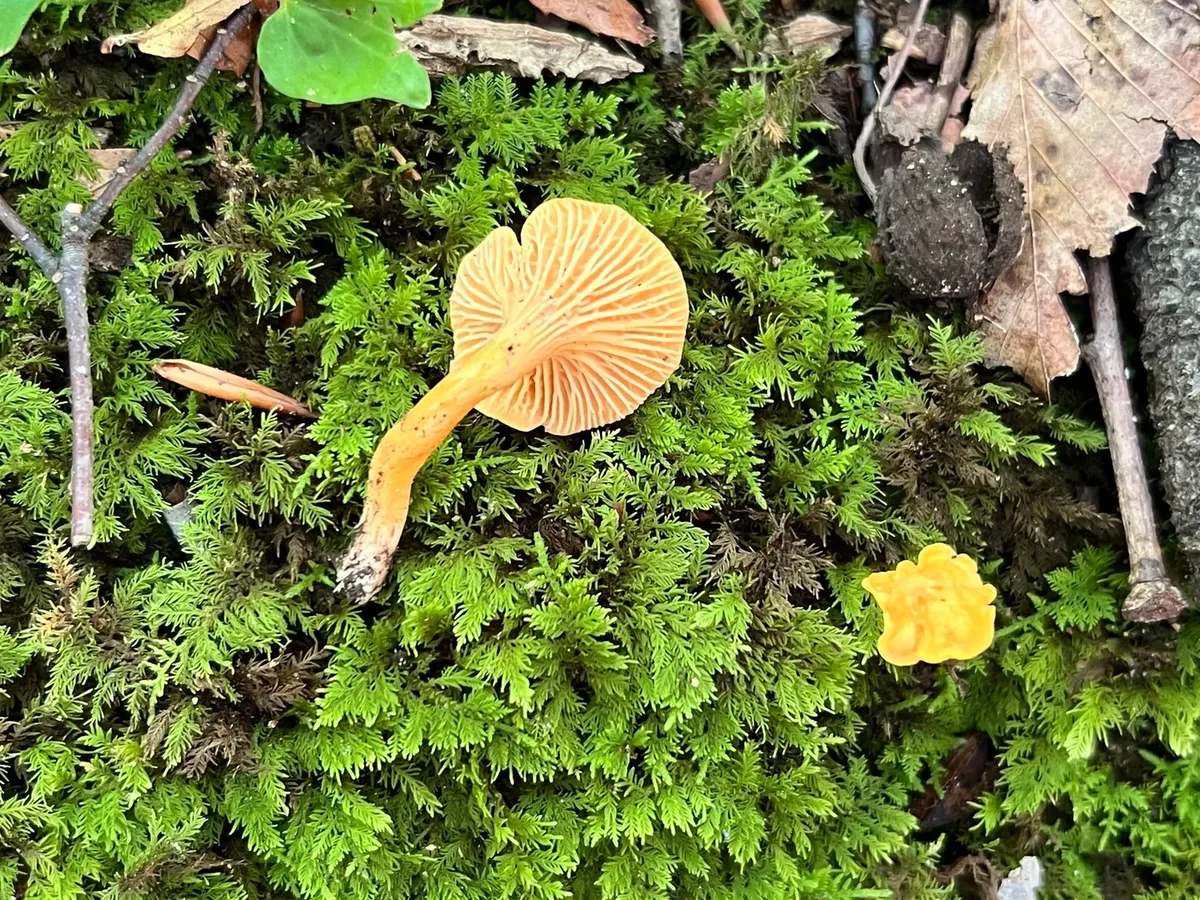 © Annie Weissman (CC BY)
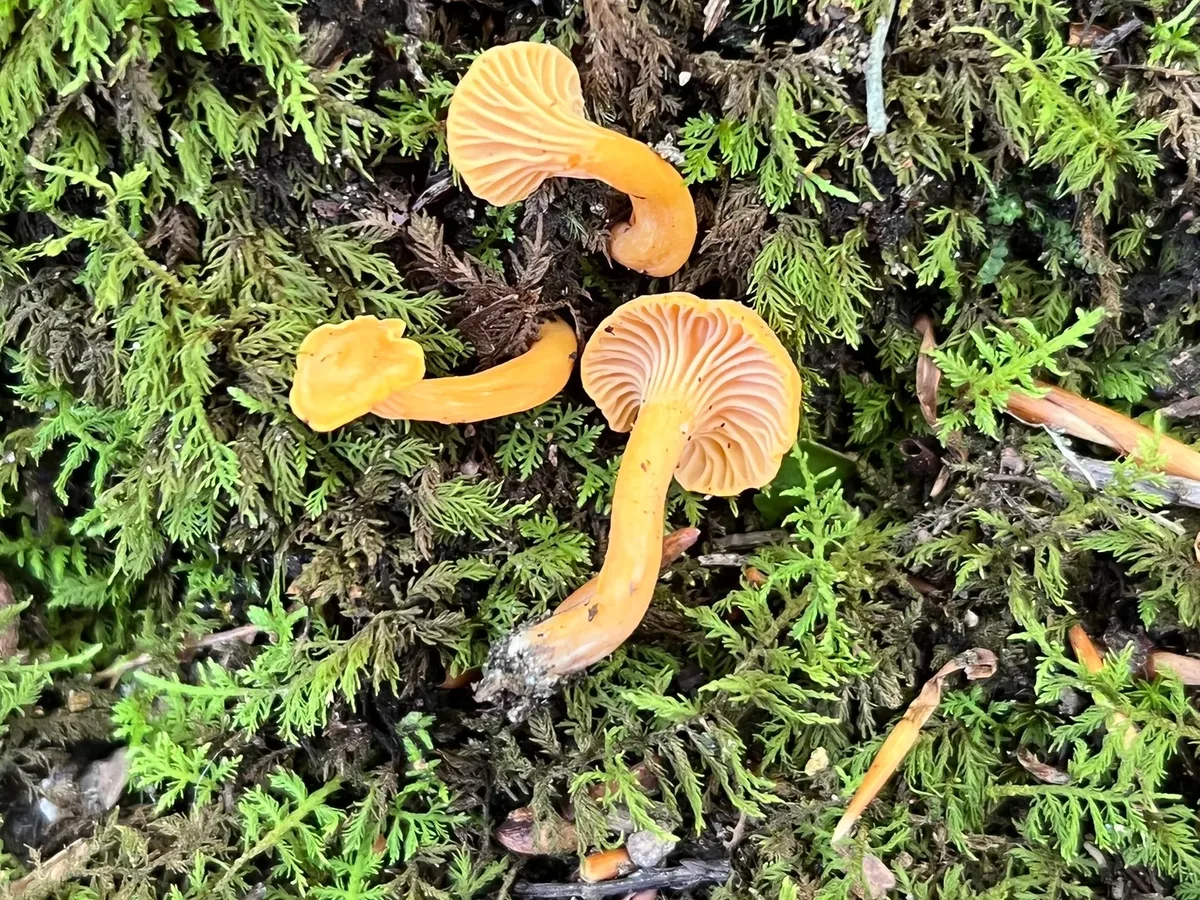 © Annie Weissman (CC BY)
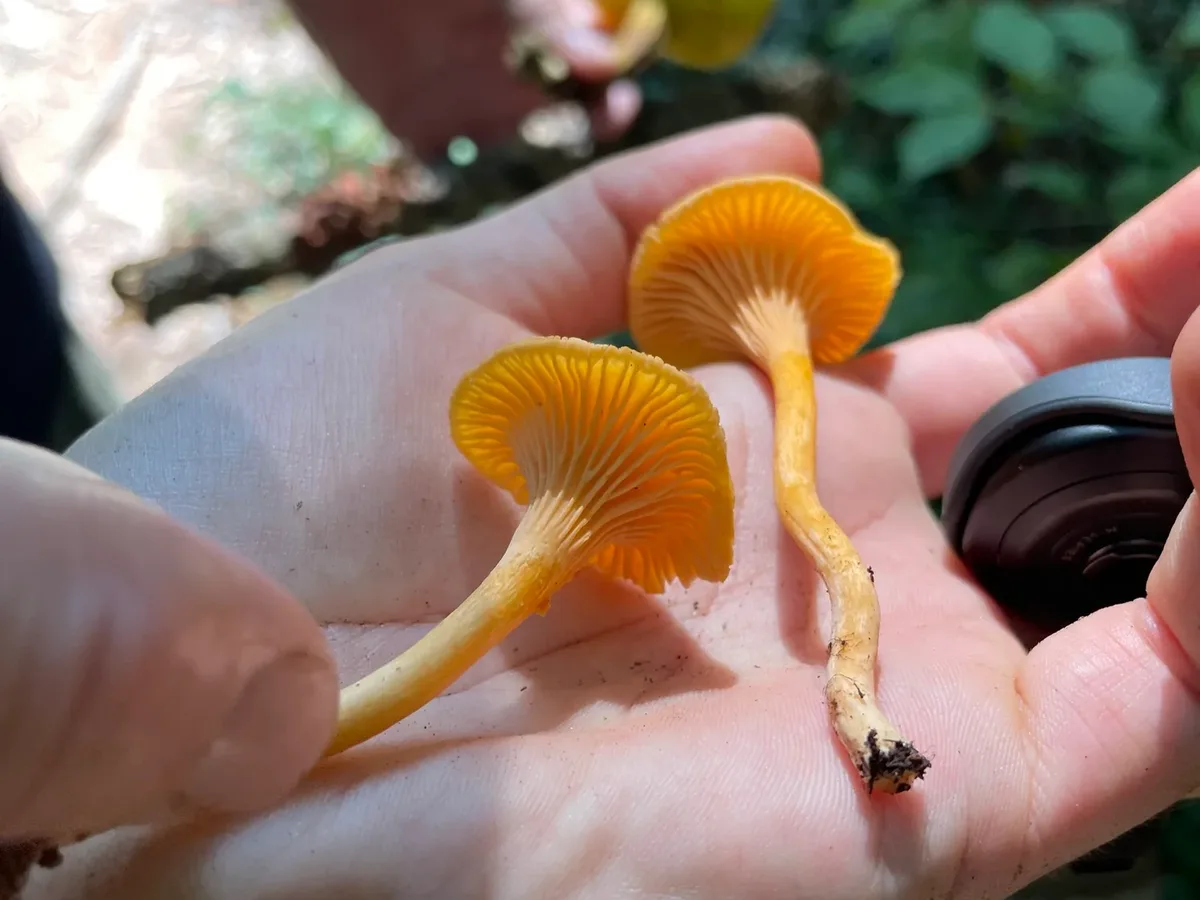 Jenny (CC0)
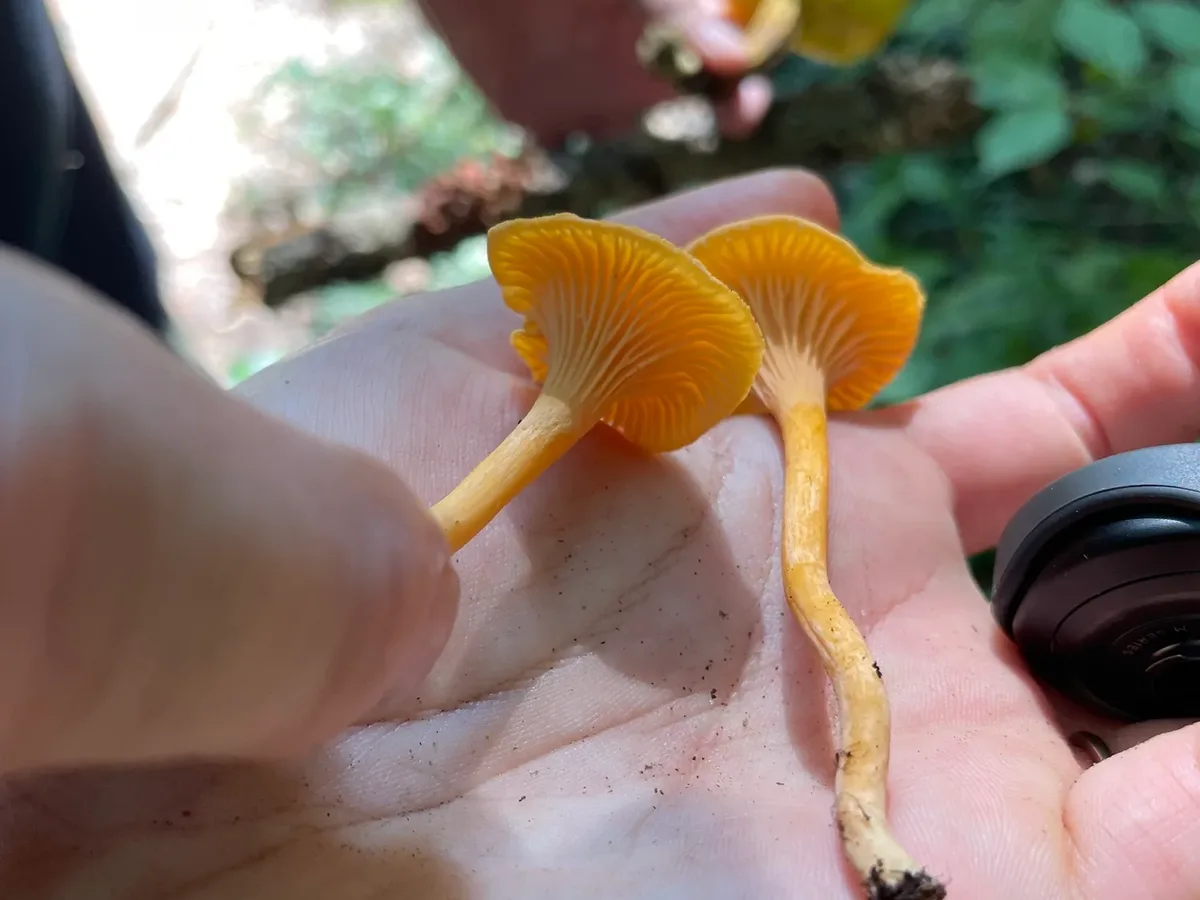 Jenny (CC0)
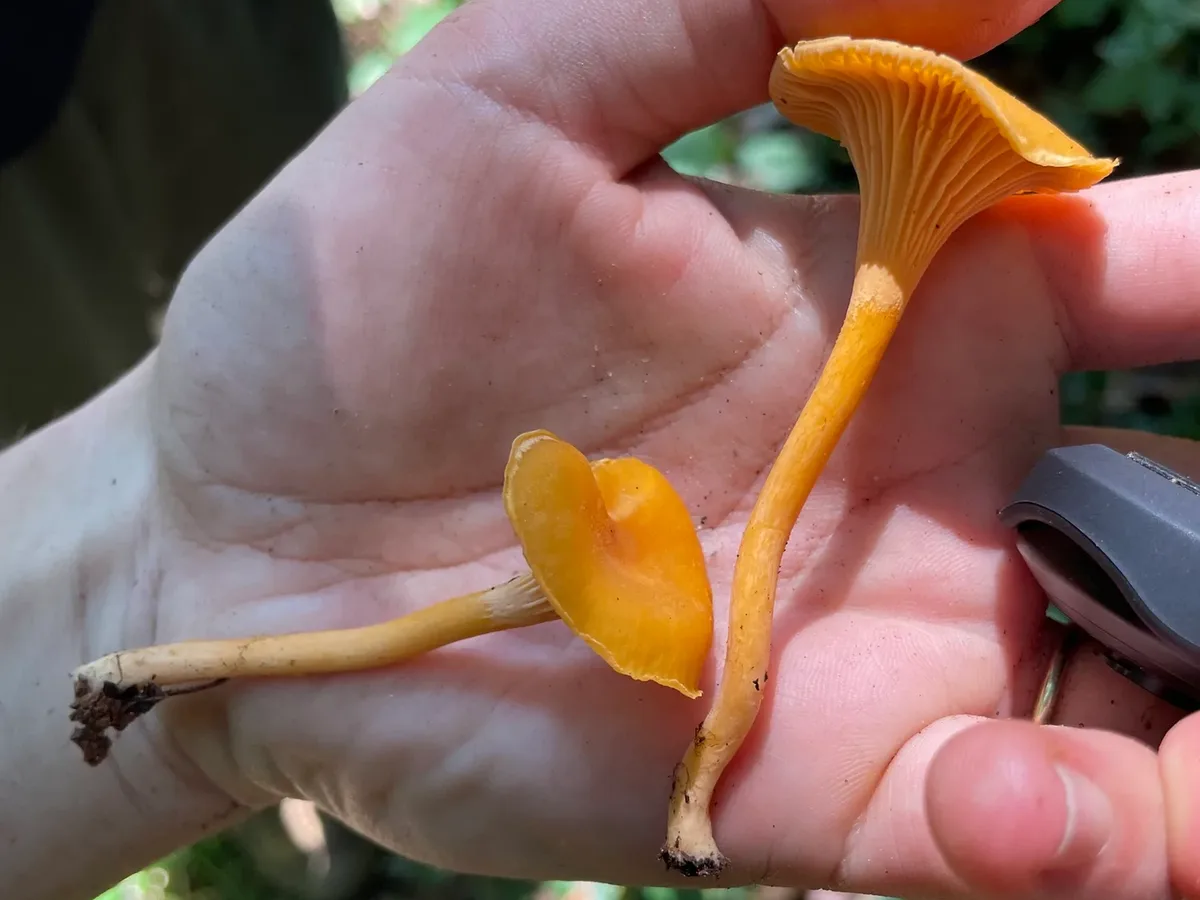 Jenny (CC0)© Annie Weissman (CC BY)© Annie Weissman (CC BY)
Edible only with the right preparation - or safe for some people but not others. Learn the caveats first.
How to recognise it
Cantharellus persicinus is the 'peach chanterelle' of East Asia, distinguished within the chanterelle family by its soft, warm peach-to-salmon colouring - a hue closer to a ripe peach skin than to the bold egg-yolk gold of Cantharellus cibarius sensu stricto. The cap, false-gill ridges, and stem all carry this characteristic pale coral-peach or apricot-rose tint, which gives the species an unmistakable delicacy among chanterelles in the field.
Cap
Cap shape follows the familiar chanterelle trajectory: convex and with an incurved margin in youth, the cap gradually opens and depresses centrally until mature specimens are shallowly funnel-shaped with a wavy, lobed margin measuring 3-8 cm across. The cap surface is dry and smooth.
Gills / Pores
The critical identification feature - as with every true Cantharellus - lies underneath: instead of true blade-like gills, the underside bears blunt, rounded, repeatedly forking folds that run (decurrent) down the stem. These ridges are rubbery-firm, never fragile or sharp, and feel clearly different to the touch from the thin, closely packed, knife-edged gills of dangerous lookalikes.
Stem
The stem is solid, dry, and the same pale peach tone as the cap.
Flesh
The flesh is white to very pale pinkish inside, firm, and non-staining. The spore print is pale cream to nearly white, sometimes with the faintest blush of pink.
Smell & taste
When the flesh is broken, it releases a gentle but clear fruity-apricot fragrance.
Where & when it grows
Habitat
Cantharellus persicinus is an ectomycorrhizal fungus - it lives in intimate, mutually beneficial partnership with the fine feeder roots of its host trees, and like all chanterelles it cannot be cultivated on artificial substrates.
The fruitbodies are just the seasonal reproductive structures of a mycelium that may persist in the same patch of forest soil for many years, which is why productive sites reliably yield chanterelles season after season.
The primary range covers the warm-temperate and cool-temperate deciduous and mixed forests of Japan (across Honshu, Shikoku, and Kyushu) and the Korean Peninsula. The species most likely also occurs in adjacent eastern China wherever the appropriate combination of broadleaf host trees and monsoon-influenced humid summers come together.
The preferred habitat is intact, shaded forest on moist but well-drained, slightly acidic soils rich in organic humus, typically in association with oaks (Quercus), chestnuts (Castanea), and beeches (Fagus) - the dominant ectomycorrhizal hardwoods of East Asian warm-temperate forest.
Compacted soils, disturbed clearings, and areas without a well-developed litter layer are generally unproductive.
Because the species fruits from the soil (never from wood), its ground-level, solitary-to-scattered growth habit is already a useful first-cut separation from dangerous wood-associated species.
When
In Japan and Korea, Cantharellus persicinus is primarily a late-summer to early-autumn species.
The first fruitbodies typically emerge in late July or early August, once the post-rainy-season warmth (Japan's doyō period) has settled in and soils are both warm and adequately moist following the summer rains.
The peak flush runs through August and into September - the period when daytime temperatures remain warm but overnight temperatures begin to ease, creating ideal conditions for chanterelle development. Fruiting can continue into October in cooler highland areas or in years with a prolonged wet autumn.
In Korea, the timing is similar, with the main harvest period coinciding with the tail of the monsoon season (jangma) and the post-monsoon warm-humid weather of August and September.
Multiple separate flush events occur across the season, each triggered by a significant rainfall episode followed by a lag of several days as the fruitbodies develop. A dry spell interrupts fruiting; a soaking rain after such a dry period can produce a reliable new flush.
How it grows
Grows singly or in scattered loose groups directly on forest soil among leaf litter and humus - never clustered densely at the base of trees or from woody debris. This solitary-to-scattered, ground-dwelling habit is a useful field character.
Because it is mycorrhizal, the same sites produce fruitbodies year after year under stable forest conditions.
Fruitbodies develop slowly and steadily over several days once conditions are right, and they persist reasonably well before deteriorating, so patches can be revisited across a season.
Habitat disturbance - particularly tree removal or soil compaction - can permanently end fruiting at a given site.
Fruiting conditions
Fruiting in Japan and Korea is triggered by adequate summer to early-autumn rainfall combined with warm soil temperatures in the range of 13-24 °C - conditions that prevail during and after the summer monsoon period. A threshold of approximately 25 mm of rain over the preceding 14 days, when soil temperature is within this range, is sufficient to initiate a flush. The lag of 5-10 days reflects the characteristically slow, steady development of chanterelle fruitbodies. Prolonged dry spells halt fruiting; a significant rainfall event after a dry period reliably restarts production within the lag window. Higher-elevation and northern-range populations tend to fruit slightly later and at cooler soil temperatures than lower-elevation sites in central Honshu or southern Korea.
Look-alikes
The primary risk to distinguish Cantharellus persicinus from is the East Asian jack-o'-lantern, Omphalotus japonicus (syn. Lampteromyces japonicus), which causes severe gastrointestinal poisoning across Japan and Korea.
Omphalotus japonicus can display an orange to salmon-orange colour that, in poor light or at first glance, may broadly suggest a chanterelle. However, its underside always bears true, sharp, blade-like gills - never blunt ridges - and it grows in dense, overlapping clusters at the base of dead or dying broadleaf trees or from buried root wood, never as solitary fruitbodies on open forest soil.
In full darkness Omphalotus japonicus may exhibit faint bioluminescence; its gills can have a faint orange glow.
The false chanterelle, Hygrophoropsis aurantiaca, has true, crowded, thin, repeatedly forking gills, a downy to velvety cap surface (not smooth), and a distinctly more orange colouring; it causes gastrointestinal distress.
Within the genus Cantharellus, several other species occur in East Asia, including Cantharellus yunnanensis (more golden-yellow, found in montane settings) and various members of the broader C. cibarius aggregate - all are edible, so any intra-genus confusion carries no safety consequence.
The peach-salmon colour of C. persicinus is sufficiently distinctive within the East Asian mycological flora that careful attention to this hue combined with the standard chanterelle checks (blunt ridges, fruity odour, soil habitat, solitary growth) makes a reliable identification achievable.
Omphalotus japonicus (also known as Lampteromyces japonicus) bears true, sharp, blade-like gills - never blunt ridges - and grows in dense, overlapping clusters at the base of dead or dying broadleaf trees or from buried root wood, never as solitary fruitbodies on open forest soil. Its overall colour tends toward vivid orange to orange-red rather than the soft peach-salmon of Cantharellus persicinus. In darkness it may show faint bioluminescence. It causes severe gastrointestinal poisoning (intense cramping, vomiting, diarrhoea) but is not typically lethal to healthy adults. The clustered, wood-associated growth pattern and true sharp gills are the decisive separation.
Bears deeply crowded, thin, repeatedly forking true gills rather than blunt ridges; the cap surface is downy to almost velvety rather than smooth; colouration is a more vivid orange throughout rather than the soft peach-salmon of C. persicinus; often associated with conifers and woody debris. The stem is sometimes off-centre or curved. Causes gastrointestinal distress and possibly neurological symptoms in some individuals. The downy cap texture and true (non-ridged) gills are the key distinction.
Several other Cantharellus species occur across East Asia. All share the defining blunt forking ridges, fruity odour, and soil-dwelling habit of true chanterelles. Any intra-genus confusion carries no safety consequence, as all currently known species in Cantharellus are edible or at most mildly indigestible for some individuals. The peach-salmon colour of C. persicinus is useful for distinguishing it from the more golden-yellow members of the complex.
A choice edible chanterelle of montane southwest China and adjacent regions. Distinguished by its more vivid egg-yolk to golden-orange colouration (not peach or salmon) and its higher-elevation montane habitat. Any confusion between these two chanterelle species carries no safety consequence as both are edible.
In the kitchen
Picking & cleaning
Harvest by gently twisting and lifting the whole fruitbody clear of the soil, or cut cleanly at the base with a knife to leave the underground mycelium undisturbed.
Transport in a basket or breathable cloth bag - sealed plastic bags cause sweating and accelerate deterioration.
Clean specimens in the field using a soft brush or dry cloth rather than washing, to preserve shelf life.
In the refrigerator, loosely wrapped in paper, they will keep for 3-5 days.
As with any edible wild mushroom, collect only specimens that can be positively identified, and examine every individual specimen before placing it in your basket - do not rely solely on the group appearance of a find.
Cooking
Cantharellus persicinus has the pleasant, mildly fruity, slightly peppery taste characteristic of the chanterelle family, with a firm, meaty texture that holds up well to heat. The pale peach colouring mellows to a warm cream-tan when cooked, but the delicate flavour remains appealing.
In Japan it is enjoyed sautéed in butter and served with rice, in miso soup, in chawanmushi (egg custard), and as a component in mixed mushroom dishes (kinoko gohan). In Korea it appears in doenjang jjigae (fermented soybean paste stew), namul preparations, and grilled alongside other seasonal mushrooms.
The best preparation technique:
- 1Sauté in a wide, hot pan with butter or neutral oil over medium-high heat, without crowding.
- 2First allow the fruitbodies to release their own moisture.
- 3Continue until that liquid evaporates and the ridges develop a light golden caramelisation.
- 4Season with salt toward the end.
Excellent in egg dishes, cream sauces, pasta, and rice. Pairs naturally with light soy, dashi, sake, and mild aromatics such as ginger and spring onion, as well as with Western herbs like thyme.
Can be dried for storage - the flavour concentrates on drying.
Do not boil chanterelles; the texture becomes waterlogged and the subtle flavour is diluted.
Good to know
Cantharellus persicinus is an edible species with no known toxins and no record of poisoning in the mycological literature. There is no deadly lookalike specifically associated with this species.
The essential safety protocol for identifying any Cantharellus in the field:
- 1Confirm the hymenium consists of blunt, rounded, forking ridge-like folds - NOT true sharp, blade-like gills. Run a fingertip across the underside: chanterelle ridges feel blunt and rubbery, not thin and fragile.
- 2Confirm a fruity, apricot-like odour.
- 3Confirm the fruitbody grows singly or scattered on the ground, NOT in dense clusters at or near tree bases or from wood.
These three checks together exclude Omphalotus japonicus (the most dangerous realistic confusion), which has true sharp gills, clusters on or near wood, and an orange-red colouring. If any specimen has true sharp gills, do not eat it.
When trying any wild mushroom for the first time, eat a small well-cooked portion and wait 24 hours before consuming more.
Never eat chanterelles raw - cooking is recommended to maximise digestibility and flavour.
A reference guide - never an edibility guarantee. When in doubt, leave it out.