Ashen chanterelle
Cantharellus cinereussyn. Craterellus cinereus, Merulius cinereus, Cantharellus cinereus var. cinereus
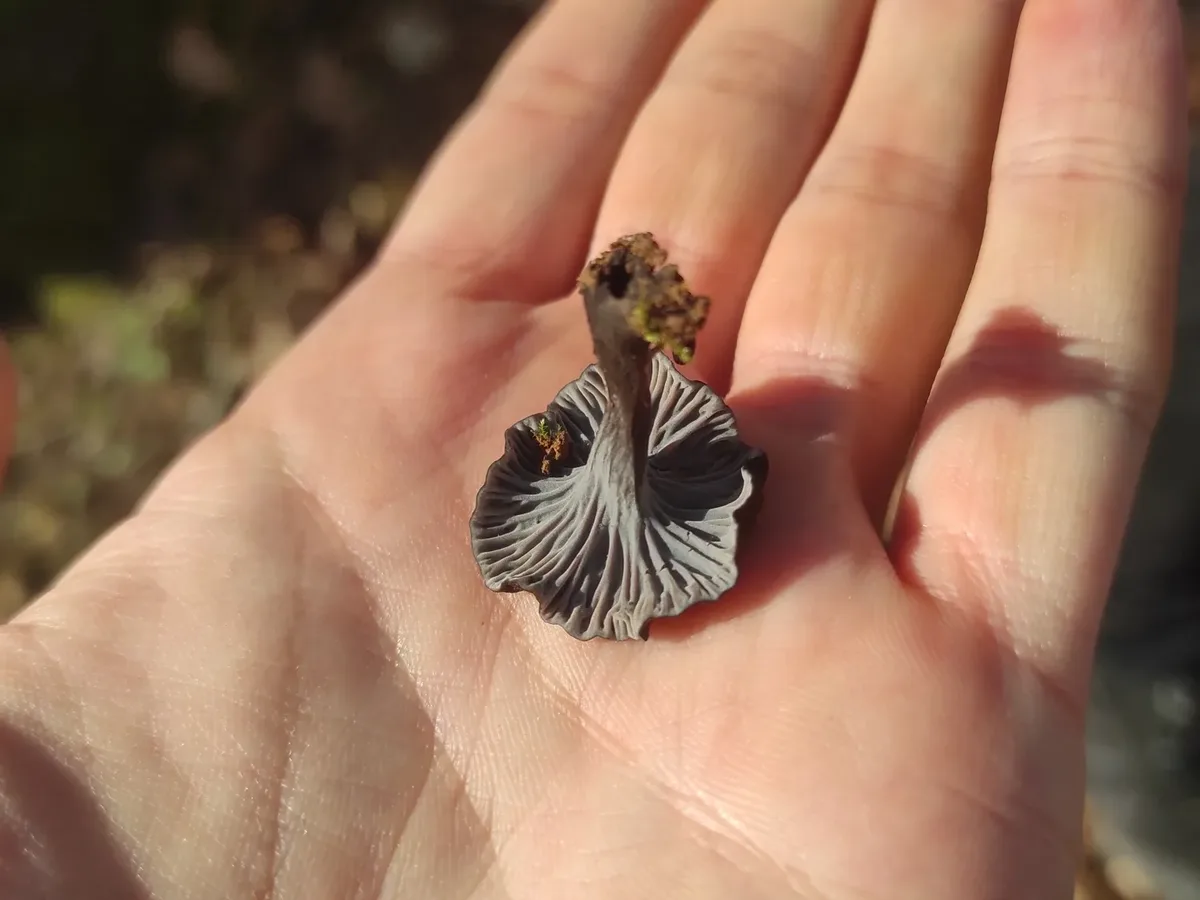 © Umut Nuri Erdoğan (CC BY)
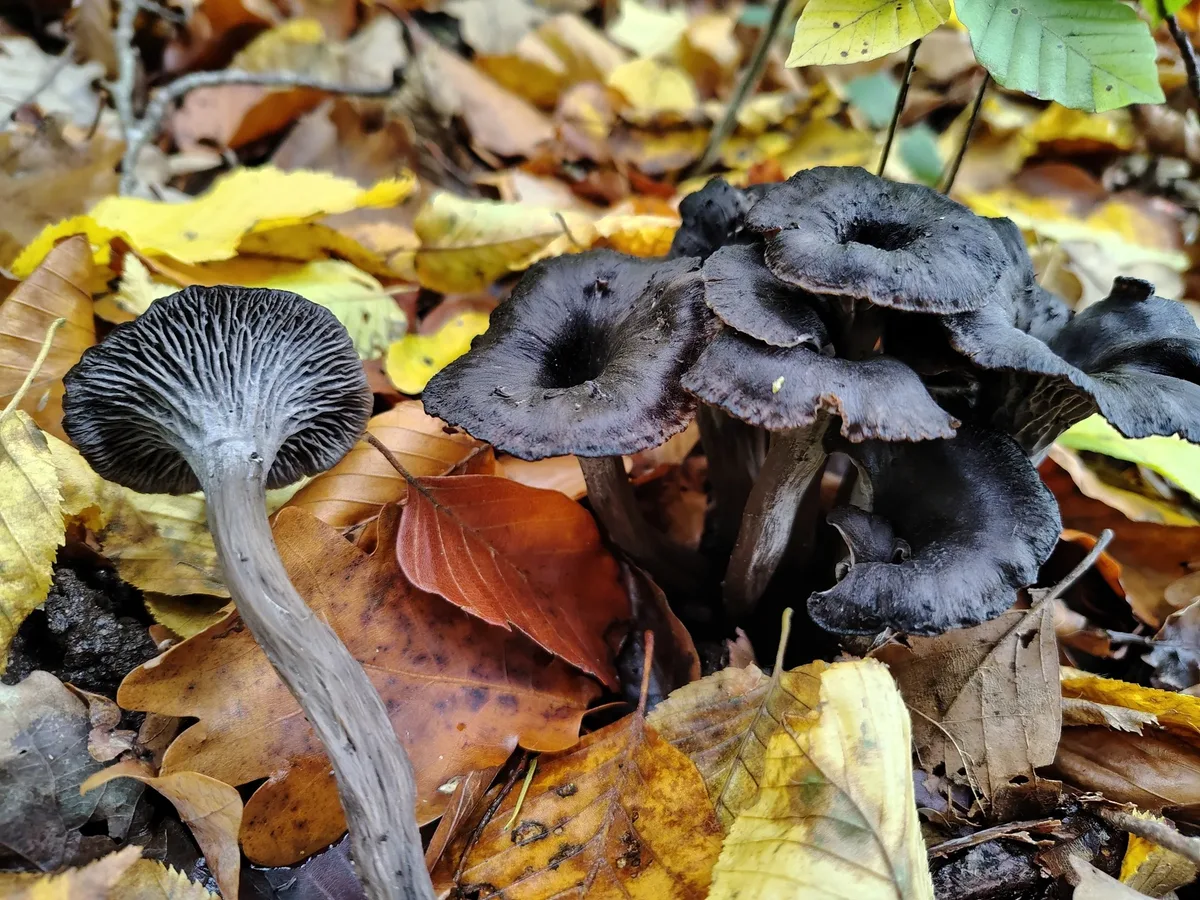 © vuikaan (CC BY)
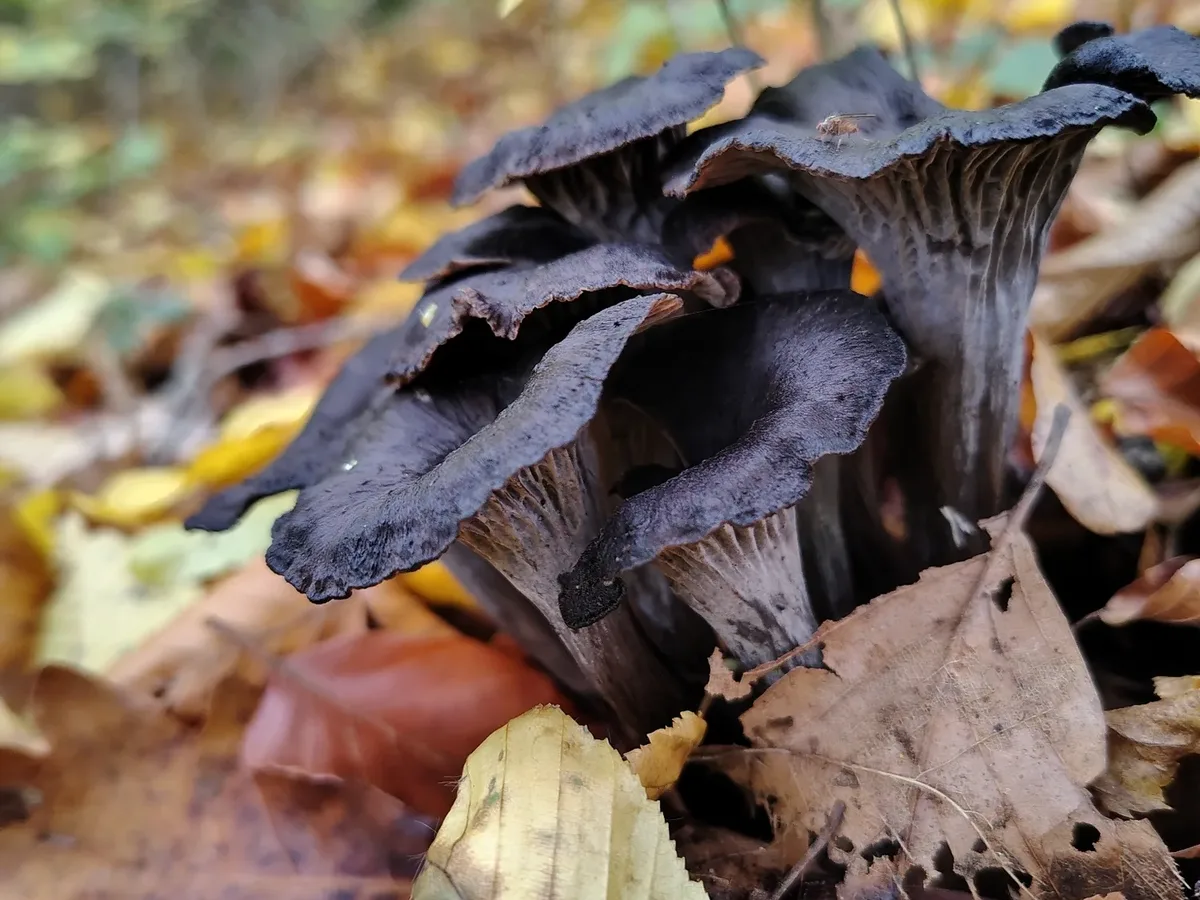 © vuikaan (CC BY)
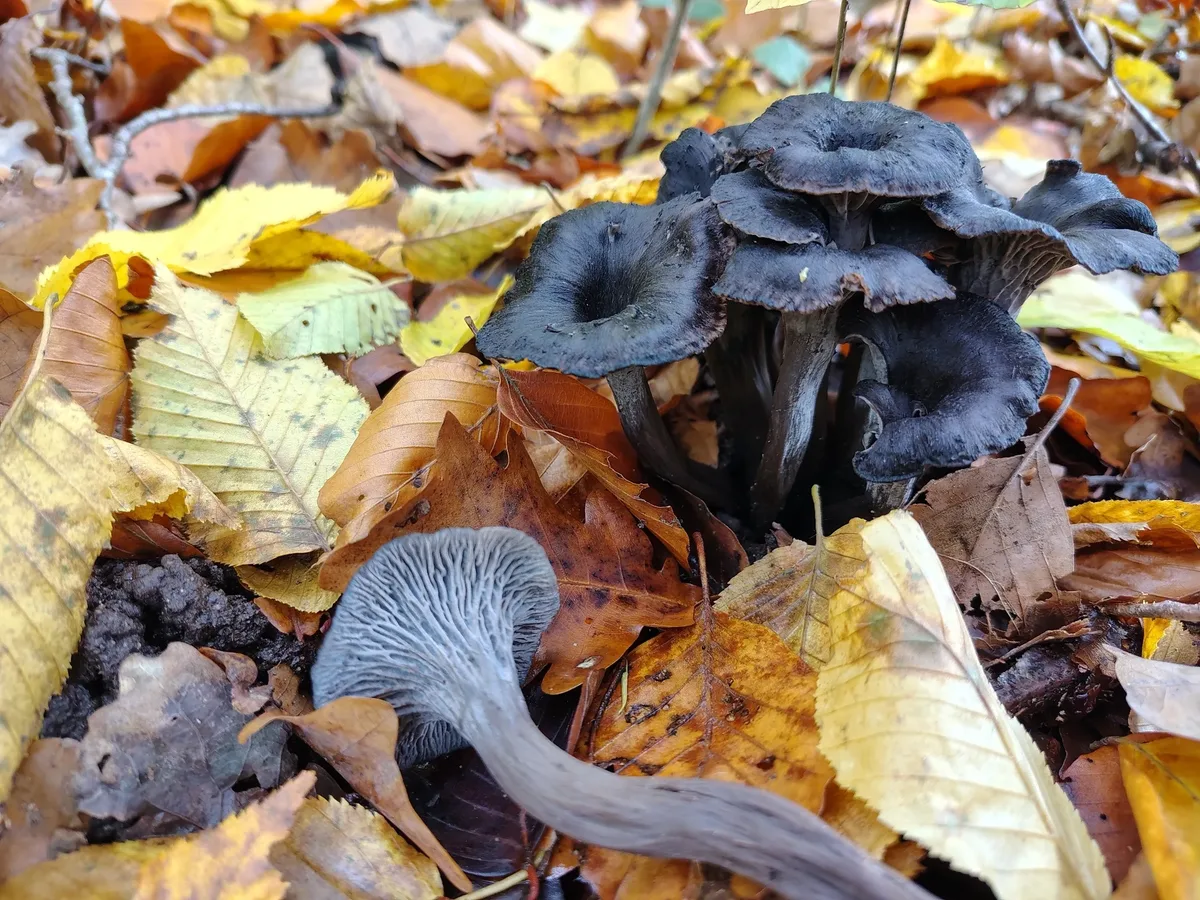 © vuikaan (CC BY)© Umut Nuri Erdoğan (CC BY)© vuikaan (CC BY)
Good to eat, once you have identified it with certainty and cooked it through.
Never eat a mushroom you are not 100% sure of - check the look-alikes below, and always cook wild mushrooms.
How to recognise it
Cantharellus cinereus is the grey cousin of the golden chanterelle - it shares the genus's characteristic anatomy but is dressed in the sombre, ashen palette of charcoal and slate rather than golden-yellow.
The entire mushroom - cap, ridges, and stem - is various shades of grey, which is one of the key recognition features.
Cap
The cap is deeply funnel-shaped from a relatively early age and often hollow to the base, with a strongly wavy, lobed margin that becomes increasingly ragged and split in old specimens.
The colour ranges from dark ash-grey to brownish-grey or almost black when wet, fading to mid-grey as the fruitbody dries.
Gills / Pores
The hymenium on the outer (lower) surface of the funnel is the critical identification character: it consists of blunt, low, forking, ridge-like folds rather than true, sharp, blade-like gills.
Run your finger along the underside - the ridges feel smooth and rounded, almost waxy, and never sharp-edged.
This feature, shared by all true Cantharellus and Craterellus species, reliably distinguishes them from toxic and inedible gill-bearing lookalikes.
Stem
The stem is hollow and pale to mid-grey.
The spore print is white to pale cream. There is no ring and no volva.
Where & when it grows
Habitat
Cantharellus cinereus is an ectomycorrhizal species of temperate European broadleaf and mixed forest, forming symbiotic partnerships with the fine roots of mature trees - principally beech, oaks, and hornbeam - and drawing carbohydrates from its host in exchange for enhanced water and mineral uptake.
This obligate mycorrhizal relationship means it cannot be cultivated commercially and is found only in established forest, never on logs, stumps, or artificial substrates.
It favours moist, humus-rich soils, often on calcareous or neutral substrates, in shaded, humid microsites:
- valley bottoms
- stream margins
- north-facing slopes
- hollows where moisture accumulates and leaf litter builds up deeply
In the right stands it co-occurs reliably with Craterellus cornucopioides (black trumpet) and Craterellus tubaeformis (yellowfoot), making these forest patches particularly rewarding to revisit.
Because ectomycorrhizal networks are perennial, productive patches tend to fruit in the same locations year after year, provided the host trees remain healthy.
When
In temperate Europe, Cantharellus cinereus is primarily an autumn mushroom, appearing from late August through October and persisting into November in mild oceanic climates such as western France, the British Isles, and southwestern Germany.
The first fruitbodies typically emerge in August after sustained warm-weather rainfall has soaked the soil. Fruiting peaks in September and October and winds down as soil temperatures fall below about 8 °C.
It tends to appear slightly later in the season than the golden chanterelle (Cantharellus cibarius) and is notably more tolerant of cool, wet autumn conditions, sometimes being among the last chanterelles still fruiting as other species succumb to frost.
How it grows
Grows singly or in scattered groups on forest soil, occasionally loosely aggregated but never in dense, tight clumps.
Like all ectomycorrhizal species it requires an established host tree and develops slowly. Fruitbodies take 7-14 days to mature from pin stage and can persist for 1-2 weeks before deteriorating.
The dark colouration makes individual fruitbodies hard to spot among the leaf litter and dark humus of the forest floor. Experienced foragers learn to look for the distinctive funnel silhouette against the ground rather than searching for colour.
Productive patches are faithful: once located, mark the GPS coordinates and return annually.
Fruiting conditions
Fruiting is driven by soil moisture following summer and autumn rainfall combined with warm-but-cooling soil temperatures characteristic of European autumn. The trigger is typically 20+ mm of rain over 14 days when soil temperature is 8-18 °C. The flush lag of 7-14 days reflects the slow, steady development of chanterelle fruitbodies relative to faster saprotrophic species. Persistent moisture - not a single heavy downpour - is more important than any one rain event; sustained humidity through the preceding two weeks is the best predictor of a productive flush.
Look-alikes
The realistic confusion candidates for Cantharellus cinereus are all within the same broad group of funnel-shaped, ridge-bearing or smooth-hymenium basidiomycetes - and importantly, none of the likely field confusions are deadly.
The most important lookalike is Craterellus cornucopioides (black trumpet / horn of plenty), which is a choice edible and even more highly regarded as a table mushroom than C. cinereus itself. It differs in several ways:
- typically darker (blackish-brown to sooty black rather than ash-grey)
- the outer surface is smooth or only very faintly wrinkled rather than bearing distinct blunt ridges
- the fruitbody is thinner-walled
- it tends to grow in larger groups or colonies
A mix-up between C. cinereus and C. cornucopioides is entirely harmless.
Craterellus tubaeformis (yellowfoot chanterelle) is another edible relative that can co-occur in the same stands. It is distinguished by its yellow-ochre to brownish cap with a perforated centre, distinctly yellow-ochre stem (never grey), and blunt forking ridges that are ochre to greyish-cream.
Cantharellus melanoxeros is a rare, closely related European species with darker, almost black colouration that stains blue-grey on cutting; it is also edible.
Among potentially dangerous species, one must be aware of certain dark Cortinarius species in the same forest habitats. These have:
- true, blade-like gills (not blunt ridges)
- a cobweb-like cortina (veil remnants) on the stem when young
- rusty-brown spore print at maturity
- rusty-brown gills when mature
These features clearly distinguish them from C. cinereus, which always has blunt ridges and a white spore print.
No species commonly confused with Cantharellus cinereus in normal field conditions is known to be lethally dangerous, provided the blunt-ridge character is confirmed.
Some dark-coloured Cortinarius species occur in the same beech-oak forest habitats and could superficially resemble a grey funnel-shaped mushroom at a distance to an inexperienced forager. Several webcap species - notably Cortinarius rubellus (deadly webcap) and Cortinarius orellanus (fool's webcap) - contain orellanin, a nephrotoxin that causes delayed but potentially fatal kidney failure, with symptoms appearing 2-3 weeks after ingestion. Critical distinction: Cortinarius always has true, blade-like gills (not blunt forking ridges), typically shows remnants of a cobweb-like cortina (veil) on the stem when young, has a rusty-brown spore print, and has rusty-brown to cinnamon gills at maturity. C. cinereus always has blunt, rounded, forking ridges on its outer surface and a white spore print. Never collect a grey or brownish funnel-shaped mushroom without confirming the ridge character by touch and close visual inspection.
The most important lookalike - and a choice edible. Black trumpet is typically darker (sooty black to blackish-brown), thinner-walled, and the outer surface is smooth or only faintly veined rather than bearing distinct blunt ridges. C. cinereus is ash-grey (not black) with more pronounced blunt ridges on the outer surface. A mix-up between these two species is completely harmless, as both are excellent table mushrooms.
A rare, closely related European Cantharellus that is darker (brownish-black) and stains distinctly blue-grey or blackish when cut or bruised - a feature absent in C. cinereus. Also edible; confusion between the two is harmless but the staining reaction is a reliable distinction.
Funnel-shaped with a perforated cap centre and blunt ridges - superficially similar habit - but distinguished immediately by the distinctly yellow-ochre to orange-yellow stem (never grey), a brownish-ochre to grey-brown cap, and ochre-grey ridges. The yellow stem is the quickest field distinction. Also edible and excellent.
In the kitchen
Picking & cleaning
Harvest by gently twisting and pulling the fruitbody from the ground, retaining as much of the stem as possible, or cut cleanly at the base with a knife.
- The hollow stem interior collects debris easily - tap each fruitbody gently to dislodge soil and leaf fragments.
- Carry in a flat-bottomed basket with good air circulation; avoid plastic bags, which accelerate deterioration.
- In the field, clean gently with a dry brush; do not wash until needed in the kitchen.
- Refrigerate in paper and use within 3-4 days.
The flavour concentrates pleasantly on drying, making C. cinereus an excellent candidate for the dehydrator.
Collect only positively identified specimens and leave smaller individuals to sporulate.
Cooking
Cantharellus cinereus has a pleasant mild flavour - slightly fruity and earthy, less intensely flavoured than golden chanterelle but more subtle and arguably more versatile.
The thin, funnel-shaped fruitbody means it cooks quickly and tends to absorb pan flavours more readily than the thicker-fleshed golden chanterelle.
Sauté in butter over medium-high heat, starting in a dry pan to drive off excess moisture, then add butter once the liquid has evaporated and cook until lightly golden on the ridges.
Excellent in cream sauces, risotto, pasta, and egg dishes. Pairs well with shallots, thyme, parsley, white wine, and aged cheeses.
It dries exceptionally well: dehydrated C. cinereus develops a concentrated, earthy, umami-rich flavour similar to dried black trumpet. Ground to a fine powder it makes a superb seasoning for soups, sauces, and compound butters.
Can also be frozen after a brief sauté. Often used interchangeably with C. cornucopioides in recipes.
Good to know
Cantharellus cinereus is considered a safe, well-established edible mushroom with no documented toxicity in correctly identified specimens.
The key safety protocol is identical to that for all chanterelles: confirm the blunt, forking, ridge-like hymenium - never sharp blade-like gills. This single check excludes all gilled lookalikes.
Additionally confirm:
- the uniform grey colouration (no yellow, orange, or red tones)
- the funnel shape with hollow stem
- ground growth (not on wood)
If you are uncertain whether the hymenium is ridges or gills, place the mushroom ridge-side-down on white paper: chanterelle ridges leave faint scattered marks and individual ridge-prints, whereas true gills leave distinct parallel lines.
When foraging alongside C. cornucopioides (black trumpet) in the same stand, the two may be picked together without concern - both are choice edibles.
As with any wild mushroom new to your diet, begin with a small portion and allow 12 hours before eating more.
A reference guide - never an edibility guarantee. When in doubt, leave it out.