Wood-loving bolete
Buchwaldoboletus xylophilussyn. Boletus xylophilus, Xerocomus xylophilus
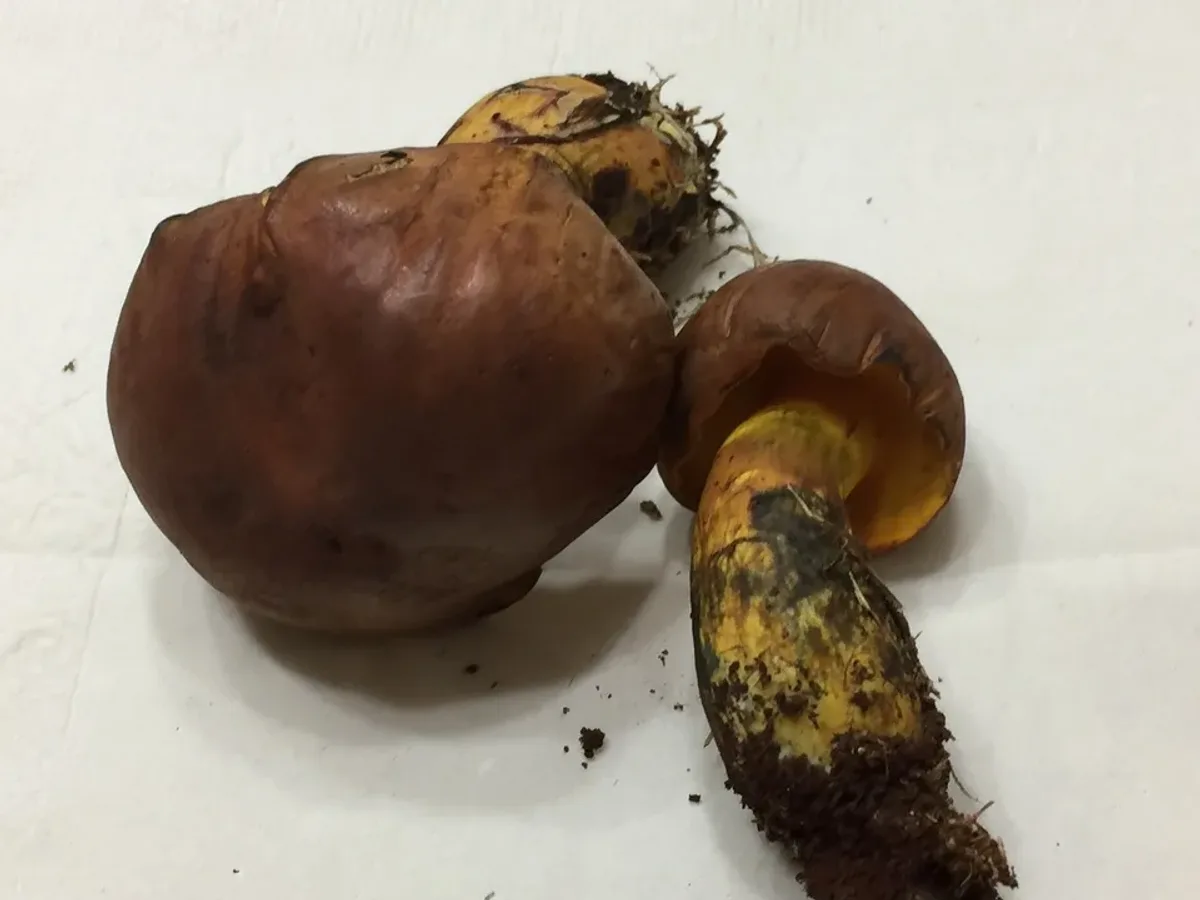 © Shroomnoname (CC BY-SA)
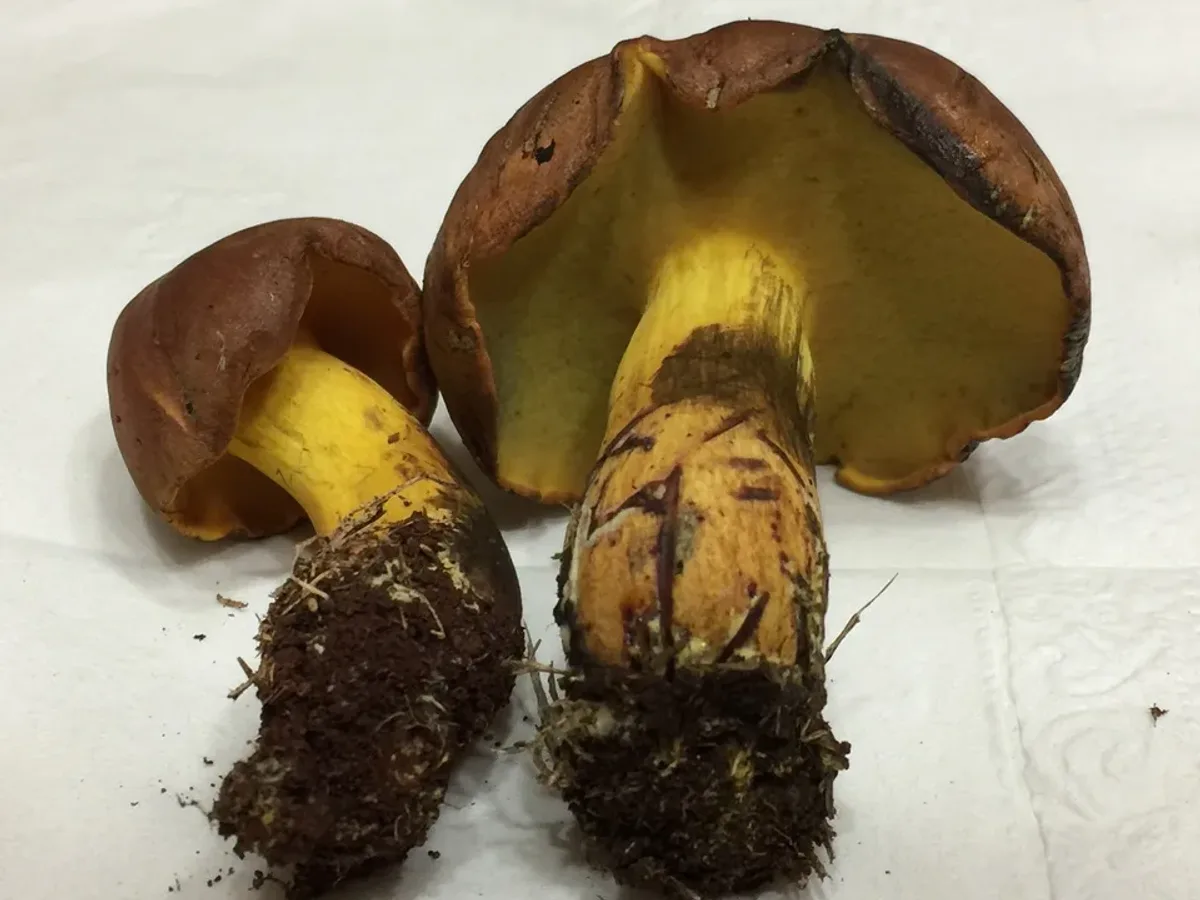 © Shroomnoname (CC BY-SA)
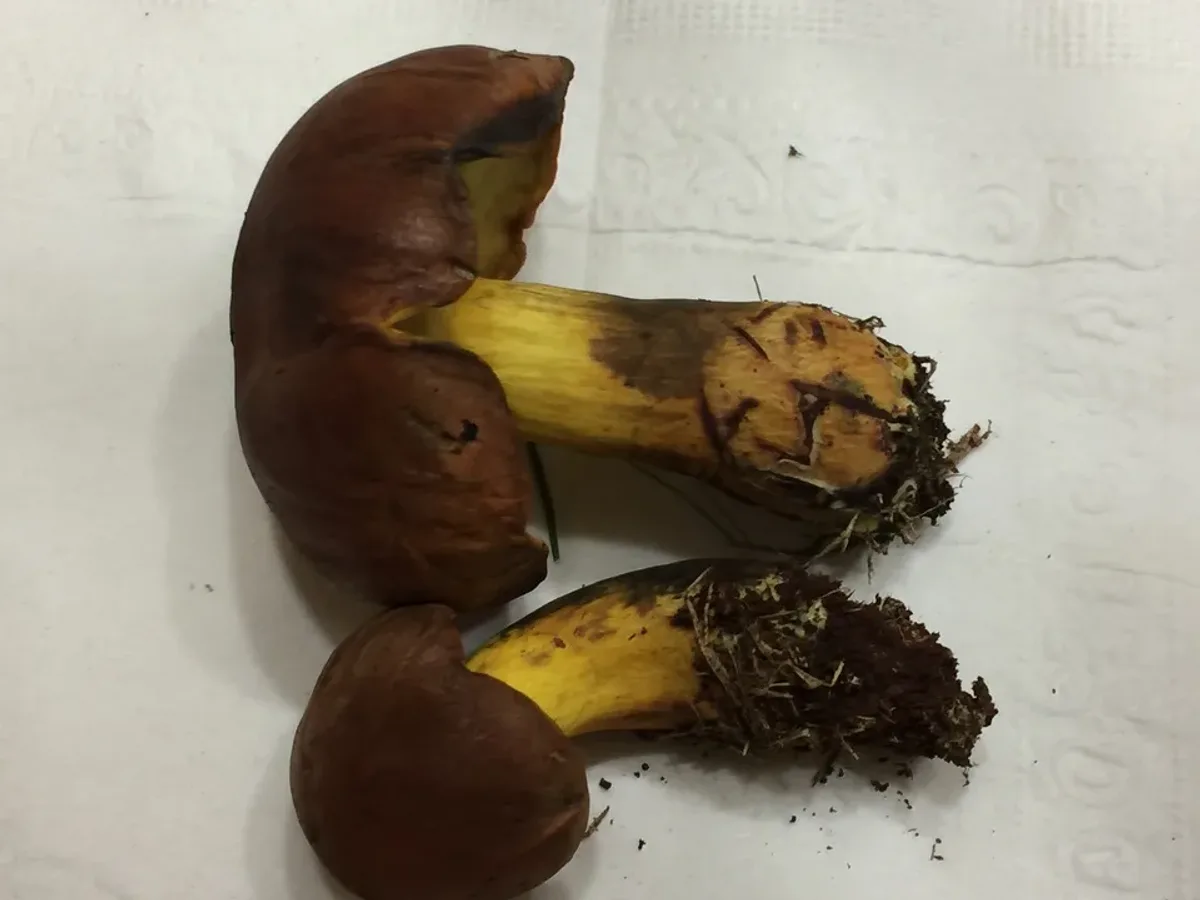 © Shroomnoname (CC BY-SA)© Shroomnoname (CC BY-SA)© Shroomnoname (CC BY-SA)
Edible only with the right preparation - or safe for some people but not others. Learn the caveats first.
Never eat a mushroom you are not 100% sure of - check the look-alikes below, and always cook wild mushrooms.
How to recognise it
Buchwaldoboletus xylophilus belongs to a small but ecologically fascinating genus of wood-rotting boletes - fungi that look like typical boletes (bolete cap, bolete pores, bolete stem) but live as decomposers of dead timber rather than as partners of living tree roots.
Cap
The cap is a warm golden-yellow to ochre-yellow, 4-12 cm across, initially convex and rounded like a bun, flattening gradually with age to a broad, slightly undulating plane.
The surface is dry and finely felty to touch - never slimy - and weathers to a duller straw-yellow with age or in dry conditions, sometimes developing fine surface cracks that reveal a lighter layer beneath.
Gills / Pores
The pore surface is one of the most eye-catching features when fresh: vivid sulphur-yellow to lemon-yellow, clean and bright, turning progressively more olive-yellow as the mushroom matures.
Unlike many boletes, the pore surface does not blue significantly when cut or pressed, which is an important field mark. The pores themselves are small and neatly circular to slightly angular.
Stem
The stem is proportionate and firm, similarly yellow to ochre, and may be subtly eccentric - slightly off-centre relative to the cap - because the fruit body is often pushing out laterally from the face of a stump or root.
Flesh
The flesh inside is yellow throughout, mild in smell, and does not noticeably change colour when cut. The spore print is olive-brown.
Where & when it grows
Habitat
What immediately sets this bolete apart from almost every other species in the family is where it grows: not in soil beside a living tree, but directly on wood.
Old pine stumps are the classic substrate - particularly species such as Pinus densiflora, Pinus massoniana, and Pinus thunbergii across East Asia - where B. xylophilus emerges from the rotting wood itself, digesting it through a brown-rot process.
The fruit bodies push out from cracks in bark, the tops of cut stumps, or the surface of root crowns at ground level. In a mixed or plantation forest, a productive stump can host fruit bodies repeatedly across multiple seasons as the mycelium slowly consumes the wood mass.
The species ranges across warm-temperate to subtropical forest zones of China, Japan, Korea, and into parts of Southeast Asia, favouring areas where pine stumps persist after logging or natural tree death.
Humid conditions are important; the species is most productive during and shortly after the monsoon period.
When
The primary season runs from late spring through early autumn - roughly May to October - peaking across most of East Asia in June through August, coinciding with warm, humid monsoon conditions.
Because B. xylophilus is saprotrophic (not mycorrhizal), it does not depend on the metabolic cycles of living tree roots; instead, it responds directly to substrate moisture and ambient temperature.
A good flush of summer rain penetrating to the wood interior is the primary trigger. Fruit bodies can emerge within four to seven days of adequate rainfall while air temperatures remain above about 18 °C.
Individual flushes are often brief - a few days of productive fruiting on a given stump, followed by senescence. A productive stump may flush two or three times across a long season if rain events are spaced out.
How it grows
Solitary to loosely clustered on woody substrate - stumps, root crowns, and buried root systems of dead or dying conifers.
The off-centre stem (eccentrically placed beneath the cap) is a clue that the fruit body is emerging from the side of a wood mass rather than growing vertically from soil.
Groups of two to five are common when a large stump provides enough substrate; very occasionally small troops of seven or more emerge from an extensive root system.
As a saprotrophic species it does not form mycorrhiza and cannot be found by searching near healthy trees. Look instead for old stumps and recently dead conifers in humid forest.
The same stump can produce fruit bodies in consecutive seasons as long as sufficient wood mass remains.
Fruiting conditions
Warm-season saprotroph responding primarily to substrate moisture and air/wood temperature rather than soil temperature. Fruitings are triggered by sustained warm, humid conditions - typically 25+ mm of rainfall over 14 days - with fruit bodies emerging 4-9 days after adequate wetting. Peak conditions correspond to the monsoon period in East and Southeast Asia (June-August), with air temperatures 18-30 °C. Not frost-tolerant; fruiting stops when night temperatures fall consistently below 12-14 °C.
Look-alikes
Several boletes share similar cap colour and can grow in comparable habitats. The most important comparisons:
- Phlebopus portentosus (giant bolete or black bolete) occurs in parts of Southeast Asia and grows large, sometimes from woody roots, with brown to dark-brown cap and yellow pore surface; it is considered edible.
- Suillus species (slippery jacks) associate with living conifers, typically have glutinous caps, and often show a partial veil or ring - none of these features are present in B. xylophilus.
- The European Buchwaldoboletus lignicola is the closest Old World relative, with very similar yellow colouration and a wood-rotting habit, but it is found in Europe (particularly on spruce) and causes gastrointestinal symptoms in some individuals - a reminder that wood-rotting boletes in this genus must not be assumed safe without species-level identification.
- Pholiota and other gilled wood-rotting fungi occupying similar substrates (old stumps) are sometimes encountered nearby but are immediately distinct because they have gills rather than pores.
- Xerocomus and Xerocomellus species share a similar felty-capped appearance but grow exclusively from soil (ectomycorrhizal) and typically have a more cracked or areolate cap surface when fresh.
A fundamentally different fungus that could be encountered in the same habitat type (pine forest). The brown roll-rim has gills rather than pores, a strongly inrolled cap margin in young and mid-aged specimens, olive-brown to date-brown gills that stain darker brown when rubbed, and flesh that browns on cutting. It causes lethal immune-mediated haemolytic anaemia through repeated consumption. B. xylophilus has a visible tube-and-pore layer (not gills), no inrolled margin, and yellow flesh that does not brown. If any specimen shows gills rather than pores, do not eat it.
The European congener, very similar in appearance - yellow cap, yellow pores, wood-rotting habit - but found in Europe (primarily on dead spruce) rather than East Asia. Known to cause gastrointestinal irritation in some individuals; a reminder that this genus should always be consumed only after thorough cooking and only when identification is certain. The geographic distinction (Europe vs. East/Southeast Asia) is the primary separator for foragers in the field.
A large, sometimes wood-adjacent bolete of Southeast and East Asia; cap is brown to dark umber-brown or blackish-brown (much darker than the ochre-yellow of B. xylophilus), and the pore surface is yellowish to olive but bruises more readily. Grows on soil near trees or from buried roots, but typically not directly from cut stumps. Considered edible and widely eaten.
Mycorrhizal with living pines (not wood-rotting); cap is glutinous to slimy when moist (never dry and felty); a partial veil leaves a ring on the upper stem; pore surface initially covered by the veil. Grows from soil beside living pines. None of these features match B. xylophilus.
Similar dry, tomentose yellow-brown cap, but mycorrhizal with living pines in soil (not wood-rotting), pores are larger and more angular, and flesh slowly blues or greenish-tinges near the pore layer when cut. Grows from soil, not from stumps.
In the kitchen
Picking & cleaning
Confirm the substrate first - the species must be emerging from wood (stump, root crown, buried wood), not from soil. A bolete growing directly from bare soil is not B. xylophilus.
Check that:
- the cap is bright golden- to ochre-yellow with sulphur-yellow pores
- the pores do not blue significantly when pressed
- the flesh inside is yellow without dramatic colour change on cutting
Select young to mid-aged specimens with firm, taut caps and bright pore surfaces.
Cut at the base with a knife rather than pulling - the off-centre stem can be anchored into the wood, and forcing it free may damage the substrate and the mycelium.
Slice each specimen vertically to check for insect larvae; in warm summer conditions, older specimens are often heavily infested.
Refrigerate and use within two days; the yellow pigments in the flesh degrade relatively quickly after harvest. Do not consume raw.
Cooking
When collected young and fresh, and thoroughly cooked, B. xylophilus has a mild, pleasant mushroom flavour with a firm, slightly meaty texture. It is not a choice edible in the way of porcini or chanterelles, but it is serviceable and eaten locally in parts of China and Japan.
Always cook thoroughly - at least 10-15 minutes of heat application to denature any potentially problematic raw compounds.
The yellow pore layer can become soft and spongy on cooking; many cooks remove it and use only the cap flesh and stem, which hold texture better.
Suitable preparations:
- Stir-frying - a common preparation in Chinese cuisine where it is combined with garlic, ginger, and vegetables
- Sautéing in oil or butter
- Inclusion in soups or congee
Drying is a viable preservation method and may concentrate flavour; rehydrate in warm water and use the soaking liquid (strained) as a broth base.
The flesh's yellow colour is appealing and holds reasonably well on cooking. Do not eat raw under any circumstances.
Good to know
Buchwaldoboletus xylophilus has been listed as edible in some Chinese and Japanese field literature, and there are no documented cases of serious toxicity attributed specifically to it.
However, the safety record is thin. Formal toxicological analysis is limited, and the closely related European species Buchwaldoboletus lignicola is known to cause gastrointestinal irritation in some consumers. This is why the species carries a caution classification rather than a straightforward edible rating.
Never eat it raw - raw consumption can cause gastrointestinal distress even in species with otherwise reasonable edible reputations, and wood-rotting boletes as a class have poorly characterised heat-labile compounds. Always cook thoroughly.
First-time tasters should eat only a small, well-cooked portion and wait 24 hours before consuming larger quantities.
Accurate substrate identification is the primary safety step: confirm the fruit body is emerging from dead wood, not soil. If identification is uncertain - for example, if the substrate relationship is unclear or the pores are atypically coloured - do not eat.
A reference guide - never an edibility guarantee. When in doubt, leave it out.