Spring king bolete
Boletus rex-veris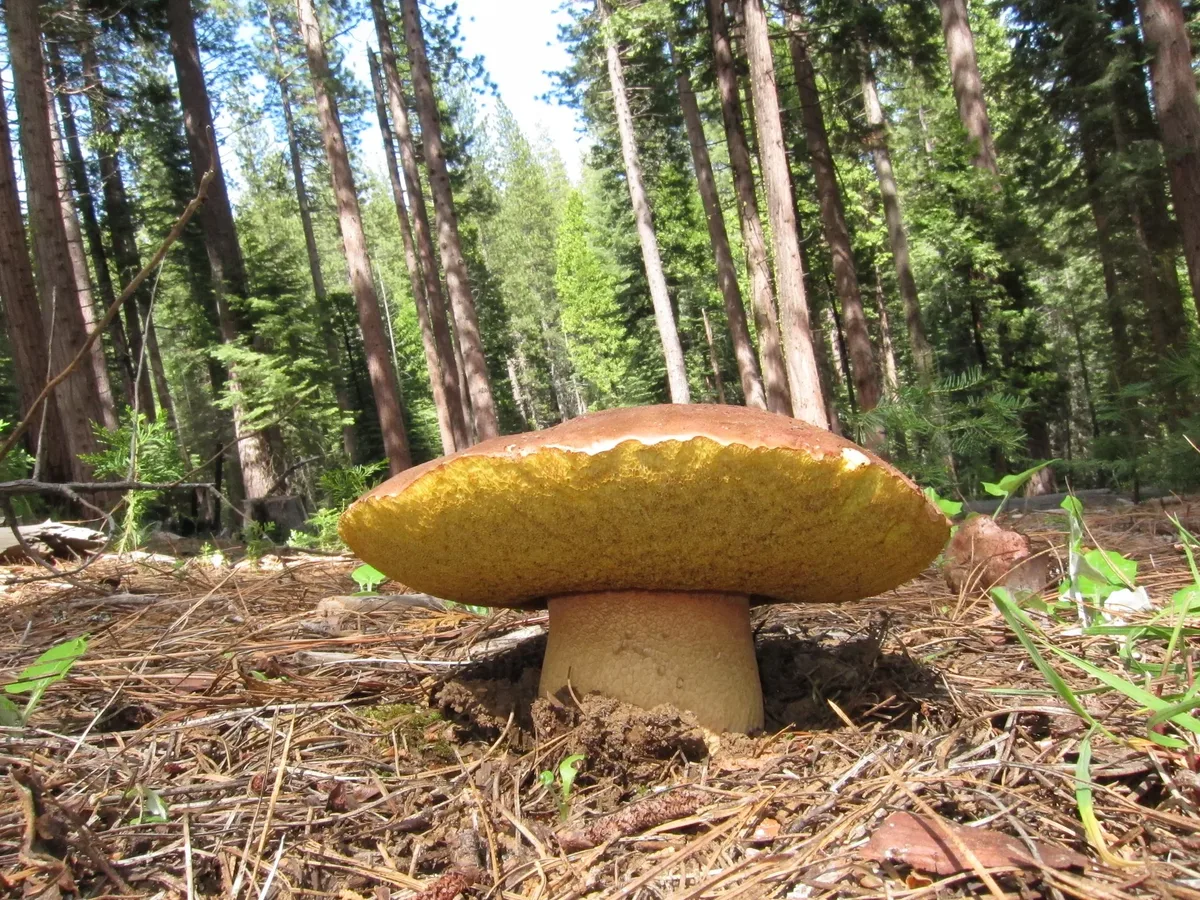 © Alan Rockefeller (CC BY 4.0)
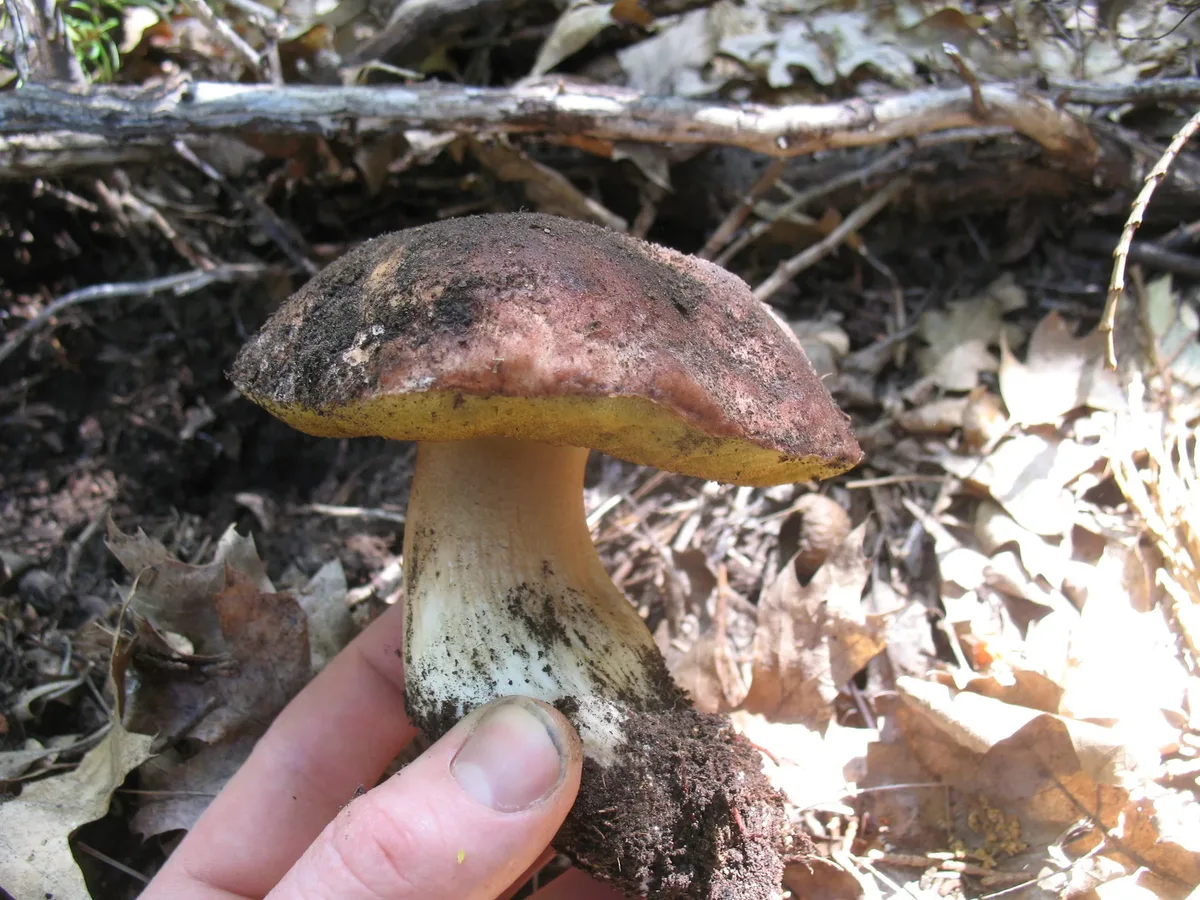 © Alan Rockefeller (CC BY 4.0)
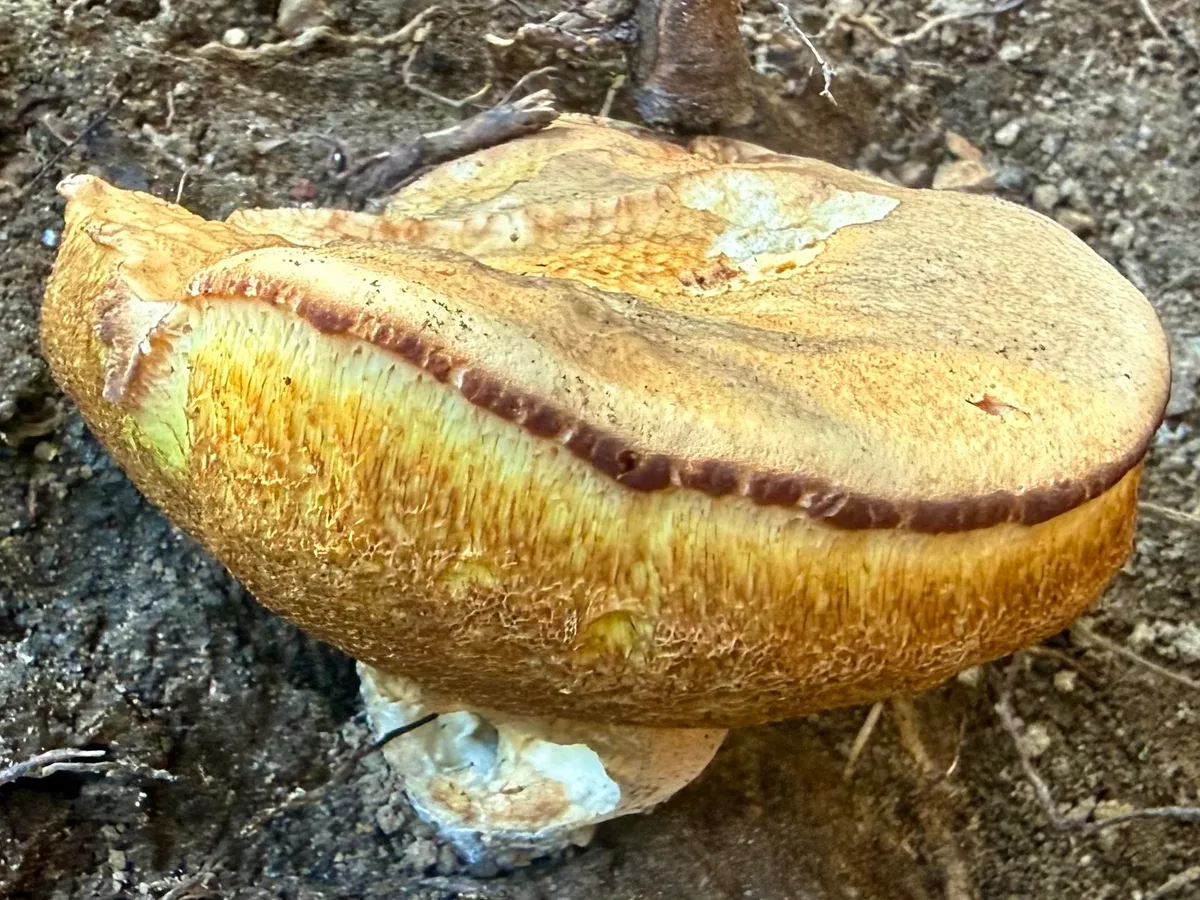 Chuck Wilson (CC0)
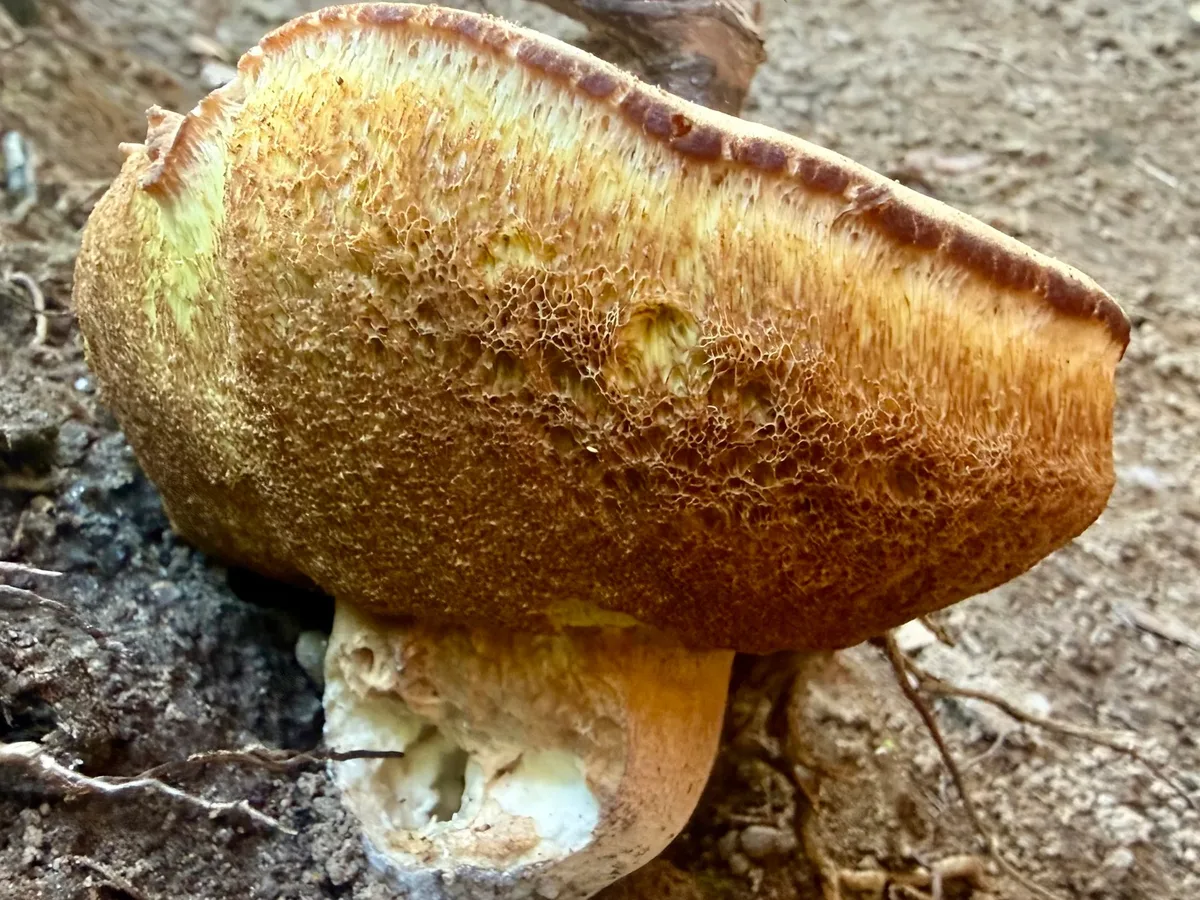 Chuck Wilson (CC0)
 Chuck Wilson (CC0)
 Chuck Wilson (CC0)
 caseyhh (CC0)
 © reagan peschke (CC BY)
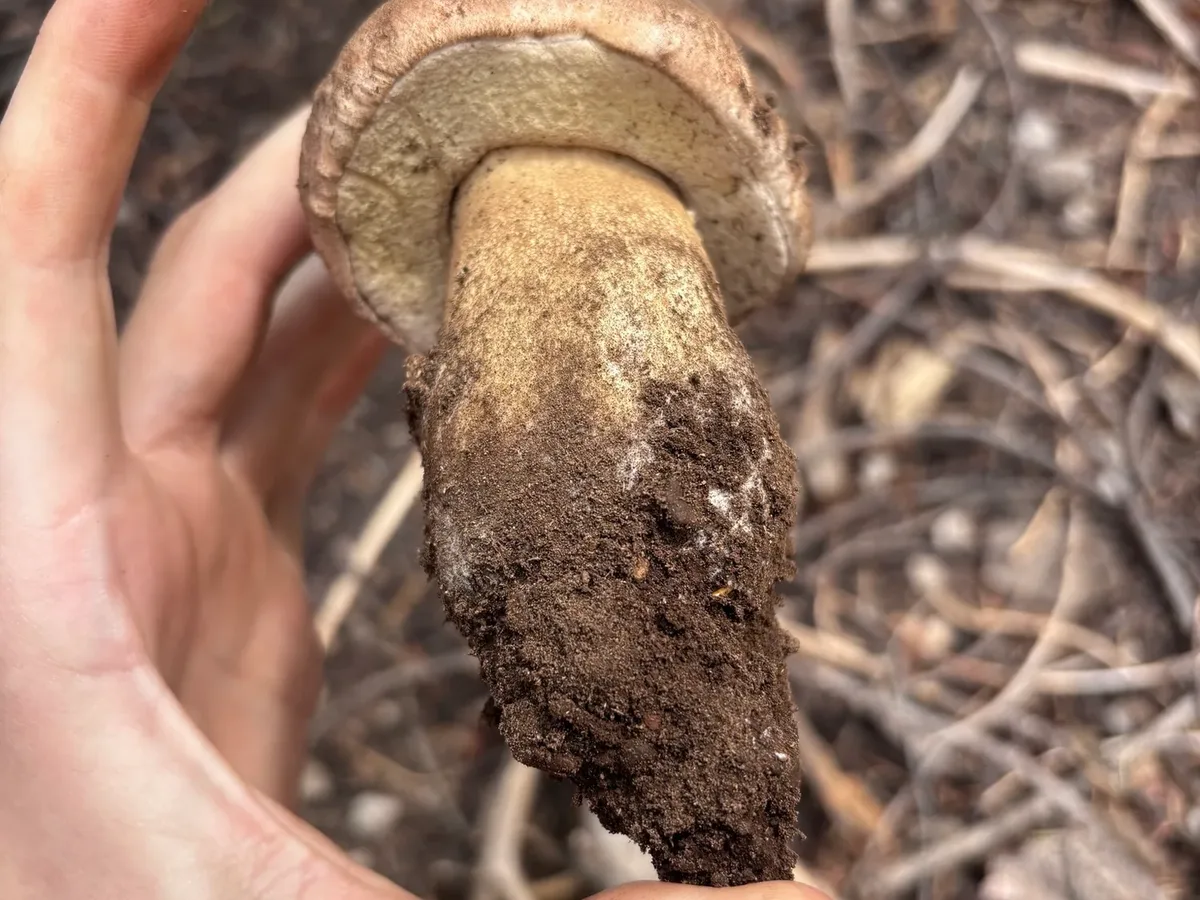 © reagan peschke (CC BY)
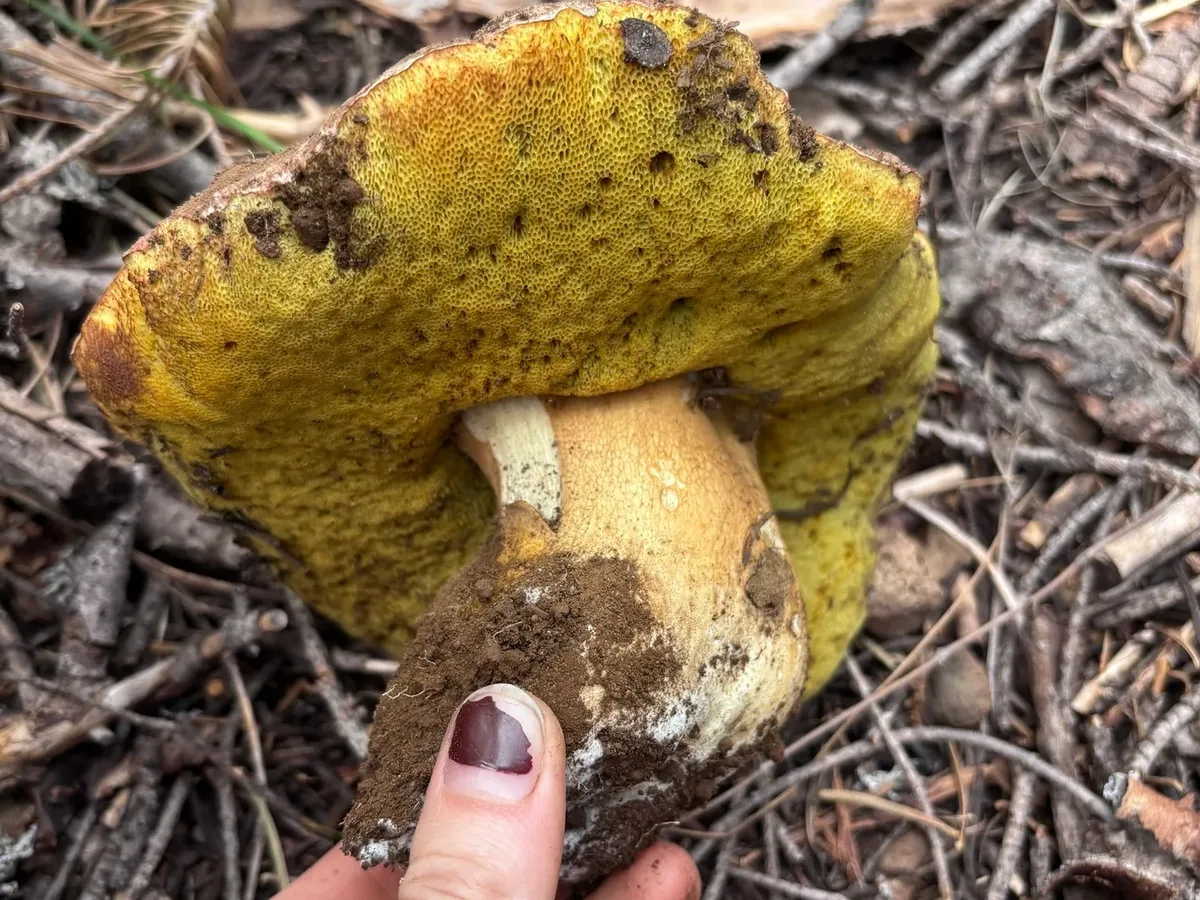 © reagan peschke (CC BY)
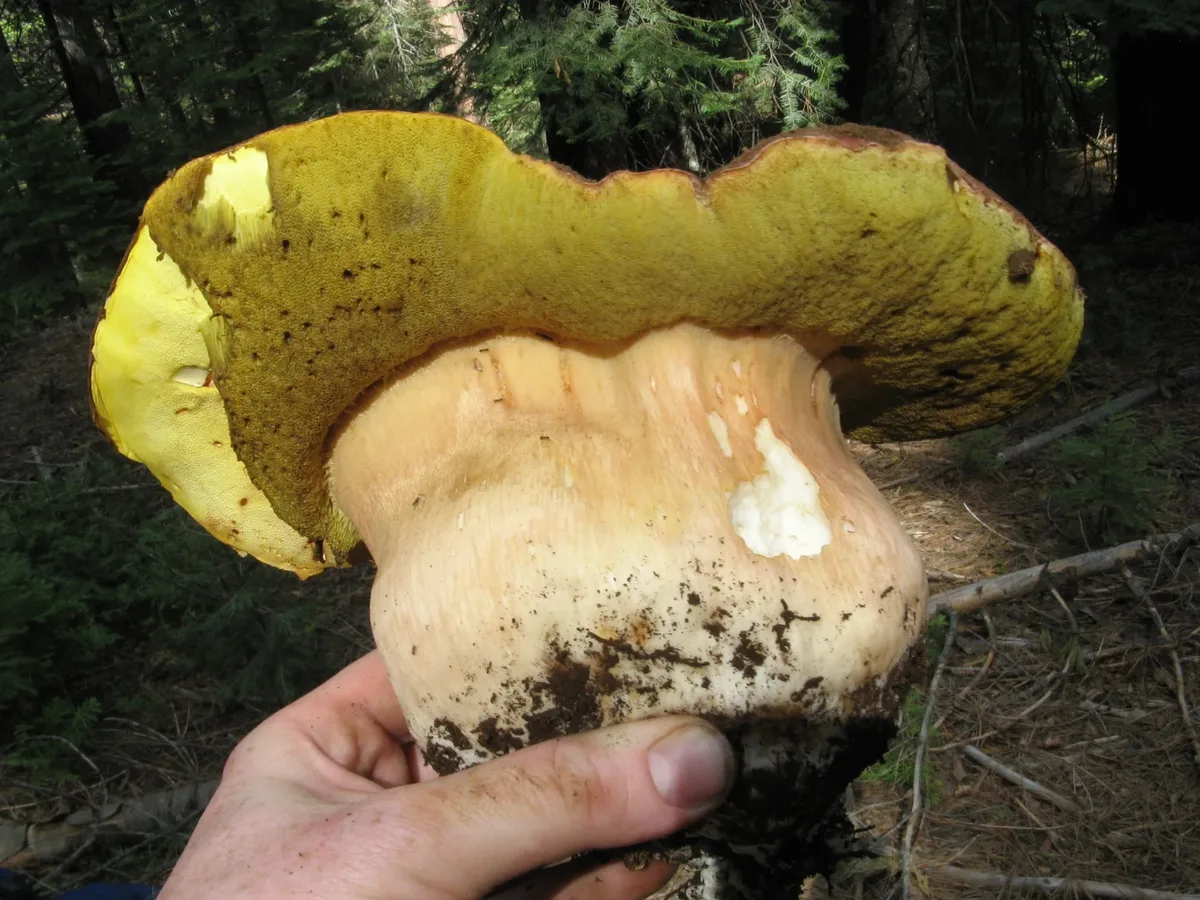 © Alan Rockefeller (CC BY 4.0)
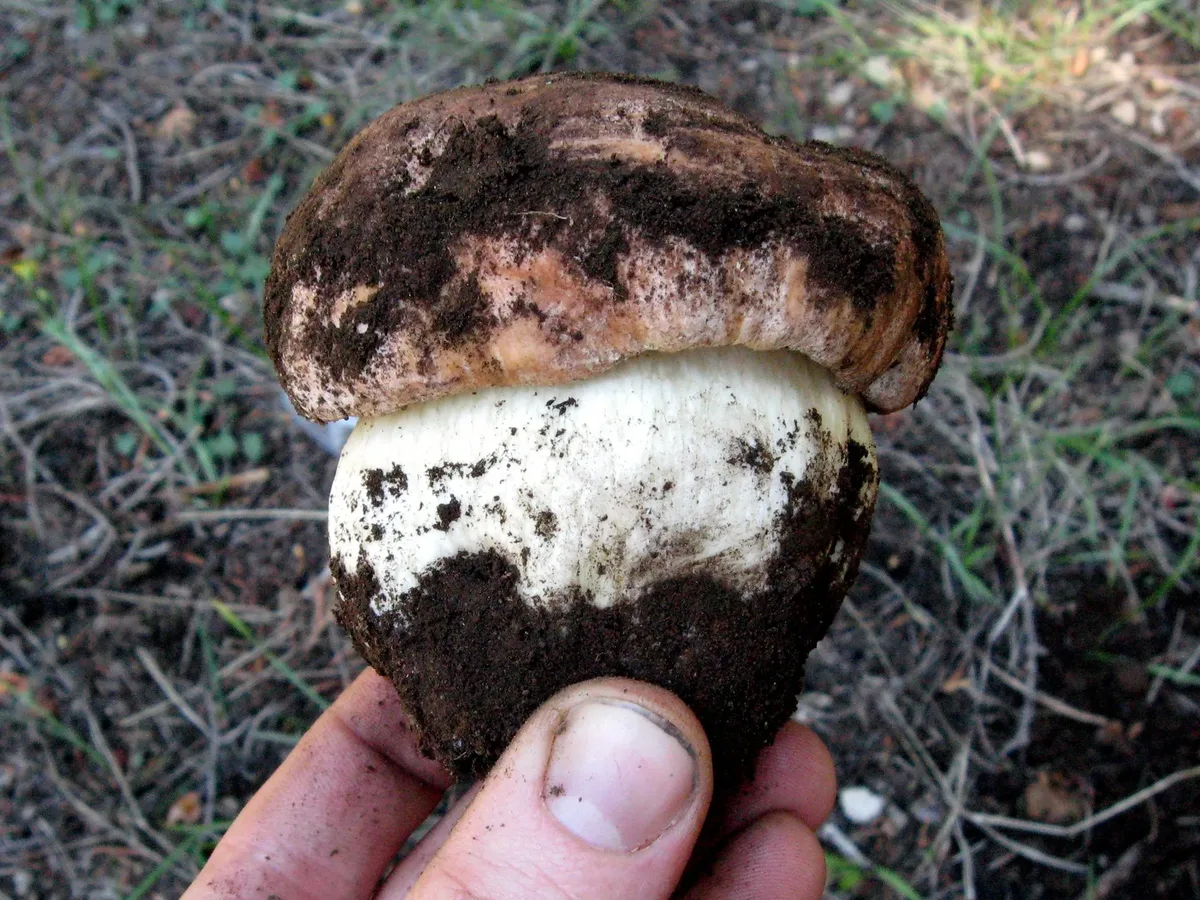 © Alan Rockefeller (CC BY 4.0)© Alan Rockefeller (CC BY 4.0)© Alan Rockefeller (CC BY 4.0)
One of the best mushrooms you can bring home - once you are certain of the identification.
Never eat a mushroom you are not 100% sure of - check the look-alikes below, and always cook wild mushrooms.
How to recognise it
Boletus rex-veris ranks among the most imposing mushrooms in the Rocky Mountain and intermontane West.
Cap
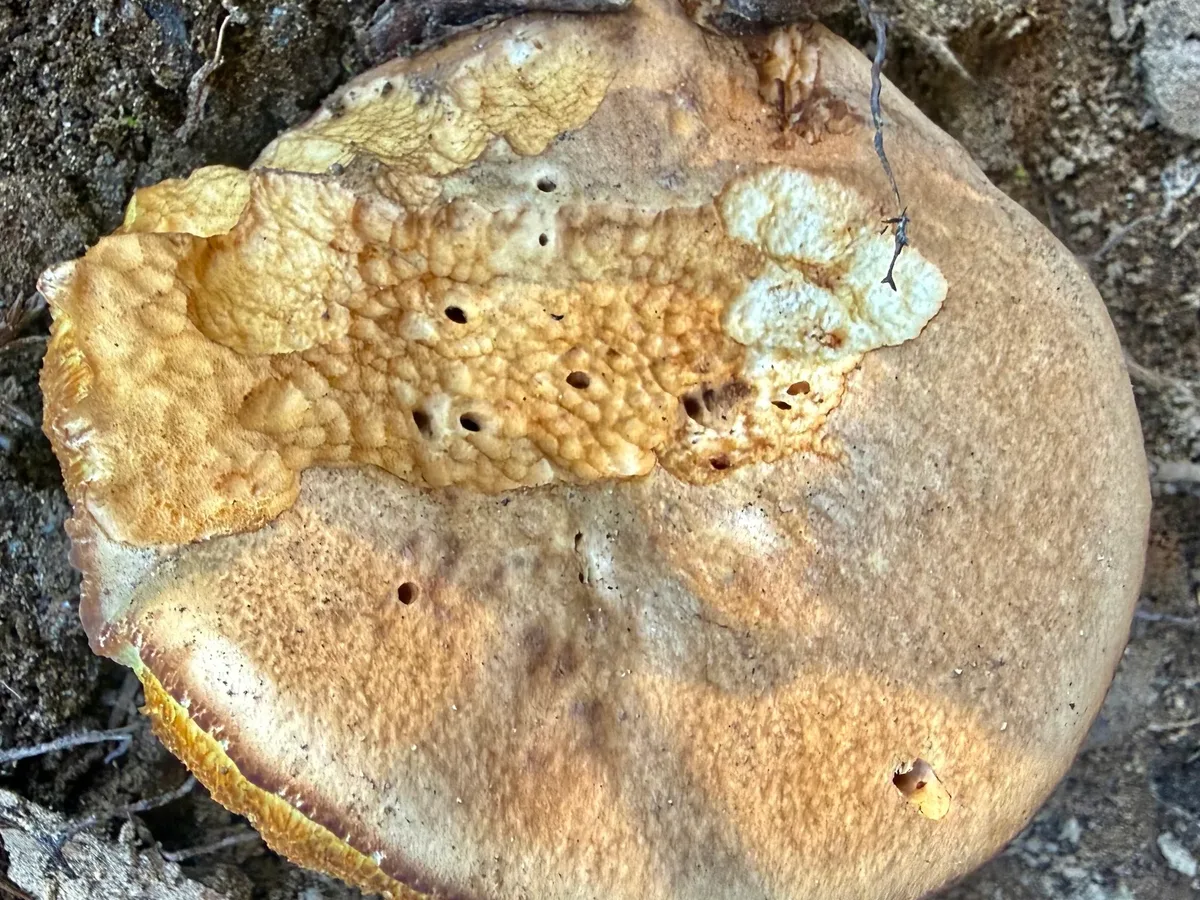
The cap begins as a dense hemisphere - sometimes nearly as broad as it is tall - and expands to a low dome, eventually flattening with age to reach 10-30 cm across.
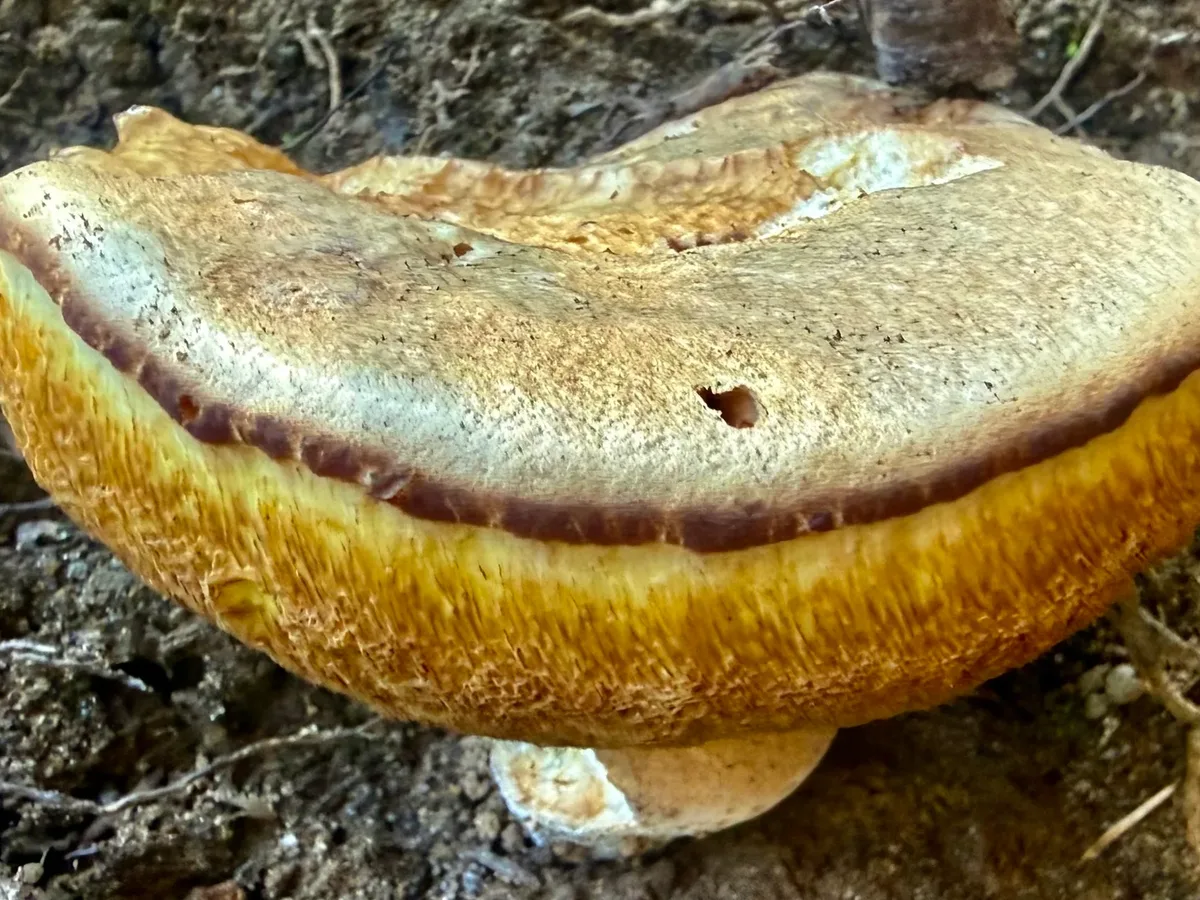
The cuticle is dry and slightly felty in young specimens, shading from a warm brick-red through chestnut-brown toward a darker, almost mahogany centre, and it frequently retains a fine, chalky bloom near the margin when still fresh from the soil.
Gills / Pores
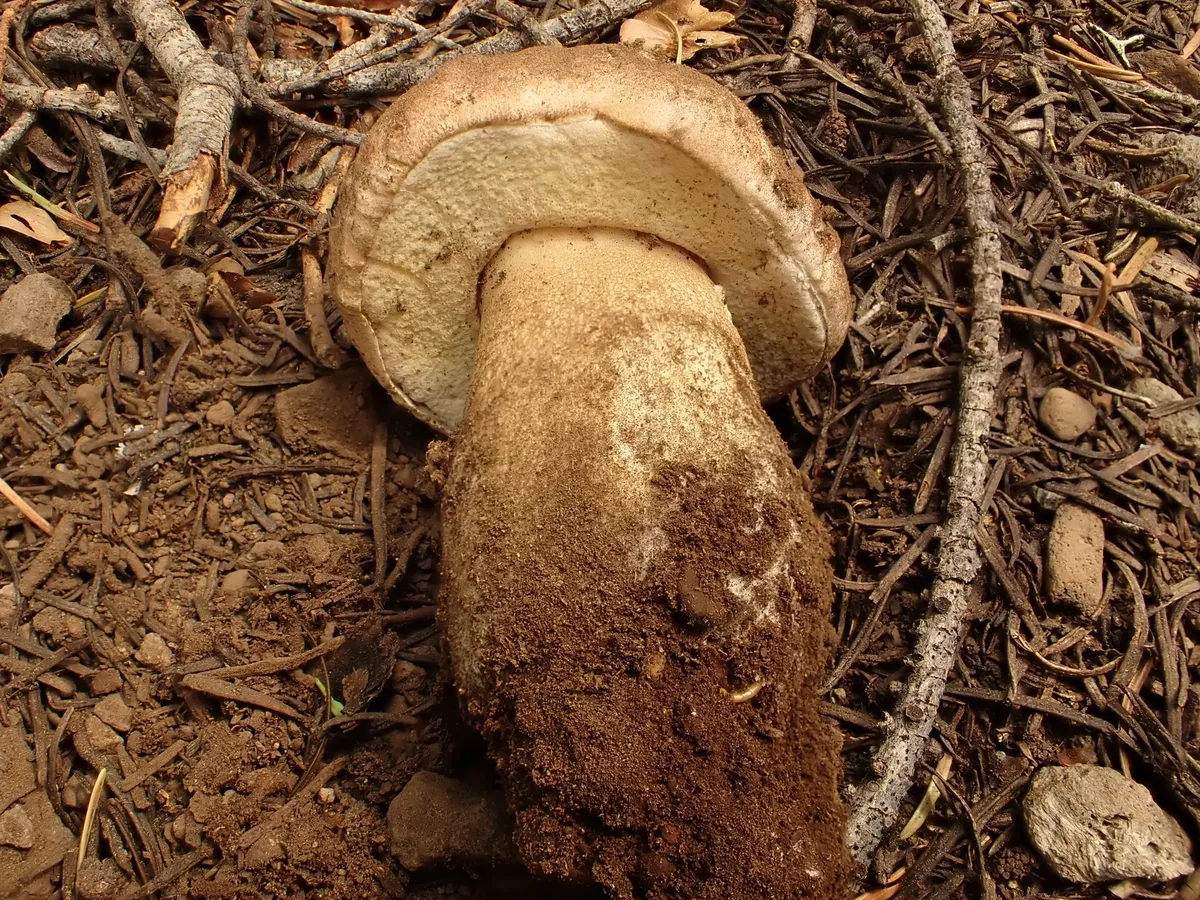
Turn the fruitbody over and the pale underside may surprise you: young pores are white and densely packed, then slowly mellow to cream and a soft lemon-yellow, always without any trace of blue staining, even when cut or bruised.
This non-bluing reaction, paired with the colour palette, is one of the clearest fieldmarks on an otherwise variable species.
Stem
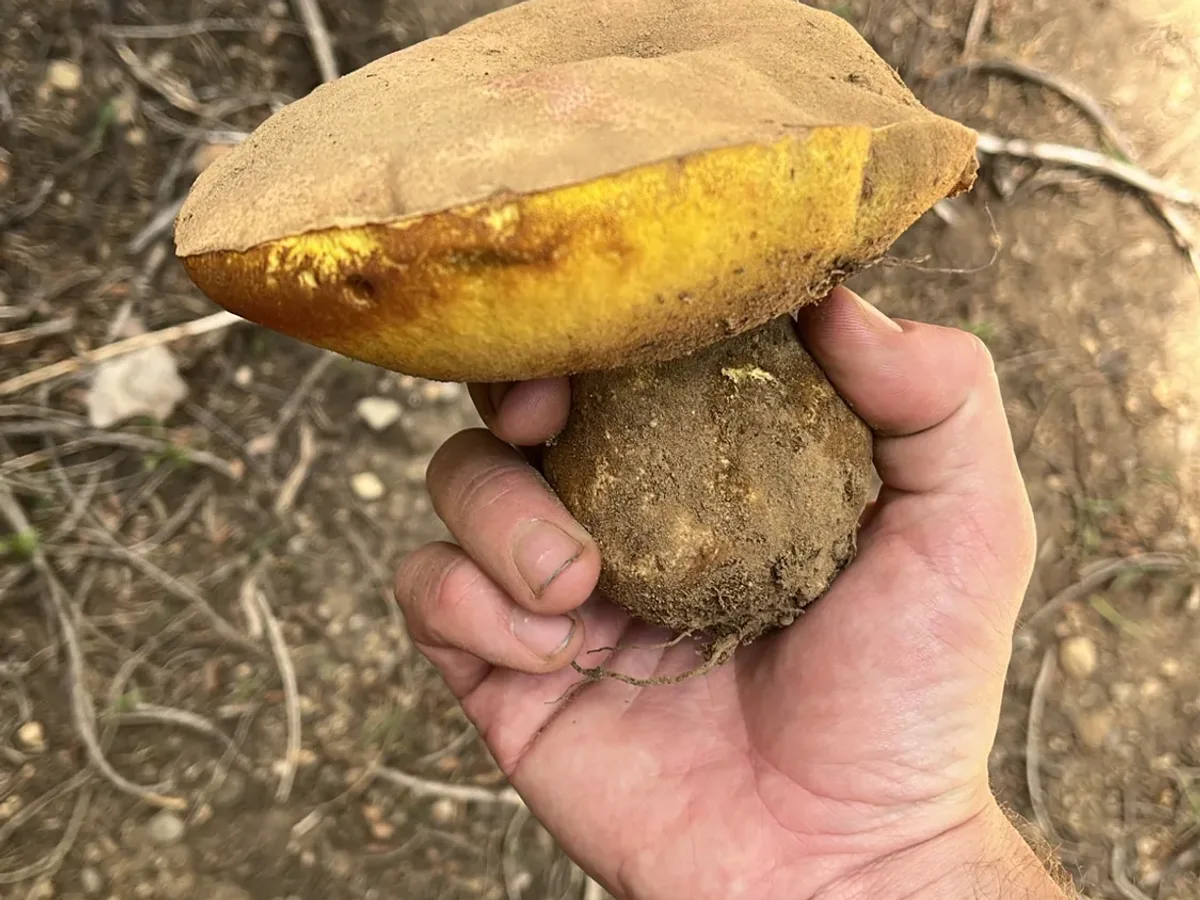
The stem is the structural anchor of the whole fruitbody - typically barrel-shaped to club-shaped in youth and fattening further as the cap expands, often 5-15 cm tall and nearly as wide, the flesh inside dense enough that the base can feel almost woody.
Over the upper half to upper third of the stem, a raised net of pale ribs and connecting strands - the reticulation - catches the light at a low angle and is especially well-developed in this species.
Flesh
Cut the stem in half and the flesh throughout is firm and brilliant white, resisting the tawny staining that other boletes show on prolonged exposure to air.
Smell & taste
The aroma of a fresh, young specimen is one of the most prized in all of foraging: a deep, nutty, mildly fruity scent that intensifies dramatically on drying.
Where & when it grows
Habitat
The spring king is a mycorrhizal obligate, meaning it cannot complete its life cycle without a living conifer partner.
The mycelium colonises the fine tips of conifer roots, sheathing each tip in a woven mantle of fungal cells while sending out hyphae into the surrounding soil. In exchange for photosynthetically fixed carbon from the tree, the fungus mines phosphorus, nitrogen, and water from mineral layers beyond the reach of the roots alone.
This is not a seasonal relationship - the mycelium persists year-round, accumulating over decades and sometimes forming networks that span multiple trees.
On the eastern slope of the Cascades and across the interior Pacific Northwest, Boletus rex-veris strongly favors ponderosa pine and true firs (Abies concolor, A. grandis, A. lasiocarpa) at mid to upper elevations, roughly 1,000-3,000 m, in open or semi-open forest with good drainage.
The Blue Mountains of Oregon and Washington, the northern Rockies of Idaho, the central and southern Rockies into Montana, and the high-elevation ponderosa belts of the Sierra Nevada are all productive ranges.
What unites these sites is a continental climate - dry summers, cold winters, snowpack - and coarse, relatively poor soils where the mineral-mining partnership offers both parties the clearest advantage. Unlike the closely related B. edulis of the rainy west-side forest, rex-veris does not tolerate heavy, perpetually moist soils.
When
The spring king is, by name and habit, a creature of snowmelt. As the winter snowpack retreats up the hillsides in May and into June, it exposes soil that has been insulated all winter at near-zero temperatures.
Once the sun penetrates and brings soil temperatures above roughly 7°C at root depth, the mycelium begins allocating resources toward fruitbody formation.
Timing tracks elevation. On south-facing slopes at the lower margin of its range, the first caps may push through as early as late April or early May; on north-facing aspects or at the upper edge of the subalpine zone, good fruiting can persist well into July in high-snow years.
A useful heuristic is to watch the snowline - foragers on the east side track its retreat with the same attention a winemaker gives harvest weather. After a season of heavy snowfall, the soil moisture following melt is high and the fruiting window can be both broad and prolific.
In dry years with thin snowpack the season is often compressed, with caps pushing through quickly and going over fast.
The autumn porcini (B. edulis) that fruits on the wet west side of the Cascades inhabits a different ecological niche and a different season entirely; the two species rarely, if ever, co-occur in the same stand.
How it grows
Below ground, the story begins weeks or months before any fruitbody is visible. The mycelium of Boletus rex-veris lives as a diffuse, branching web of hyphae woven through the organic and mineral horizons of the forest soil, anchored in the mycorrhizal mat around conifer roots.
When internal carbon reserves and soil moisture cross the thresholds needed for reproduction, the mycelium begins aggregating hyphal strands into a primordium - a dense knot of tissue, still entirely below the litter.
The primordium swells from the inside by absorbing water and elongating cells, not by cell division alone. That is why boletes can expand with remarkable speed once the process starts: a button that is marble-sized on Monday morning can be a full cap by Wednesday if conditions are warm and moist.
In the field, the earliest sign is a gentle doming or cracking of the duff over the buried button; occasionally a small mound of needles and humus is visibly lifted. Once the cap breaks through, expansion continues for another day or two, and the pore layer matures from white to cream as millions of spores ripen inside the tubes.
Spores are released by the billions during a flush, carried on convective air currents rising through the open forest canopy, and the vast majority travel no more than a few meters from the parent fruitbody.
Germination in suitable soil is the rarest event; establishing a new mycorrhizal partnership with a seedling root takes months of courtship-like chemical signaling before the sheath forms.
Fruiting conditions
Fruits a few weeks after snowmelt as soils warm in spring; flush lag reflects the post-snowmelt warming window described in the guide.
Look-alikes
Four groups of look-alike species deserve attention, and the distinguishing tests are reliable.
- Bitter boletes (Caloboletus species) share the brown cap and pale stem but produce pores that are yellow even when young and turn blue within seconds of being cut or bruised. A small taste of the pore surface reveals an intense, persistent bitterness that makes the edible spring king impossible to confuse.
- Red-pored boletes (Rubroboletus eastwoodiae and various Neoboletus species) are separable before you even test for bluing: their pore surfaces are orange to blood-red in fresh specimens. Press a thumb to the pores and they bruise blue or blue-black almost instantly. The spring king has white to cream-yellow pores that show no blue reaction and no red pigmentation at any stage.
- Poisonous webcap mushrooms (Cortinarius species) are a different family altogether - they have gills, not pores, a web-like cortina (veil) in youth, and a rust-brown spore print. No bolete shares these features; if the underside of your find has a spongy, tube-lined pore layer, it is not a Cortinarius.
A simple checklist resolves almost all field uncertainty:
- brown cap
- pale thick stem with net-like reticulation in the upper portion
- white-to-cream pores that do not stain blue
- white firm non-staining flesh
- no bitter taste
- no red coloration anywhere
Meeting all of these criteria together in the right conifer habitat in spring-early summer identifies Boletus rex-veris with high confidence.
Have gills, not pores; any bolete has a spongy pore layer underneath the cap.
Yellow pores that stain blue immediately and an intensely bitter taste; the edible spring king has a white pore layer that never stains blue and a mild taste.
Orange/red pores that turn blue (bruise blue); the spring king has white-to-yellowish pores with no color change.
Orange/red pores that turn blue; the spring king has white-to-yellowish pores that never blue.
In the kitchen
Picking & cleaning
The first field skill with the spring king is learning to read the duff. On a productive slope in good conditions, you will spot small domed humps or radial cracks in the pine needle layer before any cap is visible - press gently and feel for the resistance of a buried button.
Digging these unblemished young specimens is the most reliable way to get insect-free, larva-free mushrooms, because blowfly and fungus gnat larvae bore upward through the stem base within hours of cap emergence in warm weather.
The standard test for larvae: slice each stem longitudinally as soon as it is picked. Clean white flesh throughout is the ideal; a loose, crumbly or discolored interior, or visible tunnels, means the specimen was already past its prime at collection. Larger caps with fully open pores and yellowing tube layers are almost always wormy unless the air temperature has been cold enough to suppress insect activity.
The spring king's flesh is unusually robust for a fresh-picked bolete: it does not oxidize and blacken quickly, it tolerates jostling in a basket better than most, and it refrigerates well for two to three days without significant moisture loss or texture change.
For longer storage, slicing and drying at 40-50°C in a dehydrator captures the full aroma; alternatively, blanch and freeze for up to six months. Do not wash before drying - the cap cuticle sheds moisture reluctantly, and water soaking delays drying and encourages spoilage.
Cooking
The spring king is exceptional in the kitchen, and its high dry-matter content relative to moisture makes it one of the most versatile wild mushrooms for long-term preservation.
Drying is where it excels most. Slice the cap and stem 4-6 mm thick and dry at 40-50°C until the slices snap cleanly. The dried product concentrates all the umami, the sweet nuttiness, and the subtle fruitiness of the fresh cap into a form that stores for a year or more in sealed glass and rehydrates in warm water in 20-30 minutes, producing both reconstituted slices and a deeply flavored soaking liquid useful as a stock base.
Fresh specimens are best prepared simply: a hot pan, a generous knob of butter, a pinch of salt, and four to five minutes of undisturbed contact on each side allows the moisture to evaporate and the outer surface to caramelize. Adding acid (lemon juice, white wine) at the end brightens the flavor without masking it.
For risotto, the dried form yields a more concentrated and evenly distributed flavor than fresh. In soups and braised dishes, the firm flesh holds its structure through long cooking, unlike softer species that dissolve into the broth.
Avoid steaming or boiling fresh caps, which leaches flavor and softens texture; if moisture is needed for a dish, add broth rather than water to compensate.
Good to know
Boletus rex-veris is rated choice edible, with no documented cases of poisoning in the scientific or medical literature.
The one practical caution applies to older specimens: as the pore layer ages it becomes slimy and slightly gelatinous, and it concentrates heavier breakdown products from tissue senescence. Some individuals with sensitive digestion report mild gastric upset from eating this material, particularly raw or undercooked.
The remedy is straightforward: peel away the tube layer on older specimens (it separates cleanly from the cap flesh with a finger) and cook thoroughly, as heat resolves most minor digestive irritants in boletes.
There is no toxic compound known in this species and no record of serious illness attributable to correctly identified B. rex-veris. As with all wild mushrooms, a confident identification using multiple fieldmarks - not a single feature - is the baseline safety practice before eating any collection.
A reference guide - never an edibility guarantee. When in doubt, leave it out.