Motta's bolete
Boletus mottiaesyn. Boletus pinicola var. mottiae
 Andrew W. Wilson (CC0)
 Andrew W. Wilson (CC0)
 Denver Botanic Gardens, Sam Mitchel Herbarium of Fungi (DBG-DBG) (CC0)
 Denver Botanic Gardens, Sam Mitchel Herbarium of Fungi (DBG-DBG) (CC0)Andrew W. Wilson (CC0)Andrew W. Wilson (CC0)
Good to eat, once you have identified it with certainty and cooked it through.
How to recognise it
Boletus mottiae is a member of the porcini complex - the group of large, white-fleshed, reticulate-stemmed boletes that includes the celebrated Boletus edulis, B. pinophilus, B. reticulatus, and B. rex-veris.
Cap
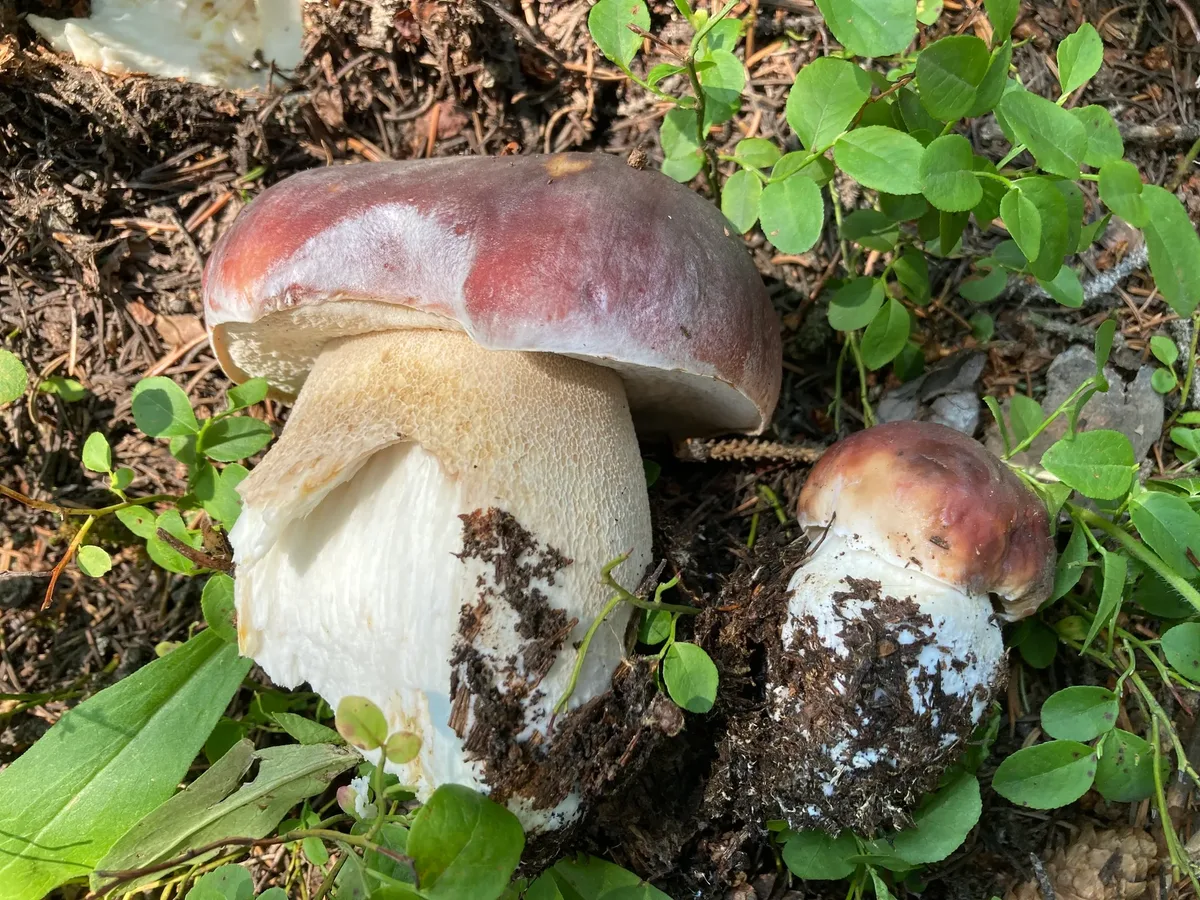
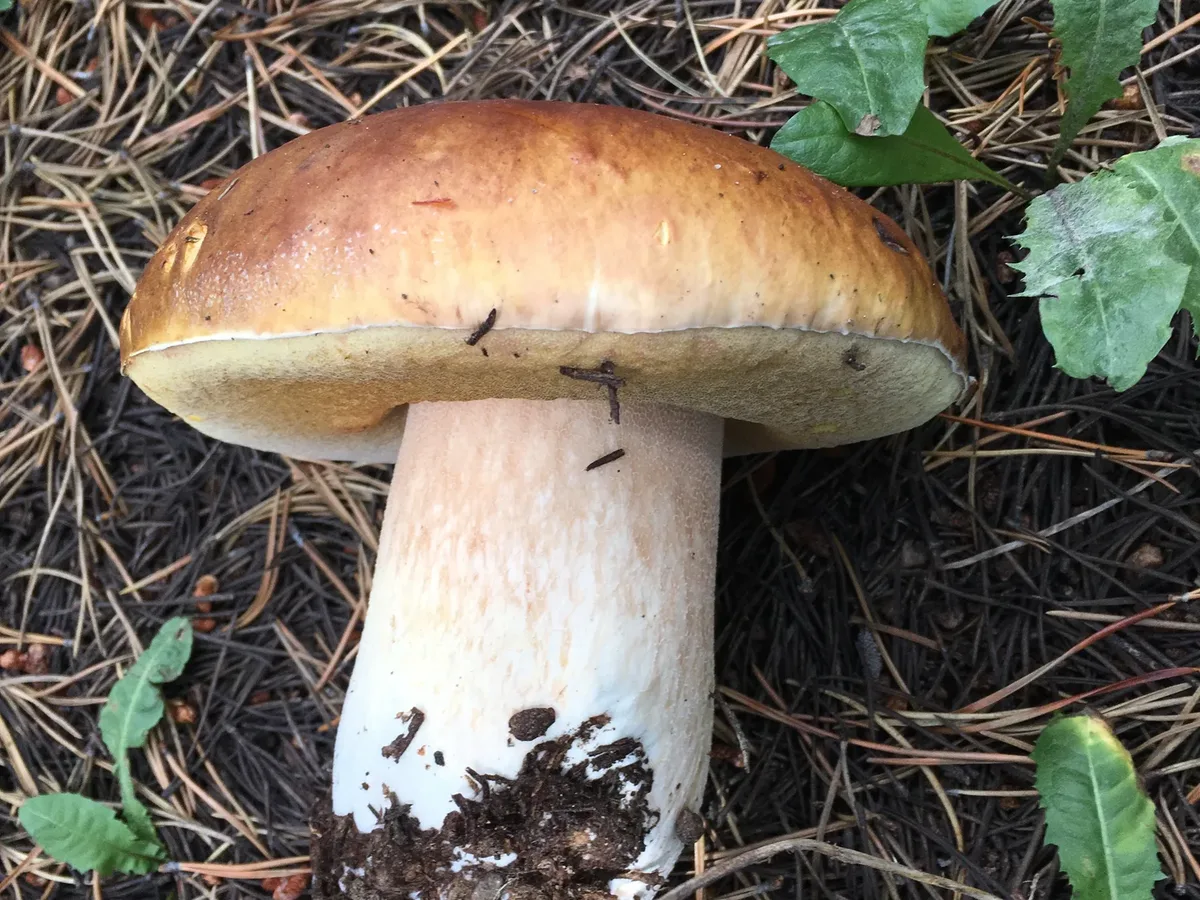
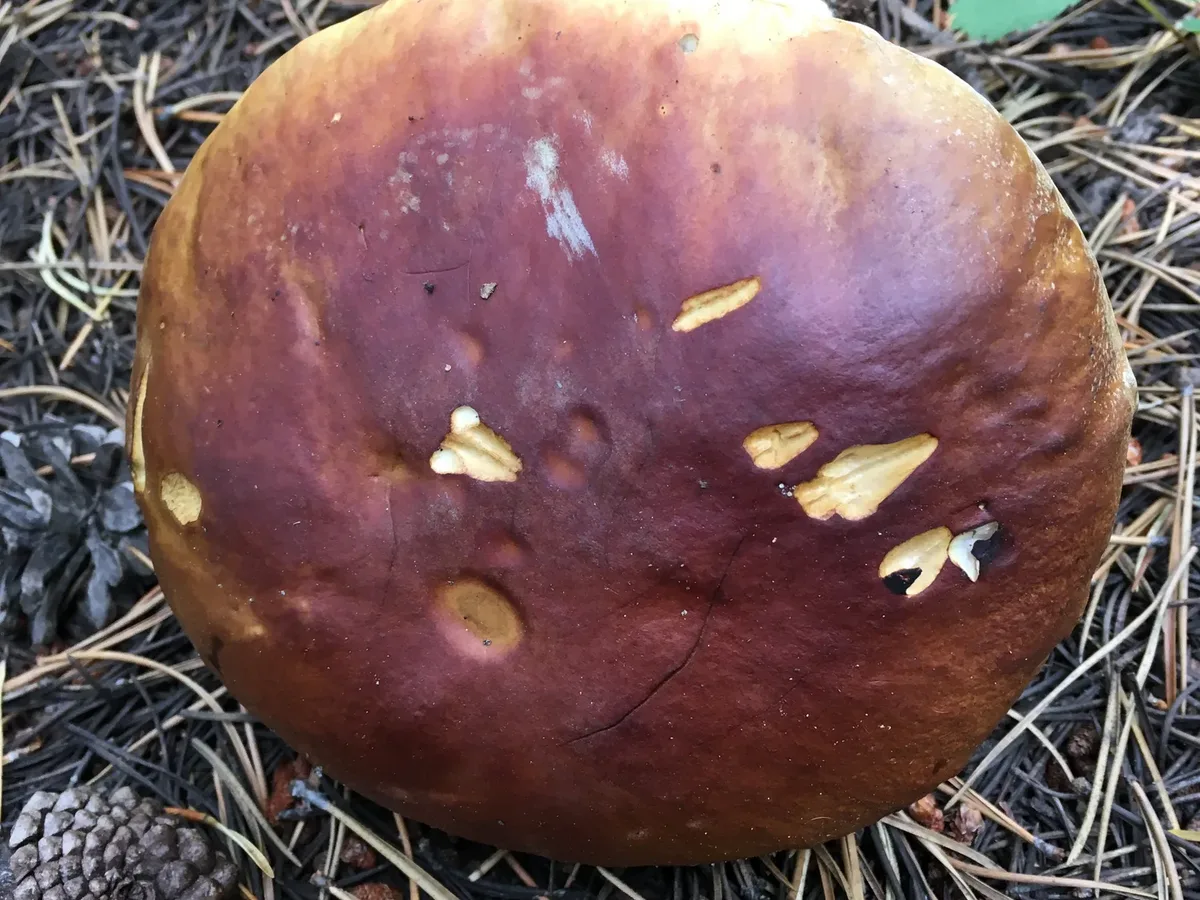
Within this group it sits in the middle ground: the cap is a warm ochre-brown to tawny buff-brown, distinctly paler than the reddish-maroon of B. pinophilus but often a touch more saturated and even-toned than a typical B. edulis.
When young, the cap surface has a fine downy, felty texture - run a finger over it and you feel a soft nap. This tomentum is shared with B. pinophilus and helps separate Motta's bolete from B. reticulatus, whose cap tends toward a more wrinkled or cracked surface in dry weather.
Pores
The pore surface progresses from white through cream to pale olive-yellow as the cap matures - a normal ageing process, not a warning sign.
Stem
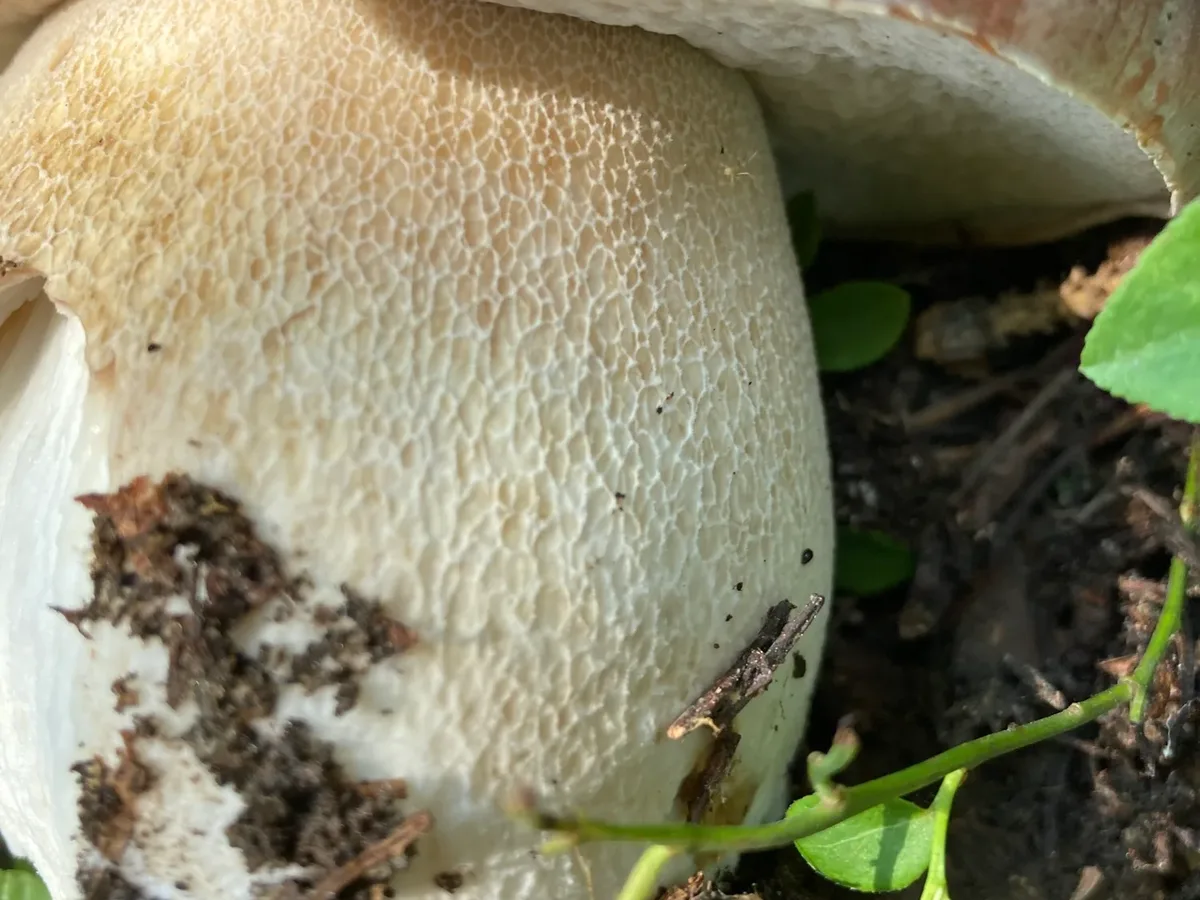
The stem carries a well-developed pale buff reticulum (net pattern) on its upper half that fades toward the base.
Flesh
The single most important feature is the flesh: cut the stem cleanly and watch for a minute. It is white, firm, and stays white. Any bolete whose flesh turns blue within a minute of cutting should be set aside unless you have solid experience with bluing species.
Where & when it grows
Habitat
Motta's bolete is a creature of cool, humid forest - it forms long-lived mycorrhizal partnerships with Norway spruce above all, though it will link up with Scots pine and silver fir where they grow alongside. In Scandinavia it threads through the boreal spruce belt from lowland valley forests up to where spruce gives way to open fell.
Look for it on moderately acid soils with a well-developed layer of partially decomposed organic matter - that moist, spongy F-layer just above mineral soil is where ectomycorrhizal root-tips are most concentrated, and where the mycelium has been quietly building its network, perhaps for decades.
The ground flora beneath productive trees is typically bilberry, lingonberry, or ferns, with carpets of feather-mosses such as Hylocomium splendens. It avoids waterlogged hollows and chalky soils.
Sheltered mid-slopes, where cold air drains away overnight but moisture lingers, tend to be the most reliable spots.
When
Motta's bolete fruits during the heart of the northern mushroom season - mid-summer through early autumn. In Scandinavia the first fruiting bodies typically push up in late July or early August, once the brief midsummer warmth begins to ease and the first meaningful post-solstice rains arrive.
The main flush comes in August and early September, when soil temperatures settle into the 10-15°C sweet spot the species seems to prefer. By mid-October, hard frosts end the season across most northern localities.
The trigger that sets things in motion is quite specific: the mycelium waits for soil temperatures to drop back below roughly 18-20°C and for at least a good soaking of rain, then sends up fruiting bodies 7-14 days later.
A July and August drought suppresses fruiting even if September brings plenty of rain - once the mycelium is stressed by summer heat and dry soil, recovery takes time. The most productive years combine a wet early August with a gentle cooling: conditions that feel almost designed to coax the forest into yielding.
How it grows
Fruits singly or in small scattered groups of 2-5, not in dense clusters. Fruiting bodies emerge from the moss and leaf litter with only their caps visible in the button stage.
Growth from button to full size takes 4-8 days in cool, moist conditions. The stem base typically remains embedded in the humus-litter interface.
The ectomycorrhizal mycelium beneath the soil is perennial - the same individual can fruit from the same patch of forest year after year, decade after decade, tethered invisibly to the roots of its host tree. A tree you find productive once is worth returning to.
One practical note: fungus-fly larvae (Pegomya and related species) move in quickly in warm weather. Very young buttons are the cleanest; older large caps are frequently riddled with tunnels. Heavily infested caps can be left in place - they are still spreading spores and doing their ecological work.
Fruiting conditions
Fruiting is triggered by at least 20 mm of rain over a 14-day window combined with soil temperatures in the range 8-18°C. The main flush appears 7-14 days after a triggering rain event. Temperatures above 20°C in the soil suppress fruiting even when moisture is adequate; conversely, temperatures below 6°C also suppress growth. The critical combination in Scandinavia is a late-summer cooling event (mid-August) accompanied by rainfall of 20-40 mm, which reliably initiates a late-August to early-September flush.
Look-alikes
Boletus mottiae sits within the porcini complex and its closest lookalikes are all the other porcini species, none of which pose a safety risk.
- Boletus edulis (penny bun) is the commonest confusion: it tends to have a smoother, more polished cap surface at maturity, a classic pale buff-to-chestnut-brown with a characteristic whitish bloom or veil-like margin zone, and broader host associations (beech, oak, spruce); in practice the differences are subtle and the two are equally choice.
- Boletus pinophilus (pine bolete) is darker - reddish-maroon to chestnut - and strongly associated with pines rather than spruce; it also has a distinctly more reddish-brown felty cap surface.
- Boletus rex-veris (spring porcini or sticky bun) occurs at higher altitude, often in subalpine spruce-fir zones, has more olive-toned flesh and a pinkish-ochre stem, and may appear slightly later in the year at its stations; equally edible.
- Tylopilus felleus (bitter bolete) is the one non-edible confusion to take seriously: it looks very similar at a glance - large, brown-capped, reticulate-stemmed, white flesh - but the pore surface turns distinctly pink to flesh-rose as it matures, the stem reticulation is coarser and darker brown, and the flesh is intensely bitter. A tiny nibble of raw flesh (spit out, do not swallow) gives an unmistakable soapy-bitter sensation that makes any dish unpalatable. T. felleus is not dangerous but causes gastrointestinal distress.
- Rubroboletus satanas (Satan's bolete) is sometimes mentioned in the context of bolete safety: it has a pale whitish-grey cap, vivid red pores, and instantly-bluing flesh when cut - nothing about its appearance resembles B. mottiae, and the combination of these features makes confusion essentially impossible for anyone who has read a description.
The universal bolete safety rule applies: do not eat any bolete with red or orange pores, or any bolete whose flesh turns blue within 1-2 minutes of cutting.
Shares large stature and reticulate stem but differs crucially: pores turn distinct pink to flesh-rose at maturity (never yellow); stem reticulation is coarse and dark brown on a brown background; flesh is intensely bitter - a tiny nibble (spit out without swallowing) is immediately diagnostic. Not lethally toxic but inedible and causes gastrointestinal distress.
B. edulis is the most commonly confused species; it tends to have a smoother, more polished cap (less felty) with a characteristic whitish 'veil-zone' at the margin, and fruits under a wider range of trees including beech and oak. In practice the differences are subtle and both species are equally choice edibles - confusion carries no safety risk.
B. pinophilus has a distinctly darker, reddish-maroon to chestnut-brown cap with a pronounced felty texture; it is strongly associated with pines rather than spruce. Equally choice - confusion poses no risk.
B. rex-veris occurs at higher altitude (subalpine zone), has a more ochre to olive-tinted cap, pinkish tones on the lower stem, and often a slight sticky sheen when moist. Also choice - no safety concern.
In the kitchen
Picking & cleaning
Harvest young to mid-maturity specimens for best quality; the white, firm flesh of button-stage fruiting bodies is far superior to the spongy, insect-tunnelled flesh of old large caps.
When collecting, twist gently at the base or cut cleanly at soil level. Immediately check the stem cross-section:
- Clean white flesh throughout indicates a maggot-free specimen.
- Dark tunnels radiating from the centre indicate fly-larva infestation.
Infested specimens sporulate freely and need not be discarded from the forest for this reason - leave heavily infested ones in situ.
Like all porcini, B. mottiae is excellent for drying: slice caps 5-8 mm thick and dry at 40-50°C until brittle and leathery. The dried product concentrates the mild nutty flavour and keeps for 12-24 months in airtight storage.
Cooking
Boletus mottiae should always be cooked before eating. Like all members of the porcini complex, the raw flesh contains heat-labile compounds that can cause mild gastrointestinal irritation - nausea, bloating, or cramping - even in species with no true toxins.
Standard thorough cooking (sautéing, simmering, roasting) deactivates these compounds completely. No special preparation such as blanching or parboiling is required or beneficial, and the delicate nutty flavour is better preserved by cooking directly in the pan rather than pre-boiling.
The mild, nutty, slightly sweet flavour of B. mottiae shines best in preparations that respect the mushroom rather than overwhelm it.
- Sautéing in butter is the canonical method: slice caps 5-8 mm thick, cook over medium-high heat in unsalted butter with a pinch of salt until golden and any released moisture has evaporated, then finish with fresh parsley or thyme. This technique concentrates the flavour and produces a slightly golden crust on the mushroom surface.
- For risotto, add sautéed B. mottiae partway through cooking so the pieces retain some texture; the starchy cooking liquid carries the mushroom's aroma into the whole dish.
- In pasta sauces and cream-based preparations, add the mushroom early enough for the sauce to absorb its aroma but not so early that the pieces become waterlogged.
- Soups and broths benefit from longer cooking times that draw out the full flavour into the liquid.
In older, larger specimens the tube layer (the spongy pore layer on the underside of the cap) can become thick, soft, and excessively absorbent, soaking up oil or butter during cooking and contributing a greasy texture to the finished dish. In these cases it is worth running a spoon or knife along the underside of the cap to scrape away the tubes before slicing.
In young, fresh specimens - the ideal harvest stage - the tube layer is thin, firm, and fully palatable, and there is no need to remove it.
Drying is the preferred long-term preservation method and, crucially, improves rather than diminishes the flavour:
- Slice the caps 5-8 mm thick (thinner slices dry faster but crumble more easily; thicker slices retain more texture when rehydrated).
- Dry at 40-50°C - a food dehydrator is ideal; a domestic oven at its lowest setting with the door slightly ajar also works.
- Dry until the slices are fully brittle and snap cleanly, with no rubbery or leathery core remaining; partial drying invites mould in storage.
- Store in airtight glass jars away from light and moisture; dried B. mottiae keeps well for up to 24 months.
The drying process drives off water while concentrating the volatile aromatic compounds, producing an intensified, deeply savoury flavour that many cooks prefer to fresh.
To rehydrate, soak in warm water for 20-30 minutes, then use both the mushrooms and the soaking liquid (strained through a fine sieve or coffee filter to remove any grit) in the recipe - the soaking liquid carries a large proportion of the flavour and is too valuable to discard.
Boletus mottiae is fully interchangeable with Boletus edulis in any recipe. The flavour profile is essentially identical - mild, nutty, slightly floury - and no recipe adjustment is needed when substituting one for the other. Any preparation that works for penny bun works equally well for Motta's bolete.
Good to know
Boletus mottiae is a safe edible mushroom with no known toxins and no confirmed cases of poisoning attributable to this species. The risk profile is identical to the porcini group generally:
- 1Confusion with Tylopilus felleus, which is non-toxic but bitter and causes gastric upset - confirmed by tasting a tiny piece of raw flesh and spitting it out.
- 2Consuming heavily maggot-infested specimens, which may cause mild gastrointestinal irritation in sensitive individuals.
- 3Eating raw or undercooked boletes, which can cause gastric irritation even in edible species - always cook thoroughly.
There are no deadly lookalikes within the spruce-forest ecosystem when the species is identified by the full combination of characters: white non-bluing flesh, white-to-olive-yellow (never red or pink) pores, reticulate stem, and pale brown non-reddish cap.
As a general rule for bolete safety: reject any bolete with red, orange, or pink pores, or with flesh that turns blue on cutting.
A reference guide - never an edibility guarantee. When in doubt, leave it out.