Southern porcini
Boletus austroedulis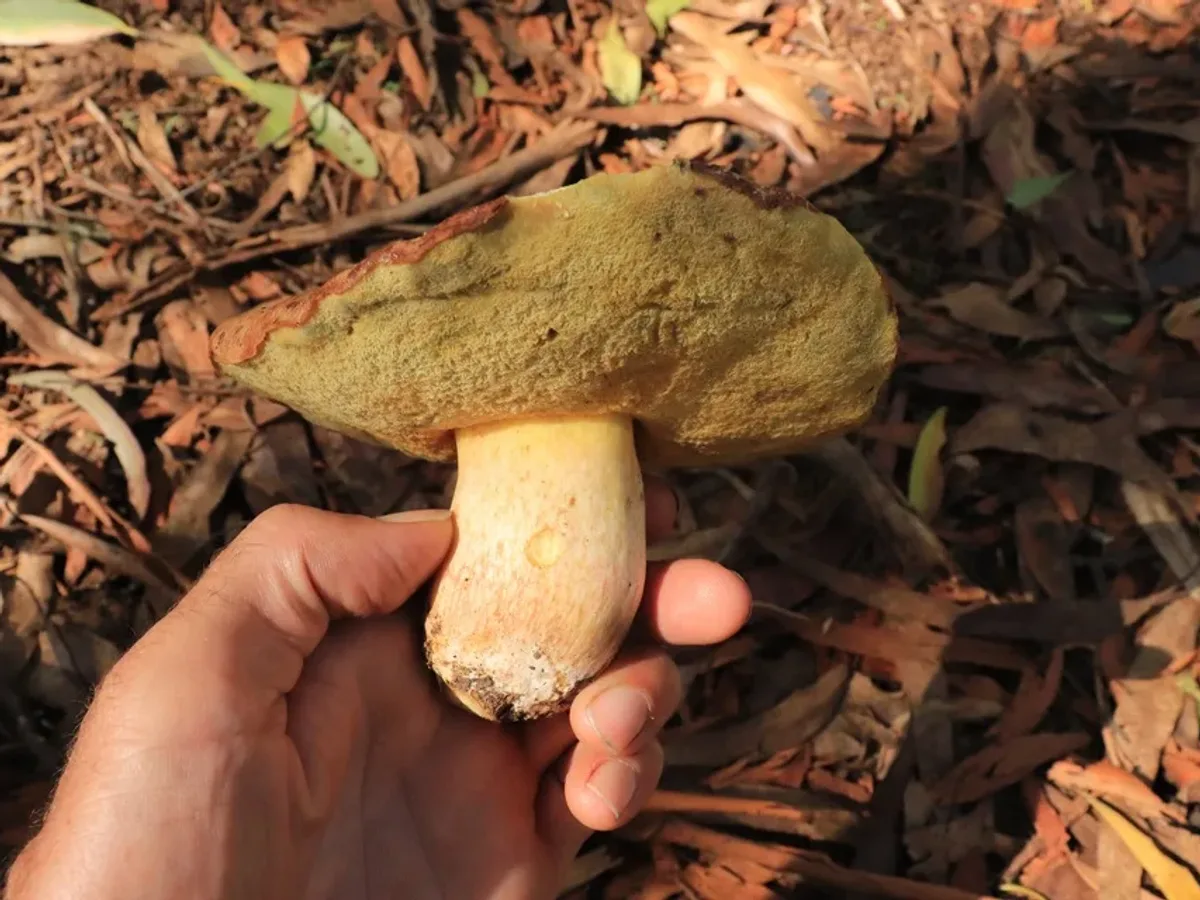 © Jsun Lau (CC BY-SA)
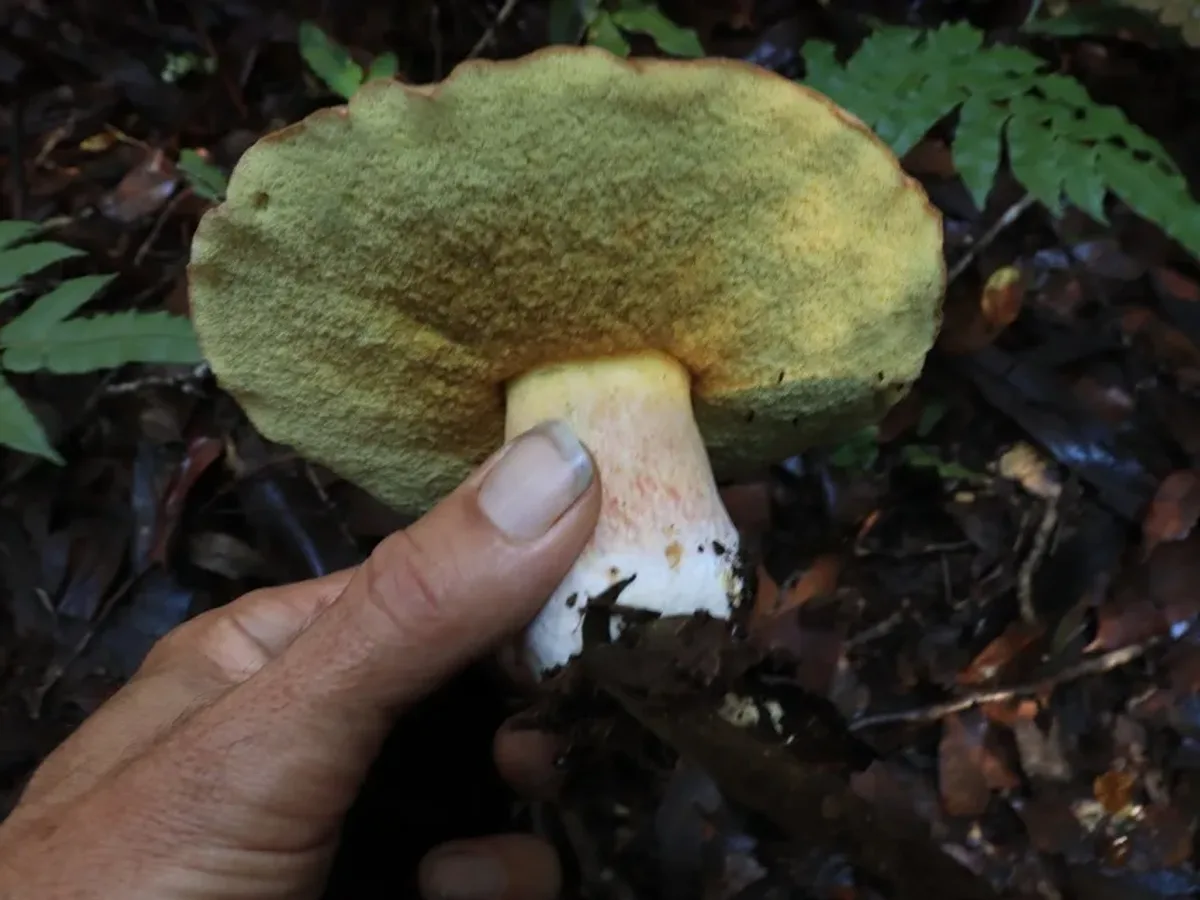 © Jsun Lau (CC BY-SA)
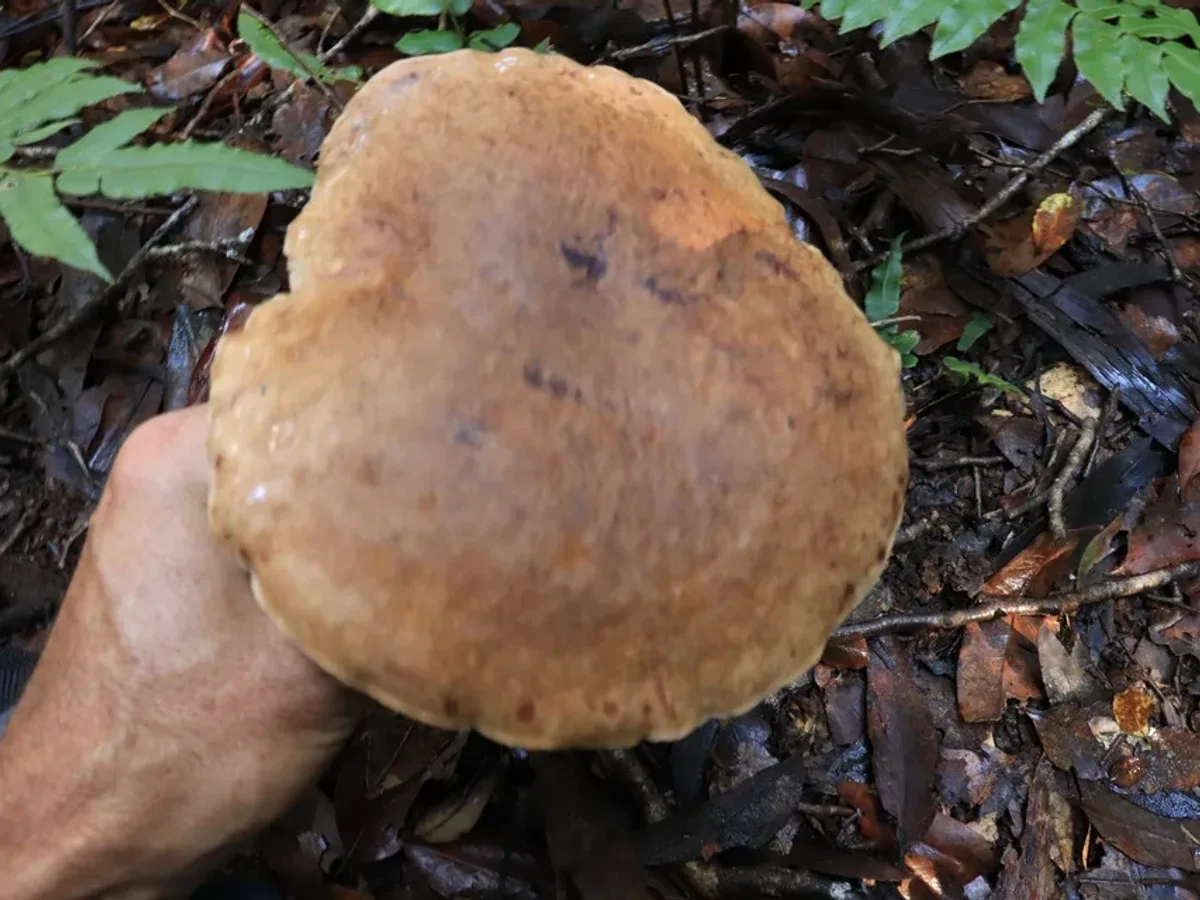 © Jsun Lau (CC BY-SA)
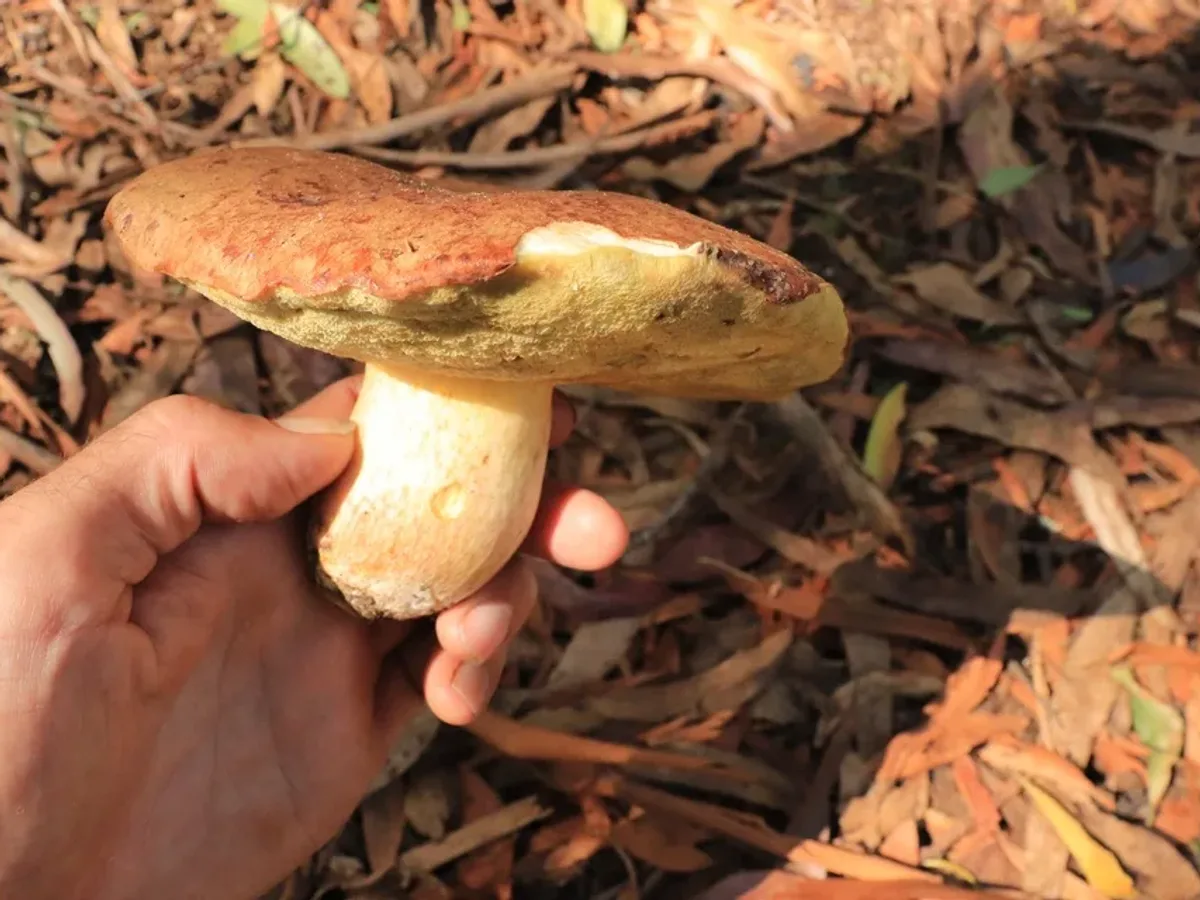 © Jsun Lau (CC BY-SA)© Jsun Lau (CC BY-SA)© Jsun Lau (CC BY-SA)
One of the best mushrooms you can bring home - once you are certain of the identification.
Never eat a mushroom you are not 100% sure of - check the look-alikes below, and always cook wild mushrooms.
How to recognise it
Boletus austroedulis is the Southern Hemisphere ecological counterpart of the celebrated European porcini (Boletus edulis), and is closely related to that species complex. In the field, the two are difficult to distinguish without reference to geography.
Cap
Typically presents with a pale buff to light ochre-brown cap that dries smooth and dry to the touch, though it can feel slightly tacky immediately after rain.
The buttons are tight and hemispherical, with very firm white flesh - this firmness is one of the hallmarks of a prime specimen. As the cap expands to full size it often retains a slight undulation or irregularity at the margin.
Gills / Pores
The pore surface begins as pure white, aging through cream to pale olivaceous-yellow as the spores mature. It never blushes pink or red, and critically, it does not blue when pressed or cut.
Stem
The stem is sturdy and may be broader than tall in young specimens. It carries a fine reticulation (net pattern) on the upper portion, pale buff to whitish on a similar background.
Flesh
The flesh is brilliant white, solid, and remains so when sliced - this non-bluing, white, firm flesh is the most important safety character for any member of the porcini group.
Smell
The smell is mild and pleasant, somewhat nutty or bread-like.
Where & when it grows
Habitat
Boletus austroedulis is ectomycorrhizal - it lives by weaving its mycelium around pine roots in a partnership where fungus and tree trade nutrients.
In Australia, that means its entire distribution follows the footprint of introduced radiata pine (Pinus radiata), a Californian species planted widely across southeastern Australia from the late 19th century for timber.
When the pine seedlings arrived, so did their fungal companions - B. austroedulis, Suillus luteus, Amanita muscaria, and others - and these European fungi have become a permanent part of the plantation ecosystem wherever the pines have taken hold.
The main regions to look:
- the Snowy Mountains foothills (Tumut, Batlow, Tumbarumba in NSW)
- the Australian Capital Territory
- the central highlands of Victoria
- the Mount Lofty Ranges and South-East of South Australia
- the green triangle straddling western Victoria and southeastern South Australia
In New Zealand, solid populations exist across the central North Island, Marlborough, Nelson, and Canterbury.
The species fruits best in undisturbed understorey with an intact needle-litter layer - a tangle of pine needles and duff that the mycelium threads through, sometimes for many years before conditions are right to fruit.
When
Autumn marks the porcini season in the Southern Hemisphere. In mainland southeastern Australia the season spans approximately March to June, with April and May representing the most reliable peak across most productive regions.
In Tasmania and New Zealand's South Island, the season may start slightly earlier (late February in a warm wet year) and extend later into June-July.
The trigger is the combination of cooling soil temperatures, shortening days, and the first sustained autumn rains following the typically dry Australian summer.
A good fruiting year tends to follow a dry summer (which stresses the mycelium productively) succeeded by moderate but consistent autumn rainfall rather than a single heavy downpour. In drought years the season may be very short or largely absent.
Early-season fruitings after the first autumn break can be spectacular but short-lived; mid-autumn is generally most productive.
How it grows
Fruits singly or in small scattered groups of 2-5 in productive spots. The fruitbodies push up from mycelial strands threaded through the needle litter, sometimes breaking through a centimetre of compacted duff.
At the button stage they may wait just below or at the surface for several days - the mycelium already primed - before a decent autumn rain triggers the final push.
Once conditions tip right, growth from tight button to full-sized cap takes roughly 5-10 days. The fastest expansion happens when soil temperatures sit in the 8-15°C range and moisture is consistent.
What makes this species especially rewarding to hunt is its fidelity: in a well-established plantation the same trees produce season after season, sometimes for decades. Experienced local pickers quietly accumulate a mental map of their best spots, returning each autumn like clockwork.
Fruiting conditions
Fruiting in southeastern Australia and New Zealand is triggered by the first sustained autumn rains (approximately 20 mm over 14 days) combined with soil temperatures cooling through 16°C down toward 7-10°C. The typical flush emerges 7-14 days after a triggering rain event. Season runs March-June in the Southern Hemisphere, peaking April-May. Summers that are moderately dry followed by reliable autumn break are most productive; consecutive wet summers or early frosts can shorten the season significantly.
Look-alikes
The most important comparison in Australian pine forests is with other boletes that share the habitat.
Suillus luteus (slippery jack), which is extremely abundant in Australian pine plantations and co-occurs with B. austroedulis at virtually every site, is distinguished by its distinctly slimy, glutinous, dark chocolate-brown to purple-brown cap, slimy partial veil that leaves a slimy membranous ring on the stem, and glandular-dotted stem below the ring - all features absent in B. austroedulis.
Suillus granulatus, another very common companion, lacks the ring but has a slimy yellowish cap and small glandular dots on the upper stem that exude milky droplets in young specimens.
Neither Suillus species is dangerous, though some people experience mild gastrointestinal sensitivity to Suillus; they must not be confused with the porcini for culinary purposes as their quality is much lower.
Amanita muscaria (fly agaric) is strikingly different - bright red or yellow cap with white warts, white gills, ring, and volva - but is mentioned because it is also present in every radiata pine plantation in Australia and New Zealand; it is a moderate toxin (ibotenic acid) and must never be confused with any edible species.
Amanita phalloides (death cap) has been introduced to Australia with European oaks planted in gardens and parks; it does not occur in pine plantations but can occur at urban plantation margins where oak-planted parks adjoin pine stands. The death cap has white gills, a skirt-like ring, a cup-like volva at the base, and typically a pale greenish-yellow cap - it has no resemblance to B. austroedulis but is mentioned here because it is responsible for all mushroom fatalities in Australia.
The critical bolete safety rule: never eat any bolete with red or orange pores, with flesh that turns blue when cut, or with flesh that tastes intensely bitter. Boletus austroedulis has white non-bluing flesh, white-to-yellow pores, and a mild pleasant flavour.
NOT a visual lookalike for B. austroedulis - included as a contextual safety warning for Australian foragers. Responsible for all mushroom fatalities in Australia; found under introduced European oaks in parks and gardens that may adjoin pine plantations. Has white gills (not pores), a pendant skirt-like ring, a cup-like volva at the stem base, and typically a pale greenish-yellow to yellowish cap. Anyone restricting collection to bolete-shaped fruiting bodies (cap with pores, no gills, no ring, no volva) will never mistake the death cap for B. austroedulis. Contains amatoxins causing delayed lethal liver and kidney failure; if in any doubt about a collected mushroom, do not eat it and consult an expert.
Present in every Australian and NZ pine plantation. Bears no resemblance to B. austroedulis: bright red or yellow cap with white warty remnants of the universal veil, white gills (not pores), a pendant ring, and a bulbous base. Contains ibotenic acid and muscimol - causes delirium, nausea, and muscular incoordination. Cannot be confused with any bolete by anyone exercising basic identification.
Also common in Australian pine forests. Lacks a ring but has a slimy yellowish-tan to orange-brown cap and glandular dots on the upper stem that exude milky droplets in fresh young specimens. The overall slimy character and absence of the white early pore stage distinguish it from B. austroedulis. Edible but of lower quality; some GI sensitivity reported.
Extremely abundant co-inhabitant of Australian and NZ radiata pine plantations. Distinguished by the strongly slimy, glutinous, chocolate-brown to purplish-brown cap; a slimy membranous ring on the stem; glandular dots on the stem below the ring; and a generally sticky, wet feel even in dry weather. The pore surface is finer and more yellowish and lacks the white-to-cream early stage of B. austroedulis. Lower culinary quality; some people experience GI sensitivity. Not dangerous but very different in texture and taste.
In the kitchen
Picking & cleaning
Harvest at the button to medium stage for best eating quality; very large, old specimens develop spongy tube layers and are often heavily infested with fly larvae.
To check, slice the stem longitudinally at the base - clean white flesh confirms absence of heavy infestation.
A gentle twist at the base, or a clean cut just below the soil surface, are both acceptable; leaving a small stub protects the mycelium.
- Brush off pine needles and soil.
- Carry in an open-weave basket or breathable bag to allow spore dispersal and prevent sweating.
- Refrigerate as soon as possible and consume within 2-3 days.
The firm, dense flesh holds up very well to drying: slice 5-8 mm thick and dry at 40-50°C; the resulting dried porcini is intensely fragrant and stores for months.
Cooking
Boletus austroedulis delivers the same rich, nutty, umami-laden flavour that makes the European porcini one of the world's most celebrated wild mushrooms. It is extraordinarily versatile in the kitchen.
For the simplest preparation, slice thickly and saute in butter or olive oil over high heat until golden; finish with salt, pepper, garlic, and fresh parsley.
The firm texture means it does not collapse during cooking, making it ideal for risotto (where it is added in the final minutes to retain texture), pasta sauces, and oven-roasted vegetable dishes. For soup and braises it can be added earlier and contributes deep, complex flavour to stocks.
Drying concentrates the flavour: slice 5-8 mm thick, dry at 40-50°C until completely brittle, and store in airtight jars for up to 12 months. Rehydrate in warm water (the soaking liquor is precious stock - strain and include it in the dish).
The dried powder ground from dried slices is an outstanding seasoning for pasta dough, cream sauces, and umami-boosting applications.
Freezing is possible after a brief saute; frozen raw results in a mushier texture upon thawing.
Good to know
Boletus austroedulis is an excellent, safe edible mushroom with no confirmed toxins. However, foragers in Australian pine forests must exercise general mushroom safety:
- 1Never eat a bolete with red or orange pores - such species (Rubroboletus spp.) cause severe gastrointestinal poisoning and some are lethal in Europe; none of these species is established in Australian plantations, but the rule is absolute.
- 2Never eat a bolete whose flesh turns blue when cut - this immediate bluing reaction indicates the presence of potentially toxic compounds.
- 3A tiny taste of raw flesh (spit out without swallowing) that is intensely bitter indicates confusion with a bitter bolete (Tylopilus-type); this is not lethal but produces gastrointestinal distress.
- 4Always cook before eating: raw boletes can cause gastric irritation in sensitive individuals.
- 5The greatest poisoning risk in Australian foraging is from Amanita phalloides (death cap) which occurs under introduced oak in urban parks - restrict your porcini hunting to pine plantations and avoid collecting mushrooms with white gills, a ring, and a basal cup.
Boletus austroedulis has no ring, no volva, no gills, and white tubes that turn yellowish - it cannot be confused with the death cap by anyone reading this guide carefully.
A reference guide - never an edibility guarantee. When in doubt, leave it out.