Butter-foot Bolete
Boletus auripessyn. Boletus auripes Peck, Boletellus auripes
 Sam Allon (CC0)
 © ashleyrsteel (CC BY)
 © ashleyrsteel (CC BY)
 © ashleyrsteel (CC BY)
 © ashleyrsteel (CC BY)
 Sam Allon (CC0)
 Sam Allon (CC0)
 Sam Allon (CC0)Sam Allon (CC0)© ashleyrsteel (CC BY)
Good to eat, once you have identified it with certainty and cooked it through.
Never eat a mushroom you are not 100% sure of - check the look-alikes below, and always cook wild mushrooms.
How to recognise it
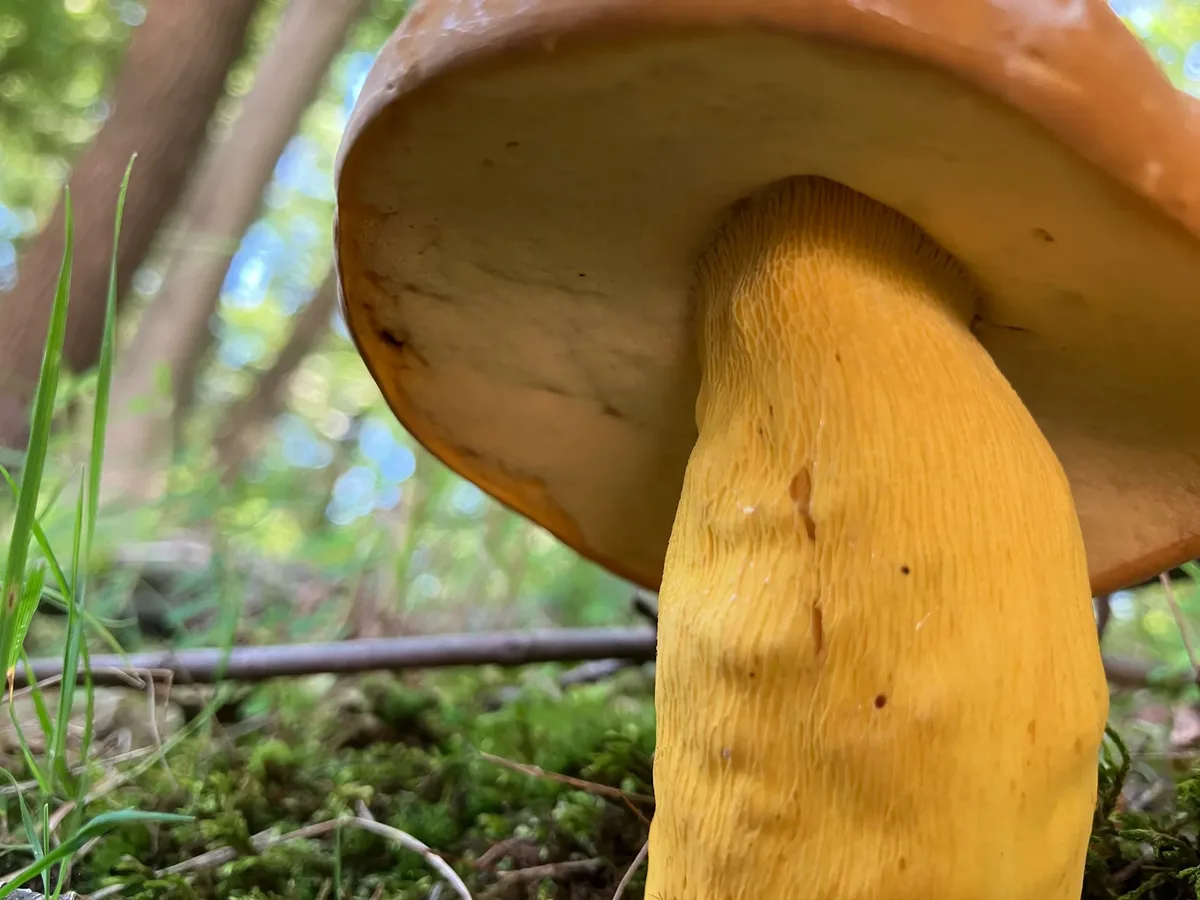
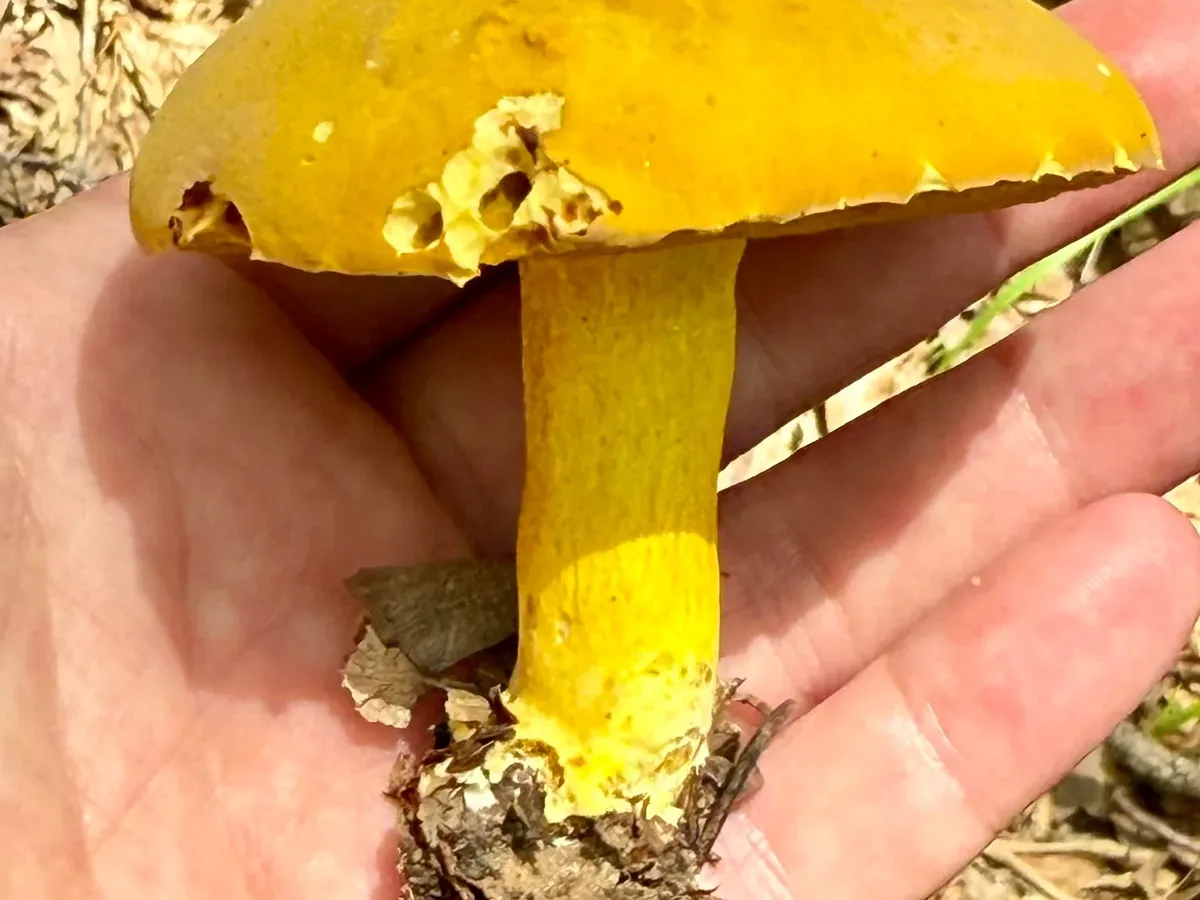
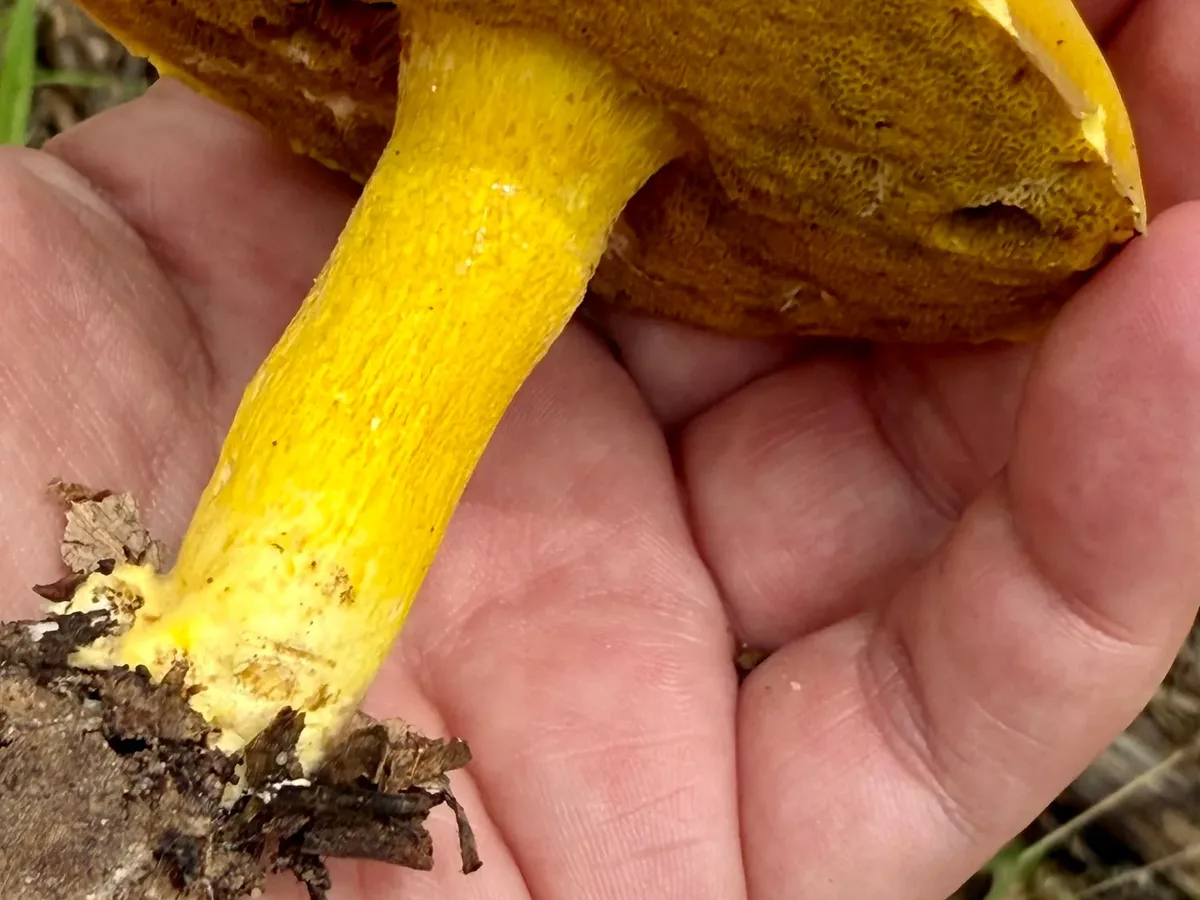
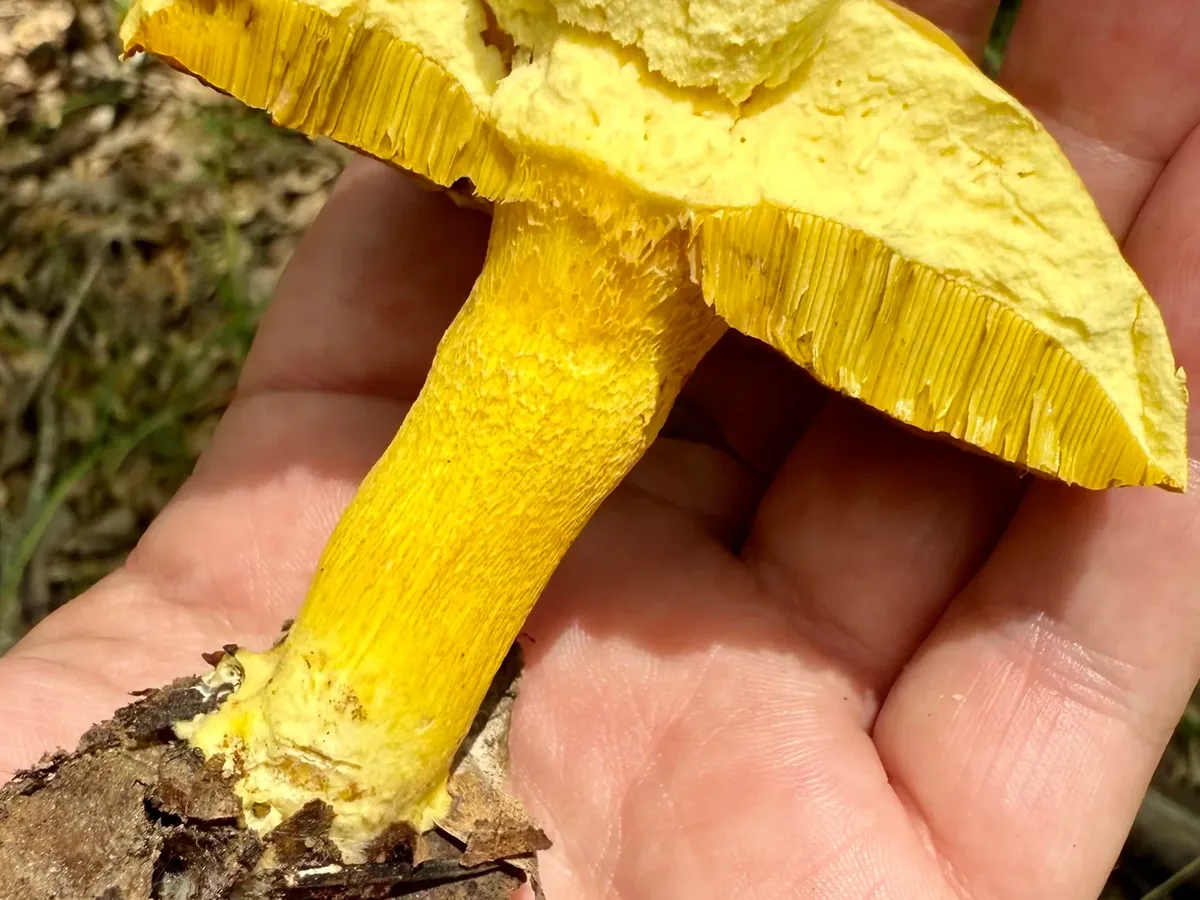
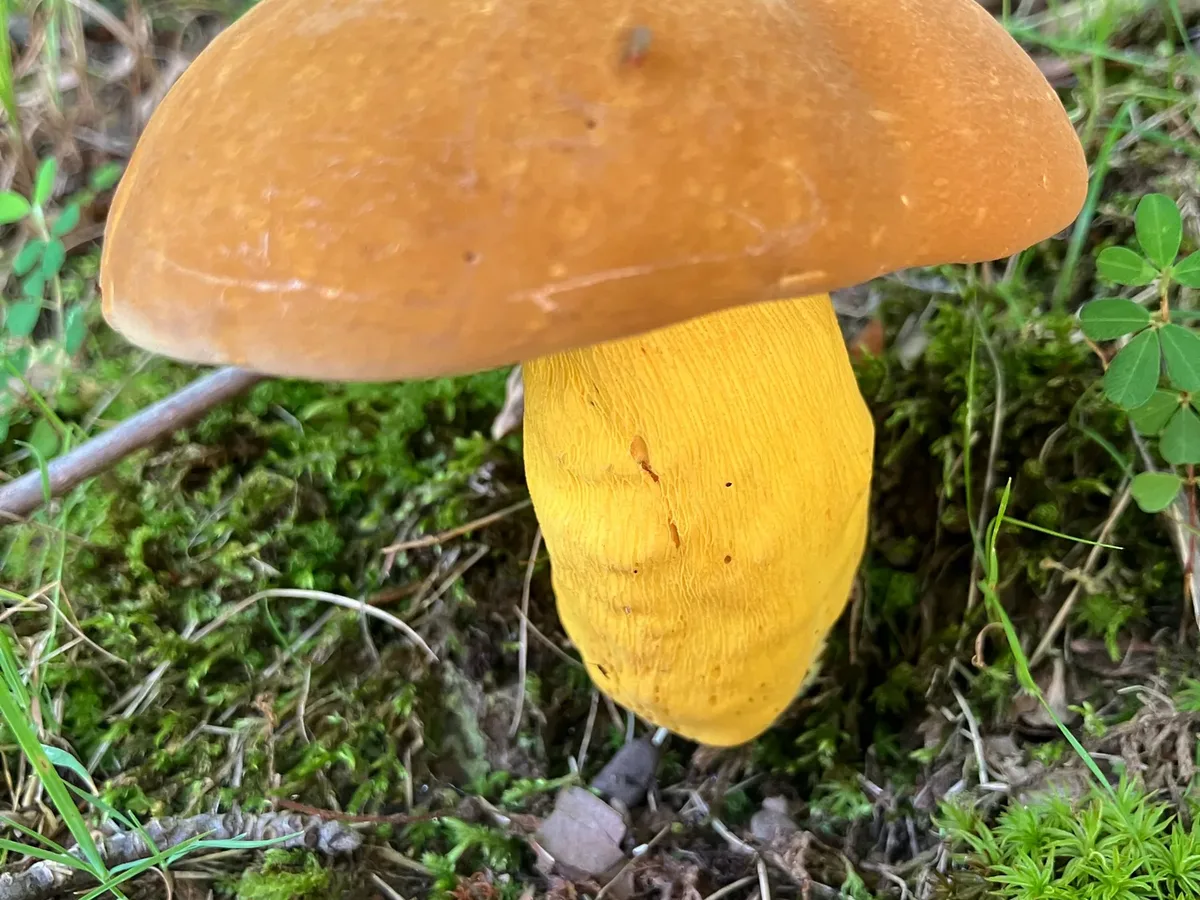
Boletus auripes is a medium to moderately large bolete whose most instantly recognisable feature is its stipe - a vivid, almost luminous yellow, particularly intense toward the base, that stands out against the leaf litter even before the cap is turned over.
Cap
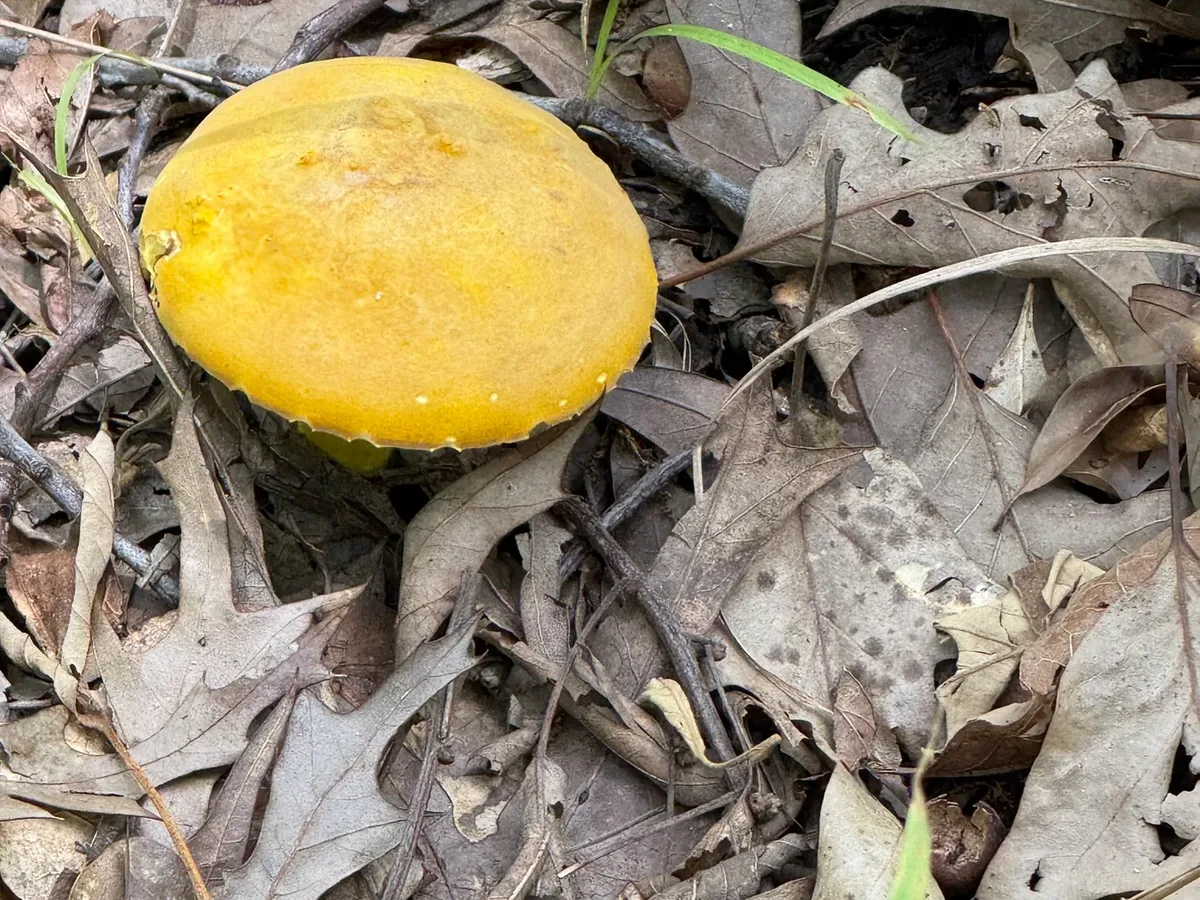
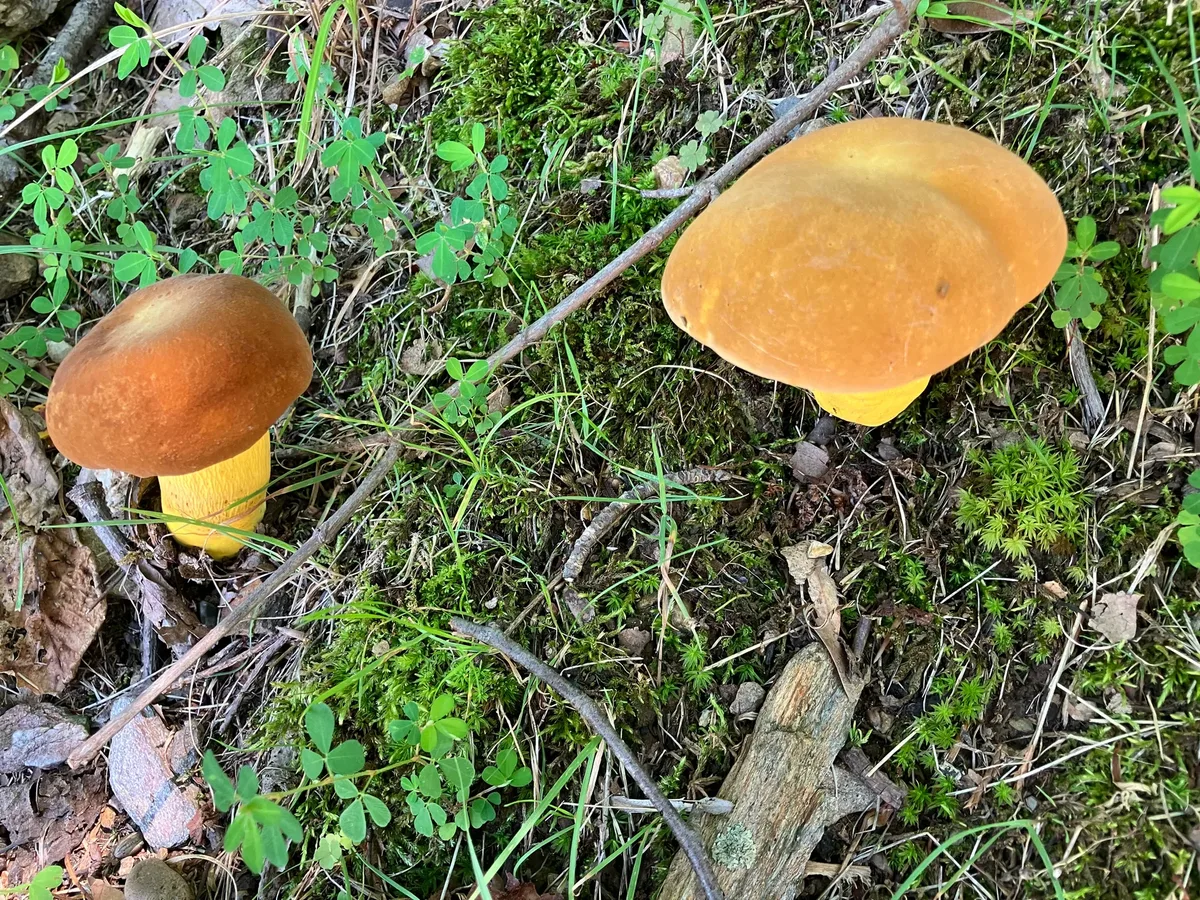
The cap is 5-15 cm across, opening from a tight hemisphere to a broad convex cushion. The surface is dry and smooth to very finely velvety, coloured pale ochre-brown to warm honey-tan, without strong markings or contrasting zones.
Gills / Pores
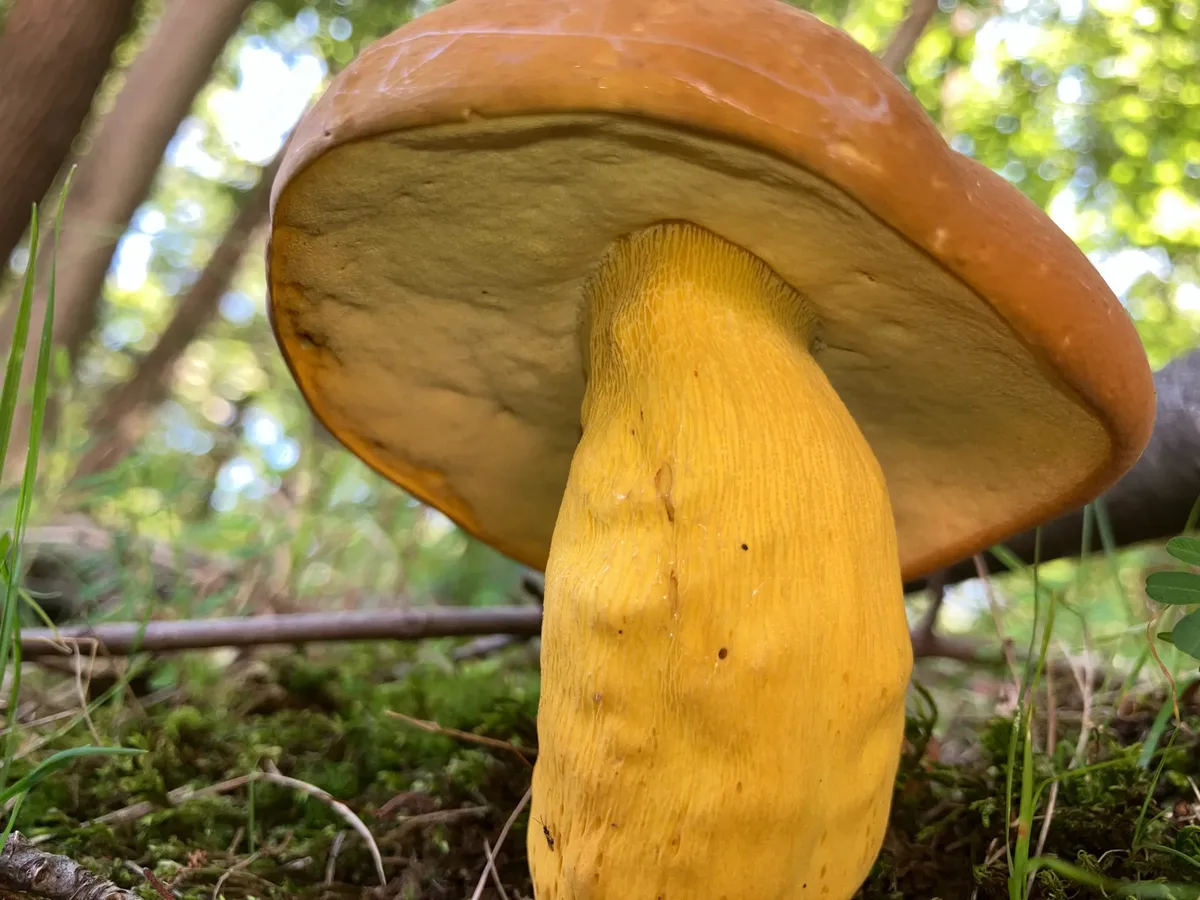
Lift the cap and you find a layer of fine, small pores rather than gills: these are bright yellow in youth and remain clearly yellow to olive-yellow at maturity - an important field mark, because many dangerous boletes in the same region have orange or red pores.
The pore surface either does not blue at all when pressed or, in fresh specimens on a cool day, may show a faint, slow, bluish-green tinge that takes many seconds to develop and never becomes the vivid indigo of the truly dangerous blue-staining species.
Stem
The stipe is stout and firm, 5-13 cm tall, carrying a fine raised net (reticulation) on its upper portion - a feature shared with the porcini group - and coloured conspicuously yellow over at least the lower two-thirds.
Flesh
The flesh is pale to mid-yellow in both cap and stipe; slicing through a fresh specimen produces no immediate dramatic colour change, though a slow and partial blueing may occur; red or brown coloration in the flesh is absent.
The overall impression is of a solid, handsome, golden-tinted bolete with yellow pores and a yellow stem.
Where & when it grows
Habitat
Boletus auripes is a warmth-loving mycorrhizal species with a broadly East Asian distribution and a secondary population in eastern North America.
In East Asia it occurs in the oak-dominated warm-temperate and subtropical forests of China (notably in Sichuan, Hubei, Jiangsu, and the provinces of central and southern China), Japan, and Korea, typically between 200 and 1500 m elevation - generally lower in elevation than the high-altitude Yunnan porcini species.
It favours mature deciduous forest on well-drained, slightly acidic, humus-rich soils: the kind of deep forest loam that builds up under decades of leaf fall beneath old oaks, beeches, and chestnuts.
In Japan it is most often found under the native deciduous oaks (Quercus serrata, Q. mongolica var. crispula) of foothill and montane forest, fruiting reliably in the same spots year after year once a productive mycelial network is established.
In eastern North America it appears in similar oak upland woodland, from the Midwest through the Appalachian region and into the coastal plain.
The mycelium cannot be separated from living host roots and cannot be cultivated, so every specimen in forest or market comes from a wild partnership that may be many years old.
When
In East Asia the season broadly tracks the summer rains and warm soil temperatures: fruit bodies begin appearing from late June, peak through July and August, and continue into September and sometimes October as conditions allow.
The trigger is essentially the same across its range - sustained warm weather (soil temperatures reliably above roughly 15 °C) combined with significant rainfall, and fruit bodies typically emerge in a flush 7-14 days after the soaking rains arrive. Japan's tsuyu (rainy season) and subsequent summer heat drive the main flush.
In eastern North America the season is somewhat longer and more variable, running from late June through October at mid-latitudes, with the summer flush following the first extended warm rains after the drier June period.
At higher elevations or in cooler years the season is compressed and shifted later.
How it grows
Grows singly or in loose scattered groups on the forest floor, never in tight sociable clusters.
The underground mycelium persists as a long-lived network around its host-tree roots; the mushroom is the brief reproductive structure of this deeper organism, not a separate entity.
Under ideal conditions - warm soil fully charged with monsoon or summer rain - a button-sized primordium can expand to a mature, spore-shedding fruitbody in four to six days.
This rapid expansion is driven by water uptake into pre-formed hyphal cells rather than by active cell division, which explains the familiar phenomenon of boletes appearing to materialise overnight after rain.
Established spots under the same trees fruit year after year and are jealously guarded by experienced foragers.
Fruiting conditions
Fruiting requires warm soils (roughly 15-26 °C) combined with sustained summer rainfall of at least 25 mm over 14 days. In East Asia the summer rains (including Japan's tsuyu rainy season and the East Asian monsoon system) provide the trigger, with flushes typically appearing 7-14 days after soaking rains. Peak fruiting in East Asia is July-August; the season extends into October at lower latitudes and in warm autumns.
Look-alikes
The most important safety distinction when foraging Boletus auripes is separating it from red-pored and strongly blue-staining boletes in the same habitat.
In East Asia, Rubroboletus sinicus and related species (the red-pored boletes) occur in warm-temperate oak forests overlapping with B. auripes.
These have orange-red to blood-red pores and flesh that turns vivid indigo within seconds of cutting - immediate and violent blueing is the hallmark, and these species cause serious gastrointestinal poisoning.
Boletus auripes has yellow (not red or orange) pores and flesh that either stays yellow entirely or only develops a faint, slow, partial blue - never the instant dramatic indigo of the dangerous species.
In eastern North America, Rubroboletus pulcherrimus (the Prettiest bolete) is the more dangerous concern: it shares an oak-forest habitat and a superficially similar bolete body plan, but its pores are red and its flesh blues instantly and intensely.
Rubroboletus pulcherrimus has caused severe poisonings and fatalities and must never be eaten. Boletus auripes lacks red pores and does not blue strongly.
Tylopilus felleus (the Bitter bolete) is a common confusion species across both continents: similar cap coloration and bolete body plan, but pores turn pink to dirty-pink with age (never yellow).
The taste of even a tiny raw fragment is intensely bitter - not toxic, but ruins any dish instantly and is a reliable separating character.
Within the porcini group (Boletus edulis and relatives), B. auripes is distinguishable by its yellower stem and flesh, which may show weak blueing - porcini has white to cream flesh and pores and does not blue at all.
The vivid yellow pores and bright yellow stem of B. auripes, combined with its mild bluing at most, form a recognisable gestalt once the key characters are known.
Pores orange to blood-red (not yellow); flesh turns an immediate, intense indigo blue within seconds of cutting or bruising. Has caused severe poisonings and fatalities in western North America. Boletus auripes has yellow pores and flesh that either stays yellow or only faintly and slowly blues - never the instant, vivid indigo of Rubroboletus pulcherrimus. Any bolete with red or orange pores must never be eaten.
Cap brown, bolete body plan, and overlapping habitat on both continents make this a plausible visual confusion. However, pores begin white and turn pink to dirty-pink with age (never yellow); taste of even a tiny raw fragment is overwhelmingly, persistently bitter - this is the fastest and most reliable separating test. Not poisonous but inedible; one piece ruins an entire dish.
Very similar bolete structure and broadly overlapping habitat in some areas. Porcini has white to cream pores (not yellow) and white flesh that does not blue at any stage - confirmed by cutting and waiting 60 seconds. B. auripes has distinctly yellow pores and yellow flesh, and may show faint weak blueing. Both are good edibles; confusion is harmless from a safety standpoint but useful to know for identification practice.
Occurs in the same East Asian oak forests as Boletus auripes. Pores orange-red to blood-red; flesh turns intensely and rapidly blue when cut or bruised. Causes serious gastrointestinal poisoning (violent vomiting and diarrhoea requiring medical attention); not documented as regularly lethal but capable of causing severe harm. Separated from B. auripes immediately by its red-orange pore colour - B. auripes has consistently yellow pores.
In the kitchen
Picking & cleaning
Harvest at the young to mid-aged stage when the cap is still convex and firm, the pores are tight, bright yellow, and dry, and the stem is solid throughout.
Cut at the base with a knife rather than pulling and twisting, to leave the mycelial base intact for future fruiting.
Immediately slice through the lower stipe and examine the cut: flesh should be pale to mid-yellow, firm, and either not changing colour at all or only developing a faint, slow, partial blueing over 30-60 seconds.
Any immediate and vivid indigo staining of the flesh is a serious warning sign - set the specimen aside and do not eat it.
Check also for maggot tunnels: in warm summer conditions insect larvae colonise the stipe rapidly, and a heavily tunnelled specimen has little culinary value.
Carry in an open-weave basket with ventilation; boletes deteriorate quickly in closed plastic bags.
Cooking
Boletus auripes is a pleasant and versatile edible with a mild, earthy, gently nutty flavour and firm flesh that holds its texture well in cooking.
It lacks the intense aromatic depth of prime porcini (Boletus edulis and close relatives) but is a worthwhile find, particularly in Japan where it is regarded as a respectable table mushroom and appears in seasonal autumn cuisine.
Slice and sauté in butter or oil over moderate-high heat until the surfaces are golden and any excess moisture has driven off; season simply with salt and a little soy sauce or garlic.
The flesh brightens into a clean pale gold under heat and the mild blue tinge in raw specimens vanishes entirely in cooking.
Works well in:
- rice dishes (takikomi gohan in Japan)
- clear soups
- hot pots
- stir-fries
Can be dried: slice 5-8 mm thick and dehydrate fully; the dried product concentrates the flavour and the soaking liquid is a useful addition to broths.
Always cook thoroughly before eating.
Good to know
Boletus auripes is a recognised edible with no documented toxicity and a long history of consumption in East Asia, particularly in Japan and China. The species itself does not contain known mycotoxins.
However, its habitat overlaps with boletes that are poisonous or potentially deadly - most critically Rubroboletus species - and confident field identification is essential before eating.
The two non-negotiable safety checks are:
- 1Examine the pore surface; pores must be yellow, not orange or red. Any orange or red pore colour is an absolute disqualifier - do not eat.
- 2Slice through the stipe base and watch for 60 seconds; a faint, slow, partial blueing is consistent with B. auripes, but any immediate, vivid indigo staining is a disqualifying sign.
Always cook thoroughly; like most boletes, B. auripes should not be eaten raw or undercooked.
Foragers new to the species should have early identifications confirmed by an experienced mycologist or knowledgeable local forager before eating, particularly in East Asian forests where the dangerous red-pored species occur in the same ecosystem.
A reference guide - never an edibility guarantee. When in doubt, leave it out.