Rhubarb bolete
Boletellus obscurecoccineussyn. Boletus obscurecoccineus, Heimiella obscurecoccinea
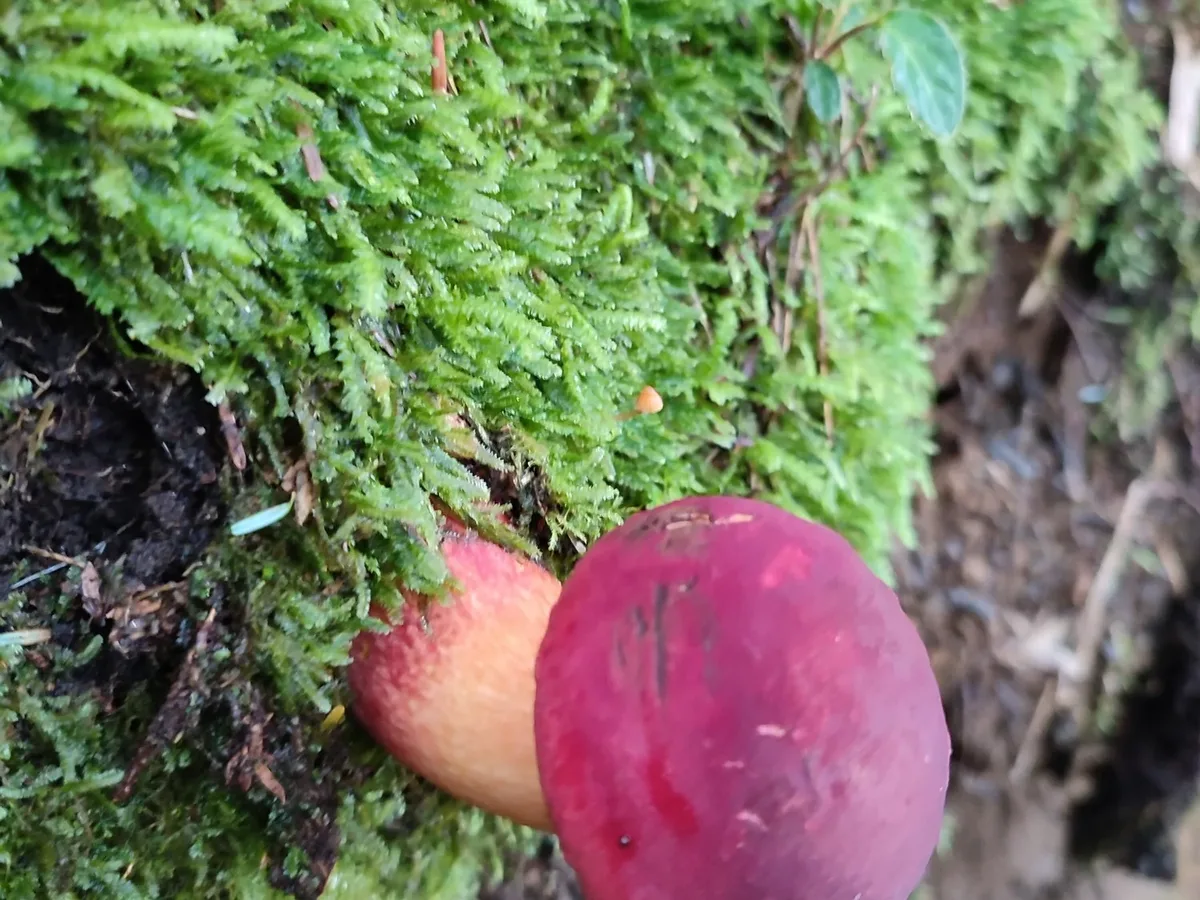 Manis Lin (CC0)
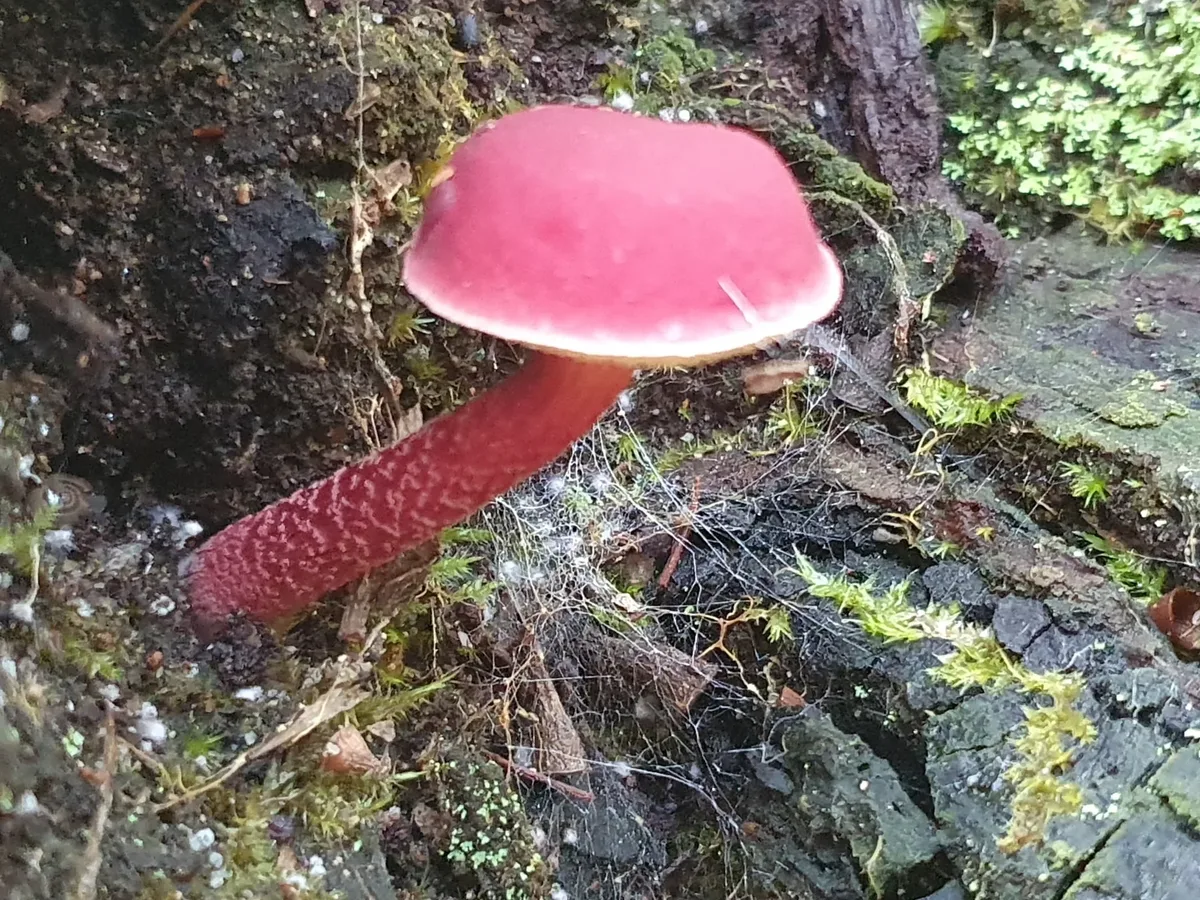 © ronavery (CC BY 4.0)
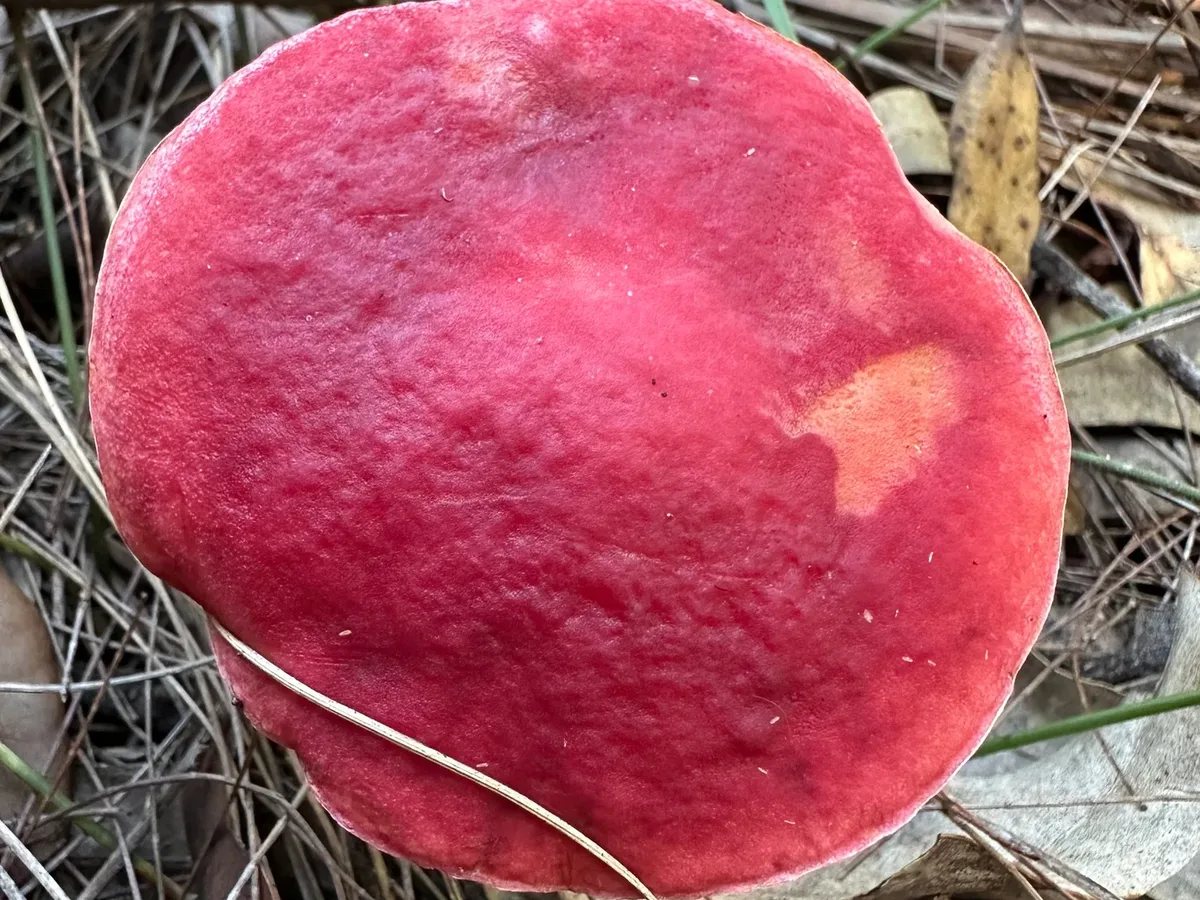 © prossington (CC BY)
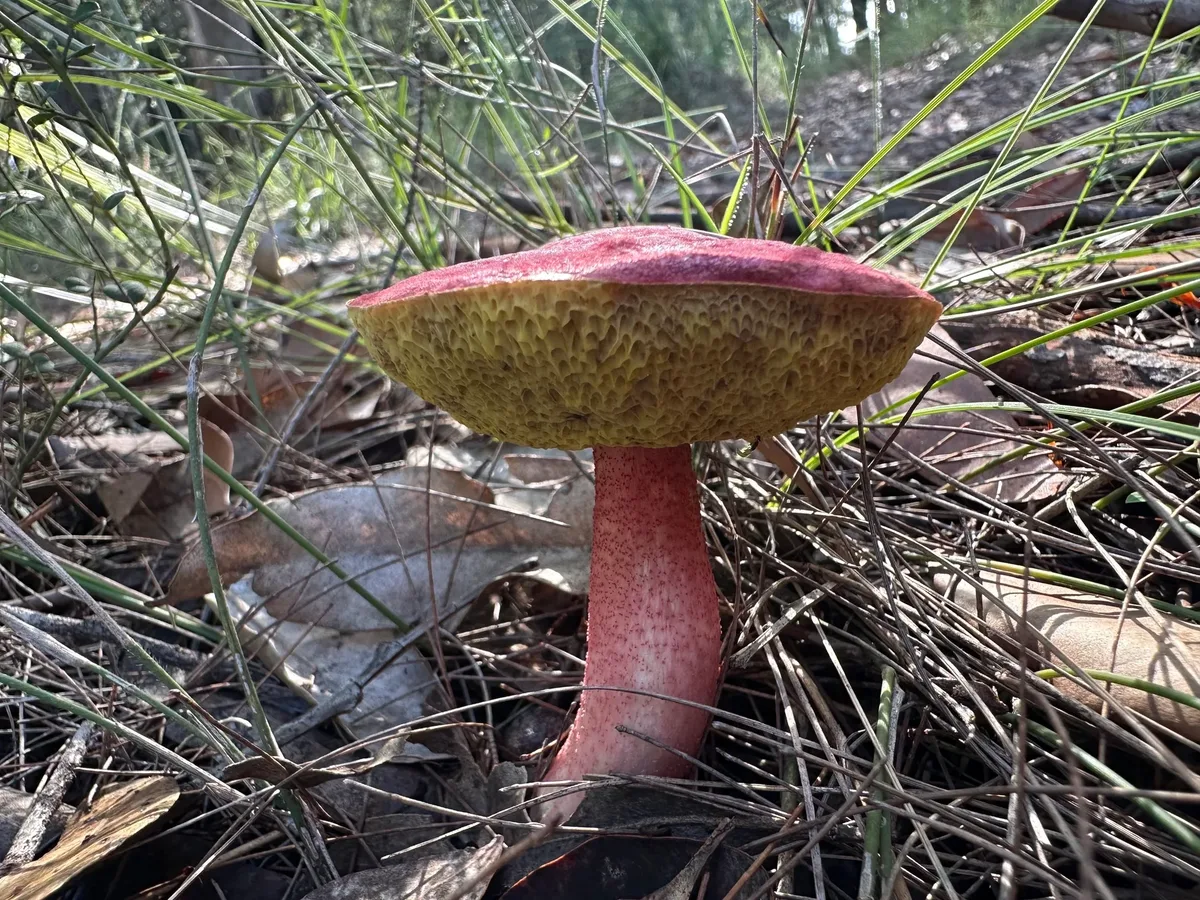 © prossington (CC BY)
 © prossington (CC BY)
 © prossington (CC BY)
 © prossington (CC BY)
 Tricia Kaye (CC0)
 Tricia Kaye (CC0)
 © Sofia Zvolanek (CC BY)
 © Sofia Zvolanek (CC BY)Manis Lin (CC0)© ronavery (CC BY 4.0)
Edible only with the right preparation - or safe for some people but not others. Learn the caveats first.
How to recognise it
The rhubarb bolete is one of Australia's most visually striking fungi and among the easiest to identify on sight.
Cap
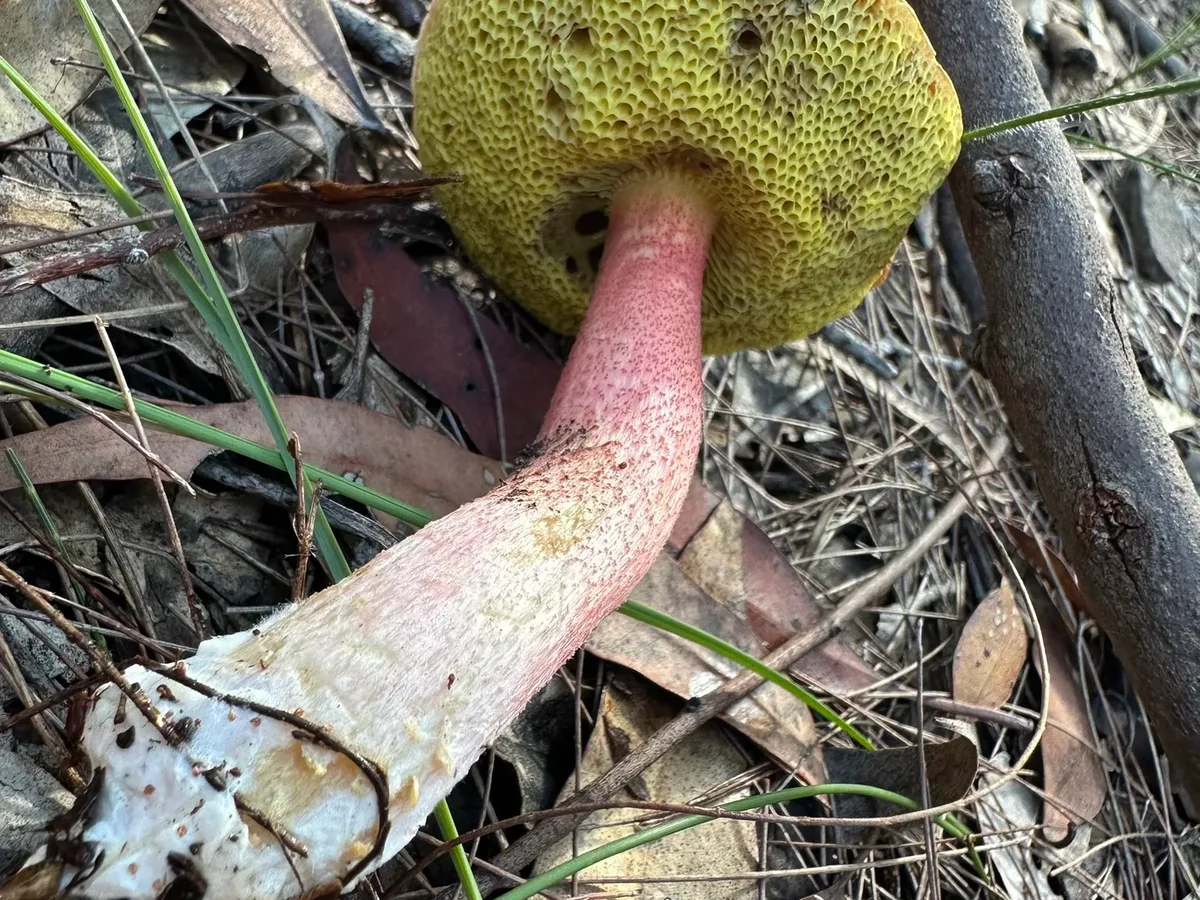
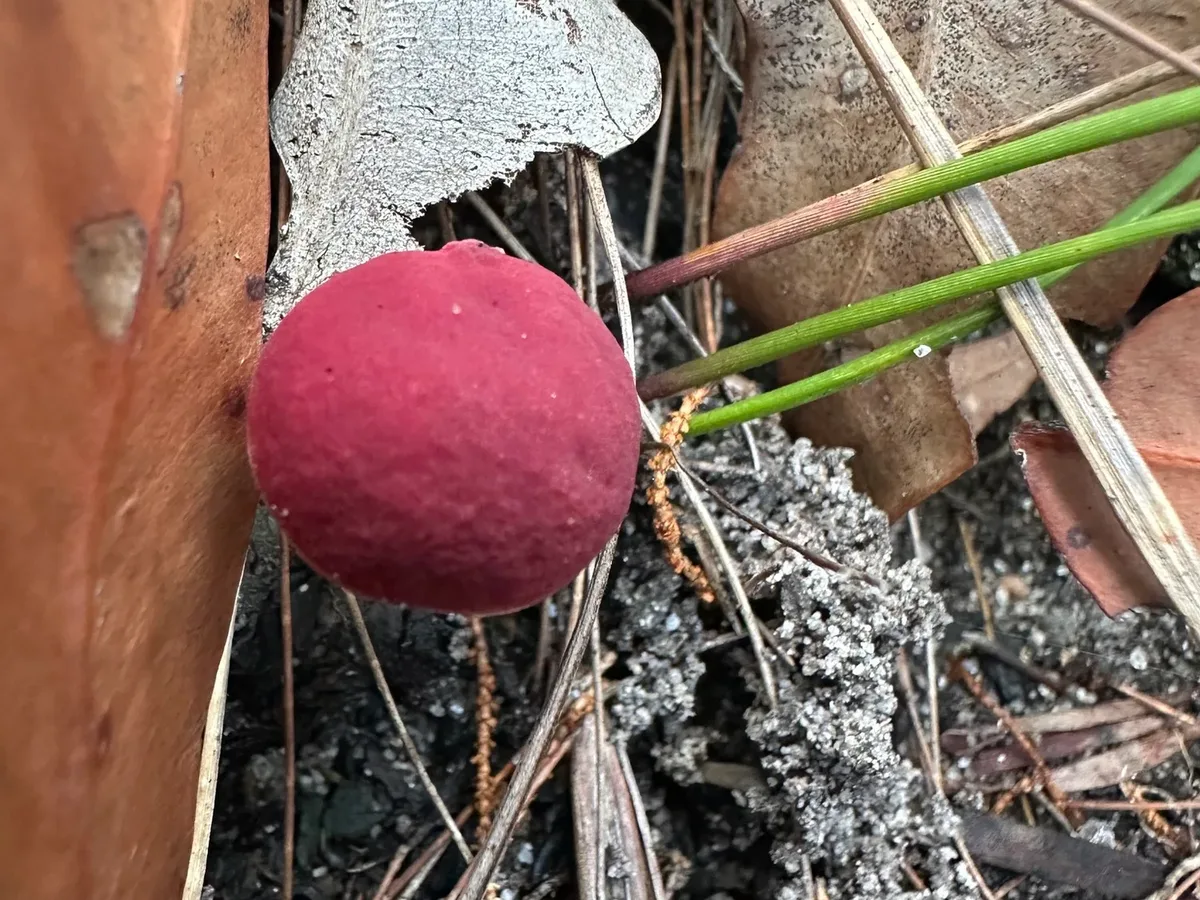
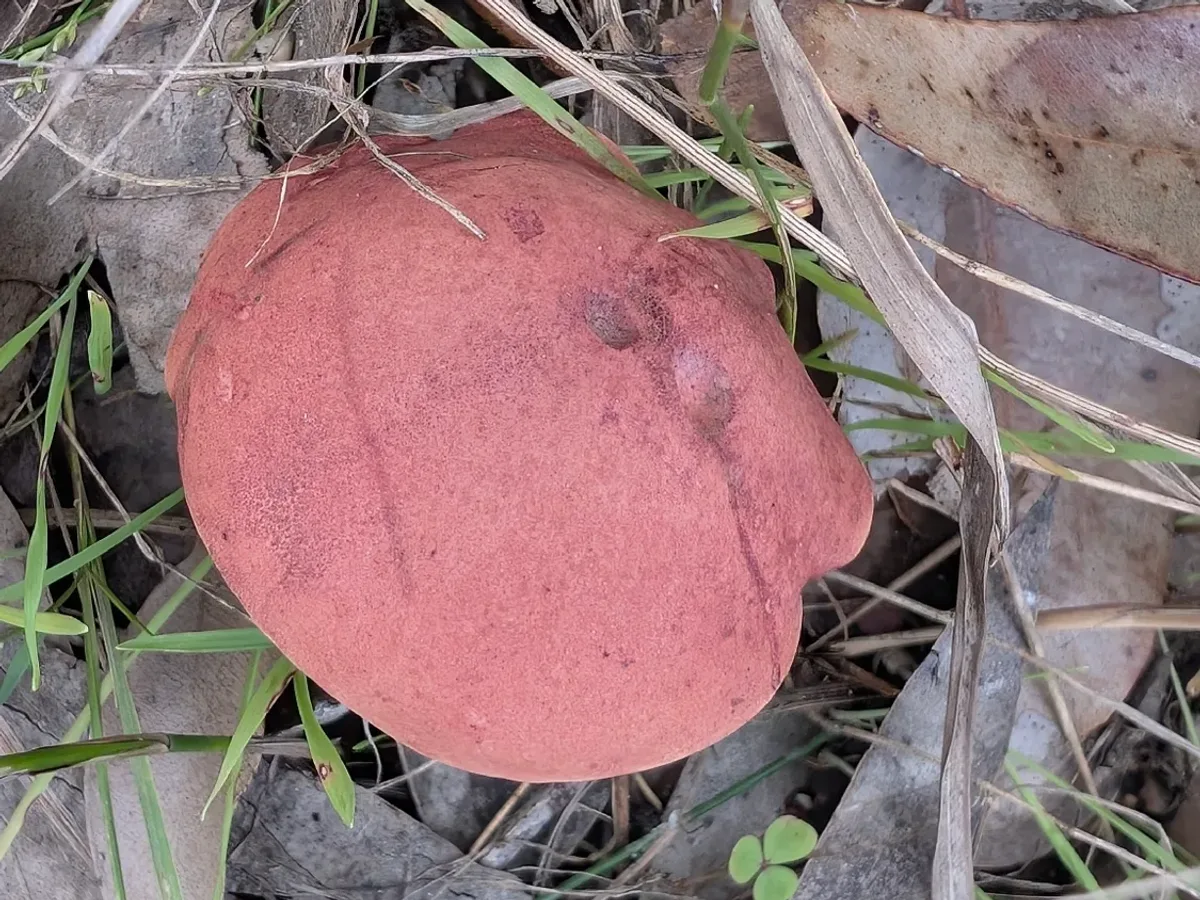
The cap (4-12 cm) is a deep, dark scarlet to crimson-red covered in coarse fibrous scales and warts that give it an almost rough or rhubarb-skin-like texture - smooth it is not. This combination of colour and surface texture is unique among Australian boletes.
Pores
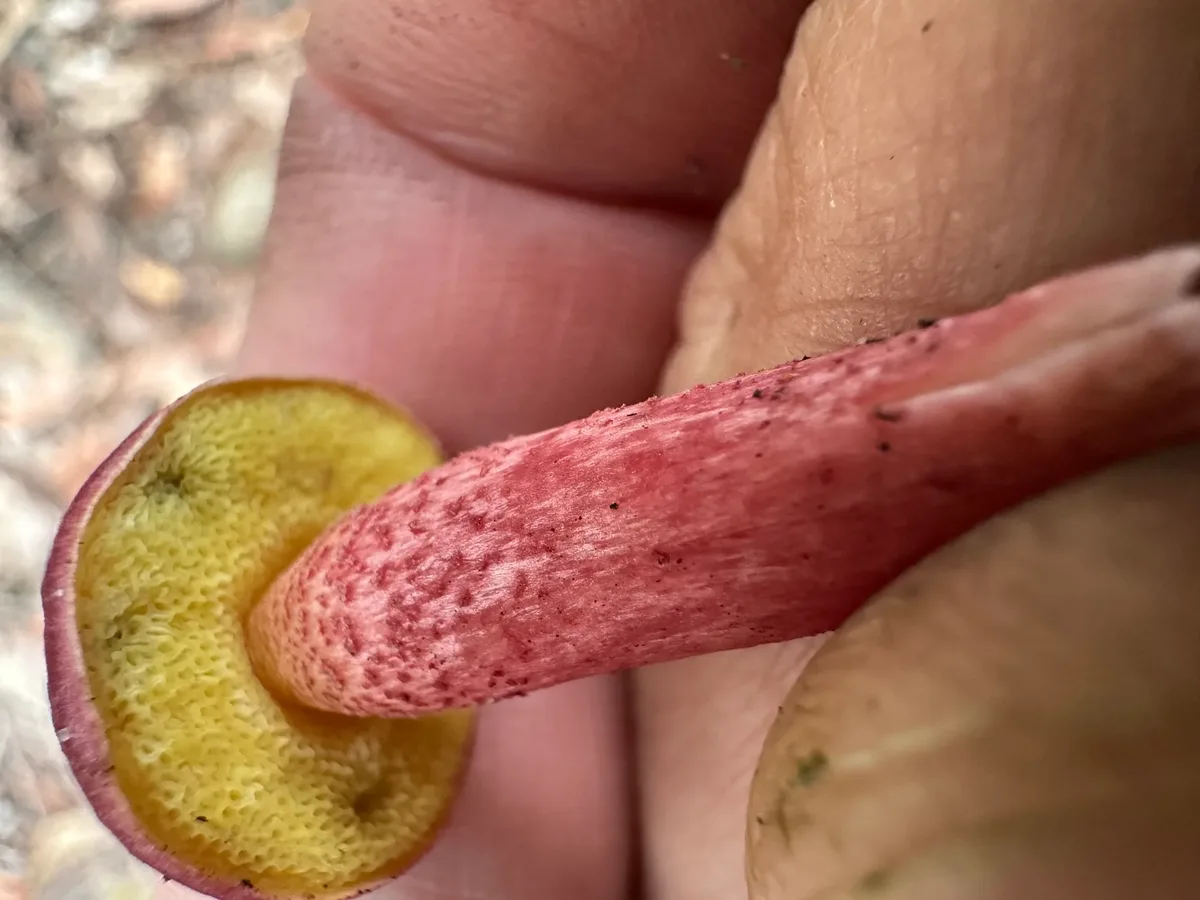
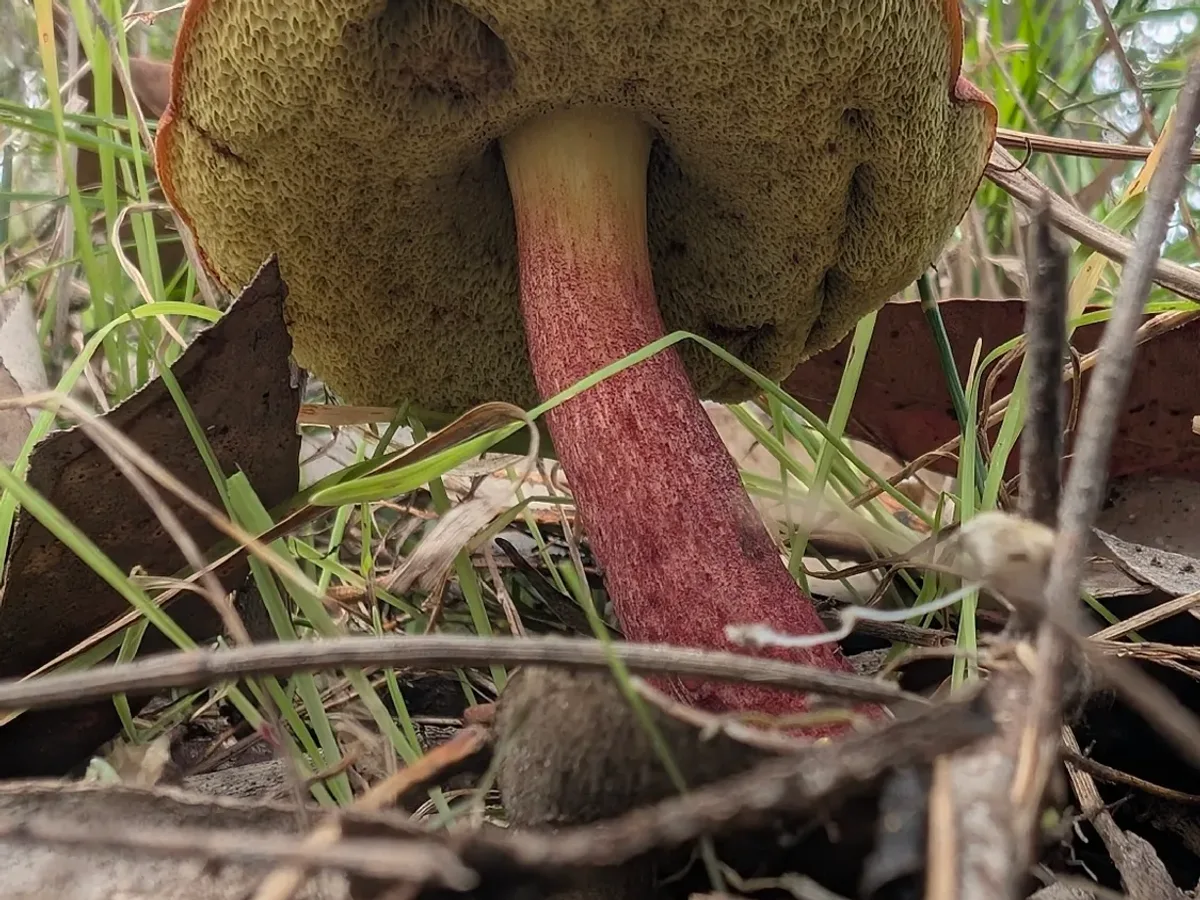
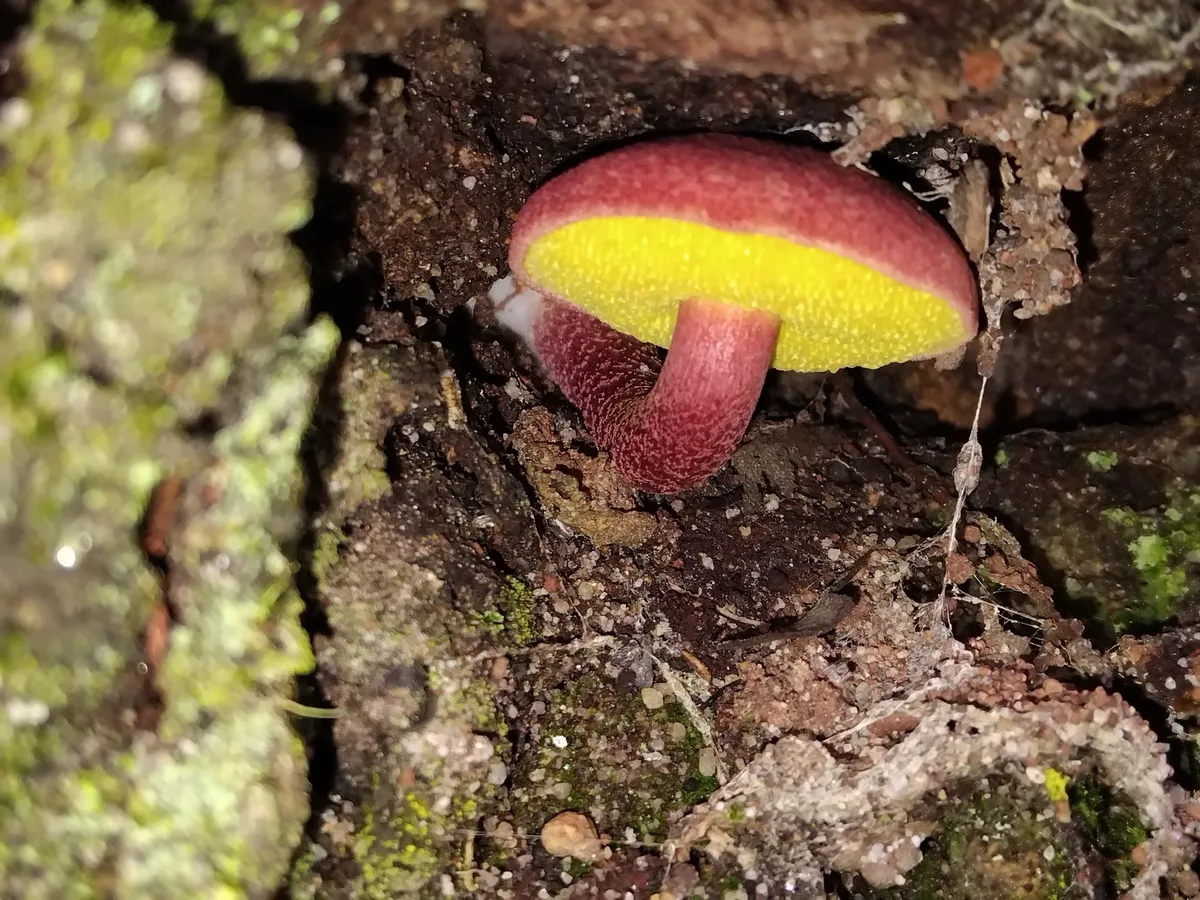
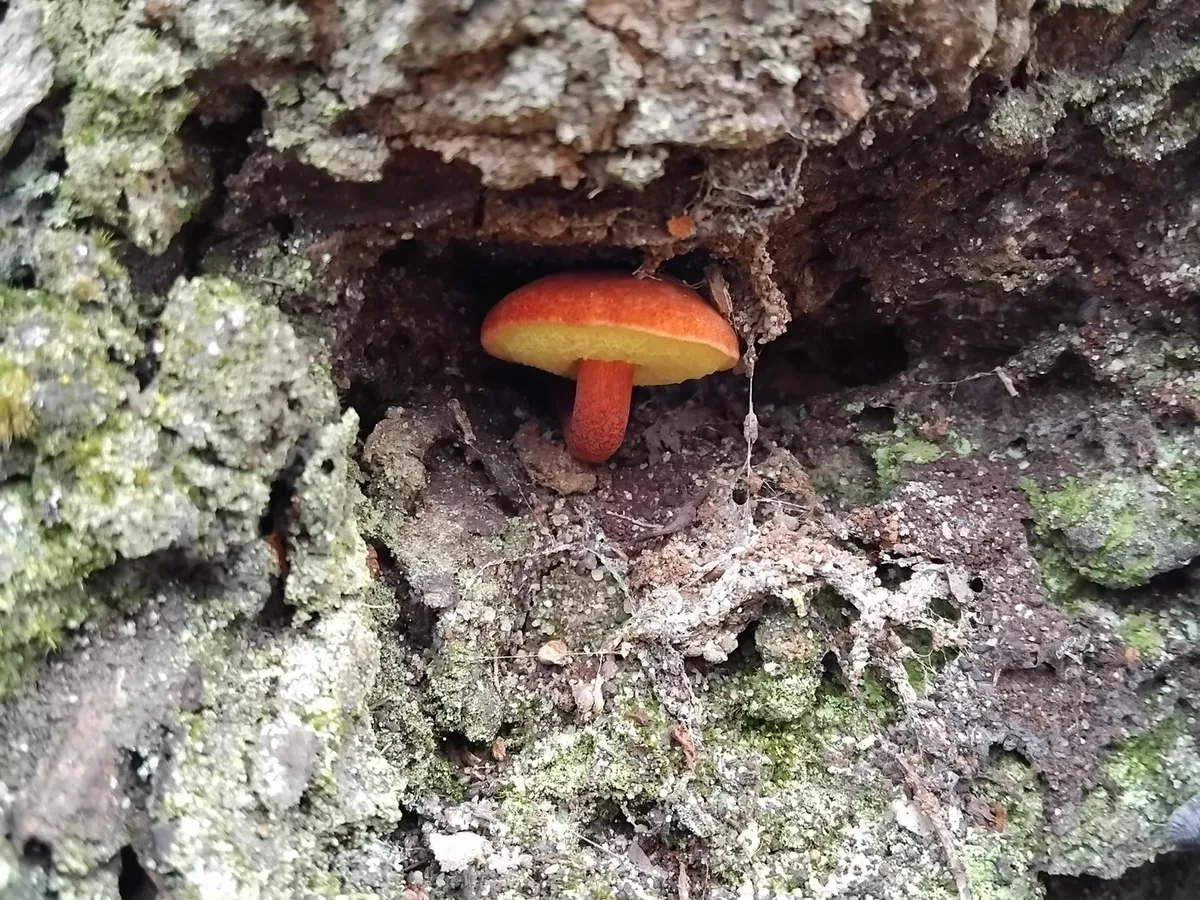
Turn the cap over and you find bright lemon-yellow pores that bruise blue-green almost instantly on contact - a chemical reaction driven by the oxidation of variegatic acid, the same compound responsible for bluing in many boletes worldwide.
Flesh
Cut the flesh and it turns dramatically blue throughout within seconds; the reaction is so rapid and complete that even a fingernail pressed against a fresh pore surface leaves an instant blue mark.
Stem
The stem is reddish to rhubarb-red, fibrillose, and lacks the white reticulate network seen on true porcini.
Spore print olive-brown, collected on white paper.
These four features together - dark scaly red cap, yellow bluing pores, instantly bluing flesh, and olive-brown spore print - make a reliable identification suite that should not be confused with any other Australian species.
Why it's dangerous
Low relative to the most dangerous mushroom toxins (amatoxins, orellanine, gyromitrin), but sufficient to cause significant discomfort and dehydration - particularly in vulnerable individuals including children, the elderly, or those with compromised health.
The main danger in a safety context is misidentification. Anyone who has been taught 'if it bruises blue, avoid it' is well-served by that heuristic in Australia, where no strong culinary tradition exists for any blue-staining boletes.
The absence of deadly risk should not be read as permission to experiment - there is no meaningful culinary reward that would justify the risk of misidentification or individual sensitivity.
Toxin
The specific toxin(s) in Boletellus obscurecoccineus have not been fully isolated and characterised.
The rapid blue-staining reaction is caused by the oxidation of variegatic acid and related bolete pigments. This is a chemical indicator of shared metabolic pathways across bluing boletes, not itself a toxin marker.
However, many bluing boletes contain heat-labile GI-irritant compounds (sometimes referred to collectively as 'boletol' in older literature, though the chemistry is complex). These compounds cause irritation of the gastrointestinal mucosa.
Some may be at least partially inactivated by thorough cooking, but this is not a reliable safety margin for a species with no documented safe culinary use.
Symptoms
Gastrointestinal syndrome: onset typically 30 minutes to 3 hours after ingestion.
Symptoms include:
- Nausea
- Vomiting
- Abdominal cramps
- Diarrhoea
The illness is self-limiting in most cases and resolves within 24 hours with supportive care. No liver, kidney, or neurological toxicity has been documented for this species.
Severity may vary considerably with the amount consumed, individual sensitivity, and whether the mushroom was cooked or eaten raw. Raw consumption is expected to cause more severe symptoms than well-cooked material.
Staying safe
Do not eat this mushroom. Boletellus obscurecoccineus is consistently described as inedible or mildly toxic in Australian mycological literature, causing gastrointestinal distress including nausea, vomiting, and abdominal cramps if consumed.
The exact toxin(s) responsible have not been fully characterised, but the species belongs to the blue-staining bolete group, many of which contain heat-labile compounds that cause GI upset.
Some of these compounds may be at least partially deactivated by thorough cooking, but this does not make the species safe because the threshold concentration and individual sensitivity vary, and there is no culinary tradition or body of safe-use evidence for this species in Australia.
The general rule for blue-staining boletes in the Australian and Pacific context: if you are not 100% certain of the species and it has a strong or rapid bluing reaction, do not eat it.
If accidental ingestion is suspected, contact the Poisons Information Centre (Australia: 13 11 26) and seek medical advice.
Where & when it grows
Habitat
Look for this species in intact native eucalypt forest and sclerophyll woodland in eastern Australia, particularly from southeastern Queensland south through New South Wales, Victoria, and Tasmania.
It favours sheltered, moist gully sides and forest understorey with mature Eucalyptus, where it forms ectomycorrhizal associations with the root systems of the trees - a partnership from which both organism and fungus benefit, with the fungus providing mineral nutrients in exchange for photosynthate from the tree.
This obligate relationship means the rhubarb bolete will not appear in cleared land, bare soil, or regenerating scrub; finding it is a reliable indicator of old or mature native forest.
Further north, related populations occur in montane Papua New Guinea and tropical northeast Queensland under mixed forest including Nothofagus.
Soils are acidic and free-draining, and the species is rarely abundant - expect scattered individuals rather than dense patches.
When
The rhubarb bolete belongs to autumn - roughly March through June in the Southern Hemisphere, peaking in April and May.
Like most ectomycorrhizal boletes it waits underground as mycelium through the long dry summer, then responds to a specific set of cues:
- Soil temperatures cooling down from summer highs through the mid-teens Celsius.
- A meaningful rain event - typically 20 mm or more spread across 10 to 14 days.
Once those signals align, fruit bodies push through within one to two weeks, persist for a few days, then collapse quickly.
Summer heat and drought shut the season down entirely; this is not a species that sneaks out in warm weather. If you find one, autumn conditions are genuinely in play.
How it grows
Grows singly or in small scattered groups - never in the dense clusters you might see in wood-decay species.
Most of the organism's life is invisible: the mycelium threads through the soil and tree roots year-round, nourishing and being nourished by its eucalypt partner, only surfacing briefly as a fruit body when autumn conditions are right.
Because of this obligate bond with living host trees, it returns to the same general site year after year, though the exact spots where fruit bodies push up may shift as the mycelium explores different points on the same root network.
A recorded location is worth revisiting each autumn.
Fruiting conditions
Southern Hemisphere autumn bolete. Fruiting triggered by cooling soil temperatures and autumn rainfall. Conservative flush-lag estimate based on standard ectomycorrhizal bolete phenology; soil temperatures falling through 15 °C downward after summer is the key trigger.
Look-alikes
The rhubarb bolete's combination of dark scarlet shaggy cap and instantly bluing yellow pores is highly distinctive among Australian boletes, and serious confusion with a deadly species is unlikely in the Australian context.
The most realistic confusion risks are with other red-capped boletes and with related Boletellus species:
- Boletellus ananas (pineapple bolete) is superficially similar but is primarily a North American and Asian species, not established in Australia, and its cap is more pinkish-rose rather than deep scarlet.
- Harrya chromapes (formerly Tylopilus chromapes) has a pinkish-red cap but has a distinctive yellow stem base and non-bluing flesh.
- Rubroboletus satanas (Satan's bolete), in Europe, has a somewhat similar colour scheme (whitish cap, red pores, bluing flesh) and causes severe poisoning, but it does not occur in Australia - however, this is a reason to maintain discipline about not eating red-capped bluing boletes on general principle.
No currently known Australian bolete that could be confused with B. obscurecoccineus is known to contain amatoxins or orellanine; the risk category is gastrointestinal irritant.
Has a pink to rose-red cap that could superficially resemble B. obscurecoccineus at a glance, but the flesh does not blue (or blues only weakly), the pore surface is whitish to pale pink rather than yellow, and the stem base is distinctively bright chrome-yellow - a reliable and unique field mark. The cap surface is smooth and dry, not coarsely scaly.
Several undescribed or poorly documented native Australian boletes share a red to orange-red cap and bluing pores with B. obscurecoccineus. Distinguishing them to species level requires close attention to cap texture (shaggy vs. smooth), pore colour at different ages, stem features, and spore characteristics. All should be treated as inedible unless specifically cleared by an Australian mycologist, as the edibility of most native boletes remains unstudied.
Closely related and morphologically similar with a coarsely scaly cap and bluing yellow pores, but B. ananas has a pinkish-rose to brick-red cap (not the deep dark scarlet of obscurecoccineus) and is primarily a North American and Asian species not established in native Australian forest. Where both might occur in tropical far north Queensland or PNG, the deeper, darker crimson of B. obscurecoccineus and its stronger association with eucalypt forest help distinguish it.
A reference guide - never an edibility guarantee. When in doubt, leave it out.