Shaggy Bolete
Boletellus emodensissyn. Boletus emodensis, Boletellus emodensis var. emodensis
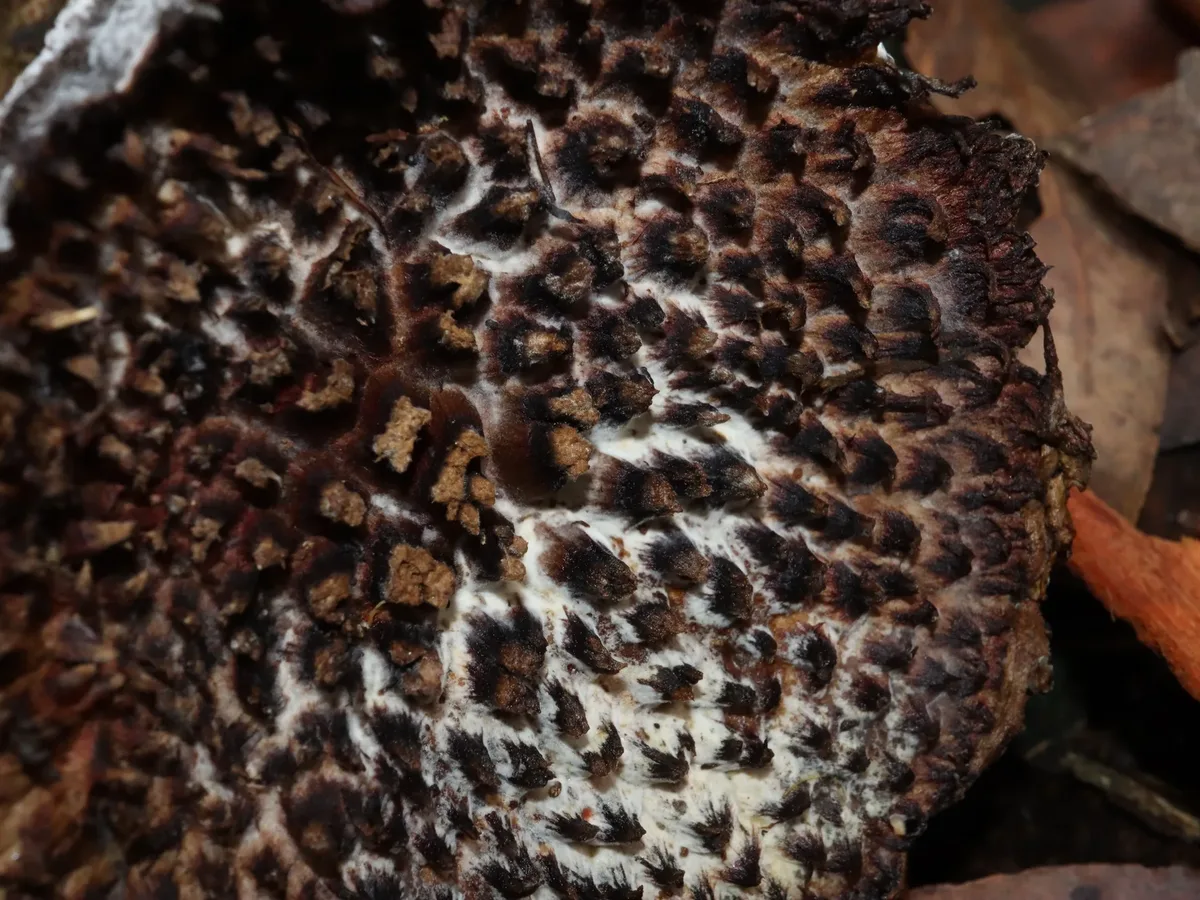 © Thomas Mesaglio (CC BY)
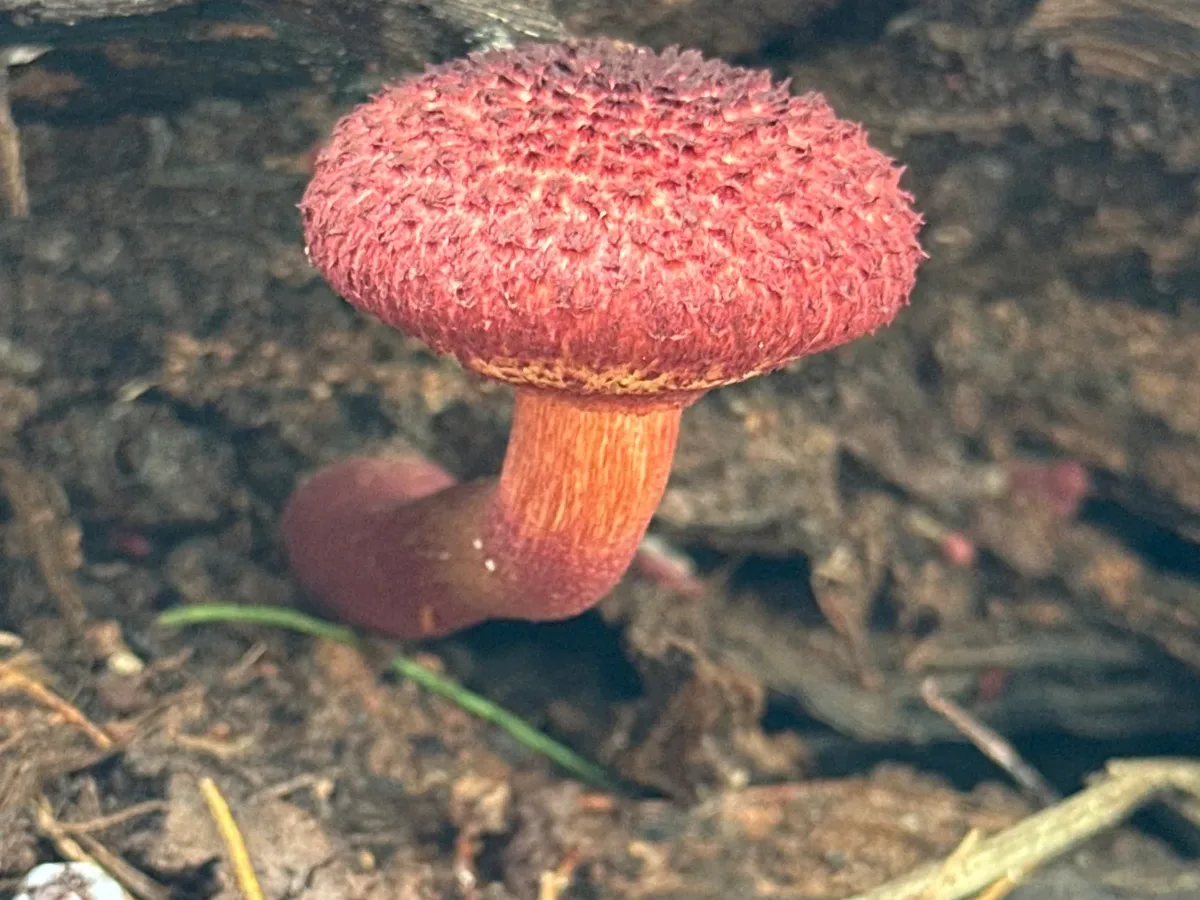 © Rosario (CC BY)
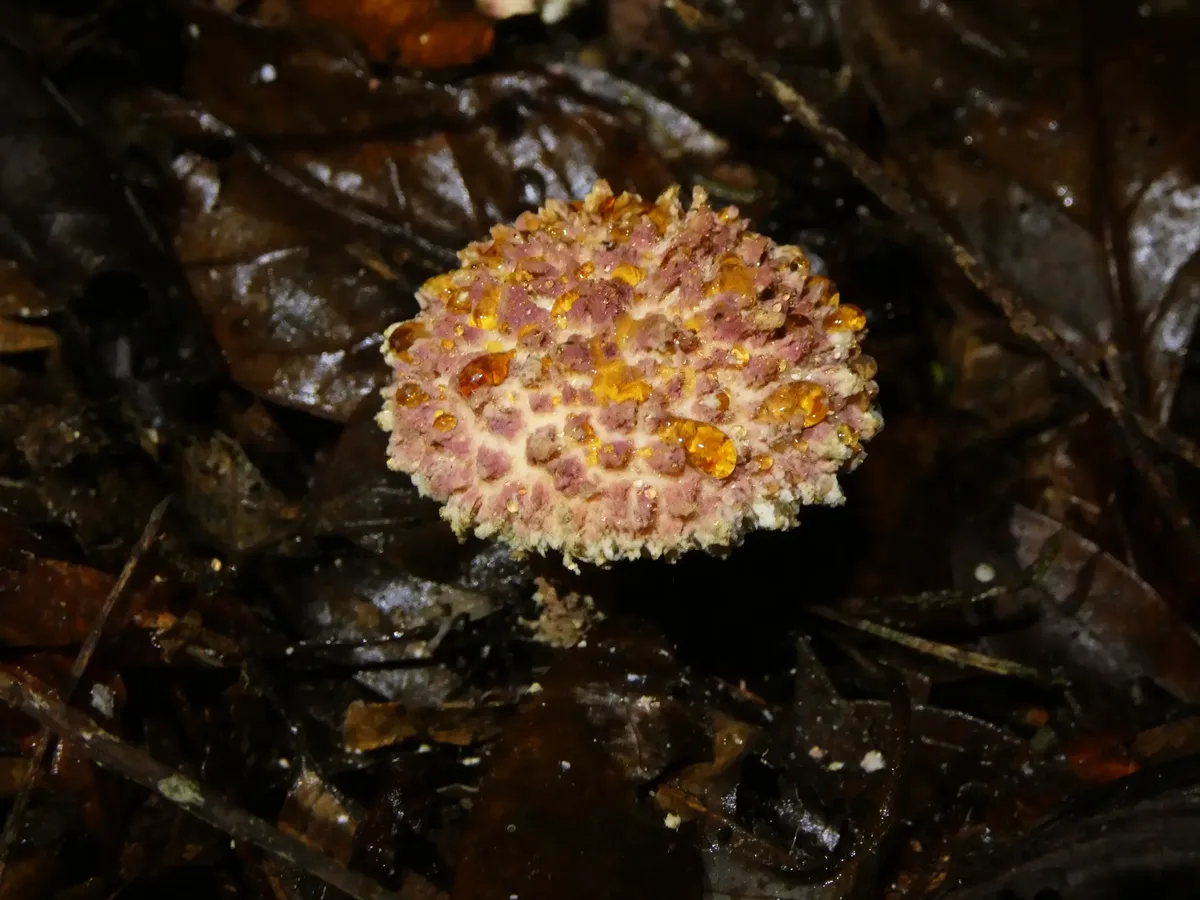 © Kai Squires (CC BY)
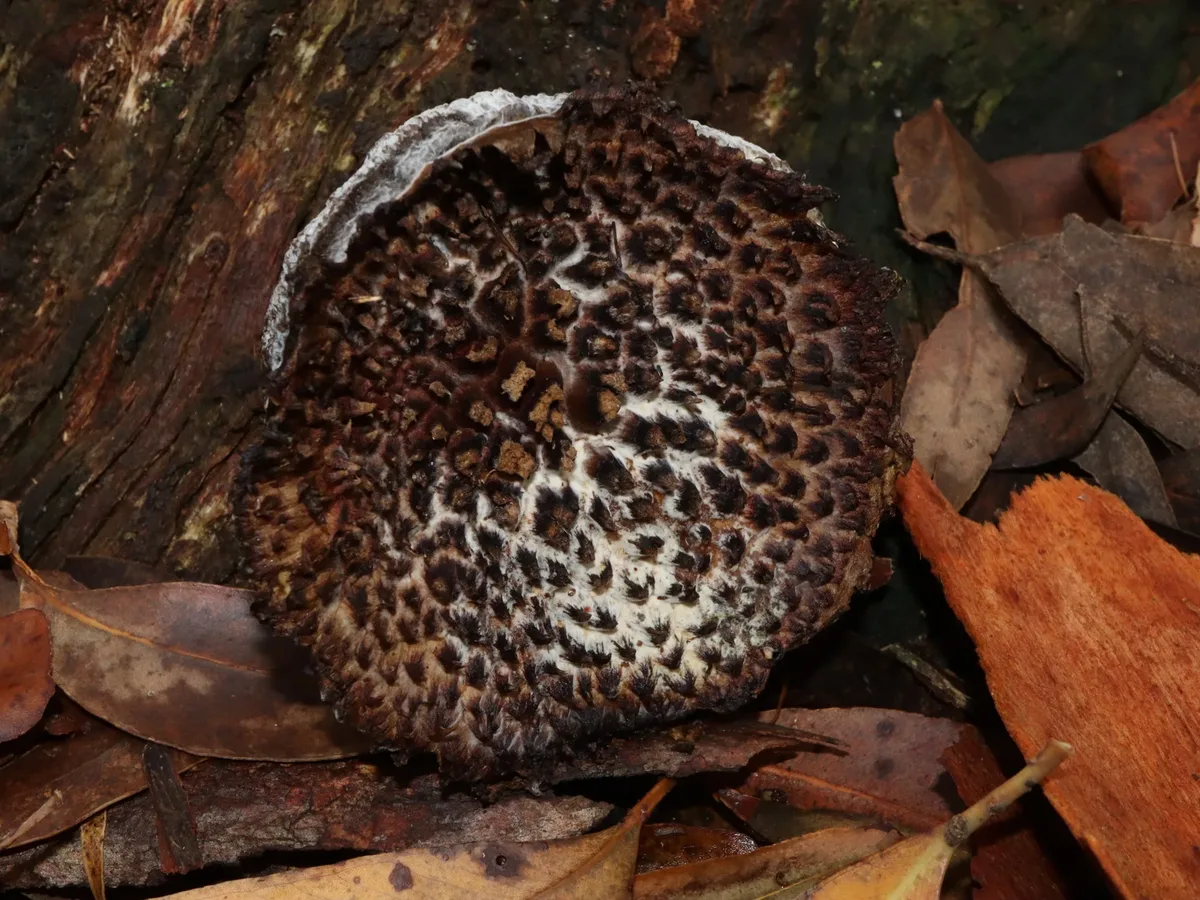 © Thomas Mesaglio (CC BY)© Thomas Mesaglio (CC BY)© Rosario (CC BY)
Not poisonous, but not worth eating - too tough, bitter, or bland for the pot.
How to recognise it
The shaggy bolete earns its common name straightforwardly: the cap is densely covered in coarse, dark-tipped fibrous scales and tufts standing away from the surface, giving it an unkempt, tousled look quite unlike the smooth domes of many other boletes. This scaliness is the single most reliable field mark.
Cap
Cap size ranges from 5 to 14 cm - a medium-to-large bolete. The colour is a dull ochre-brown to olive-brown, occasionally with faint reddish-brown tints; the darker scale tips create a mottled contrast against the paler background.
Gills / Pores
The underside reveals bright lemon-yellow pores when fresh, bruising blue to blue-green on pressure or cutting - the same variegatic acid oxidation that drives bluing reactions across dozens of bolete species worldwide. This bluing is moderately rapid and consistent, a useful secondary field character.
Stem
The stem is brownish-yellow to reddish-brown and fibrillose, without the raised white network (reticulation) that characterises the true porcini (Boletus edulis group).
Flesh
Flesh is pale yellowish-white, bluing on cut, with a mild, unremarkable odour. The spore print is olive-brown.
Reading these features together - shaggy dark-scaled brown cap, yellow pores that blue, fibrillose stem without reticulation, moderate flesh bluing - gives a field identification that is fairly reliable within its restricted range.
Where & when it grows
Habitat
Boletellus emodensis is a creature of warm forest.
Across its primary Himalayan and subtropical Asian range it grows in montane and subtropical broadleaf forest under oaks (Quercus, Lithocarpus, Castanopsis), chestnuts, and in mixed Rhododendron woodland from roughly 1000 m to 2500 m.
In tropical northeast Queensland and Papua New Guinea it appears in patches of subtropical rainforest and montane Nothofagus woodland.
Australian records are genuinely sparse - this is not a common species in Australia/NZ, and documented finds are localised to subtropical rainforest remnants and adjacent margins.
The species is strictly ectomycorrhizal, meaning it forms a mutually beneficial partnership with the fine root tips of living host trees, so it will never appear in open grassland, degraded scrub, or areas where the appropriate host trees are absent.
Finding it is a strong indicator of intact, mature subtropical or montane forest. Soils are typically moist, well-drained, slightly acidic, and rich in humus.
When
In the Southern Hemisphere (Australia), expect the shaggy bolete in autumn - March through June - when declining day temperatures and autumn rainfall together cool the soil from its summer peak down through the mid-teens Celsius.
Ectomycorrhizal boletes as a group respond to this dual cue: it is the combination of soil cooling and moisture, not moisture alone, that triggers fruiting. Allow one to two weeks after meaningful autumn rainfall for fruit bodies to push through.
In its Himalayan heartland the season is very different: the Asian monsoon drives fruiting from June through October, with peak fruiting in July and August in montane areas.
Individual fruit bodies are short-lived - a few good days, then rapid decay.
How it grows
Produces solitary to scattered fruit bodies, never in the gregarious clusters typical of wood-decay species.
The visible mushroom is only a brief surface expression of a much longer-lived underground mycelium that threads through soil and root tissue year-round.
That mycelium is tied to its host tree in a reciprocal exchange: the fungus receives sugars from the tree's photosynthesis and returns mineral nutrients - especially phosphorus - absorbed from the soil matrix.
This bond means the shaggy bolete is entirely absent from landscapes lacking appropriate host trees.
It also means it is faithful to a general location: once found in a forest patch, the mycelium will persist there and surface year after year under favourable autumn conditions, though exact fruiting spots may drift as the mycelium extends through the root zone.
Fruiting conditions
Autumn bolete in the Southern Hemisphere Australian range. Fruiting triggered by soil cooling through the mid-teens Celsius combined with meaningful autumn rainfall (20+ mm over 14 days). Flush lag of 7-16 days is consistent with ectomycorrhizal bolete phenology. In the Asian monsoon range the triggers are reversed - warm, wet monsoon conditions rather than cooling.
Look-alikes
The shaggy brown-scaled cap with yellow bluing pores is distinctive enough that dangerous confusion is unlikely in the Australian-NZ context, where no deadly boletes in the Rubroboletus-group (red-pored, highly toxic) have been confirmed as established.
The realistic confusion risks are with other brown or dark-scaled boletes:
- Strobilomyces strobilaceus (old man of the woods) has a similarly coarsely scaled, tousled cap but is grey to black throughout - cap, pores, and stem are all dark grey to black, a colour immediately distinct from the ochre-brown of emodensis.
- Boletellus obscurecoccineus (rhubarb bolete) also occurs in eastern Australia and has a shaggy cap, but its cap is deep scarlet to crimson-red - a vivid colour quite unlike the dull brown of emodensis - and it has dramatically rapid bluing pores.
- Leccinum species have superficially rough stems but smooth to dry caps and only faint bluing.
In the Asian range, care should be taken to distinguish it from other brown bluing boletes including Neoboletus brunneissimus and related species; in that context any bolete with red pores should be treated as potentially dangerous.
Has a brownish smooth to dry cap (not shaggy), whitish pores that do not blue (or only faintly), and a distinctive stem covered in coarse dark scabers (raised rough dots) rather than a fibrillose-smooth surface. The non-bluing cream pores contrast directly with emodensis's bright yellow bluing pores.
Also has a coarsely scaly, shaggy cap and bluing pores, but the entire fruit body - cap, pores, stem flesh - is grey to black rather than ochre-brown and yellow. The colour contrast is immediate and unmistakable. Pores are grey-black, not yellow.
Co-occurs in eastern Australia and also has a shaggy fibrous cap and instantly bluing yellow pores, but the cap is deep scarlet to dark crimson-red - vivid and saturated - compared to the dull ochre-brown of emodensis. The brilliant red colour is the key separator.
Another shaggy-capped bolete relative with grey-black scaling and grey pores. Distinguished from emodensis by its entirely dark grey to blackish colouration throughout, including grey pores that bruise black or reddish rather than bright yellow bruising blue.
In the kitchen
Picking & cleaning
Do not collect this species for the table. Boletellus emodensis has no established culinary tradition and is widely considered inedible - not because it is dramatically poisonous, but because it is not edible in a practical sense: the flesh texture is reported as unpleasant and the flavour unremarkable at best.
The broader principle here is important: the Boletellus genus in Australia includes species whose toxicological profiles are incompletely characterised, and in the absence of strong positive evidence of safety combined with an established culinary tradition, the responsible position is to treat unfamiliar boletes as not for the table.
If collecting for photography or scientific documentation, cut the stem cleanly rather than pulling to preserve the mycelium.
Good to know
Boletellus emodensis is classified as inedible. It is not known to contain potent toxins and is not documented as causing serious poisoning under its own name, but it has no history of safe culinary use and is not recommended for consumption by any modern mycological authority.
The broader safety principle for blue-bluing boletes in Australia is straightforward: in a region with no strong culinary bolete tradition, and where the edibility of most native and introduced bolete species has not been rigorously studied, the safest default is not to eat unfamiliar boletes.
If accidental ingestion occurs and any symptoms develop, contact the Poisons Information Centre (Australia: 13 11 26) and seek medical advice.
A reference guide - never an edibility guarantee. When in doubt, leave it out.