Australian false truffle
Austrogautieria nudicolasyn. Gautieria nudicola
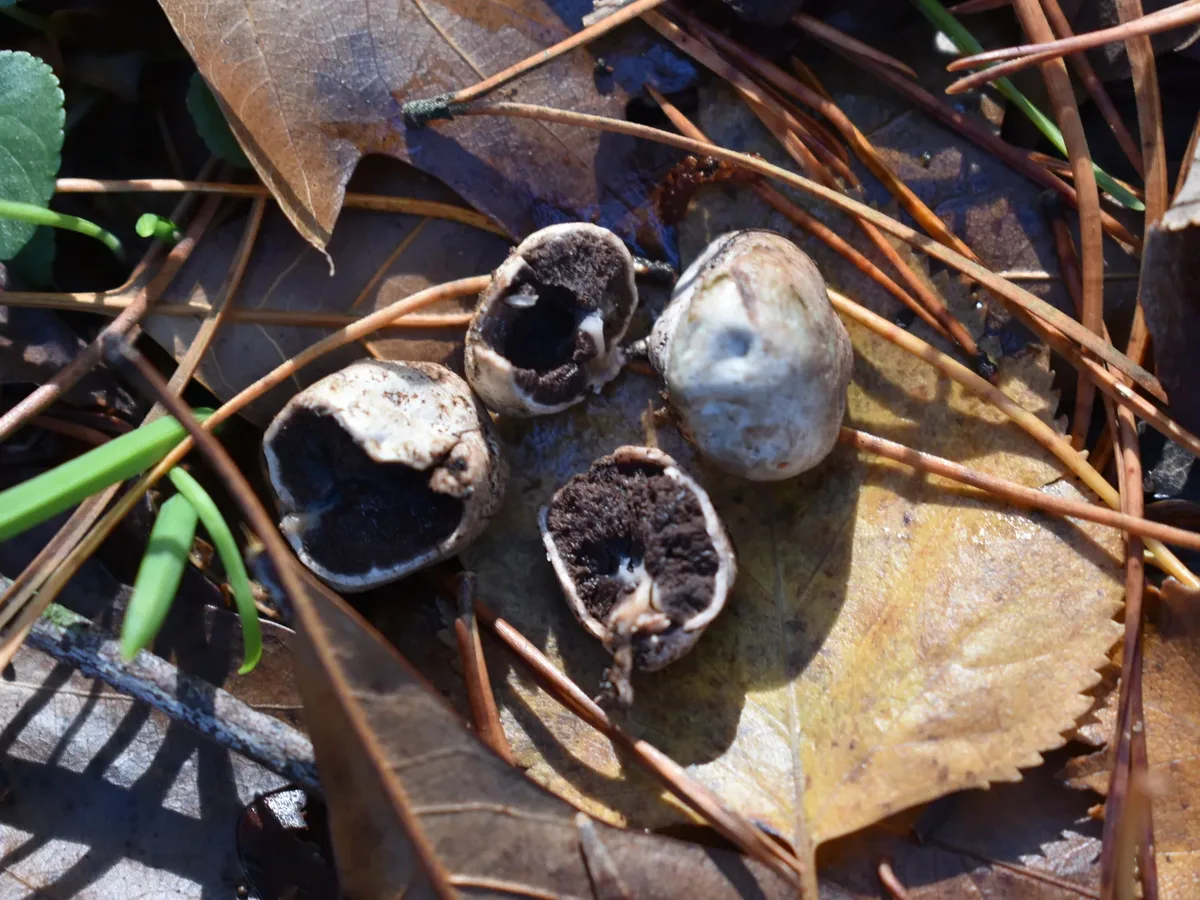 © Atlas of Living Australia (CC BY-SA)
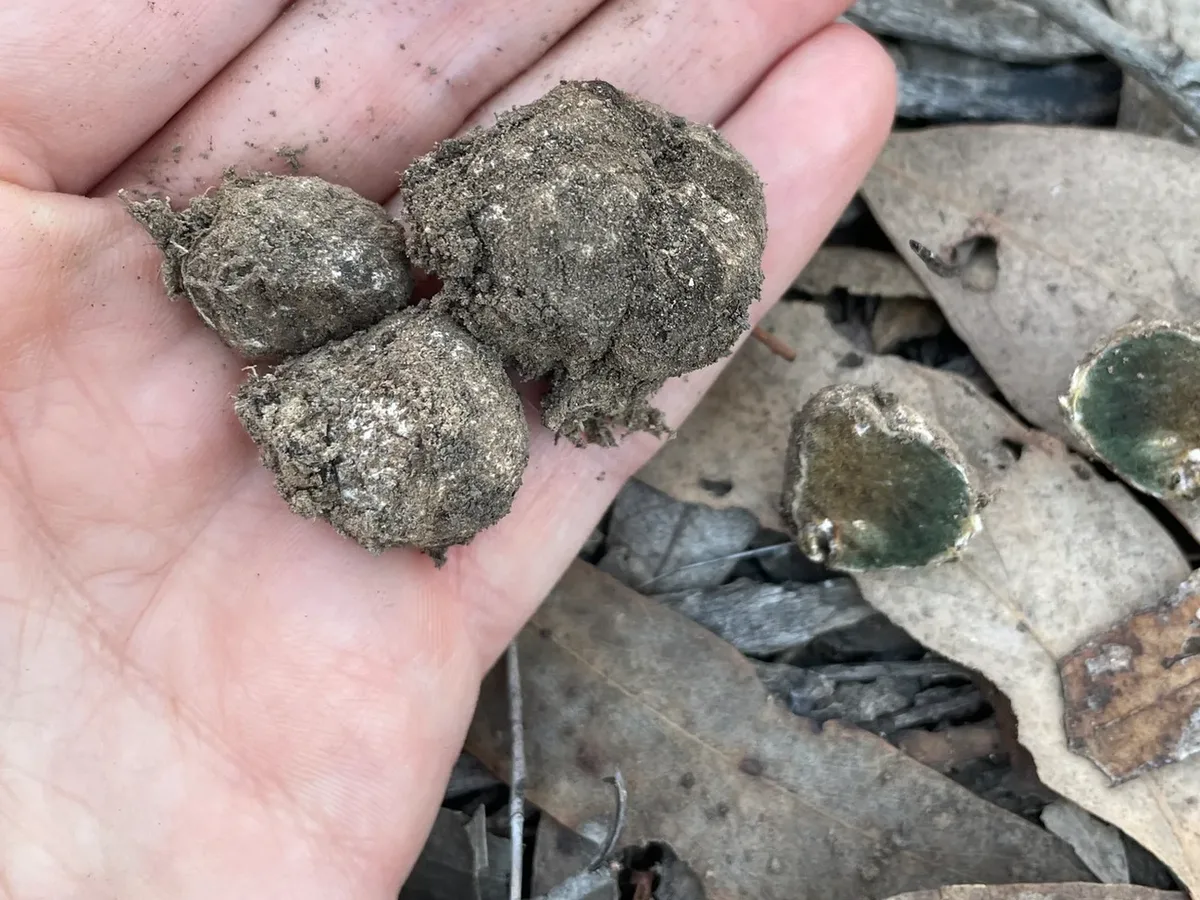 © Atlas of Living Australia (CC BY)
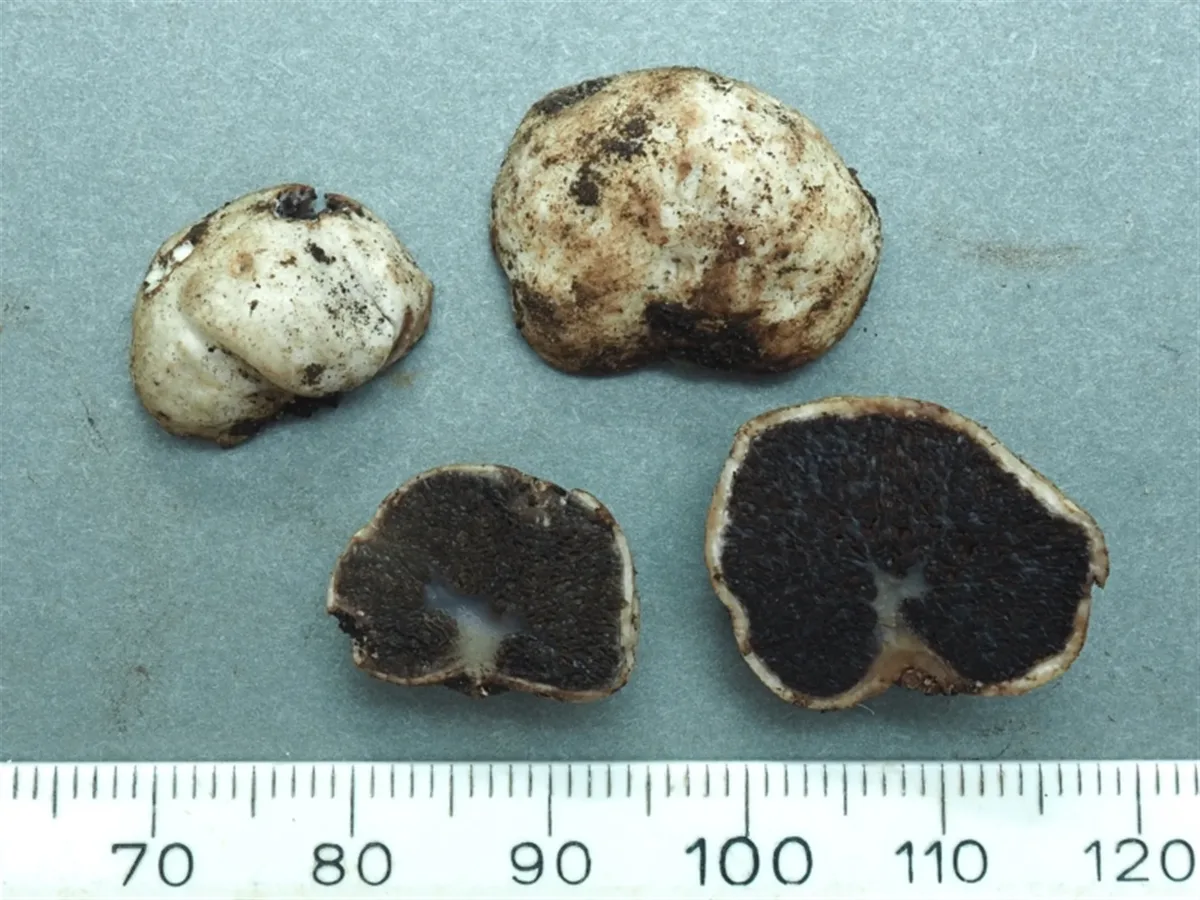 © Atlas of Living Australia (CC BY)© Atlas of Living Australia (CC BY-SA)© Atlas of Living Australia (CC BY)
Not poisonous, but not worth eating - too tough, bitter, or bland for the pot.
How to recognise it
Austrogautieria nudicola belongs to an ecologically and structurally fascinating group: the sequestrate fungi, colloquially known as false truffles, that have evolved to retain their spore mass inside a closed fruiting body rather than releasing spores into the air from open gills or pores. This is not a mushroom that opens - it is anatomically a closed package from the day it forms.
The body is roughly round to irregularly lobed, 1.5-5 cm across, firm and leathery in texture. It sits either fully underground or just barely poking above the soil surface.
The outer rind (peridium) is smooth to finely warted, pale buff to ochre or mid-brown when fresh, darkening to reddish-brown or greyish-brown with age. There is no stipe; the underside is often slightly narrowed or bears short mycelial cords anchoring it to the soil.
The epithet nudicola, from the Latin for 'naked dweller,' captures this feature - the species lacks the sterile base (columella) present in some related genera.
Slice a specimen open and you reveal the gleba: a pale, cream-coloured interior when immature, crossed by an intricate network of thin-walled chambers in a labyrinthine pattern - like a miniature coral reef in cross-section. As the spores ripen, the gleba turns ochre, then olive-brown to purplish-brown.
The odour shifts from faintly earthy when young to a sharper, slightly acrid fungal smell at maturity, distinguishing it from the alluringly fragrant perigord truffle genera.
The ornamented spores, visible only under the microscope, show a distinctive network of ridges and warts.
Where & when it grows
Habitat
This species occupies a highly specific ecological niche: the root zones of eucalyptus trees in open, dry sclerophyll woodland, where it lives as an ectomycorrhizal partner - exchanging sugars for soil minerals with its host tree, entirely underground. The above-ground world hardly knows it exists.
Look for it in the sandy to gravelly soils of dry eucalypt woodland in southeastern Australia, on well-drained slopes and ridges where the tree canopy is open enough to allow summer drying.
The soil profile is typically shallow and low in organic matter - not the rich, damp forest floor where true truffles of European commerce thrive, but a harsher, sun-baked Australian environment. Specimens sit buried 1-6 cm below the surface.
You can sometimes locate them by:
- Scanning for slightly mounded or cracked soil around the base of eucalypt trees
- Following the mycelial-cord traces when digging
- Noticing where native mammals have been digging: potoroos, bandicoots, and bettongs regularly excavate false truffles and are important dispersers of their spores
The species is documented across New South Wales, Victoria, South Australia, and the ACT, always under open Eucalyptus woodland.
When
Fruiting occurs through Southern Hemisphere autumn and into early winter, from March to July, with the main flush in April and May.
The underlying biology parallels other ectomycorrhizal autumn fruiters: cooling soil temperatures after summer heat and the rehydration of soils by seasonal rains signal the tree-fungus partnership that it is time to reproduce.
Because the fruiting bodies develop underground and do not need to release airborne spores, they persist for considerably longer than above-ground mushrooms - a body that formed in late April may still be intact (though increasingly dark and mature) in June.
The fruiting bodies are not visible at the surface until they are nearly mature or have been disturbed. Between rain events the soil can dry around them; this resilience in the rind allows them to survive conditions that would collapse a thin-walled above-ground mushroom.
How it grows
Like all ectomycorrhizal fungi, Austrogautieria nudicola spends most of its existence as an invisible network of fungal threads woven through the soil and around the fine root tips of eucalyptus trees. This mutual dependency has likely persisted for millions of years in Australian forest.
The fruiting bodies we can find are just the reproductive structures - the equivalent of a single apple on a vast underground tree. They develop individually or in small, loose groupings around a single host tree, sometimes in arcs or irregular clusters that trace the reach of the mycelium.
They are not particularly numerous in any given site; finding three to five specimens in one search is a good result.
Because the bodies develop entirely underground, they rely on native mammals (potoroos, bandicoots, bettongs, wombats) to find and eat them, dispersing spores through the animals' droppings across the woodland. This mammal-mediated dispersal is ecologically critical - the loss of these small marsupials from woodland fragments is a genuine threat to the persistence of false truffle fungi and their eucalyptus partners.
Fruiting conditions
Fruiting triggered by autumn rains (March-July in the Southern Hemisphere) combined with cooling soil temperatures in the 7-15 °C range. Being hypogeous, fruiting bodies develop more slowly than above-ground mushrooms and persist longer; a flush lag of 12-21 days from rain event to detectable bodies is typical. Minimum 20 mm rainfall in the prior two weeks provides the soil moisture needed. Does not fruit in summer heat or hard winter frost.
Look-alikes
Austrogautieria nudicola is one of many native Australian false truffles and can be confused with a range of other sequestrate species in the same habitats. Positively separating species within this group often requires microscopy of spore ornamentation and examination of the peridium structure.
The genera most likely to be encountered alongside Austrogautieria in dry eucalypt woodland include:
- Castoreum - a more fibrous, strongly aromatic gleba and often firmer rind
- Hysterangium - a distinct gelatinous layer between peridium and gleba, and a usually prominent sterile base
- Mesophellia - tending to be larger and more aromatic
- Zelleromyces - an often more persistent, thicker rind
- Rhizopogon species - primarily under pines in Australia, not native eucalypt woodland
Thaxterogaster and sequestrate Cortinarius relatives have a more fibrous, lamellate gleba.
None of these lookalikes are deadly, and the false truffle group as a whole is not associated with serious toxicity in Australian species. No deadly species is realistically confused with Austrogautieria nudicola by a forager in the field.
Castoreum species share the hypogeous habit and ectomycorrhizal eucalypt association but typically have a distinctly aromatic, rich fungal odour, a more fibrous gleba, and often a firmer, thicker peridium. The gleba in Castoreum tends to remain firmer at maturity rather than becoming soft and olive-brown. Microscopy of spore ornamentation is needed for reliable separation.
Hysterangium false truffles have a characteristic gelatinous inner layer between the peridium and the gleba, visible when sliced, which Austrogautieria lacks. They often have a more prominent sterile base (stipe-like structure) and the gleba texture at maturity differs - olivaceous and somewhat gelatinous rather than powdery. Widespread in eucalypt woodland but separation from Austrogautieria in the field is difficult without slicing and microscopical examination.
Mesophellia species are typically larger (up to 8+ cm) and have a strongly aromatic, distinctly sweet-fungal odour that contrasts with the sharper, more acrid smell of Austrogautieria nudicola. The peridium in Mesophellia is often thicker and the gleba at maturity is powdery and pale to ochre rather than chambered and olive-brown. Also found in eucalypt woodland in southeastern Australia.
Rhizopogon species are introduced to Australia with plantations of exotic pines (Pinus) and are therefore found under conifers, not native eucalypt woodland. The peridium typically has a yellowish to olivaceous colour and conspicuous mycelial cords attached at the base. The habitat distinction - pine plantation vs. native eucalypt woodland - is the simplest separator.
In the kitchen
Picking & cleaning
There is no culinary or practical reason to collect Austrogautieria nudicola; it is not eaten and has no documented use.
If you find one for identification or scientific purposes, use a small stick or trowel to unearth it carefully without destroying surrounding mycelium and the adjacent soil structure.
Record the depth, soil type, host tree species, and any signs of animal disturbance (digging marks, bite marks on the rind). Replace displaced soil to protect the remaining mycelium.
Because false truffles rely on mammals to disperse their spores, leaving mature specimens in place - or replacing disturbed ones near the surface - contributes to natural spore dispersal. Photographs with a scale reference are useful for documentation.
Good to know
Austrogautieria nudicola is not known to be poisonous. No toxins have been identified in this species, and there are no documented poisoning cases from any Austrogautieria species.
The species is inedible in the practical sense:
- A tough, leathery rind
- An unpleasant acrid odour at maturity
- No culinary tradition whatsoever
'Not toxic' is not the same as 'worth eating' - this is a fungus that nature has designed to be eaten by bandicoots, not by humans, and both the texture and the smell make its evolutionary intent fairly clear.
Do not collect it for eating. There are no deadly lookalikes among the native Australian false truffle genera.
A reference guide - never an edibility guarantee. When in doubt, leave it out.