Olive-brown Austroboletus
Austroboletus olivaceobrunneussyn. Boletus olivaceobrunneus
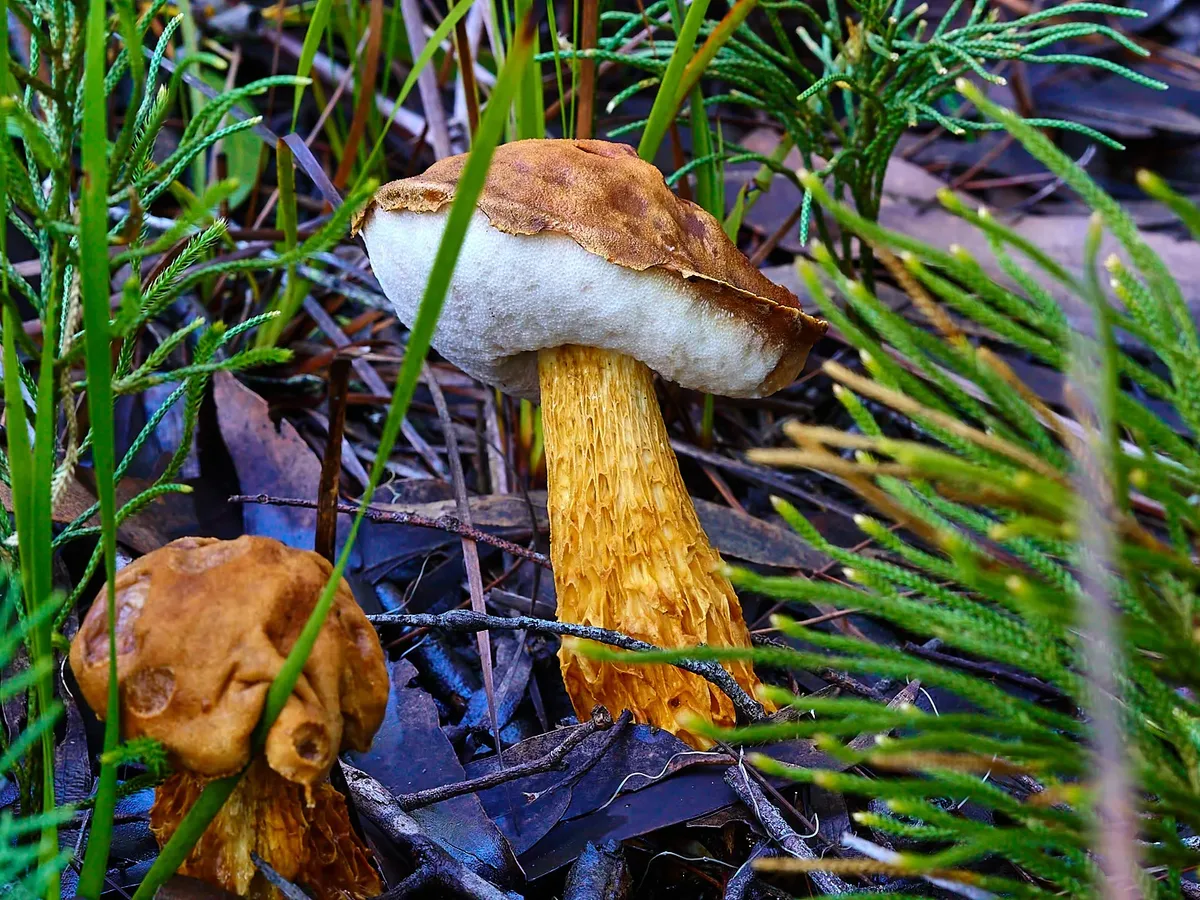 Atlas of Living Australia (CC0)
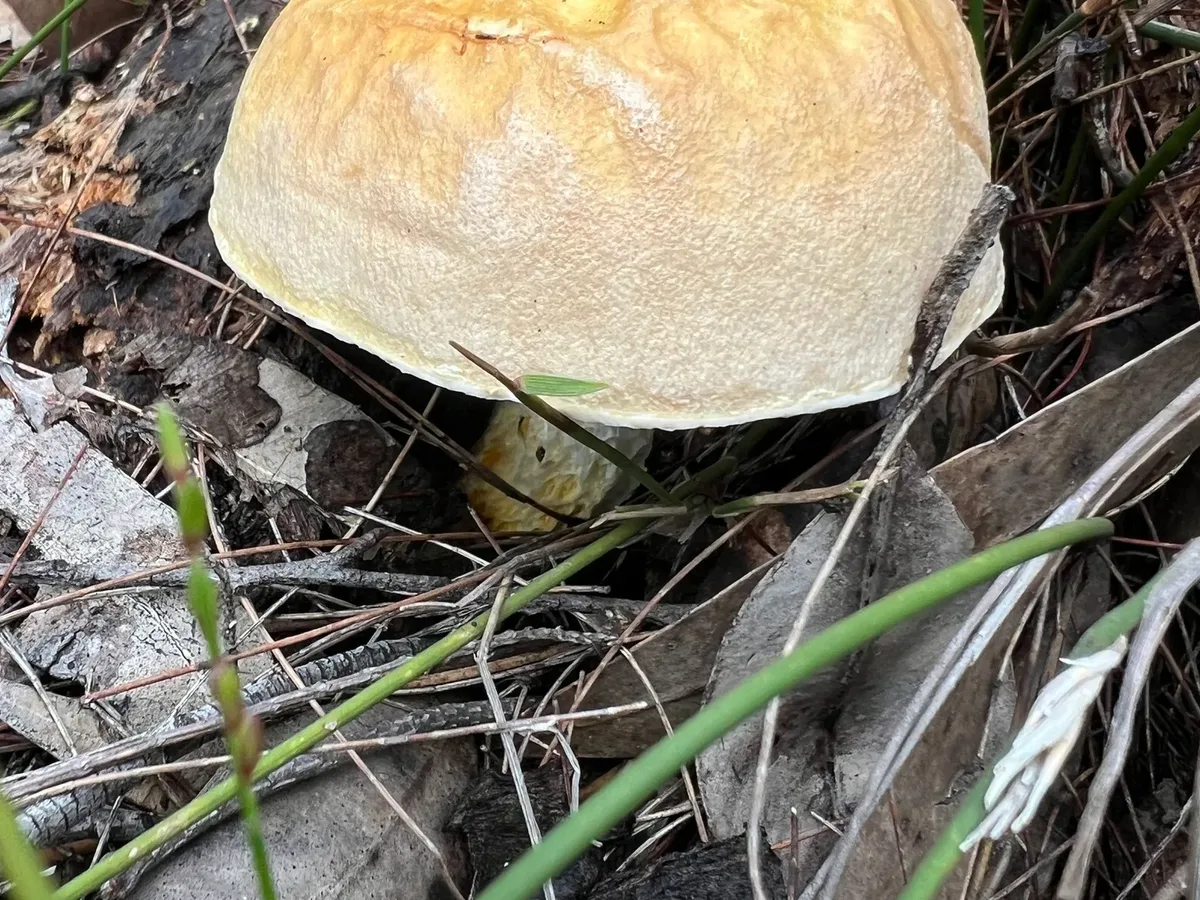 Atlas of Living Australia (CC0)
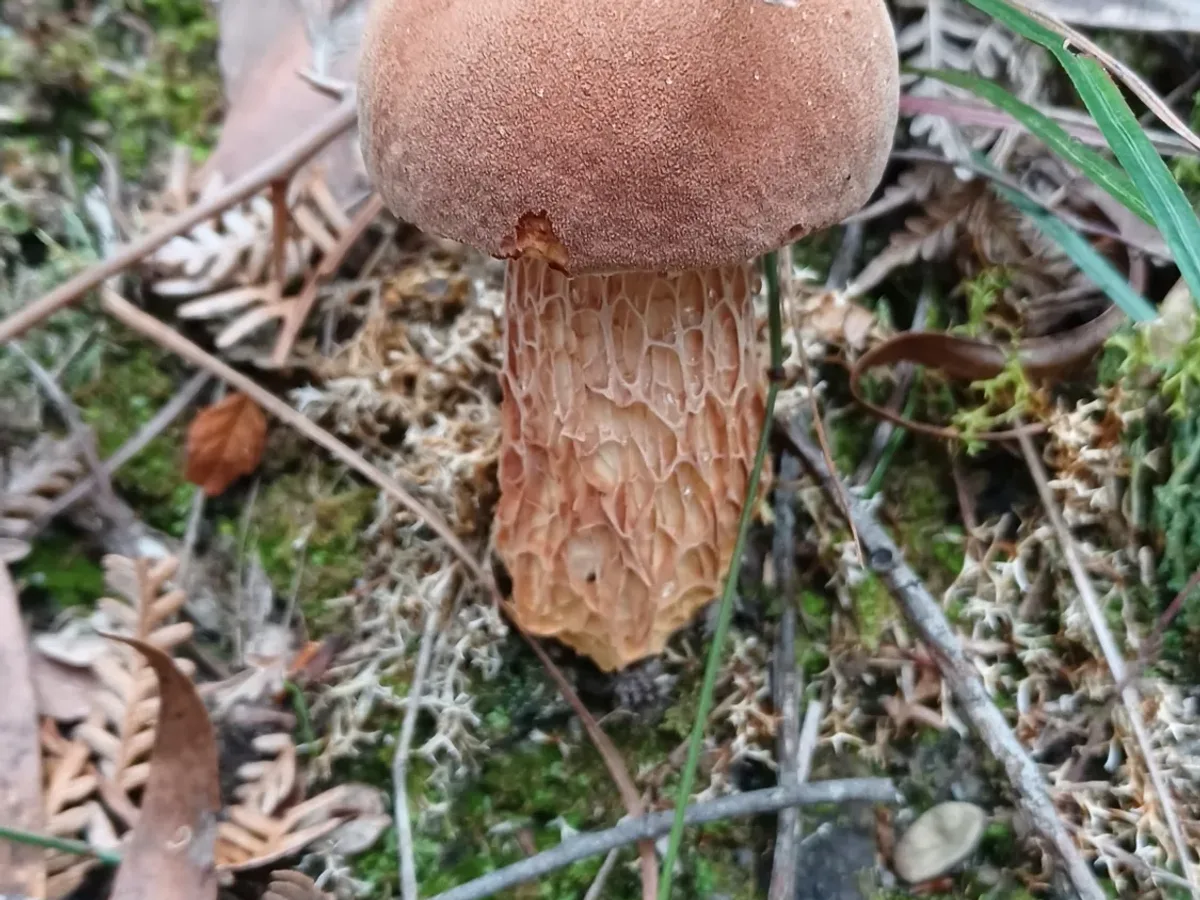 Atlas of Living Australia (CC0)
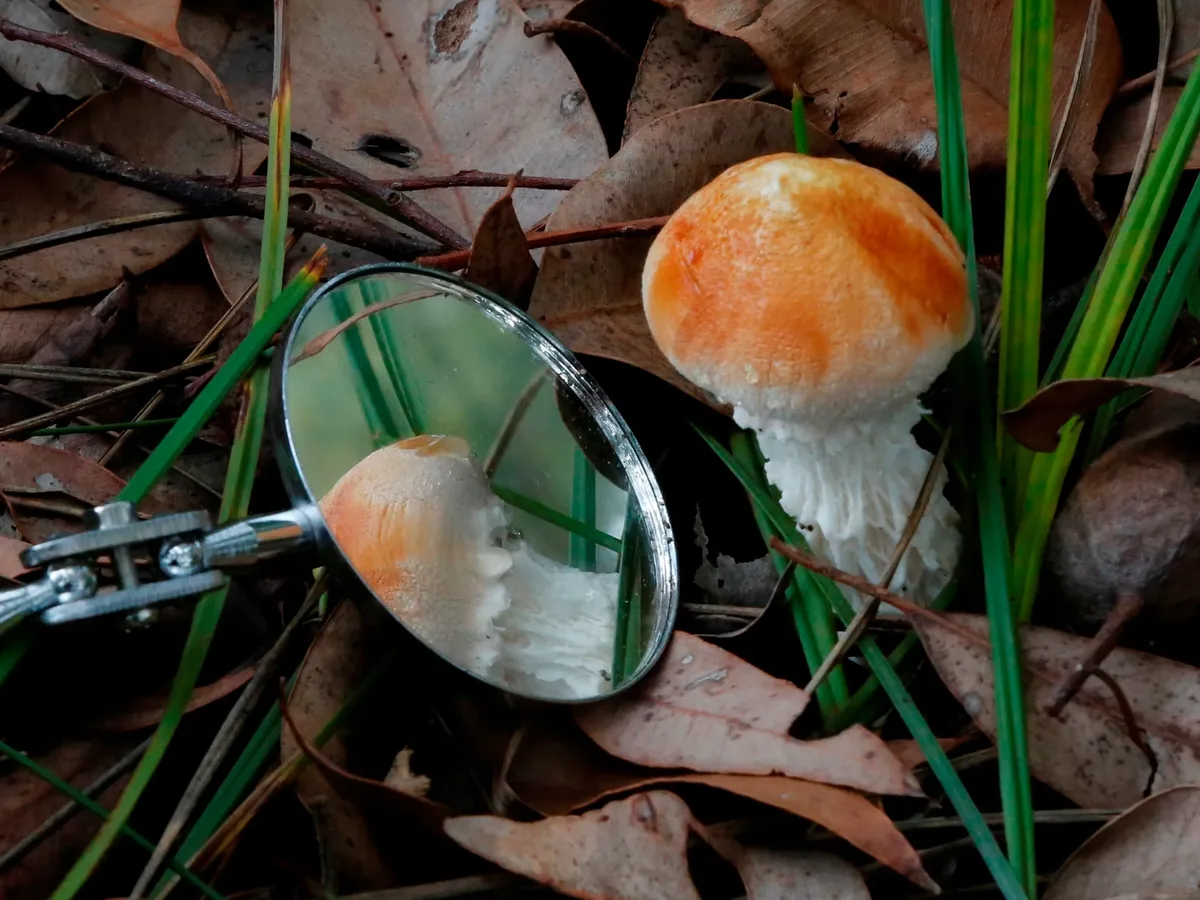 Atlas of Living Australia (CC0)Atlas of Living Australia (CC0)Atlas of Living Australia (CC0)
Not poisonous, but not worth eating - too tough, bitter, or bland for the pot.
How to recognise it
Austroboletus olivaceobrunneus is a quietly handsome Australian bolete whose identity is encoded in its name: olivaceobrunneus is Latin for 'olive-brown', and the cap colour lives up precisely to that description.
Cap
The cap (4-10 cm) carries a dull, dry surface coloured in muted olive-brown to brownish-olive, often darker and more brown at the disc and marginally paler, more yellowish-olive toward the edge - a subtly greyed-down palette quite unlike the warmer rust-brown or reddish-chestnut of many boletes.
This muted tone, combined with the finely felty cap texture, gives the species a distinctive understated appearance in the field.
Pores
Beneath the cap, the pore surface is white to cream when fresh, ageing to pale yellowish - notably, the pores do not blue when bruised or cut.
This non-bluing character is a reliable and reassuring field mark, placing it outside the group of potentially harmful blue-staining boletes.
The tubes are 6-12 mm deep, the same colour as the pores.
Stem
The stipe (5-12 cm tall) is pale buff to whitish and bears a clear reticulate network - a raised mesh of ridges - over most of its length, a standard character for the genus Austroboletus and useful in separating it from non-reticulate Australian boletes.
Flesh
Flesh is white, firm, and does not change colour when cut.
The spore print is olive-brown.
Where & when it grows
Habitat
This species belongs to the dry and wet sclerophyll eucalyptus forests of eastern Australia - the sun-dappled, bark-strewn open forest dominated by tall Eucalyptus that covers much of the Great Dividing Range's lower slopes and coastal ranges from southeastern Queensland to Victoria.
It forms obligate underground partnerships (ectomycorrhizae) with the roots of mature Eucalyptus trees, exchanging mineral nutrients it captures from the soil for the photosynthetic sugars that sustain it.
This dependency on living host trees and intact soil means it is an ecological indicator of undisturbed or at least well-recovered native forest: look for it where the tree canopy is continuous, the soil undisturbed, and the leaf litter deep.
Compared to its relative Austroboletus lacunosus - which reaches into cool temperate rainforest and higher elevations - A. olivaceobrunneus seems to favour somewhat warmer, drier conditions and is not consistently recorded from Nothofagus or alpine zones.
It occurs singly or in small, scattered groups, and is never abundant.
When
Fruiting follows the classic pattern of Southern Hemisphere ectomycorrhizal boletes: the season belongs to autumn, broadly March through July, with the productive core in April and May.
The physiological trigger is a combination most characteristic of autumn in the eucalypt forest belt: soils dried by summer heat become rewetted by seasonal rainfall, while temperatures cool into the range of roughly 10-18 °C at soil level.
Once those conditions align, primordia initiate within the mycelial mat beneath the leaf litter and caps emerge over one to two weeks.
The timing shifts predictably with geography: on the warmer, more maritime Queensland coast, fruiting may begin in March; in the cooler southern parts of the range in Victoria, the season can extend to June or occasionally July.
This species does not fruit during summer heat or winter cold, and the window in any given year is governed primarily by rainfall.
How it grows
Solitary or in small, loosely scattered groups; never in clusters.
As an obligate ectomycorrhizal species, it returns to the same general patches of eucalypt forest year after year, with the underground mycelium persisting as a long-lived network between fruiting seasons.
Fruit bodies emerge from the soil over several days, caps tightly convex before gradually flattening.
The species is not particularly common and significant hauls are unusual; finding two or three specimens in an outing at a productive site is typical.
Fruiting conditions
Southern Hemisphere autumn (March-July). Fruiting triggered by autumn rains and cooling soil temperatures. Soil temperatures falling from summer highs through roughly 18 °C downward, combined with at least 20 mm rainfall over the preceding two weeks, produce reliable flushes. Flush lag from rain event to emergent caps estimated at 10-18 days, consistent with standard ectomycorrhizal bolete phenology. Does not fruit in summer heat or winter cold.
Handle with care
Toxin
No toxins have been isolated or characterised from this species.
The inedible classification reflects the lack of culinary tradition and absence of systematic edibility testing rather than documented toxicity.
No blue-staining reaction and no red-pore characters are present; this species does not share the metabolic profile associated with GI-irritant bluing boletes.
Symptoms
No toxicity is documented for this species.
In the extremely unlikely event of a significant accidental ingestion, monitor for non-specific gastrointestinal symptoms (nausea, discomfort) as a precaution, and seek medical advice if symptoms develop.
Look-alikes
The combination of olive-brown cap colour, non-bluing white pores, and clearly reticulate stipe is distinctive within the Australian Austroboletus complex. The most realistic confusions are with other Austroboletus species.
- Austroboletus lacunosus - shares the reticulate-to-lacunose stipe and similar forest habitat but differs clearly in its deeply pitted (lacunose) rather than simply reticulate stipe; its cap runs more towards warmer ochre-brown and chestnut tones rather than the greyed olive-brown of A. olivaceobrunneus; it also has a strong association with Tasmania and cool temperate Nothofagus forest, while A. olivaceobrunneus is predominantly an eastern mainland species.
- Austroboletus novae-zelandiae - primarily a New Zealand species with a viscid cap in wet conditions.
- Other brown-capped Australian boletes in Suillus and related genera associated with introduced pines - easily separated by habitat (always under Pinus, never under Eucalyptus) and by the ring or granular-dotted stipe of most Suillus species.
There are no deadly boletes currently known from Australian native eucalypt forest that could be realistically confused with this species.
Why it matters
Low. No toxic compounds are known from this species and no poisoning incidents are on record.
The primary reason for the inedible classification is absence of culinary value and unconfirmed edibility status, not documented harm.
Standard bolete safety discipline applies here as to all Australian boletes:
- never eat a species whose identity is not fully certain
- never eat bluing boletes without expert guidance
Primarily a New Zealand species associated with Nothofagus; tends to have a more viscid (sticky) cap in wet weather. Its cap colour is broadly brown but differs in tone from the distinctive olive-brown of A. olivaceobrunneus. Habitat and geography are the main separating factors; both occur in the australia-nz region but are geographically and ecologically distinct.
Boletus austroedulis (the southern porcini) also grows under Eucalyptus in eastern Australia with a brown cap and non-bluing pores, but it has a distinctly warmer, richer brown cap without the olive-grey undertones of A. olivaceobrunneus, and its stipe reticulation is prominent and whitish rather than net-like over the whole stipe. B. austroedulis is edible; A. olivaceobrunneus is not.
Suillus species grow exclusively under introduced pines (Pinus), never under native Eucalyptus. They have slimy or glutinous caps in wet conditions and most bear a ring or ring-zone on the stipe; the stipe surface is granular-dotted, not reticulate. Habitat alone immediately rules them out wherever A. olivaceobrunneus occurs.
The most closely related species likely to be encountered in overlapping habitat. A. lacunosus has a warmer ochre-brown to reddish-chestnut cap (not the greyed olive-brown of A. olivaceobrunneus) and its stipe is dramatically lacunose - deeply pitted with irregular channels and cavities - rather than simply reticulate. A. lacunosus also has a stronger association with Tasmanian cool temperate rainforest and Nothofagus. Both are non-bluing. A. lacunosus is edible; A. olivaceobrunneus is inedible.
In the kitchen
Picking & cleaning
Austroboletus olivaceobrunneus is not collected for food.
It is classified as inedible - not because it is known to be toxic, but because it has no established culinary merit, no tradition of safe use, and has not been cleared by systematic edibility testing.
Collectors encountering it in the field can confidently identify it and photograph it without any temptation to collect for the table.
If collecting reference specimens for scientific or documentation purposes:
- cut the stipe cleanly at the base to preserve the mycelial mat
- bag separately
- note the host tree species
Cooking
This species is not eaten and should not be brought to the kitchen.
It is classified as inedible because it has no established culinary merit; it is not an unrecognised delicacy waiting to be discovered, and the absence of documented toxicity does not make it appropriate for experimentation.
Australian native boletes as a group remain poorly studied for edibility, and the precautionary position is to avoid eating any native bolete not specifically cleared in reputable Australian mycological sources.
Good to know
Austroboletus olivaceobrunneus is not known to be toxic, and no cases of poisoning attributable to this species have been documented in the Australian mycological literature.
However, it is classified as inedible because it lacks culinary merit and has not been cleared by any systematic edibility assessment.
The standard safety rules for Australian boletes apply:
- do not eat any bolete that bluely stains when cut (this species does not)
- do not eat any bolete with red or orange pore surfaces
- do not eat any bolete unless the identification is certain
The general principle with less-studied native Australian fungi is that 'no reports of poisoning' is not the same as 'documented safe to eat'.
If accidental ingestion of a significant quantity is suspected, contact the Poisons Information Centre (Australia: 13 11 26).
A reference guide - never an edibility guarantee. When in doubt, leave it out.