Festive Austrobolete
Austroboletus festivussyn. Boletus festivus
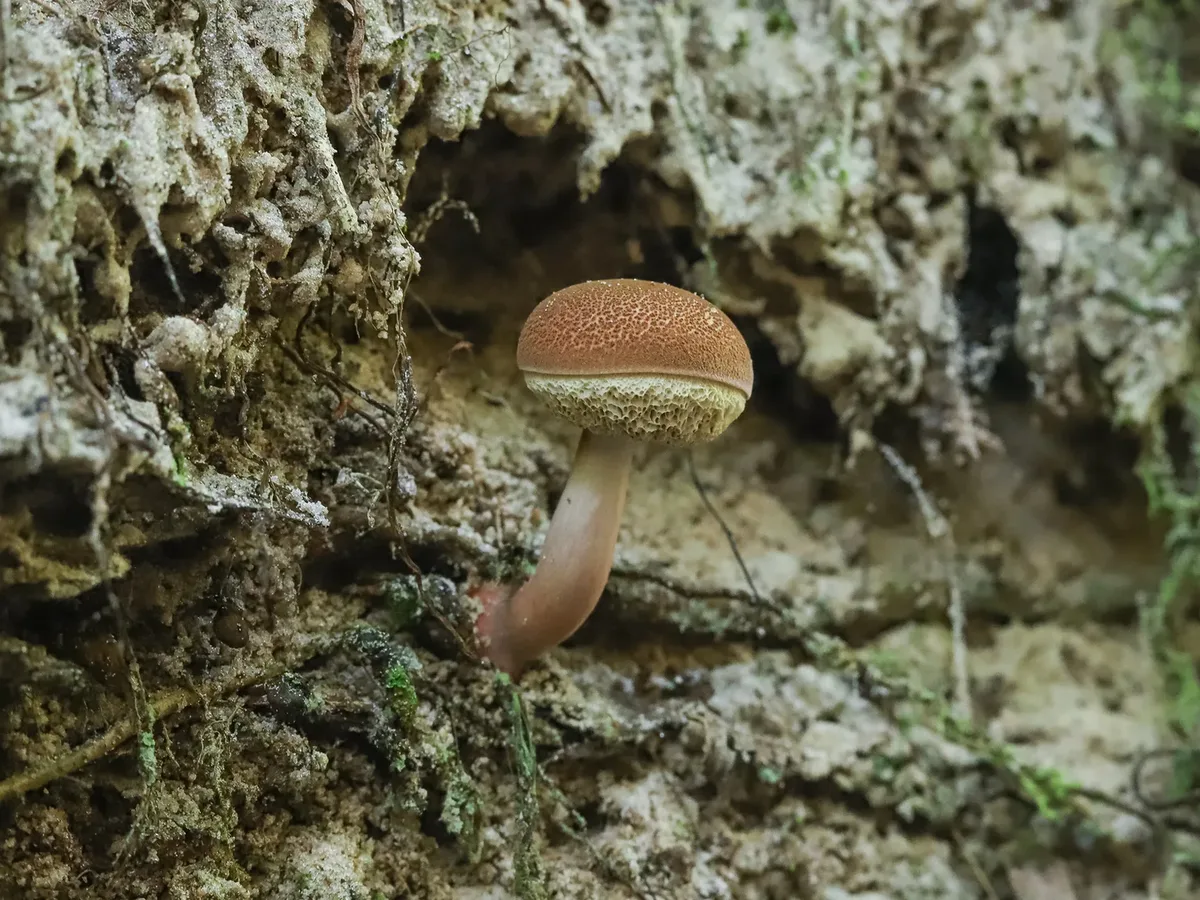 © Denis Zabin (CC BY)
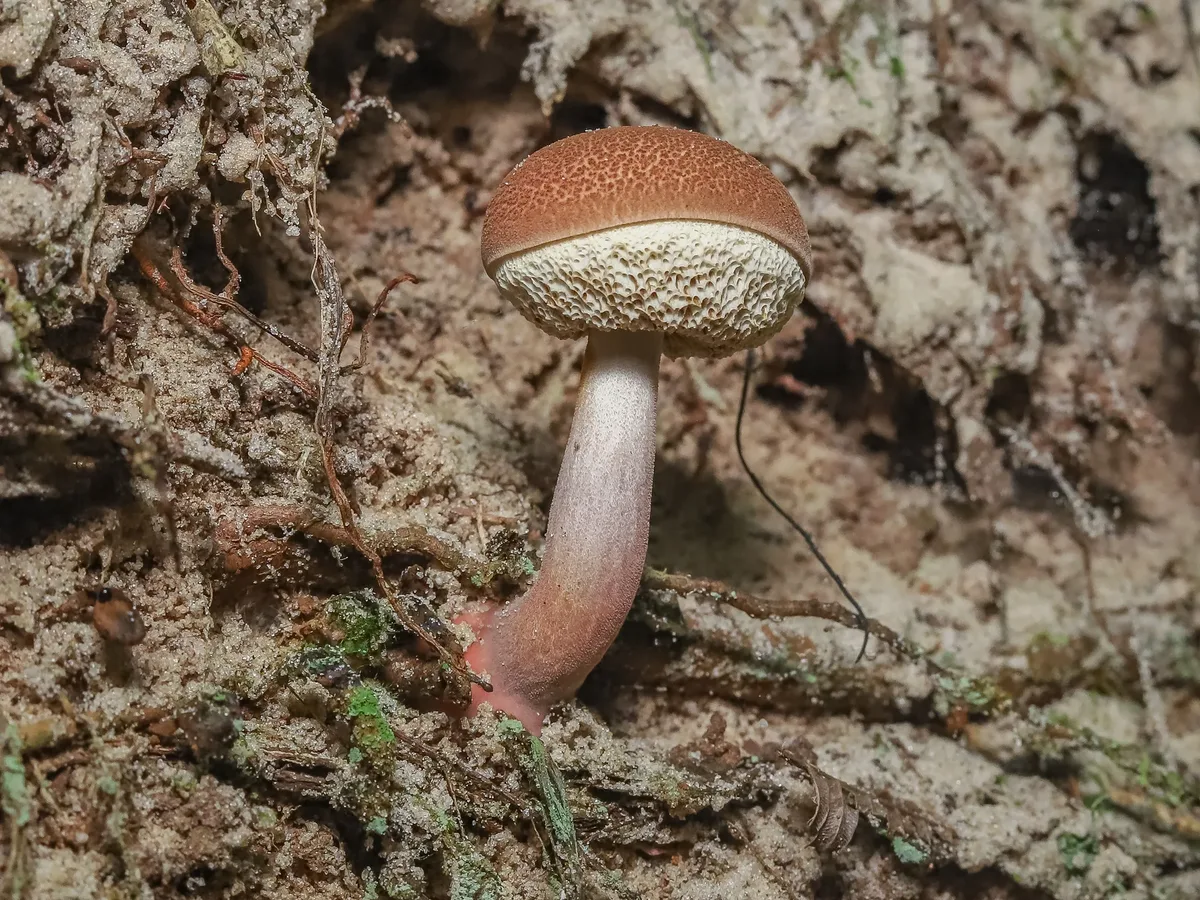 © Denis Zabin (CC BY)
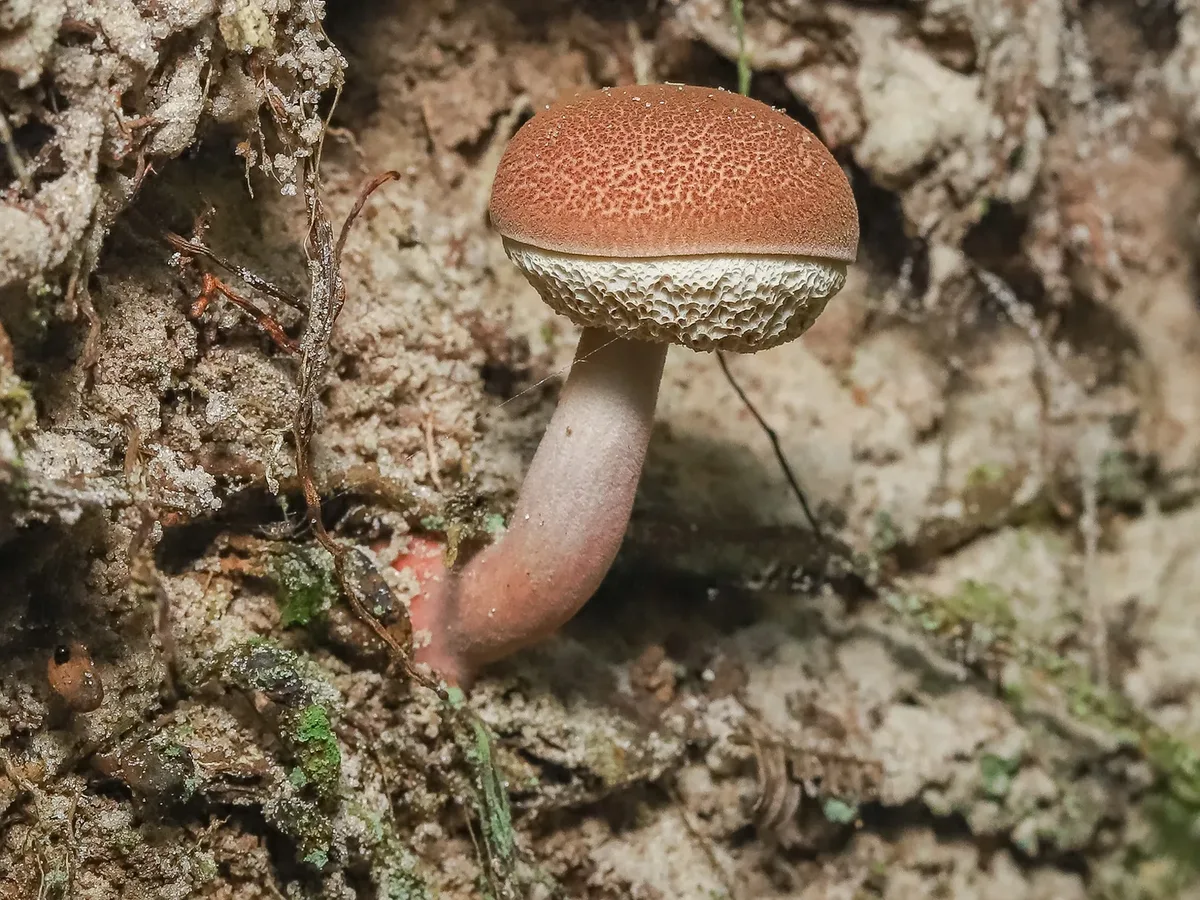 © Denis Zabin (CC BY)
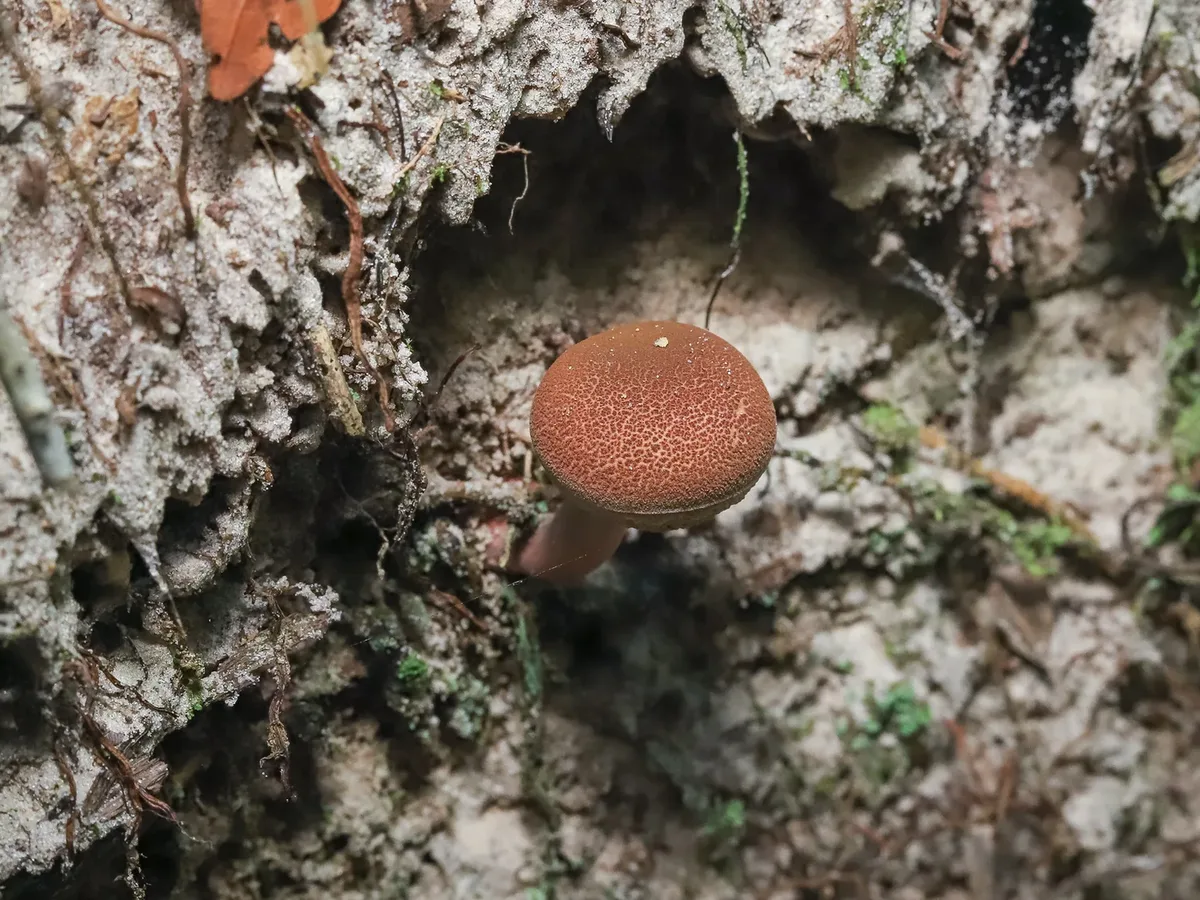 © Denis Zabin (CC BY)© Denis Zabin (CC BY)© Denis Zabin (CC BY)
Edible only with the right preparation - or safe for some people but not others. Learn the caveats first.
How to recognise it
Austroboletus festivus earns its name. Where many forest-floor fungi blend into the leaf litter, this bolete stands out.
Cap
The cap is armored in coarse, fibrous scales pressed against a deep wine-red to purplish-crimson background that can approach the brilliance of a cultivated dahlia. Cap diameter runs 5-15 cm, starting as a tight, convex button and broadening to a wide, flattened dome in maturity.
The dry, non-slimy surface is the first important field mark - the cap never feels greasy or sticky even in rain. As it ages, the center retains its vivid red-purple while the outer margin may fade toward ochre or pale buff, producing a two-toned effect.
Gills / Pores
The underside of the cap carries a tube layer typical of boletes: small, circular pores close-set across the surface, white to cream when fresh and in good condition, shifting gradually to pale yellow as the specimen matures.
The pores do not blue dramatically when pressed or cut - check this carefully, because it is a significant distinction from the group of toxic blue-staining boletes.
Stem
The stem is the second definitive feature: it is lacunose - the surface is deeply pitted and ridged, with channels and hollows running its length, producing an unmistakably textured appearance quite unlike the smooth or gently reticulate stems of most European and North American boletes.
This pitting is present even in young specimens and intensifies with age. Stem coloration is whitish above, blending through buff to reddish or wine-tinted toward the middle and base.
Flesh
Cut through the cap and stem and the flesh is white to very pale cream throughout, firm and close-grained, with no meaningful reaction to air exposure.
The spore print, if you obtain one on white paper, comes out dull olive-brown.
Where & when it grows
Habitat
This is a mushroom of old, intact tropical forest. Austroboletus festivus threads its mycelium underground in obligate ectomycorrhizal partnerships with mature trees - an intimate exchange in which the fungus receives photosynthate (sugar) from the tree's roots in return for mineral nutrition and water the mycelium extracts from the soil.
That dependency on living, established host trees means you do not find it in recently cleared land, plantation crops, or young secondary scrub. The fungus is a biological marker of habitat continuity and mature forest.
In Brazil, its heartland is the Atlantic Forest (Mata Atlântica), one of the most biodiverse and most threatened biomes on Earth. Most of the original forest has been converted, which concentrates records in the remaining protected fragments of São Paulo, Rio de Janeiro, Paraná, and Santa Catarina states.
The soils under which it grows are typically sandy to loamy, acidic, warm, and well-drained, with a rich litter layer and often some moss.
In favorable weather, look on south-facing slopes in humid forest where canopy shade maintains soil moisture. Old logging roads through protected forest, where edges of mature trees still adjoin open soil, are sometimes productive.
When
The fruiting season follows the Southern Hemisphere warm-and-wet cycle that governs the Atlantic Forest's phenology. Expect fruit bodies from October through April - roughly the Brazilian summer - with the core productive period from November through March.
This coincides with the monsoonal-pattern rainfall that delivers the bulk of the region's annual precipitation, and with soil temperatures warm enough (typically 18-28 °C) to stimulate mycelial activity.
As with most boletes, individual flushes are triggered by substantial rainfall events. A period of 15-30 mm of rain, or multiple smaller events accumulating to meaningful soil saturation, is typically followed by emerging caps 7-14 days later.
In years of drought or irregular precipitation - increasingly common in the region - flushes may be sparse or absent.
The seasonal pattern shifts slightly with latitude and elevation: at higher altitudes in Paraná or Santa Catarina, the season starts somewhat later and peaks in January-February rather than December.
How it grows
Solitary or scattered in small groups of two to five, never clustered.
As a strict mycorrhizal associate of mature forest trees, it reappears in the same general areas from year to year. The mycelial network is perennial - the same patch of forest floor may fruit each growing season for decades, as long as the host tree remains alive and the habitat is undisturbed.
Individual fruit bodies emerge rapidly after triggering rainfall. A small mound of disturbed litter may precede the cap tip by one to two days, and full cap expansion from button to mature mushroom takes roughly four to eight days under warm conditions.
Caps deteriorate quickly in tropical heat - a specimen past its prime shows soft, darkened pores and often heavy insect activity.
Fruiting conditions
Tropical warm-season bolete fruiting in the Southern Hemisphere spring and summer (October-April). Flushes are triggered by monsoonal or convective rainfall events when soil temperatures are in the 18-28 °C range. A minimum of approximately 30 mm of rain over the preceding 14 days combined with warm soils produces reliable fruiting. Flush lag from rain event to emergent caps is 7-14 days. Peak months are November-March across the Atlantic Forest zone of southeastern Brazil.
Look-alikes
Austroboletus festivus is relatively distinctive within the South American bolete flora due to the combination of its vivid reddish-purple scaly cap and deeply pitted (lacunose) stem. No deadly species closely replicates this exact combination of features.
The most important general rule for boletes in tropical South America - as everywhere - is to avoid any bolete with red or orange pore surfaces, and to be cautious with any bolete exhibiting dramatic, immediate blue staining when cut.
Within the region, the following confusions are plausible:
- Other Austroboletus species in the region tend to be less vividly colored.
- Boletellus species such as B. obscurecoccineus also have a reddish to pinkish cap with pronounced scales, but Boletellus typically shows yellow pores with stronger and faster blue-bruising reactions, and the stem lacks the characteristic deep lacunose pitting of Austroboletus.
- Phlebopus species found in South American tropical zones are large, robust boletes with tawny-brown caps and yellow pores but lack the vivid red-purple scaliness and the lacunose stipe, and some have caused gastrointestinal illness.
- Suillus species in the region grow exclusively under introduced pine plantations (Pinus spp.) - their habitat alone distinguishes them.
None of the known deadly or seriously toxic boletes of South America closely mimics the full appearance of Austroboletus festivus.
Also a scaly-capped bolete with reddish to dark crimson coloration in tropical and subtropical forests, including South America. Distinguished by more strongly blue-bruising yellow pores, a typically smoother or less deeply pitted stem surface, and different microscopic spore ornamentation. Both are considered edible, but verify the lack of dramatic blueing and confirm the lacunose stem before consuming any red-capped bolete.
Large, tawny-brown boletes found in tropical forest and savanna, sometimes overlapping in range. Phlebopus has a smooth to finely tomentose cap in tawny-ochre shades without red-purple vivid coloring, and lacks the characteristic lacunose stipe of Austroboletus. Some Phlebopus species have caused gastrointestinal illness; treat any tawny bolete you cannot confidently identify with caution.
Suillus boletes in South America occur only under introduced pine plantations (Pinus spp.) - the habitat alone eliminates them where native Atlantic Forest or Amazon forest grows. Their caps are typically slimy or viscid and lack the coarse scales and vivid reddish-purple color of Austroboletus festivus. Edible but easily distinguished.
In the kitchen
Picking & cleaning
Select young to mid-maturity specimens:
- Cap broadly convex but not yet fully flattened
- Pores white to pale yellow and firm
- Cap surface brilliantly colored and scaly
- Stem firm and resistant to pressure
Reject any specimen with soft flesh, darkened or collapsed pore layer, a fermented or unpleasant odor, or extensive insect tunneling (check by cutting the stem lengthwise - fine channels running vertically indicate larvae).
The lacunose stipe surface can trap soil and debris in its pits; clean with a dry brush in the field.
Use a knife to cut the stem near its base rather than pulling the entire fruit body - pulling can disturb surrounding mycelium and, in loose soils, risk uprooting neighboring buttons.
Carry in a breathable wicker or mesh basket; plastic bags cause rapid sweating and accelerated deterioration in tropical heat.
Use within 24-48 hours; the warm climate means shelf life in refrigeration is shorter than for temperate boletes.
Cooking
The flavor of Austroboletus festivus is mild to moderately earthy, pleasant but not as assertive as the great porcini or chanterelles of the Northern Hemisphere. Young, firm specimens are best.
- Before cooking, brush the cap and clean the pitted stipe carefully - the lacunose surface traps soil and debris that should be removed with a dry or barely damp brush rather than washing, which will waterlog the flesh.
- Slice each specimen lengthwise to expose the interior and check for insect larvae, which are common in tropical climates and can be extensive in older caps; remove and discard affected sections.
- Cook thoroughly before eating - do not consume raw.
It sautés well in butter or olive oil over medium-high heat, developing mild browning and a pleasant, faintly nutty aroma. It integrates smoothly into mixed mushroom dishes, rice dishes, and stews, where it absorbs surrounding flavors without overpowering them.
Drying is possible and concentrates the mild flavor somewhat. The flesh does not discolor unpleasantly during cooking.
Because this species comes from biodiverse tropical forest, treat individual discoveries as rare finds to be sampled rather than harvested in quantity.
Good to know
Austroboletus festivus is documented as edible in Brazilian mycological literature, and no cases of poisoning attributable to it have been recorded. The deeply lacunose stipe and brightly colored scaly cap combine to make it recognizable with practice.
Nonetheless, some universal bolete cautions apply:
- Do not eat any bolete with bright red or orange pore surfaces, as several such species in Rubroboletus and allied genera are severely toxic.
- Do not eat any bolete showing rapid, dramatic, deep blue staining throughout the flesh when cut. Faint or slow blueing in Austroboletus festivus is insignificant, but extreme immediate blueing warrants rejection of the specimen.
- Always cook the mushroom thoroughly before eating, as eating any large bolete raw is inadvisable.
In a region as mycologically rich as the Atlantic Forest and Amazon basin - with many species undescribed or incompletely characterized - identification confidence should be high before consumption.
If you are new to this species, verify your identification with a local expert or mycological society before eating.
A reference guide - never an edibility guarantee. When in doubt, leave it out.