Tibetan bolete
Aureoboletus thibetanussyn. Boletus thibetanus, Pulveroboletus thibetanus, Xerocomus thibetanus
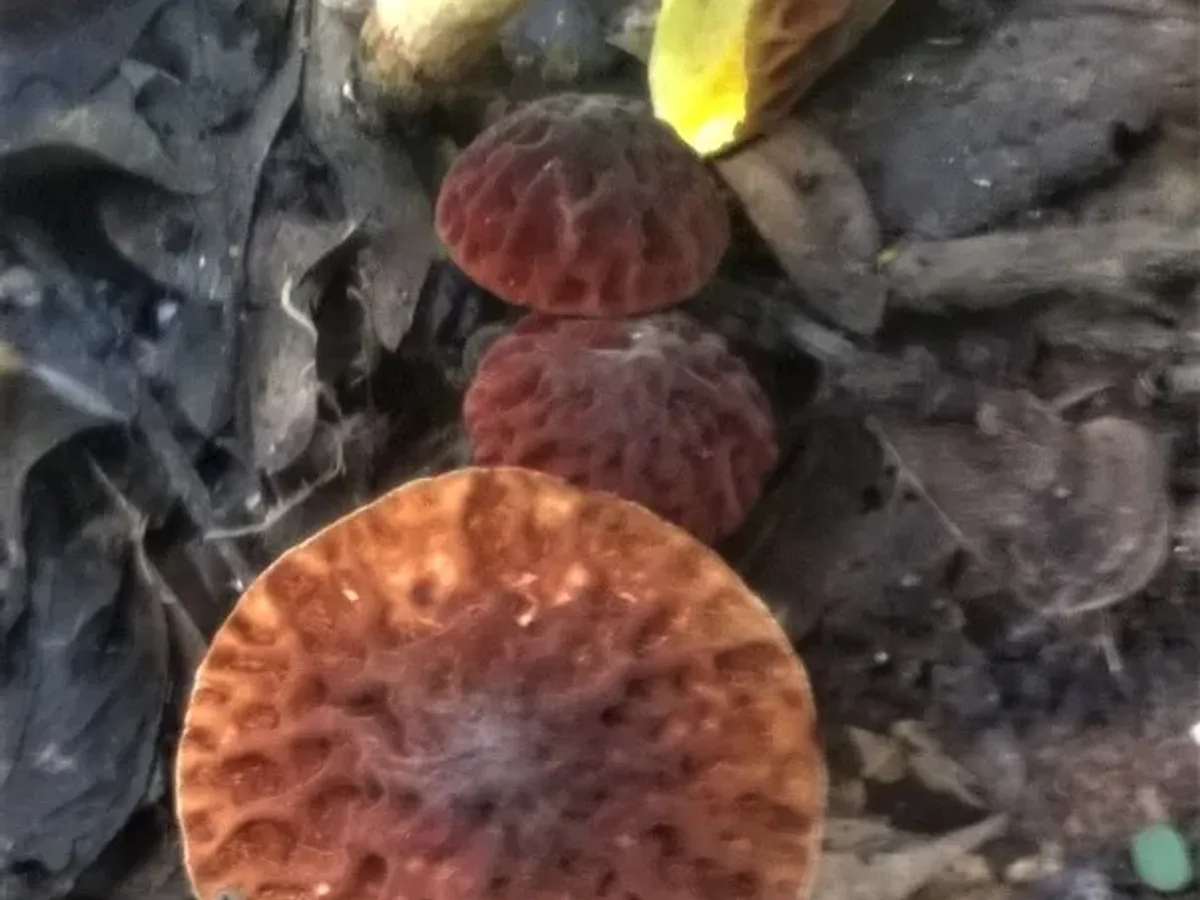 © Vihane (CC BY-SA)
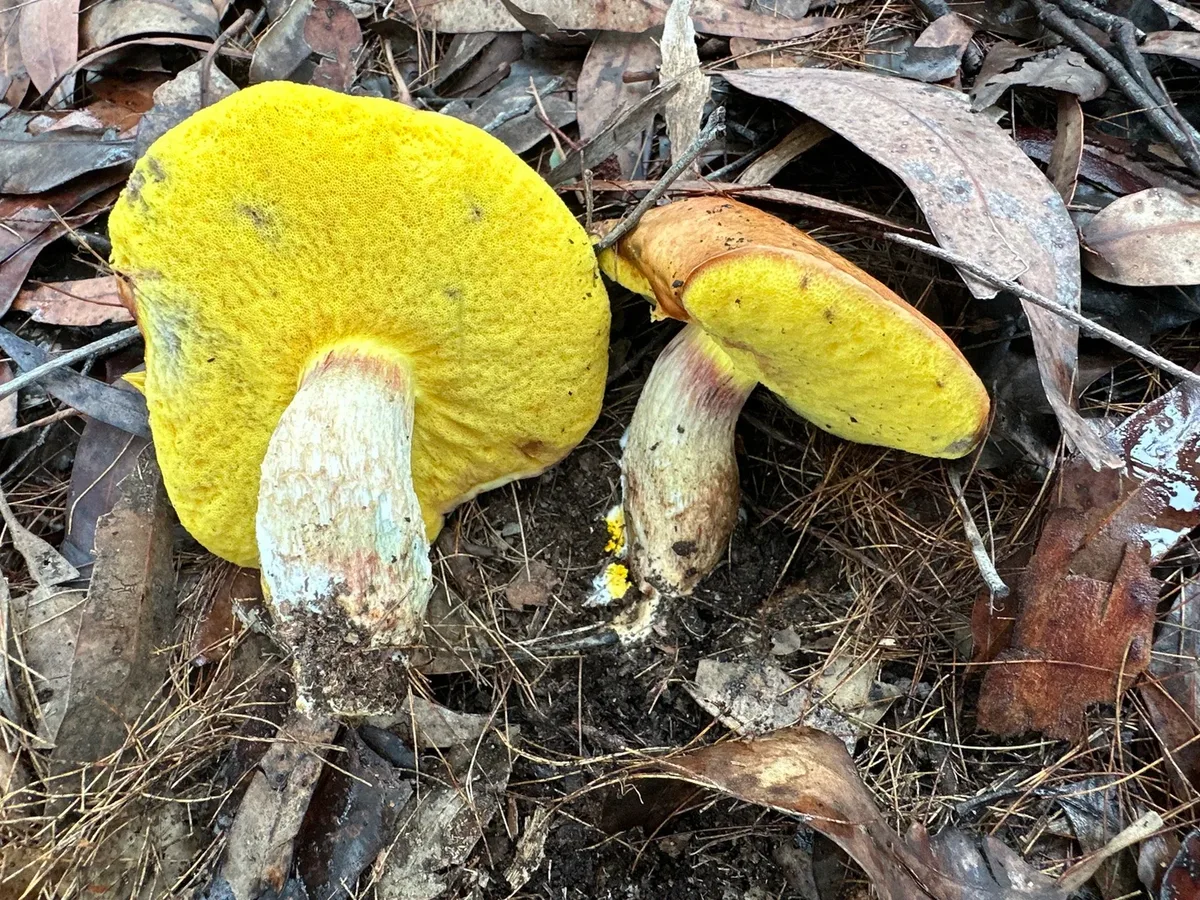 © Atlas of Living Australia (CC BY)© Vihane (CC BY-SA)© Atlas of Living Australia (CC BY)
Good to eat, once you have identified it with certainty and cooked it through.
Never eat a mushroom you are not 100% sure of - check the look-alikes below, and always cook wild mushrooms.
How to recognise it
Cap
Aureoboletus thibetanus announces itself with a gleaming, honey-coloured cap that catches the light in the dappled shade of high-elevation forest.
The cap is 4-12 cm across, starting life as a snug dome and gradually flattening to a broad cushion or nearly level disc.
Its surface is unmistakably glutinous or viscid when moist - run a finger across it in wet weather and it feels slippery, coated in a thin, clear golden jelly that dries to a lacquered sheen when conditions are dry.
The colour ranges from bright lemon-yellow to warm tawny-golden or ochre-orange at the centre, fading slightly toward the margin.
Gills / Pores
Beneath the cap there are no gills - instead the classic bolete sponge of tightly packed vertical tubes opens at the surface as small angular pores coloured a vivid golden to chrome-yellow.
Flesh
Pressing the pore surface or slicing through the flesh causes no colour change whatsoever: no blue, no violet, no reddening.
This is one of the most important field safety checks for any bolete, and in Aureoboletus thibetanus the white-to-pale-yellow flesh and golden pores remain resolutely unchanged when cut or bruised.
Stem
The stipe is pale to golden-yellow, solid, and decorated with a raised golden reticulation (a net of ridges) particularly well-developed in the upper half - a feature shared with other choice boletes and a useful additional character.
The overall impression is of a clean, bright golden mushroom with a slippery cap, radiant yellow undersurface, and no colour-changing flesh.
Where & when it grows
Habitat
Aureoboletus thibetanus is a mushroom of altitude. Its heartland is the high montane and subalpine conifer forest of the eastern Tibetan Plateau and its margins - the vast spruce and fir forests of Yunnan's Hengduan Mountains, the cold mixed forest of the Tibetan valleys, and the equivalent high-elevation zones of Sichuan and adjacent Myanmar and Nepal.
It thrives from roughly 2000 m up to nearly 4000 m, a zone characterized by cool summers, abundant monsoon rainfall, and soils that are deep, humus-rich, freely draining, and distinctly acidic.
Its mycorrhizal partners in this zone are primarily Sino-Himalayan conifers:
- Lijiang spruce (Picea likiangensis)
- George's fir (Abies georgei)
- Himalayan hemlock (Tsuga dumosa)
At the lower margins of its range it also associates with high-altitude oaks and birch.
The fruiting spots to search are:
- shaded forest floors under dense conifer canopy
- mossy banks along forest paths
- the slightly open ecotones where conifer forest meets dwarf rhododendron or juniper scrub
At these elevations the forest floor is typically carpeted in deep sphagnum or cushion mosses, and the bolete pushes up through needle duff and moss mats alike.
When
Fruiting is synchronised with the summer monsoon as it penetrates the high valleys of the eastern Tibetan Plateau, typically arriving from the south and east in late June.
In the core Yunnan-Tibet range, the season runs from July through September, with the peak flush in late July and August when warm, wet monsoon air reaches even the highest forested valleys and soil temperatures at altitude are at their annual maximum.
- Above 3500 m the season is compressed to a brief August-September window.
- In the lower montane belt (2000-2800 m) fruiting may begin in late June and persist into October in warm, wet years.
The trigger is sustained warm monsoon rainfall over a period of one to two weeks after soils have warmed sufficiently - soil temperatures in the 8-16 °C range appear to be the functional sweet spot at these elevations.
A lag of approximately 7-14 days between significant rain and the emergence of fruit bodies is typical for mycorrhizal boletes.
How it grows
Solitary to scattered in small groups of two to five; not clustered or tufted.
As a strict mycorrhizal fungus it cannot grow away from its host trees and cannot be cultivated artificially. The mycelium forms long-term partnerships with conifer roots, and productive sites in known good habitat tend to fruit year after year when monsoon conditions are favourable.
Buttons emerge quickly once triggered - a small, gleaming golden dome can expand to a full-sized cap within three to five days under ideal wet-warm conditions - so revisiting a productive spot every few days during peak season is worthwhile.
The viscid cap surface is an adaptation to the moist, mossy environment: moisture is retained even between rain events, keeping the cap surface functional for spore release.
Fruiting conditions
Fruiting is triggered by sustained monsoon rainfall (25+ mm over 14 days) combined with soil temperatures in the 8-16 °C range typical of high-elevation East Asian montane forest in summer. Flushes emerge 7-14 days after significant rain events. The cool soil temperature window reflects the high-elevation habitat; fruiting stops when monsoon rains end or when autumn temperatures cool soils below 6-8 °C.
Look-alikes
Aureoboletus thibetanus grows in montane forest alongside several other boletes, and careful identification is essential because the region harbours some seriously toxic blue-staining species.
The most dangerous confusion risk is with toxic blue-staining boletes - in particular species in the genus Neoboletus and related genera that may share a yellowish or brownish-yellow cap colour when young.
Any bolete that blues when cut or pressed must be treated as potentially toxic, as several blue-staining boletes of the East Asian montane zone (including Neoboletus venenatus and related taxa) cause severe gastrointestinal poisoning or worse.
The viscid golden cap and non-blueing flesh of A. thibetanus are the critical differentiating characters; if the pore surface is reddish or the flesh blues in any way, do not eat the specimen.
- Aureoboletus projectellus (largely a North American species) is a relative with a similar viscid golden cap but is geographically remote.
- Other Aureoboletus species in the region, such as Aureoboletus flaviporus and A. gentilis, are closely related and similarly edible; distinguishing them from A. thibetanus is largely a matter of microscopy and molecular analysis, but from a safety perspective all well-established Aureoboletus in the region are considered edible.
- Suillus granulatus and related Suillus species can superficially resemble a young viscid yellow bolete and sometimes co-occur with conifers at the same elevations; they are distinguished by glandular dots on the upper stipe (not a reticulate net), milk-drop secretions from the pores in young specimens, and their strict association with two-needled pines. Suillus species are generally edible but of lower quality; confusion causes no safety issue.
- Tylopilus or bitter bolete species with pale yellowish caps can be excluded by tasting a tiny raw fragment - intensely bitter taste is immediate and disqualifying (spit it out and do not swallow).
Always cross-check against local expertise when possible.
Occurs in montane East Asian forest and can have a brownish-yellow to ochraceous cap that superficially resembles A. thibetanus when young. The definitive distinguishing feature is immediate and intense blueing of the flesh, tubes, and pore surface when cut or pressed - this is instant, vivid, and unmistakable. A. thibetanus shows absolutely no colour change on cutting. N. venenatus causes violent rapid-onset gastrointestinal poisoning and is considered seriously toxic. Never eat any bolete that blues when cut.
Similar stature and brownish-cap appearance but pores turn distinctly pink to dirty-rose with age, the stipe net is dark brown on pale, and the flesh is intensely bitter - even a tiny raw fragment on the tongue is unpleasantly bitter immediately (spit out, do not swallow). Not toxic but renders any dish inedible and the bitterness is the immediate and decisive test.
Red to orange-red pore surface, flesh that blues strongly and immediately on cutting, and often reddish stipe colouration. The pore colour alone immediately separates it from the golden-yellow pores of A. thibetanus. Causes severe gastrointestinal poisoning. Not lethally toxic in the conventional sense but capable of requiring hospital treatment.
Also has a viscid yellowish to ochre cap and occurs with conifers at similar elevations. Distinguished by milky guttation droplets from the pores in young specimens, glandular dots (not a raised reticulate net) on the upper stipe, and strict association with two-needled pines. Edible but of lower quality than A. thibetanus; confusion causes no safety concern.
A brown-capped, blue-staining bolete of Yunnan montane forest recorded as causing severe gastrointestinal poisoning. Flesh and pore surface blue intensely and immediately when cut or bruised; pores may have orangeish to brownish tones. A. thibetanus has a more distinctly golden-yellow viscid cap and never blues. Any blueing is an absolute disqualifier.
In the kitchen
Picking & cleaning
Select young to mid-aged specimens with firm flesh and tightly packed, bright-golden pores - the pore surface darkens and becomes spongy in old specimens and is less desirable.
Wipe the cap clean of adhering moss, needle debris, and the gelatinous coating if it bothers you; alternatively leave the coating intact, as it cooks off without any unpleasant effect.
Before cutting, confirm:
- 1the pore surface is golden-yellow and not red, orange, or blue-tinged;
- 2slicing the flesh shows white-to-cream colour with no change - no blueing, no reddening.
Cut the stipe cleanly near the base with a knife.
The viscid cap surface means that field debris clings easily; a soft brush or damp cloth in the kitchen cleans the cap well.
Use within two to three days; the gelatinous coating means the cap should be kept loosely wrapped and refrigerated, not sealed in plastic which can cause rapid softening.
The species dries well if sliced and dried promptly.
Cooking
A highly regarded edible and one of the premium boletes of the Yunnan mushroom markets, Aureoboletus thibetanus is valued for its firm, flavourful flesh, pleasant mild taste with a gentle sweetness, and versatility in cooking.
The glutinous cap surface cooks off without any unpleasant effect - most cooks simply wipe the cap clean and slice without peeling.
Young, firm specimens are the most prized; the pore layer in older specimens softens and can be scooped out if desired, though in prime caps it is perfectly palatable.
- Slice and fry quickly in a very hot wok with garlic, dried chillies, and a touch of Sichuan pepper for a simple preparation that showcases the flavour.
- Excellent in Yunnan-style mixian noodle soups, hot pot, and braised dishes.
- Pairs well with ham, tofu, and green vegetables.
- Can also be added to risottos, cream sauces, and European-style mushroom dishes.
Dries well: slice 5-8 mm thick and dry at 40-50 °C until completely crisp; dried Aureoboletus thibetanus is sold in dried form in Yunnan markets and rehydrates with an intensified, concentrated umami flavour.
Store dried mushrooms in a sealed jar and add the fragrant soaking water to sauces and stocks.
Never eat raw.
Good to know
Aureoboletus thibetanus has a well-established tradition of safe consumption in Yunnan and Tibet, where it is sold at mountain market stalls alongside other choice boletes, and there is no documented toxicity.
The non-blueing flesh and golden pore surface are the critical safety anchors. Always cut through the flesh and pore layer in the field and wait at least 60 seconds watching for any colour change before placing any bolete in your basket.
If any part of the flesh, tubes, or pore surface turns blue, violet, green, or pink-red after cutting or pressing, discard the specimen without tasting it - the same forest harbours Neoboletus venenatus and other toxic blue-staining boletes that cause violent, rapid-onset gastrointestinal poisoning.
Confirm a golden-yellow pore surface (never red, never orange) and cream-to-white non-blueing flesh before eating.
- Cook thoroughly - as with all wild boletes, eating raw or undercooked specimens may cause gastrointestinal distress even for choice species.
- First-time consumers should eat a small portion and wait 24 hours before eating a full meal.
- Beginners in East Asian montane forests should have specimens verified by an experienced local forager or mycologist before consuming.
A reference guide - never an edibility guarantee. When in doubt, leave it out.