Lemon honey cap
Armillaria limoneasyn. Armillaria limonea G. Stev.
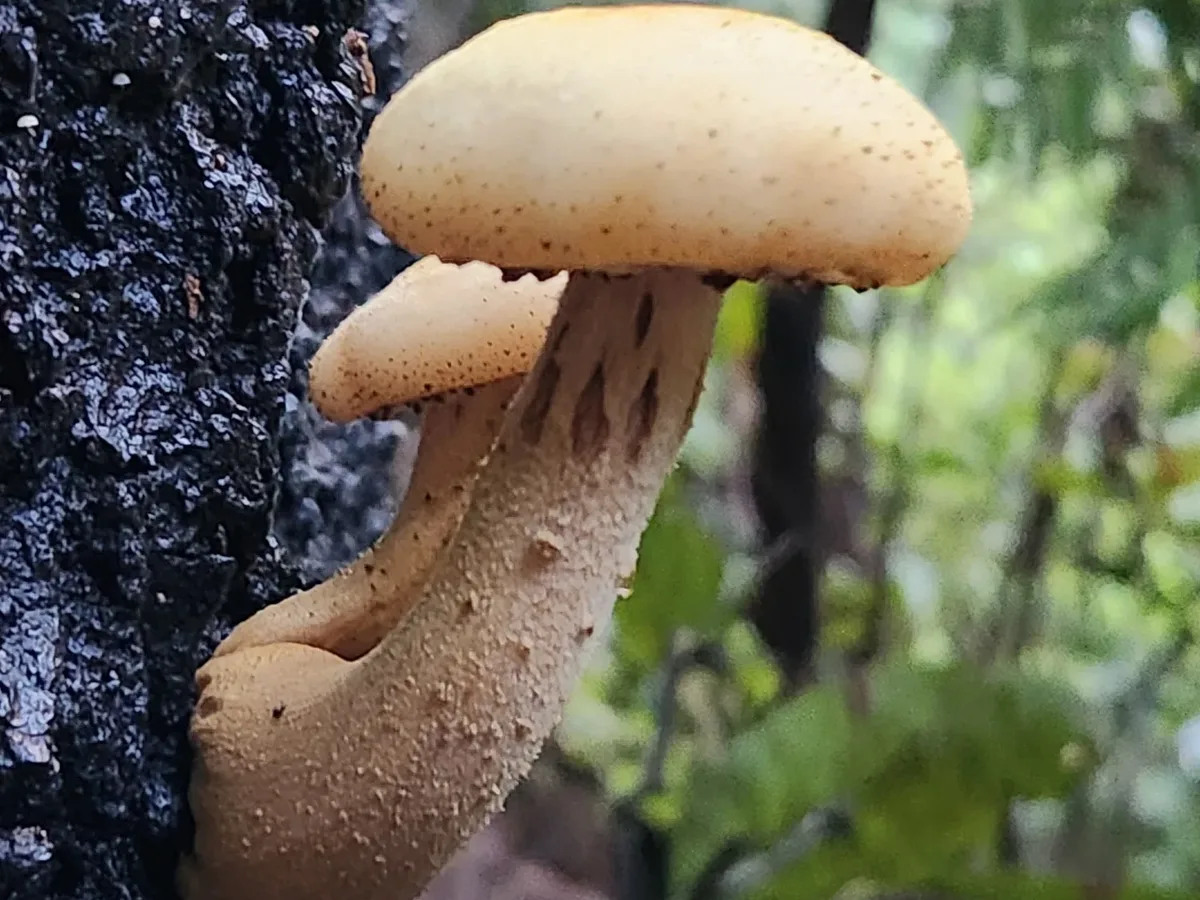 Chelsea Haley (CC0)
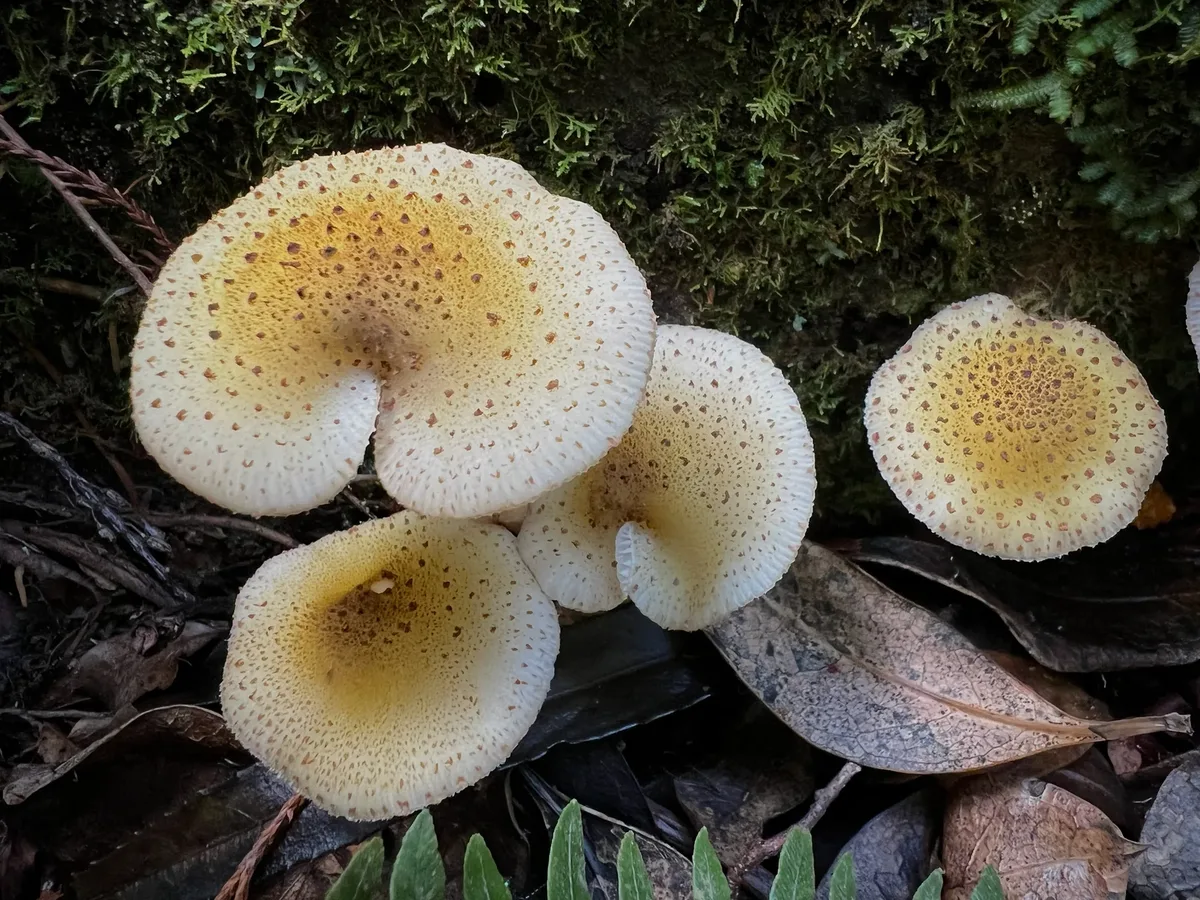 Sue Leov (CC0)
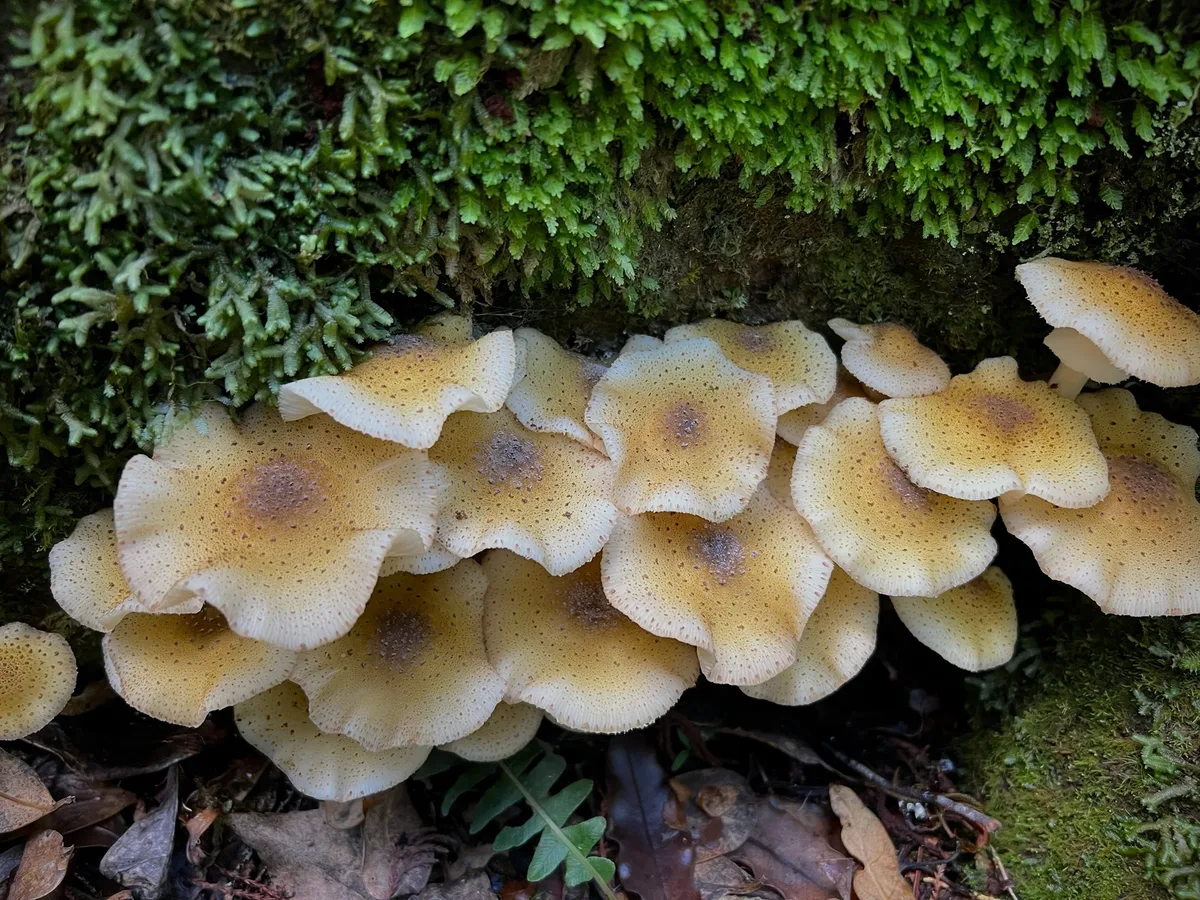 Sue Leov (CC0)
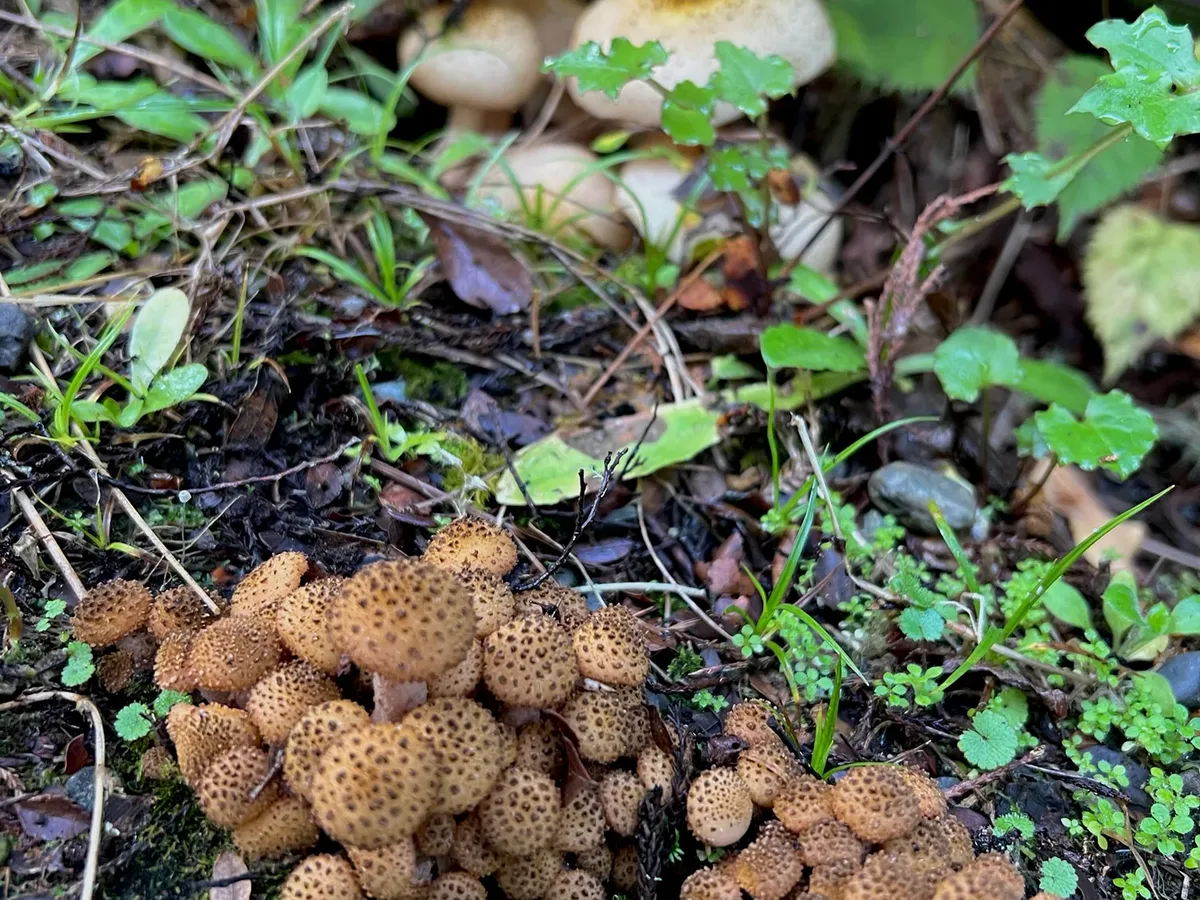 Sue Leov (CC0)
 Sue Leov (CC0)
 Charlie Thomas (CC0)
 © Mark Stirling (CC BY)
 © Mark Stirling (CC BY)Chelsea Haley (CC0)Sue Leov (CC0)
Edible only with the right preparation - or safe for some people but not others. Learn the caveats first.
Never eat a mushroom you are not 100% sure of - check the look-alikes below, and always cook wild mushrooms.
How to recognise it
The lemon honey cap shares the general architecture of all Armillaria species - a ringed, clustered, wood-inhabiting mushroom with white gills, a white spore print, and a tough fibrous stem - but its ground colour sets it apart within the genus in its region.
Cap
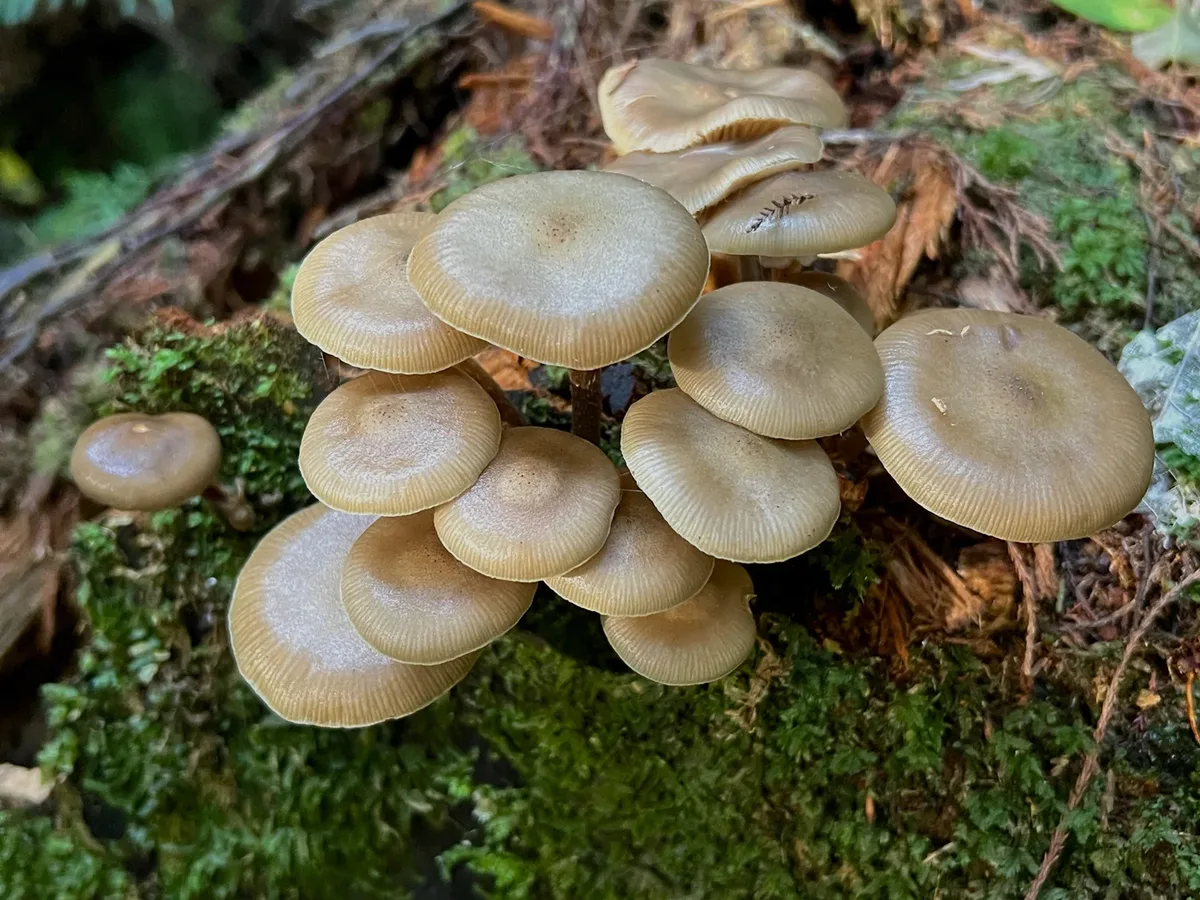
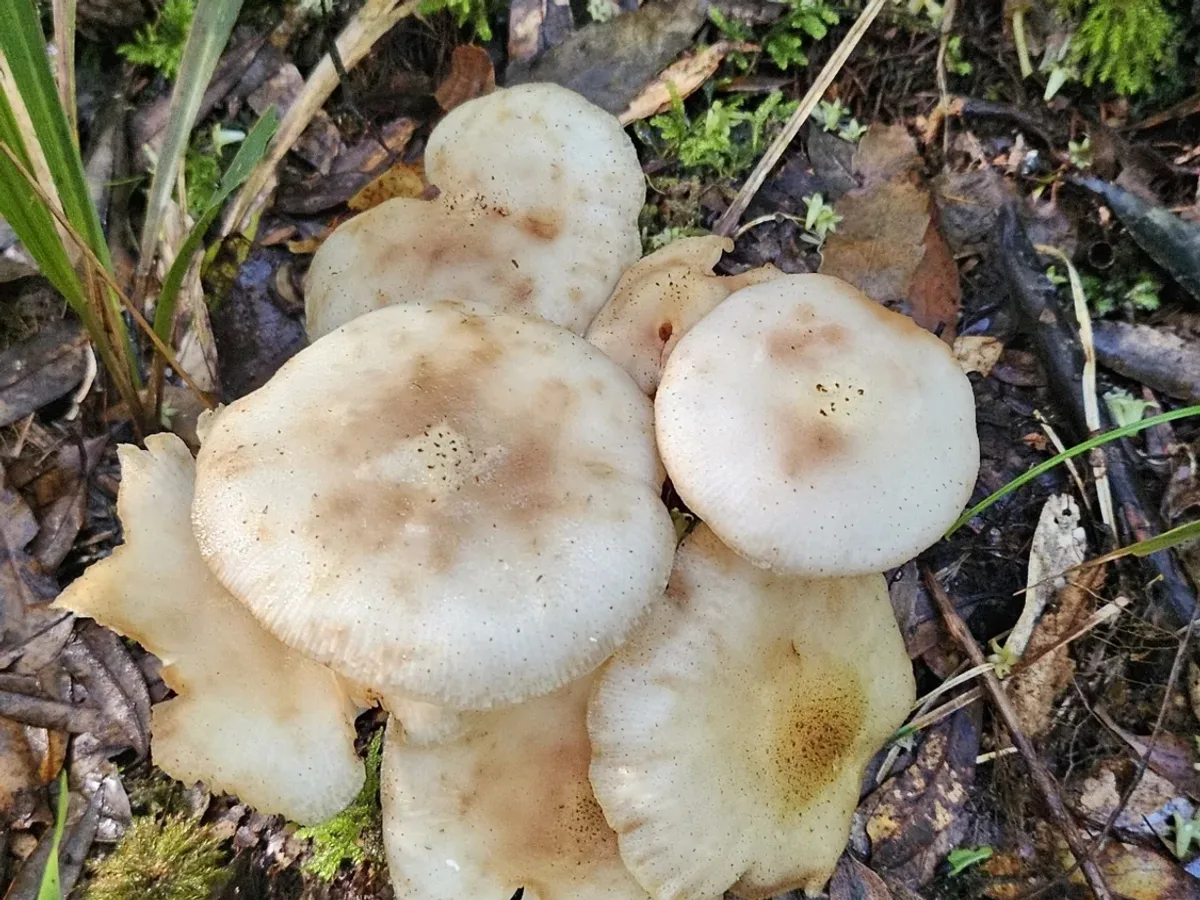
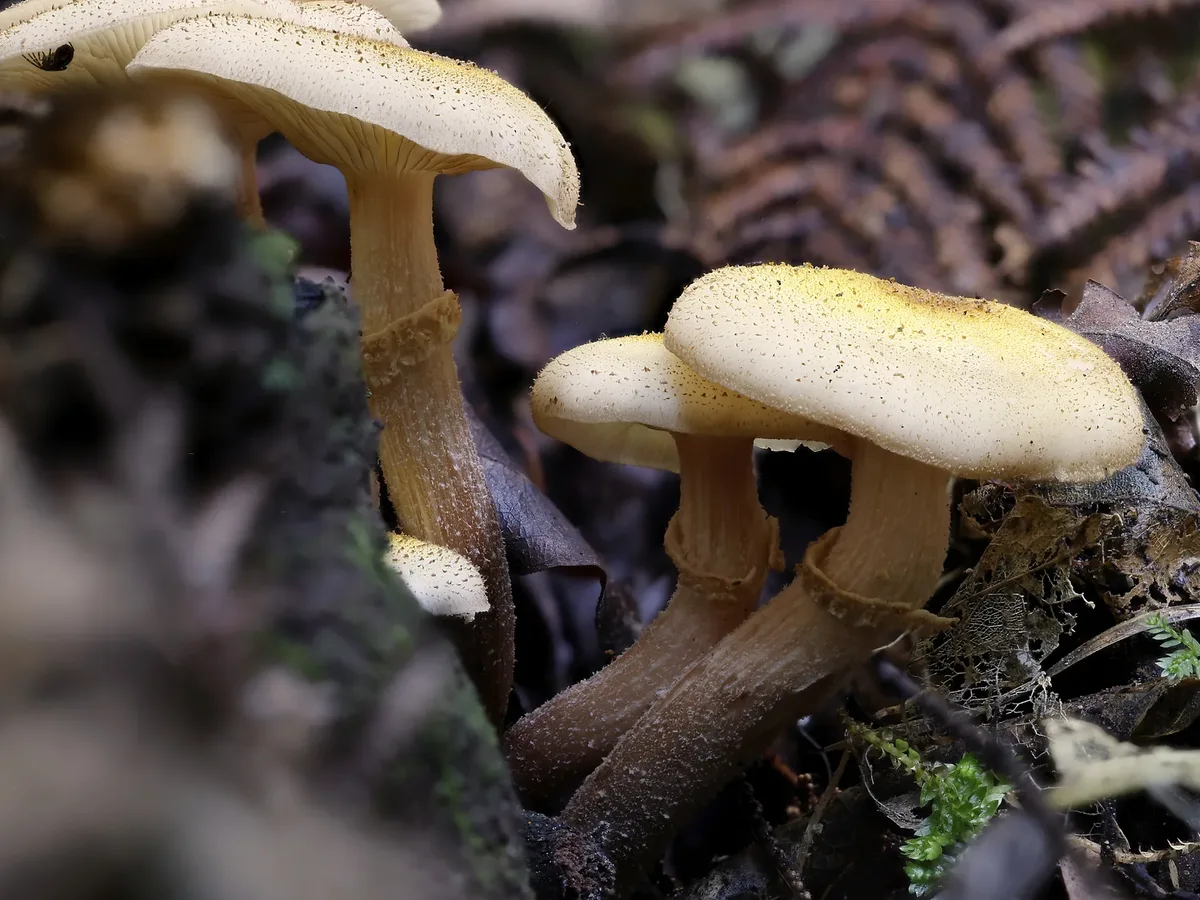
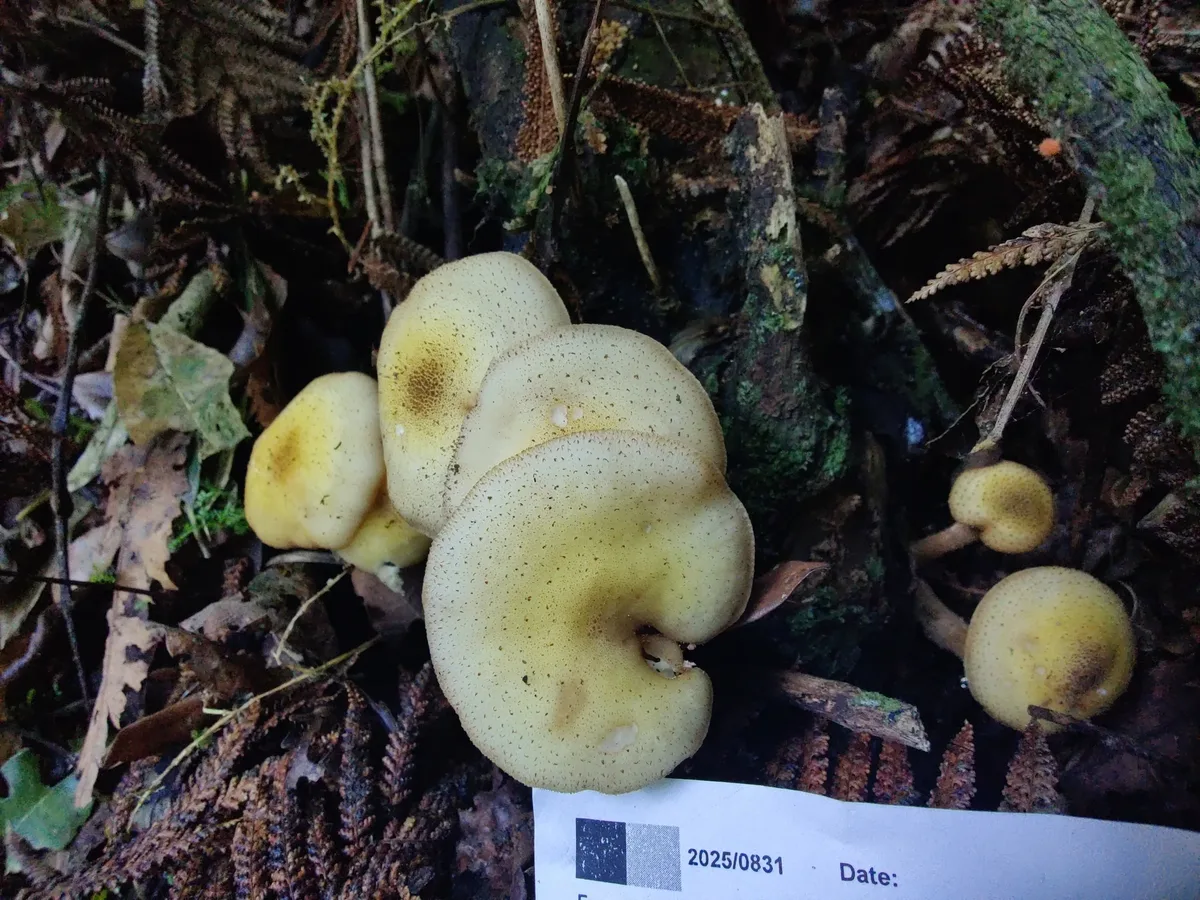
The cap ranges from lemon-yellow to yellow-olive or yellow-green, most intensely coloured at the disc and fading to pale yellow-cream at the margin, producing the warm citrus tones that give the species both its Latin epithet and its English name.
Small, tawny-olive fibrillose scales mark the centre of the cap; these are most obvious in young, fresh specimens and can become inconspicuous on old or rain-washed caps.
Stem
The ring is a key structural feature: well-formed, membranous, persistent, pale and cream, positioned high on the stem - this is one of the most reliable visual anchors for the Armillaria genus.
Gills
The gills are white to cream throughout the lifespan, becoming pale buff with age but never pink or rusty.
Flesh
The flesh is white and firm.
Smell & taste
The most diagnostic character of all - the one that makes field identification unambiguous in practice - is the taste: intensely and persistently bitter. Chew a small piece of raw cap, let it sit for five to ten seconds, then spit: the acrid bitterness is unmistakable and entirely absent in the co-occurring edible A. novae-zelandiae. Never confuse this bitterness test with an edibility test; always spit without swallowing.
Why it's dangerous
The direct danger from Armillaria limonea itself is low: its bitter taste is a natural deterrent, and documented severe poisoning is not recorded in the literature.
The primary practical danger is indirect, and is the same for this species as for A. luteobubalina and A. novae-zelandiae: Galerina marginata, which contains lethal amatoxins, can grow within the same cluster on the same log in the same season. A forager who picks what they believe to be bitter honey cap without taking a spore print may inadvertently include deadly galerina in the same harvest. A white spore print is the only reliable field test that rules out Galerina.
The secondary danger is confusion with A. novae-zelandiae: a forager who misidentifies A. limonea as the edible species will create a bitter, potentially irritant dish that at minimum wastes a meal and at worst causes gastrointestinal illness. The taste test resolves this confusion before any cooking occurs.
Toxin
The bitter compounds in Armillaria limonea have not been fully characterised by published chemical analysis. Based on the known chemistry of the genus, the bitterness is most likely attributable to secondary metabolites in the sesquiterpene aryl ester class (melleolide-class compounds) or related phenolic structures.
In other Armillaria species, these compounds act as gastrointestinal irritants that inhibit cellular respiration at the mitochondrial level when consumed raw, and are deactivated by thorough boiling. Whether the specific compounds in A. limonea behave the same way is not confirmed.
The bitterness itself - a taste property, not directly toxic - survives cooking in A. limonea according to field reports. This may indicate:
- heat-stable compounds,
- a different compound class,
- or simply a higher baseline concentration than in species where cooking reduces bitterness.
The genus-level default of treating the raw material as a GI irritant is the conservative and appropriate approach.
Symptoms
Eating large quantities of raw or cooked Armillaria limonea may cause gastrointestinal irritation, based on the class of secondary metabolites associated with Armillaria species. Symptoms may include:
- nausea
- abdominal cramping
- vomiting
The species is primarily avoided due to its intense bitterness rather than documented clinical poisoning reports.
If significant quantities have been consumed and gastrointestinal symptoms develop, contact a poisons information centre.
If there is any doubt about whether the species consumed was A. limonea or another Armillaria that may have been growing in the same cluster, and especially if a spore print was not confirmed white before eating, seek emergency medical advice immediately: accidental consumption of Galerina marginata (a possible companion species on the same log) causes amatoxin poisoning with a latency of 6-24 hours before severe liver damage becomes apparent.
Staying safe
Armillaria limonea is classified as inedible in all standard mycological references for New Zealand and Australia, primarily because of its intense, persistent bitterness that survives cooking and renders any dish unpalatable.
The full toxicological profile of A. limonea is not well-characterised in published literature. Bitterness in Armillaria species is generally attributed to secondary metabolites in the melleolide and sesquiterpene classes, which in other Armillaria species (such as A. mellea and A. luteobubalina) are gastrointestinal irritants that are heat-labile. Whether A. limonea's bitter compounds are heat-labile or heat-stable has not been confirmed analytically.
Because the heat-stability is unknown and the species is intensely unpalatable even when cooked, it should be treated as inedible and avoided entirely. Eating large quantities - particularly raw - may cause gastrointestinal upset.
The more significant safety concern is misidentification: A. limonea occupies the same habitats, substrates, and seasons as the edible A. novae-zelandiae and the deadly Galerina marginata. The taste test distinguishes A. limonea from A. novae-zelandiae; only a confirmed white spore print separates both Armillaria species from Galerina. Always take a spore print before eating any clustered, ringed, wood-growing mushroom.
If you suspect mushroom poisoning, contact a poisons centre:
- New Zealand: National Poisons Centre 0800 764 766
- Australia: Poisons Information Centre 13 11 26
Where & when it grows
Habitat
Armillaria limonea inhabits the same native forest ecosystems as its close relative A. novae-zelandiae, and fills the same ecological role: a parasite of living tree roots that transitions to saprotrophic decay of dead wood after killing or outliving its host.
In New Zealand, it is found in both North and South Island forests, particularly in the cathedral stands of red beech (Nothofagus fusca), silver beech (N. menziesii), and black beech (N. solandri), as well as in the rich mixed broadleaf podocarp forests where rimu, kahikatea, and tōtara tower over a dense understorey. In southeastern Australia, records place it in moist eucalypt and cool-temperate forest in Victoria and Tasmania.
Like all Armillaria species, it extends itself through root systems and through the flat black cord-like rhizomorphs - the 'bootlaces' visible under bark and in soil near the base of affected trees - that allow it to travel between hosts without relying solely on windborne spores. Individual mycelial networks can be substantial; the fruiting bodies are simply the autumn expression of a hidden perennial organism that has been quietly colonising wood for months or years.
The co-occurrence with A. novae-zelandiae in the same forests and often on the same stumps is what makes this species mycologically and practically important: it presents a genuine identification challenge for foragers who know one and assume they know the other.
When
Fruiting follows the same seasonal rhythm as the co-occurring A. novae-zelandiae: Southern Hemisphere autumn through early winter, broadly April through August, with the main flush in May and June after sustained autumn rain has penetrated the soil and temperatures have dropped below approximately 15 degrees C.
The biological trigger - falling soil temperature combined with adequate moisture - is the standard Armillaria fruiting cue across all species in this group.
Fruit bodies emerge quickly from established perennial mycelium, can mature in just a few days under good conditions, and deteriorate with equal speed. Known sites on large stumps or root collars of beech trees tend to produce flushes in the same location year after year, making repeated-visit foraging practical.
The brevity of the flush - a matter of days at peak - is captured in the Maori proverb applied to the whole harore group: 'he harore rangitahi', meaning 'a one-day mushroom.' This ephemerality applies equally to A. limonea; the two species are essentially indistinguishable by season alone.
How it grows
As with all Armillaria species, the visible fruitbodies represent only the seasonal reproductive expression of a much larger, hidden organism. The main body of A. limonea is a perennial mycelial network that threads through the wood and soil of its host system, digesting structural polymers and colonising living root tissue.
Black, flat, cord-like rhizomorphs extending under bark and through soil are the mycelium's expansion mechanism - these allow the fungus to travel metres between woody substrates. At the root collar of actively colonised trees, white mycelial fans can often be found beneath loosened bark: a hallmark of active Armillaria root rot, shared by all species in this genus.
Fruitbodies emerge in dense clusters from the base of trees, stumps, or from soil above buried root systems, swelling rapidly when cool, wet autumn conditions arrive. A single productive stump may bear dozens to hundreds of caps in a single flush.
There is no unambiguous record of bioluminescent foxfire from the mycelium of A. limonea in published literature, though it may occur given how widespread this property is in the genus; the closely related A. novae-zelandiae does produce foxfire in its wood substrate.
Fruiting conditions
Southern Hemisphere autumn through early winter fruiter. Flush triggered by sustained autumn rainfall (20+ mm over 14 days) combined with cooling soil temperatures (below ~15 °C). Fruitbodies emerge rapidly from established perennial mycelium - as quickly as 5 days after a triggering rain event - and deteriorate within days. Peak May-June across most of the New Zealand range. Same seasonal trigger and timing as the co-occurring A. novae-zelandiae; the two species cannot be separated by season or phenology.
Look-alikes
The most important and practically significant lookalike is Armillaria novae-zelandiae, the edible honey mushroom that co-occurs throughout New Zealand and southeastern Australian forests in the same season and often on the same substrate.
The two species share:
- the same ringed stem
- white gills
- white spore print
- clustered growth on wood
- broadly overlapping cap colour (both can appear olive-buff to olive-yellow in the field)
Reliable separation requires the taste test: A. novae-zelandiae is mild; A. limonea is intensely and persistently bitter. Colour alone is not reliable. The Maori name 'harore' covers both without distinction. A forager who gathers from a mixed cluster without tasting may harvest A. limonea alongside the edible species.
The second critical lookalike - and the genuinely deadly one - is Galerina marginata, the deadly galerina, which grows in clusters on the same stumps and logs as both Armillaria species in the same season. Galerina marginata contains alpha-amatoxins identical to those in the death cap (Amanita phalloides), causing fatal liver failure. It can be intermingled within a cluster of Armillaria on a single piece of wood.
The decisive separator is the spore print: G. marginata prints rust-brown to cinnamon; both A. limonea and A. novae-zelandiae print white. The ring in Galerina may be more fragile and evanescent; Galerina is typically smaller (cap 1-4 cm) with brown gills from the outset. None of these secondary features are individually reliable - only a confirmed white spore print rules out Galerina.
Sulphur tuft (Hypholoma fasciculare) also grows in dense clusters on wood and may be encountered nearby; it is distinguished by strongly yellow-green gills (never white), intensely bitter taste, and a purple-brown spore print. It is not deadly but causes significant gastrointestinal distress.
Grows on the same rotting logs and stumps as A. limonea, often intermingled within the same cluster. Contains alpha-amatoxins - the same lethal compounds found in the death cap - that cause irreversible liver failure. The decisive separator is the spore print: Galerina marginata prints rust-brown to cinnamon-brown; A. limonea prints white. Secondary features - Galerina is typically smaller (cap 1-4 cm), has brown gills from the outset, and often has a more fragile, evanescent ring - are not individually reliable and must not be used as the sole identifier. A confirmed white spore print is the only field-safe separator. Never collect wood-growing clustered ringed mushrooms without this check.
The dominant Armillaria in southern and southwestern Australia, overlapping geographically with A. limonea in Victoria and Tasmania. A. luteobubalina has a warm ochre-buff to yellowish-tan cap rather than the more intensely lemon-yellow to yellow-green tones of A. limonea, and is edible when thoroughly cooked (not bitter). Taste test distinguishes the two. Both have white spore prints and require the Galerina check. At the foraging level in areas of potential overlap, a confirmed non-bitter taste and a white spore print are both needed before cooking A. luteobubalina.
The most practically important confusion in New Zealand and southeastern Australian forests. Both species share ringed stems, white gills, white spore prints, clustered growth on wood, and overlapping cap colours in the olive-buff to yellow-olive range. The decisive separator is taste: A. novae-zelandiae is mild and edible; A. limonea is intensely and persistently bitter. Chew a small piece of raw cap and spit immediately - the bitterness of A. limonea is unmistakable within seconds. Colour alone is not reliable in the field. The Maori name harore applies to both without distinction; linguistic tradition cannot substitute for the taste test.
Grows in dense clusters on stumps and logs in the same forests and season. Distinguished by strongly yellow-green gills (never white), intensely bitter taste (do not swallow), and a purple-brown to dark brownish spore print. The yellow-green gill colour alone is a strong indicator, but the spore print must be checked to rule out Galerina. Hypholoma fasciculare is not deadly but causes severe gastrointestinal illness if eaten.
A reference guide - never an edibility guarantee. When in doubt, leave it out.