Viscid Yellow Amanita
Amanita viscidolutea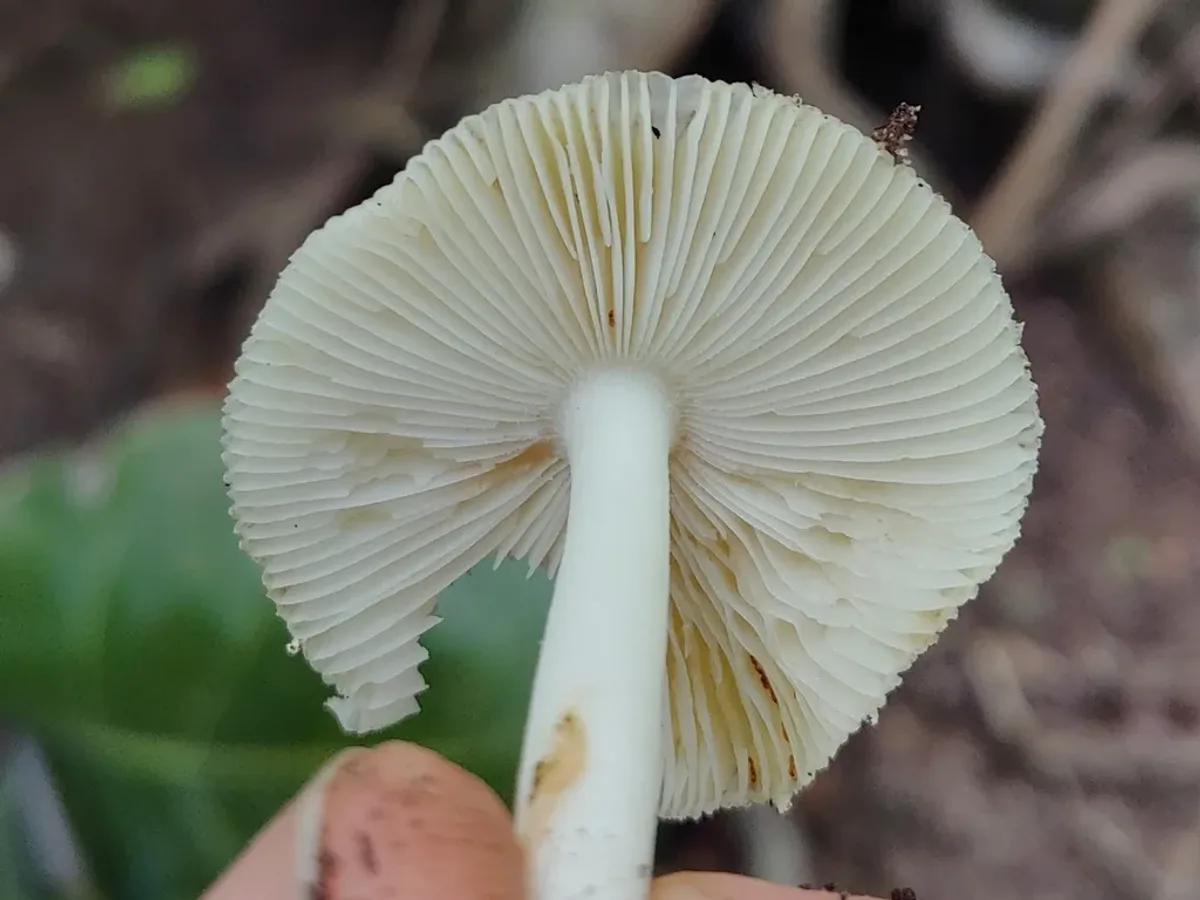 (c) Kurt Miller, some rights reserved (CC BY-SA)
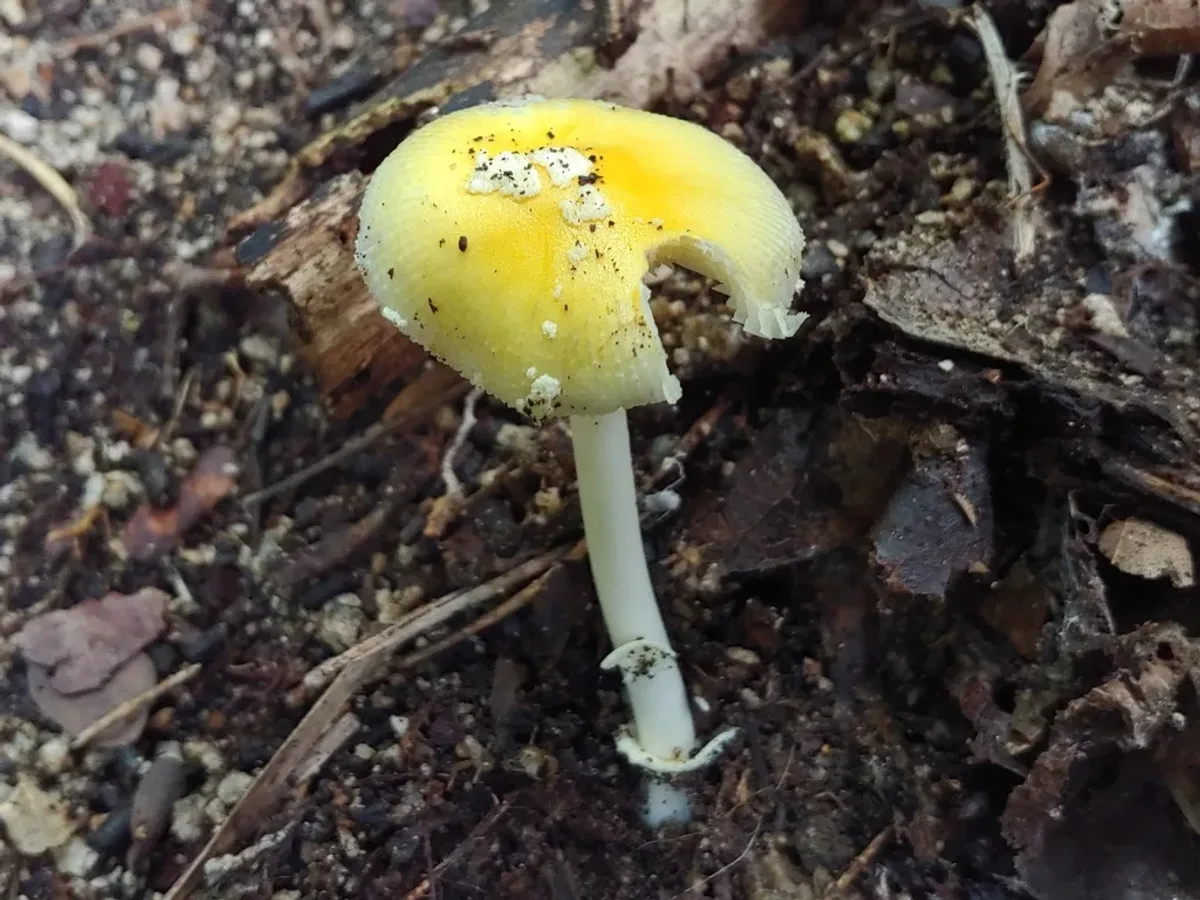 (c) Kurt Miller, some rights reserved (CC BY-SA)
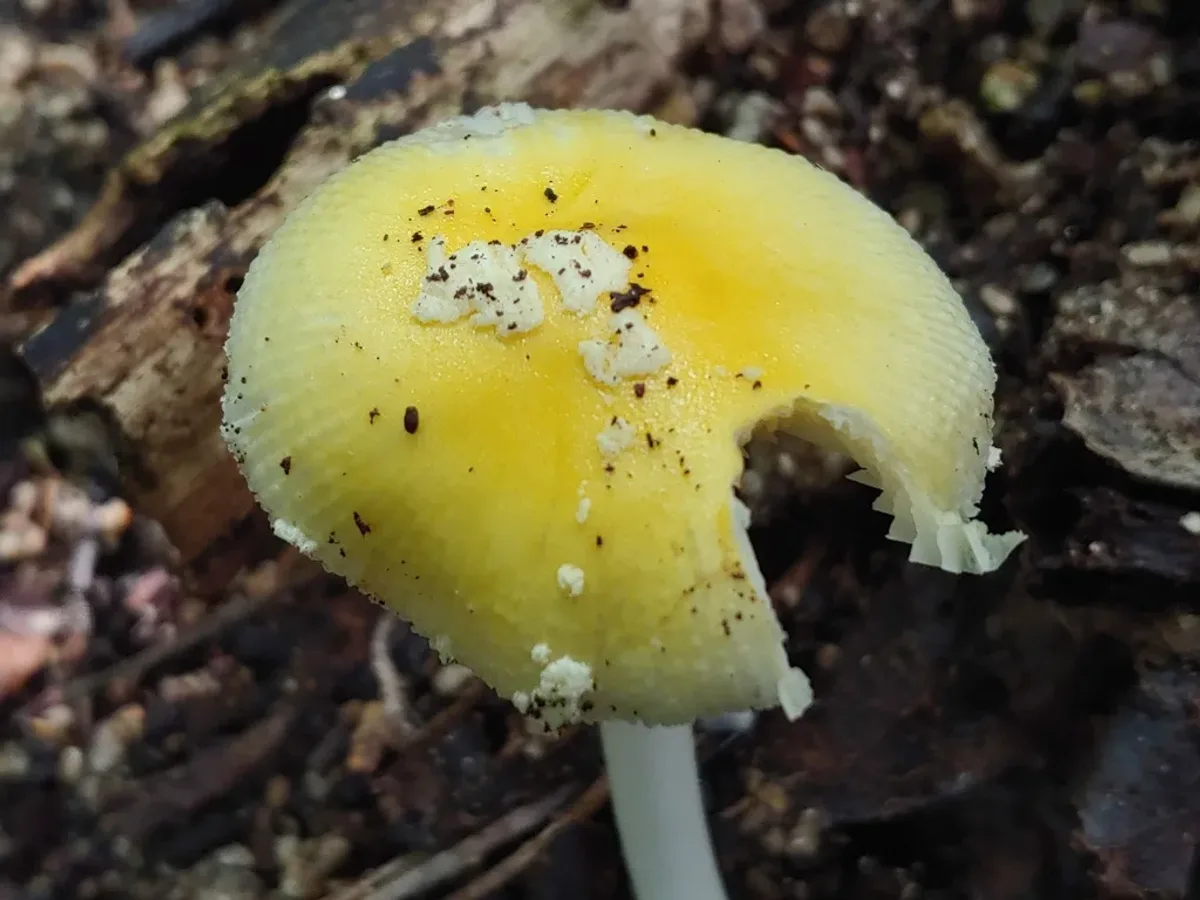 (c) Kurt Miller, some rights reserved (CC BY-SA)
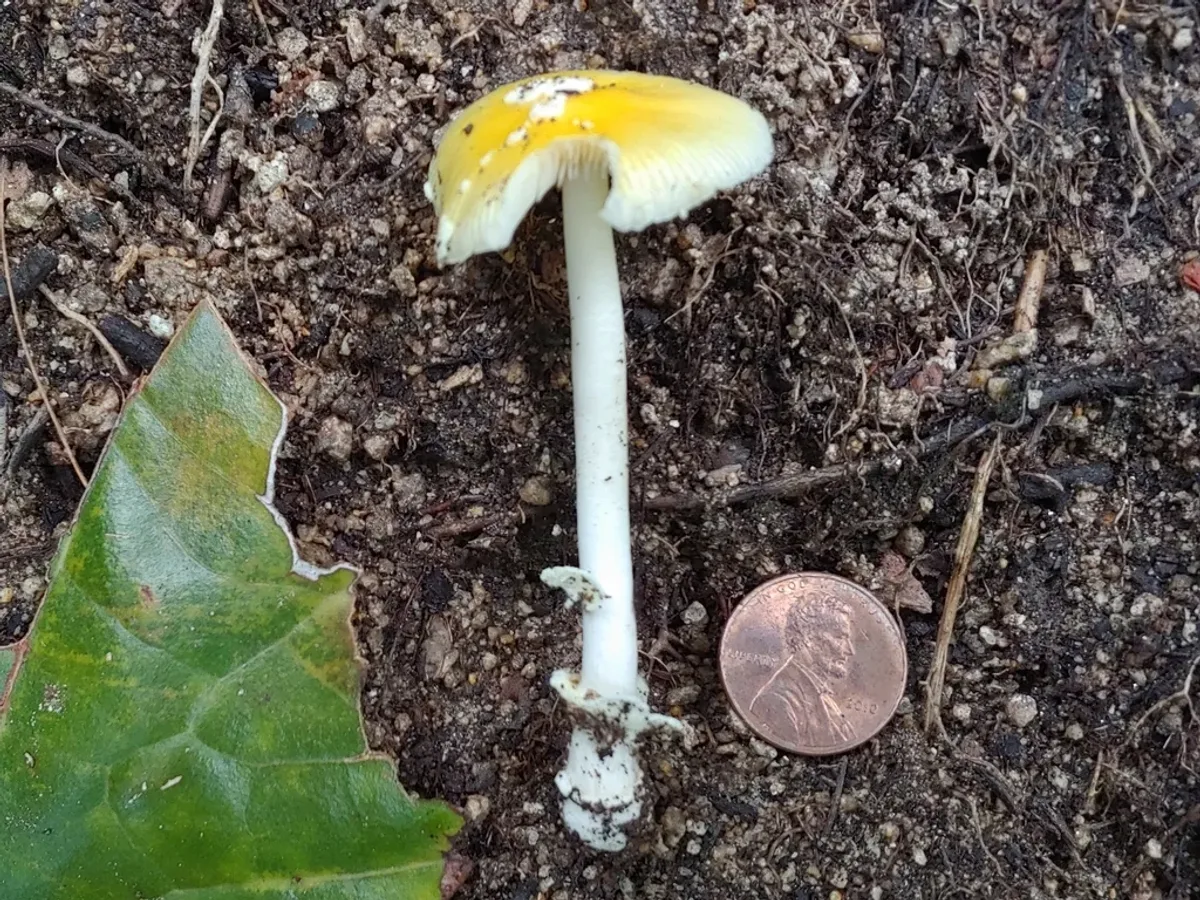 (c) Kurt Miller, some rights reserved (CC BY-SA)(c) Kurt Miller, some rights reserved (CC BY-SA)(c) Kurt Miller, some rights reserved (CC BY-SA)
Edible only with the right preparation - or safe for some people but not others. Learn the caveats first.
Never eat a mushroom you are not 100% sure of - check the look-alikes below, and always cook wild mushrooms.
How to recognise it
The Viscid Yellow Amanita is a medium-sized, yellow-capped species in a genus that rewards slow, methodical examination - the cap colour alone is not enough to identify any Amanita safely.
The most immediately useful character is the cap's viscid (glutinous, sticky) surface in moist conditions, which is unusual in the genus and directly encoded in the scientific name: viscido- (sticky) + lutea (yellow).
The cap runs from bright lemon-yellow to ochre-yellow, deepening at the centre, and sits on a pale stem bearing both a pendant ring and - critically - a sac-like volva at the base.
The gills are white, free from the stem, and show no colour change. The flesh is white throughout and does not blush or discolour when cut or damaged.
In dry weather the cap loses its characteristic stickiness and fades to straw-yellow, making field recognition harder; in these conditions extra care is needed because the single most visually reliable character has diminished.
Where & when it grows
Habitat
A mycorrhizal species of the temperate and montane forests of Argentina and adjacent southern South America, with its strongest documented associations in the Nothofagus (lenga, ñire, coihue) forests of the Andean foothills and Patagonian precordillera.
These southern-hemisphere beeches form dense, structurally rich forests that support a diverse and partly endemic ectomycorrhizal flora, much of which remains inadequately documented.
Amanita viscidolutea grows on the moist leaf-litter floor of these forests, often in sheltered gullies and on south-facing slopes where moisture persists longer into autumn.
Occasional records from planted parks and plantations suggest it may also associate with introduced Nothofagus planted outside its native range.
When
In the austral temperate calendar, fruiting runs from late summer into autumn - broadly February through June - with the main flush in March, April and May as the soil cools after summer and the first significant autumn rains arrive.
This mirrors the timing of the European Amanita season shifted six months ahead for the Southern Hemisphere.
At higher altitudes (above 1000-1500 m) the season compresses toward the warmer months and fruiting may begin and end earlier.
Fruiting bodies respond to the combination of declining soil temperature and adequate rainfall, typically appearing 7-14 days after rain events that bring at least 20-30 mm.
How it grows
Solitary or in scattered small groups, emerging from a buried universal veil as a tightly enclosed pale 'egg' which breaks open to reveal the cap, gills and ring.
The basal volva - the sac-like remnant of the universal veil at the stem base - is often partly or fully buried in the substrate and is easily severed and left behind if the fruiting body is pulled upward rather than being carefully excavated.
Because this volva is the most important safety feature in the Amanita genus, always use a knife to dig down and expose the full base of any candidate specimen.
Fruiting conditions
Austral-autumn fruiter in Nothofagus forest; flushes follow autumn rains (25+ mm over 14 days) as soil temperatures cool into the 6-16 °C range - broadly March through May in the Patagonian precordillera. Timing shifts to earlier months at higher elevation sites.
Handle with care
Toxin
No toxins have been confirmed in Amanita viscidolutea, and it is not known to contain amatoxins, ibotenic acid, muscimol, or other characterised mycotoxins.
However, systematic toxicological analysis has not been performed, and an absence of published toxin data in a poorly studied South American Amanita cannot be taken as evidence of safety.
Edibility is unknown.
Symptoms
No poisoning cases attributable to Amanita viscidolutea are documented in the scientific literature.
Because the species' toxicology is unknown, the practical concern is not its own potential toxins but the risk of misidentification with deadly sympatric species.
If a white-gilled, ringed, volvate Amanita has been eaten and there is any uncertainty about species identity, treat the situation as potential amatoxin poisoning: seek emergency care immediately without waiting for symptoms.
Look-alikes
The yellow cap and ring-plus-volva architecture place this species in a neighbourhood of the genus that demands careful navigation.
- The introduced death cap (Amanita phalloides) is present throughout temperate South America in parks and plantations under European ornamental oaks. While its cap colour is typically greenish-olive rather than yellow, pale or yellow-tinted forms occur and the cap colour of viscidolutea in dry conditions can shift toward paler straw tones that overlap.
- The Neotropical death cap (Amanita arocheae) occurs in northern South America under oak and tropical hardwoods. It can appear pale to grey-green-white, and the deadliness of this group means any Amanita with a volva in South American forests warrants maximal caution.
- The jonquil amanita (Amanita junquillea / gemmata group) is a yellow-capped, ring-and-volva bearing species that is poisonous via ibotenic acid and muscimol. It may overlap in region and habitat and can cause serious illness.
- Caesar's mushroom relatives (Amanita sect. Caesareae) in South America - such as Amanita hemibapha or local Caesareae species - have a similar colour scheme but are distinguishable by their orange-red to deep orange cap and yellow gills. Any yellow Amanita lacking the vivid orange-red tones of the Caesareae group should not be assumed edible.
Why it matters
The danger of Amanita viscidolutea is primarily one of genus membership and regional context. It grows:
- alongside or near Amanita phalloides (introduced, lethal)
- within the range of Amanita arocheae (native, lethal) in South America
The ring-and-volva structure that defines the genus is easy to overlook in field conditions, and the yellow cap could be confused with edible Caesareae relatives by inexperienced foragers.
Because Amanita identification in South America is underdocumented relative to European species - and because local indigenous and subsistence foraging traditions may not include reliable species-specific knowledge of all Amanitas - the hazard of confusion with lethal species is a genuine public health concern.
Leave this species untouched.
The introduced death cap is present in temperate South America under planted European oaks and ornamental trees. Typical forms are greenish-olive to grey-green on the cap, but paler and even yellowish forms occur. A. phalloides always has a free sac-like volva, white gills and a white spore print - features shared with viscidolutea. The death cap's cap is not viscid (only slightly silky to dry in texture), has faint radial streaks, and its odour becomes sweetish-unpleasant with age. Both species are lethal if confused; any doubt means do not eat.
Native to Central America and the northern Andes, A. arocheae produces amatoxins and is responsible for fatal poisonings in the region. Its cap is pallid grey-white to pale olive-grey rather than yellow; the cap is also smooth and somewhat viscid - which creates surface-texture overlap with viscidolutea. Distinguishing the two in the field requires close examination of cap colour and expert knowledge; both have white gills, a pendant ring, and a sac-like volva. Any uncertainty must be resolved by not eating the specimen.
Edible Amanita species in section Caesareae (such as A. hemibapha, which ranges into South America) have an orange-red to bright orange cap and distinctly yellow gills - a very different colour palette from the pale-yellow-to-ochre cap and white gills of A. viscidolutea. Any yellow Amanita with white (not yellow) gills is NOT a Caesar's mushroom relative and should not be eaten on that basis.
The fly agaric is present in South America (introduced with planted pines and birches). Its cap is typically bright red to orange-red with contrasting white warts - quite different from the yellow, viscid, wart-free (or only lightly patchy) cap of A. viscidolutea. The yellow form (var. guessowii or var. formosa) is more ochre-orange with a less viscid cap. A. muscaria causes ibotenic-acid/muscimol poisoning and is not a safe confusion partner.
Amanita junquillea (formerly lumped with A. gemmata) is yellow-ochre to yellow with white warts on the cap, a ring, and a poorly developed collar-like volva rim rather than a full sac. It contains ibotenic acid and muscimol and causes serious poisoning (hallucination, delirium, vomiting). The less developed volva and presence of white cap warts (where not washed off) help distinguish it from viscidolutea, but both are unsafe to eat.
In the kitchen
Picking & cleaning
Amanita viscidolutea should not be eaten. Its edibility has never been established by scientific study, and the species belongs to a genus that contains the world's most lethal mushrooms.
The bright yellow, viscid cap and white ring plus volva combination is shared or approximated by several other Amanitas in Argentina - including dangerous or deadly species - and confident field identification at the species level requires expert knowledge of local Amanita diversity.
Photograph before handling further:
- the cap (top and gills)
- the ring
- the volva, after carefully digging out the base
Never harvest any yellow-capped Amanita for the table in Patagonian or Andean forests without laboratory or expert confirmation.
Good to know
Do not eat this species. Amanita viscidolutea has not been studied for toxin content and its edibility is entirely unestablished.
It exists within a genus in which identification errors are responsible for the majority of fatal mushroom poisonings worldwide, and it shares its South American habitat with at least two confirmed deadly species:
- the introduced death cap (Amanita phalloides)
- the Neotropical death cap (Amanita arocheae)
A yellow, viscid Amanita with white gills, a ring, and a volva in Argentine Patagonian or Andean forest is not a safe find: photograph it and leave it.
If any Amanita has been consumed and you are uncertain of the species, call the national poison control centre immediately - do not wait for symptoms. In Argentina: (011) 4923-6200 (CIATOX Buenos Aires).
The characteristic 6-24 hour latency of amatoxin poisoning means victims can feel well for hours after a lethal ingestion.
A reference guide - never an edibility guarantee. When in doubt, leave it out.