Sato-tamagotake
Amanita satotamagotake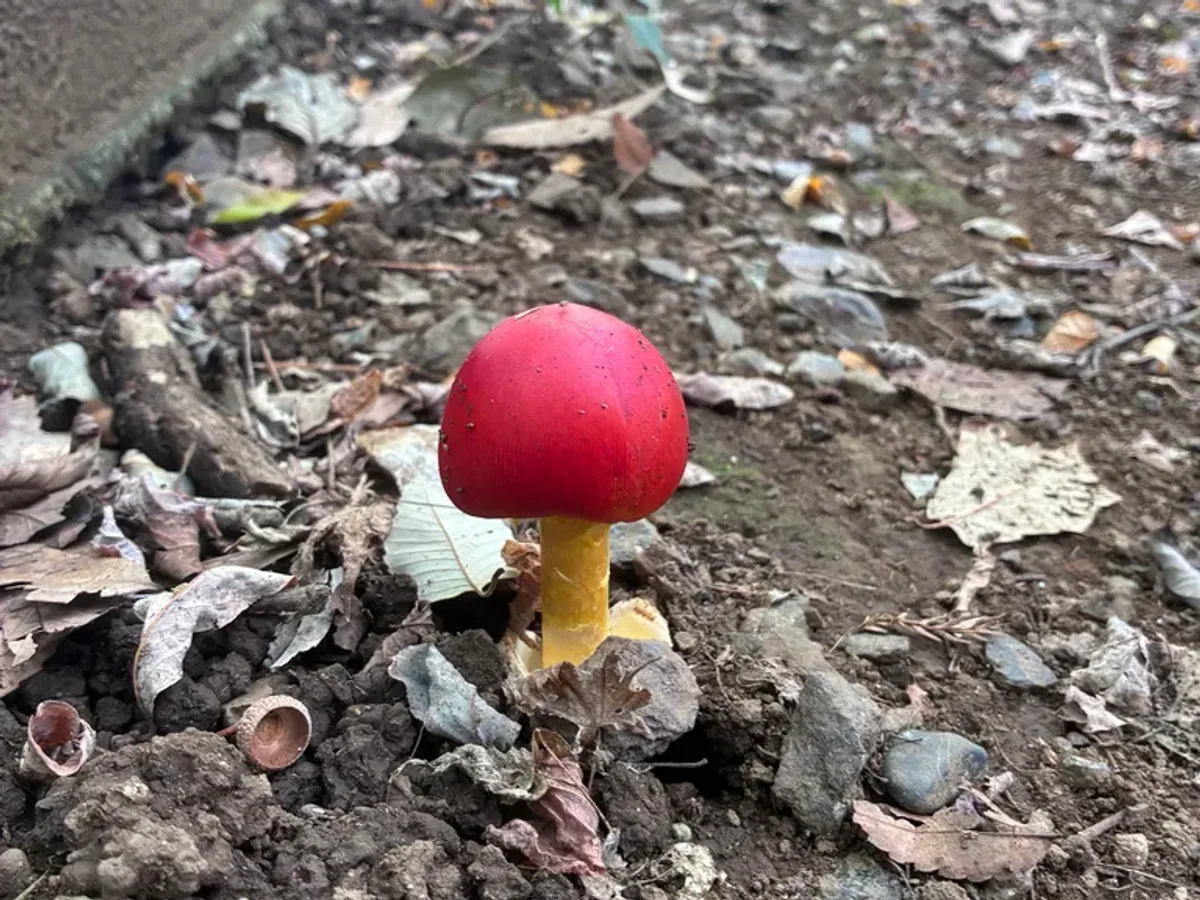 (c) MUNENORI YAMAKAWA, some rights reserved (CC BY)
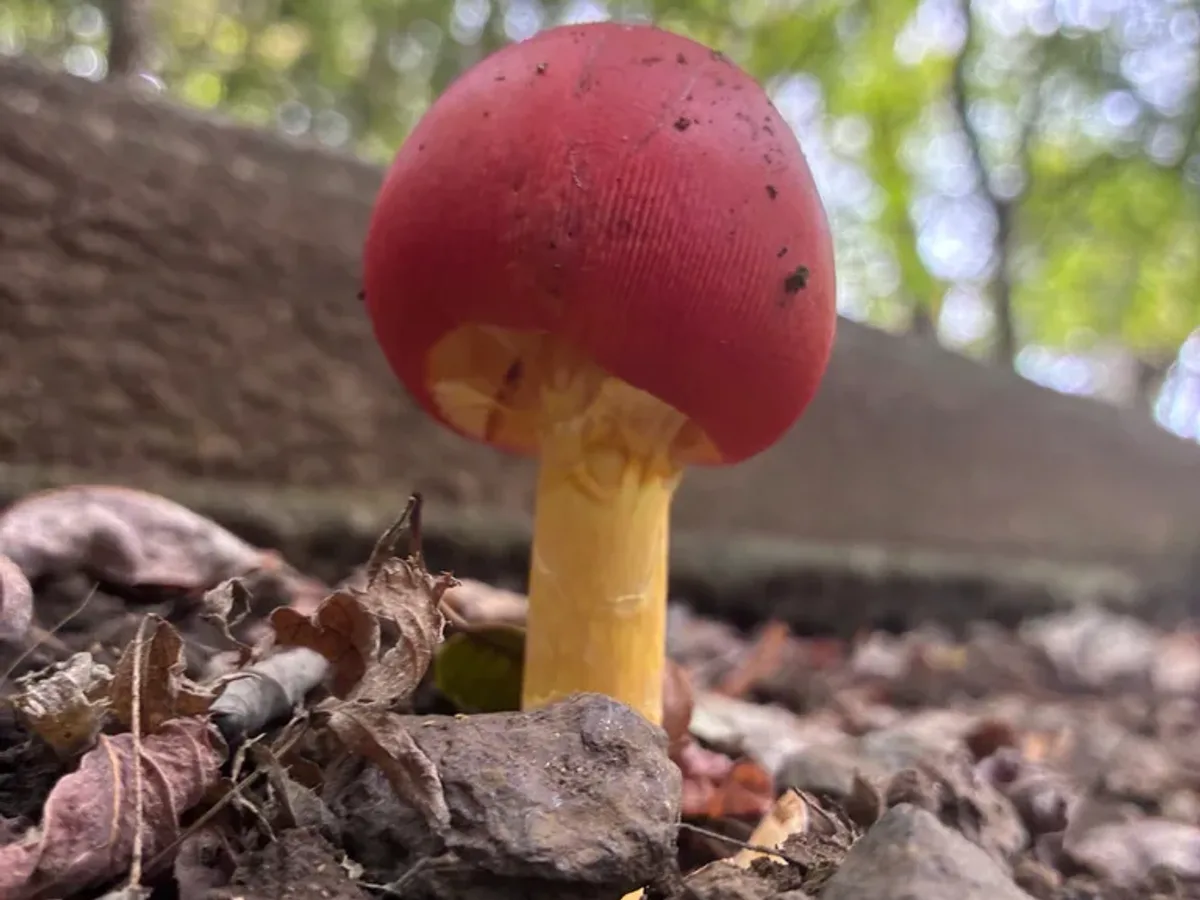 (c) MUNENORI YAMAKAWA, some rights reserved (CC BY)(c) MUNENORI YAMAKAWA, some rights reserved (CC BY)(c) MUNENORI YAMAKAWA, some rights reserved (CC BY)
Good to eat, once you have identified it with certainty and cooked it through.
Never eat a mushroom you are not 100% sure of - check the look-alikes below, and always cook wild mushrooms.
How to recognise it
Amanita satotamagotake arrives first as a smooth white egg nestled in the leaf litter - a compact, ovoid structure 25-50 mm tall, showing no hint of the colour inside.
Cap
When summer warmth and rain provide the right signal, the veil splits and an orange-yellow cap pushes upward and expands to 40-100 mm across, eventually broadening to nearly flat with a subtle central umbo.
The cap margin bears a ring of short radial furrows - a striate edge characteristic of all Caesar-group Amanita - that give it a subtly pleated, almost handmade look.
In tone, the cap is orange-yellow to warm orange, generally a little softer and less scarlet than Amanita hemibapha, though the two species do overlap.
Gills
Under the cap, the gills are free, crowded, and yellow - a vivid contrast to the deadly white-gilled Amanita species that share the same forest.
Stem
The stem is slender for its cap size (a trait common to the tamagotake group), pale yellow to orange-yellow, and carries a membranous, pendant ring of the same warm colour. In older specimens the ring may have drooped or collapsed against the upper stem.
Excavate the base carefully and you will find the white sac-like volva, often partly hidden in the soil.
Flesh
The flesh is white and unchanging.
The combination of orange-yellow striate cap, yellow gills, yellow pendant ring, yellow-orange slender stem, and white volva is the recognition set - all five elements should be confirmed before any tentative identification is accepted.
Where & when it grows
Habitat
A mycorrhizal partner of oaks and chestnuts in the warm-temperate broadleaf woodland of Japan, Amanita satotamagotake occupies a particular ecological niche: the satoyama, the mosaic of secondary woodland, farmland, and settled landscape that has been shaped by human use for centuries.
This intimate relationship with the cultural landscape gives the species its name and explains why it is more likely to turn up along a woodland path near a rural village than deep in primary forest.
The mycelium lives quietly in the soil, threaded between oak and chestnut roots in long-term mutualistic partnership - feeding the tree sugars in exchange for minerals and water - and only makes itself visible above ground for the brief reproductive window of summer and early autumn.
Productive spots near established oaks and chestnuts tend to produce fruit bodies year after year, provided the summer rains arrive on schedule.
When
Summer through early autumn: June to October in most of Japan, with the main flush running July through September.
The trigger is the pairing of warm, settled soil temperatures (18-28 °C) with significant rainfall.
Japan's tsuyu (the rainy season running roughly mid-June to mid-July in most of Honshu) often initiates the first flush. Subsequent typhoon rainfall or summer thunderstorms sustain further fruiting through August and into September.
As a lowland species occupying warmer forest margins and valley woodland, A. satotamagotake can begin to appear slightly earlier in the season than the montane tamagotake, sometimes emerging in late June in warm years.
Individual fruit bodies appear quickly - a few days after rain - and are best collected young to avoid insect damage.
How it grows
Emerges singly or in small scattered groups, never in dense clusters. Each fruit body pushes up from a buried volva, going through the white egg stage before expanding.
The mycelium responsible is engaged in a mycorrhizal relationship with the tree overhead - not a simple rot, but a reciprocal exchange of nutrients that has been running, in good spots, for years or even decades.
That underground partnership is why a productive spot under an old oak tends to produce mushrooms reliably season after season, as long as the weather cooperates.
The egg-to-expanded-cap transition unfolds over a few days. Once expanded, the cap flattens and the ring becomes easier to see, but insects find the flesh quickly. Collect in the early morning while fruit bodies are still firm.
Fruiting conditions
Warm-season mycorrhizal fruiter in lowland to hill broadleaf forest of Japan; flushes follow significant summer rainfall (20+ mm over 14 days) when soil temperatures reach 18-28 °C. Tsuyu rainy season rains and post-typhoon precipitation are the main flush triggers. Peak July-September; slightly earlier onset than montane relatives due to warmer lowland soil temperatures.
Look-alikes
The egg stage is the critical danger point: the white ovoid egg of A. satotamagotake is externally indistinguishable from the eggs of the destroying angel (Amanita virosa), the death cap (Amanita phalloides), and other lethal Amanita species.
Cutting an egg in half along its long axis reveals the future cap:
- A. satotamagotake shows a clearly orange or orange-yellow cap primordium within the white universal veil flesh.
- Deadly Amanita eggs contain white or pale flesh with no orange toning inside.
At full expansion, the orange-yellow striate cap, yellow gills, and yellow ring make A. satotamagotake unmistakable among mature specimens.
The closest relative in Japan is Amanita hemibapha, which occupies more montane forest and tends to be slightly larger and more vividly coloured (more scarlet-orange vs. orange-yellow). Both are edible and neither confusion is toxicologically significant.
The only edibility-relevant confusion is the egg stage, where the deadly white Amanita species are involved.
The typical death cap has a greenish-yellow to pale olive-brown cap with radial fibres, white gills, and a greenish-tinged ring - clearly different from the orange-yellow cap and yellow gills of A. satotamagotake at maturity. The white form (var. alba) is more dangerous: the cap is almost pure white and confusion could arise in theory, but even white-form death cap lacks the orange-yellow to orange colouring. At the egg stage, however, A. phalloides eggs are white ovals essentially indistinguishable from A. satotamagotake eggs - the cut test revealing an orange primordium versus pale undifferentiated flesh is the only reliable field separation. A. phalloides is an amatoxin species and lethal.
At the egg stage, A. virosa produces a smooth white ovoid that is externally indistinguishable from A. satotamagotake. Cut the egg in half along its length: A. virosa contains undifferentiated white flesh with no orange colouring inside; A. satotamagotake shows an orange cap outline. At maturity A. virosa is entirely pure white - white cap (often broadly conical, rarely fully flattening), white gills, white stem, and a grooved pendant ring - and completely lacks the orange-yellow colouration of A. satotamagotake. Both species occur in similar Japanese broadleaf woodland. A. virosa contains lethal amatoxins; a single fruit body is sufficient to cause fatal liver failure.
Amanita exitialis is a white to pale species documented primarily from subtropical China and implicated in fatal mass-poisoning events in Guangdong Province. Its egg stage is white and superficially similar to A. satotamagotake eggs. At maturity the cap is white to very pale - no orange-yellow - and gills are white. This species is an amatoxin-producer and deadly. Unlikely to co-occur with A. satotamagotake in Japan, but relevant in continental East Asian regions where tamagotake-group mushrooms are also collected.
Amanita hemibapha is the closest relative and the primary look-alike - both species are edible members of the tamagotake group. A. hemibapha tends to be larger (cap to 150 mm vs. 100 mm in A. satotamagotake), more vividly scarlet-orange rather than orange-yellow, and is more associated with montane forest and a broader East/Southeast Asian range extending from Japan through China, India, and Southeast Asia. A. satotamagotake is a Japanese lowland/satoyama species. Confusing the two is not toxicologically significant since both are edible; however, any perceived divergence from the expected description should prompt caution and confirmation.
Volvariella volvacea also produces a white to brownish egg-like universal veil and has a sac-like volva; it is widely cultivated and foraged across East and Southeast Asia. At maturity the cap is grey-brown to smoky-grey (never orange), gills turn pink with age, and the spore print is pink - contrasting with the orange cap and yellow gills of A. satotamagotake. It lacks a ring entirely. Found on compost, rice straw, or decaying organic matter in agricultural and garden settings - not in forest under trees. The risk of confusion is at the egg stage in harvesting contexts, not in the forest; the ecological separation (agricultural vs. forested habitat) is the first line of separation.
In the kitchen
Picking & cleaning
Collect only fully expanded specimens in which every identifying character is clearly visible and confirmed:
- the orange-yellow striate cap
- the yellow free gills
- the yellow-orange pendant ring
- the yellow-orange slender stem
- the white sac-like volva at the base
Carefully excavate the base - do not pull or snap the stem at ground level - to expose and confirm the volva before collecting.
Never collect egg-stage specimens of this or any Amanita for consumption: the white egg of A. satotamagotake is externally identical to the eggs of several deadly species including Amanita virosa and Amanita phalloides, both of which co-occur in Japanese broadleaf forest.
If the ring is absent or degraded and you cannot confirm it was present, do not eat the specimen.
Carry collections in a basket so that the volva is not crushed. Re-examine each specimen at home before cooking.
Cooking
Amanita satotamagotake is a pleasant, mild-flavoured edible mushroom in the Caesar's mushroom tradition.
The flesh is firm, cream-white, with a delicate, slightly sweet taste that suits clear soups (suimono), miso soup, rice dishes, and simple sautés with butter or light oil.
It requires no special preparation to eliminate toxins (it has none) but should be cooked through before eating, as a sensible precaution with any wild Amanita.
In Japan the tamagotake group, of which this species is a member, is regarded as a fine summer mushroom worthy of simple, appreciative preparation - not overwhelmed with strong flavours but allowed to contribute its own mild character to the dish.
Start with a modest amount on a first occasion to test individual tolerance, as with any newly tried wild mushroom.
Good to know
Amanita satotamagotake is a well-documented edible species consumed in Japan as part of the tamagotake tradition, without any known reports of toxicity from correctly identified material.
The overwhelming safety danger is the egg stage: a smooth white Amanita egg on Japanese forest soil is statistically as likely to be the destroying angel or death cap as any edible species.
The rule, without exception, is never consume a white egg-stage Amanita collected in Japan without first slicing it in half along the long axis to confirm an orange cap primordium inside.
Fatal poisonings in Japan and elsewhere in East Asia have occurred when foragers collected egg-stage Amanita virosa or Amanita phalloides, believing them to be edible tamagotake.
Even among fully expanded specimens, always confirm all five characters:
- orange-yellow striate cap
- yellow free gills
- yellow-orange pendant ring
- yellow-orange stem
- white sac-like volva
A specimen with any deviation from this set should not be eaten. When in doubt, leave it.
Poison control centres and hospitals in Japan are experienced with Amanita poisoning, and any suspected ingestion of the wrong species requires immediate emergency medical attention - do not wait for symptoms.
A reference guide - never an edibility guarantee. When in doubt, leave it out.