Proximate amanita
Amanita proxima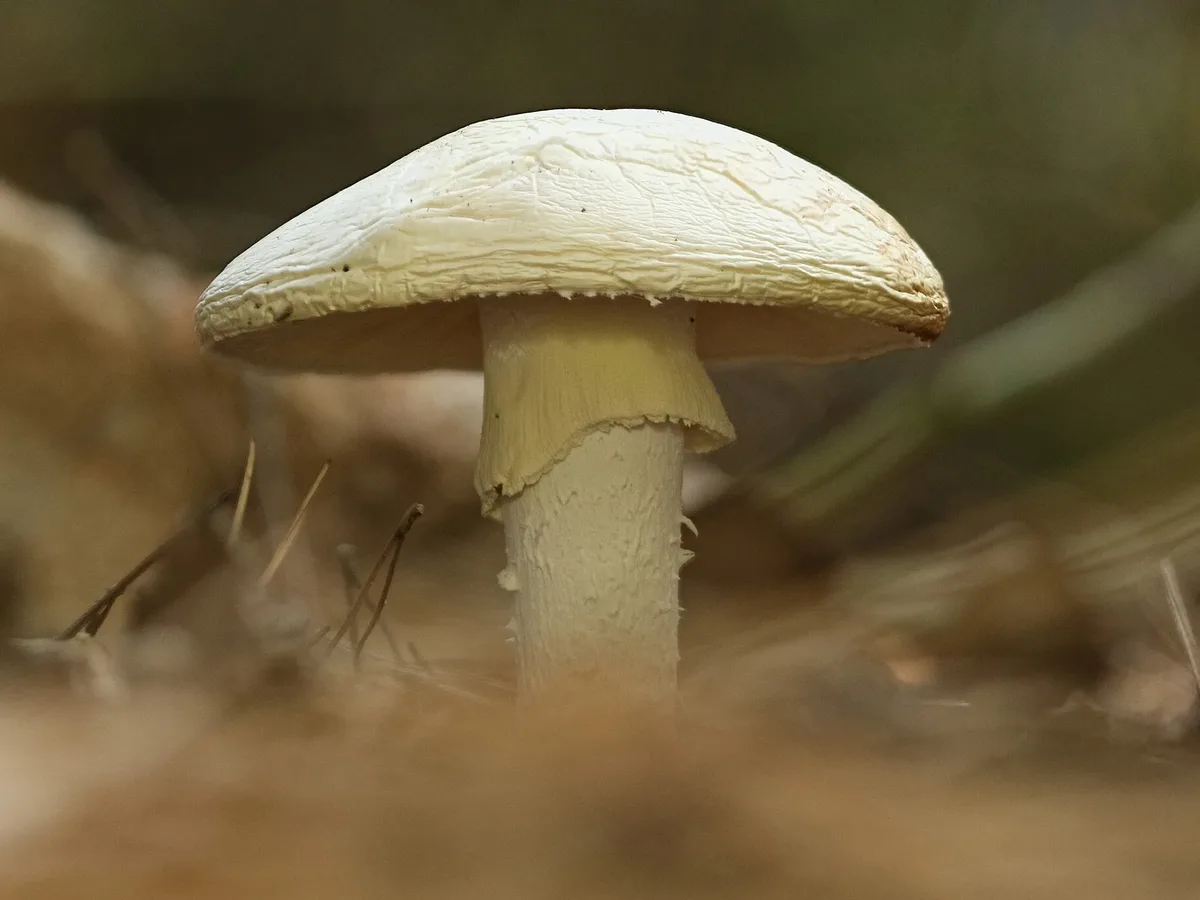 © Chaym Turak (CC BY-SA)
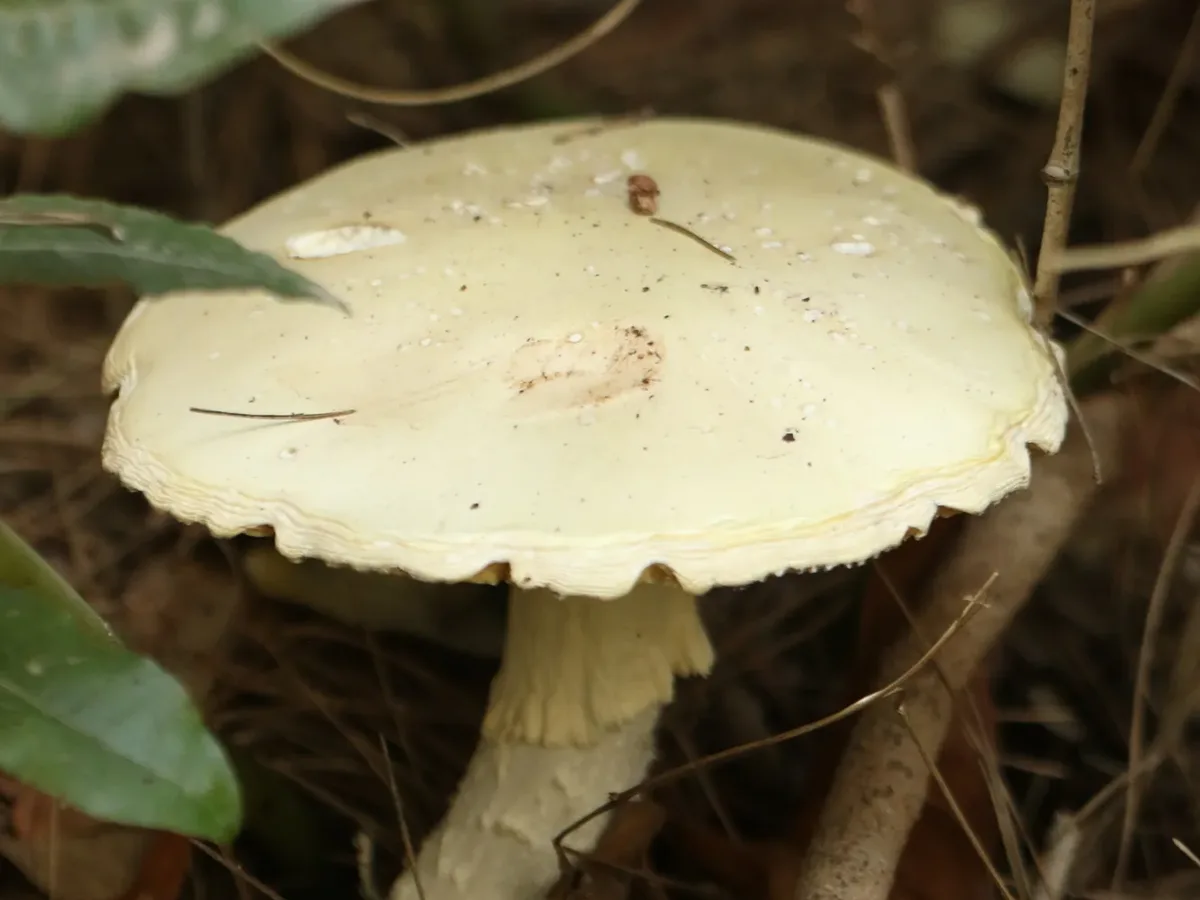 © Chaym Turak (CC BY-SA)
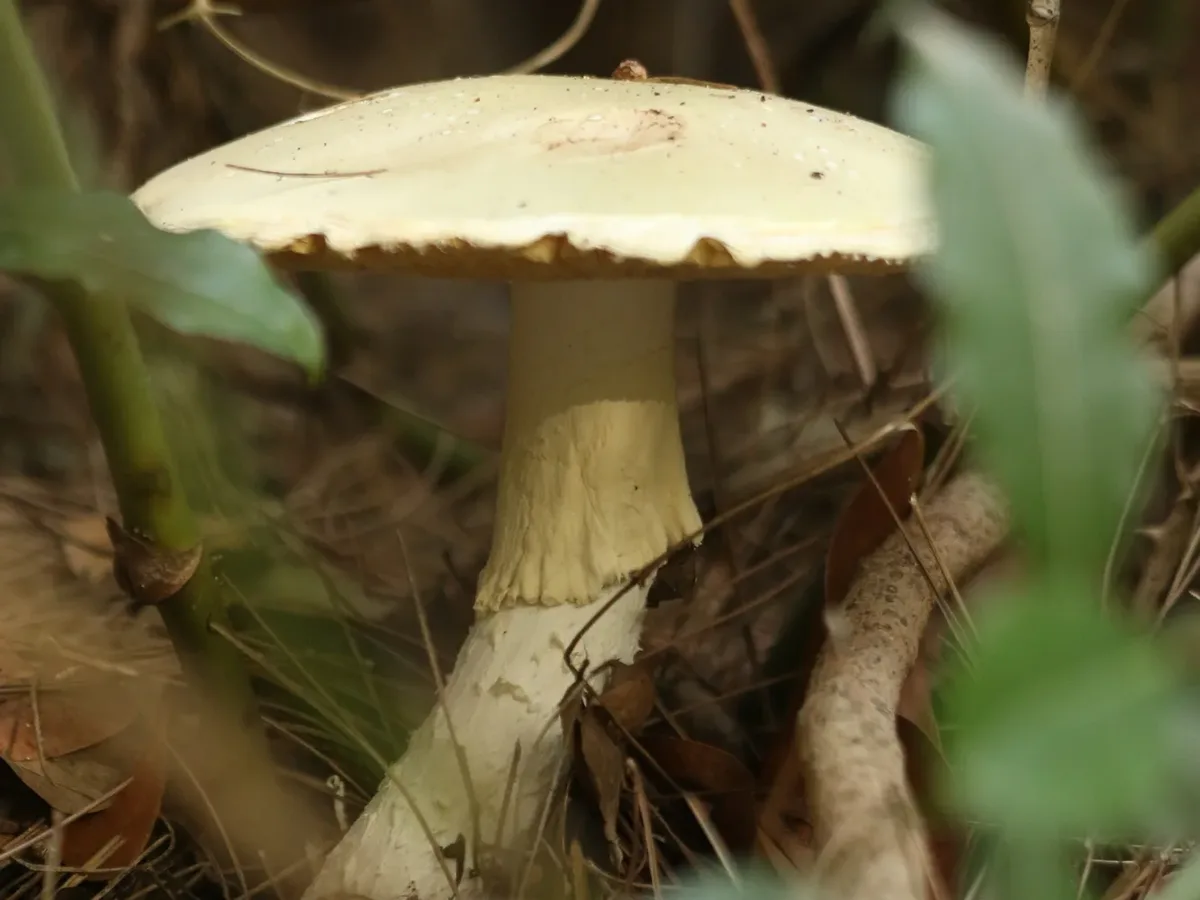 © Chaym Turak (CC BY-SA)© Chaym Turak (CC BY-SA)© Chaym Turak (CC BY-SA)
Toxic - and the most serious cases can be fatal. Never eat it, and wash your hands after handling.
Never eat a mushroom you are not 100% sure of - check the look-alikes below, and always cook wild mushrooms.
How to recognise it
Amanita proxima is a large, wholly white mushroom that can look deceptively wholesome.
Cap
The cap (7-18 cm) opens from a white egg through convex to flat or slightly depressed, white to cream-white, sometimes holding soft cottony veil patches that rain easily washes away.
Gills
The gills are free, crowded and permanently white - they show no colour change at any stage of development.
Stem
The stem is robust and white, finely scaly above the ring, tapering toward a fusiform to club-shaped base.
The ring is membranous, white and pendulous but often fragile, collapsing on older specimens.
The volva - the basal sack or sheath - is the most structurally important feature: it is thick, white, and deeply buried in the soil, so the base must always be carefully excavated with a knife or trowel to assess it.
Flesh
Flesh is white throughout and does not redden, grey, or blue when cut.
The spore print is white and spores are amyloid, as is typical for Amanita.
Do not rely on warts or smell to confirm this species; structural features - volva, ring, gills, non-reacting flesh - are essential for documentation.
Why it's dangerous
The danger of Amanita proxima lies almost entirely in its visual resemblance to the edible Amanita ovoidea.
In Mediterranean countries where A. ovoidea has a tradition as an edible mushroom, foragers with experience picking A. ovoidea have been fatally or seriously poisoned by picking A. proxima in the same habitats.
- The toxin is heat-stable (cooking offers no protection).
- Onset is delayed, so the connection to a meal may not be immediately apparent.
- The syndrome can progress to irreversible kidney damage requiring transplantation.
This is among the most underappreciated and regionally specific lethal mushroom dangers in Europe.
Toxin
The nephrotoxic agent responsible for Amanita proxima poisoning was identified as allenic norleucine (chemical name: (S)-2-amino-4,5-hexadienoic acid), an unusual non-protein amino acid.
This compound is structurally unrelated to amatoxins, orellanin, or gyromitrin, and is not destroyed by cooking.
It selectively damages proximal renal tubule cells, leading to acute tubular necrosis. The mechanism involves conversion by renal tubular cells into a reactive intermediate that causes oxidative damage.
The toxin is water-soluble; cooking and drying do not render the mushroom safe.
Symptoms
The clinical course of Amanita proxima poisoning differs notably from amatoxin and orellanin poisoning.
After a latency period of approximately 12 to 24 hours after ingestion (occasionally shorter), patients develop nausea, vomiting, abdominal pain, and profuse diarrhoea.
This is followed over the next few days by progressive impairment of kidney function - rising creatinine and urea, oliguria, and in severe cases anuria requiring dialysis.
Liver enzymes may be mildly elevated, but severe liver damage (as seen in amatoxin poisoning) is not characteristic.
Recovery without dialysis is possible in mild cases, but severe poisoning has required kidney transplantation or has resulted in death from renal failure.
The delayed onset (meals consumed at dinner; renal deterioration 2-5 days later) and the absence of early liver damage can complicate early diagnosis.
Staying safe
Amanita proxima is responsible for a distinct and well-documented poisoning syndrome in Mediterranean France and neighbouring countries - the 'proxima syndrome' or 'Mediterranean renal failure syndrome'.
Unlike the amatoxin poisoning of death caps and destroying angels, this syndrome causes acute and often severe kidney (renal) failure without significant liver damage.
Cases recorded in Provence and Languedoc during the 1990s and 2000s involved patients who had eaten what they believed to be Amanita ovoidea. Several patients required dialysis or kidney transplantation; some died.
Because the confusion with edible Amanita ovoidea is so easy and so dangerous, and because no safe field test exists to separate them reliably, this species is rated DEADLY. No forager should pick large white volvate Amanitas in Mediterranean maquis for eating.
Where & when it grows
Habitat
A specialist of Mediterranean landscapes, Amanita proxima is almost always found in maquis, garrigue, or open scrubland dominated by Cistus species (rockroses), or in open holm oak and cork oak woodland on warm, well-drained calcareous or sandy soils.
It is an ectomycorrhizal partner of Cistus as well as Mediterranean oaks and pines - its underground mycelium can sustain these partnerships across many growing seasons, fruiting each autumn as long as the host plants and soil conditions persist.
It is particularly associated with the sun-warmed, shrub-covered hillsides of coastal and hilly southern France, northeastern Spain, Sardinia, Corsica, and the Maghreb.
It does not occur in cool-temperate forests and is absent from northern Europe.
When
Amanita proxima fruits in autumn and early winter, keyed precisely to the first cooling rains of the Mediterranean rainy season.
October and November are the core months; sporadic fruiting extends from late September to December.
In years of prolonged summer drought followed by heavy autumn rain, flushes can be abundant and concentrated. There is no spring fruiting.
How it grows
Fruit bodies push up singly or in small scattered groups from the soil, beginning as white eggs enclosed in the universal veil.
Over several days the cap expands and the veil tears, leaving remnant patches on the cap surface while the basal volva remains intact around the stem base.
Because the volva is deeply buried, the emerging fruit body can look like a short-stemmed or almost stemless white cap sitting close to the ground - a superficial resemblance to large puffballs at the button stage.
Full development from egg to mature cap takes several days in moist, warm-night conditions.
Fruiting conditions
Fruiting is triggered by the onset of the Mediterranean autumn rainy season, requiring significant rainfall (>25 mm over a 14-day window) after the summer drought, with soil temperatures cooling into the 10-20 °C range. Flush appears roughly 1-2 weeks after soaking rains.
Look-alikes
The most significant and dangerous confusion in the Mediterranean region is with Amanita ovoidea (the White Egg Amanita or Ovoid Amanita), which is edible and has historically been collected for food in southern France and around the Mediterranean.
The two species are structurally very similar: both are large, white, volvate Amanitas with crowded white gills.
- Amanita ovoidea tends to be slightly larger and more robust, with a more obviously sack-like open volva, often a distinctly sweet-honey smell, and a broader, more open cap with a slightly wavy margin.
- Amanita proxima is generally slightly smaller, has an initially more enclosed volva, and may lack the pronounced sweet smell.
But these differences are subtle and unreliable in the field without side-by-side comparison. No visual or smell character can be considered a safe separator: the only reliable distinction requires microscopy (spore size, pileipellis structure).
A second, milder confusion is with Amanita strobiliformis (the Warted Amanita), which has more conspicuous pyramidal warts on a larger cap, grows under broadleaves in central Europe, and is regarded as edible with caution - but this species is found further north and in different habitats.
Amanita ponderosa is another white Mediterranean Amanita (already in our library), associated with cistus, that has caused renal poisoning under debated taxonomy.
The crucial safety rule: in Mediterranean maquis and garrique, ANY large white volvate Amanita must be treated as potentially Amanita proxima until mycological confirmation by a specialist, and never eaten on visual identification alone.
Another large white cistus-associated Mediterranean Amanita. A. ponderosa has been associated with renal syndrome poisoning under debated taxonomy and is also regarded as dangerous; it tends to have a more pronounced earthy-farinaceous smell, and older specimens show an olivaceous or ochre tinge on the cap centre. Structurally very close to A. proxima; the two may be confused and both should be avoided for eating.
A large white Amanita with more prominent, coarser, pyramidal grey-white warts on the cap surface, found more typically in central European broadleaf woodland (especially under lime/linden and oak) rather than Mediterranean maquis. It has a grooved ring margin and a well-formed volva. Regarded as edible with caution, but the different habitat (broadleaf woodland vs. maquis/garrigue) and coarser warts are the main separators from A. proxima.
The classic dangerous confusion. Amanita ovoidea is edible but structurally very similar: both are large, all-white, volvate Amanitas with crowded white gills and a membranous ring. A. ovoidea tends to be larger (cap to 25 cm), often has a more open, ragged volva in mature specimens, and some forms have a pronounced sweet-honey smell. A. proxima is generally smaller and the volva may remain more tightly closed. These differences are too subtle and variable for safe field identification - no visual character reliably separates them. Only microscopy (spore dimensions: A. ovoidea has slightly larger spores averaging 11-14 x 7-9 µm versus 9-12 x 6-8 µm for A. proxima, though overlap exists) or chemical analysis can confirm the distinction. In Mediterranean maquis, treat all large white volvate Amanitas as potentially deadly.
A reference guide - never an edibility guarantee. When in doubt, leave it out.