Prince Amanita
Amanita princepssyn. Amanita princeps Corner & Bas
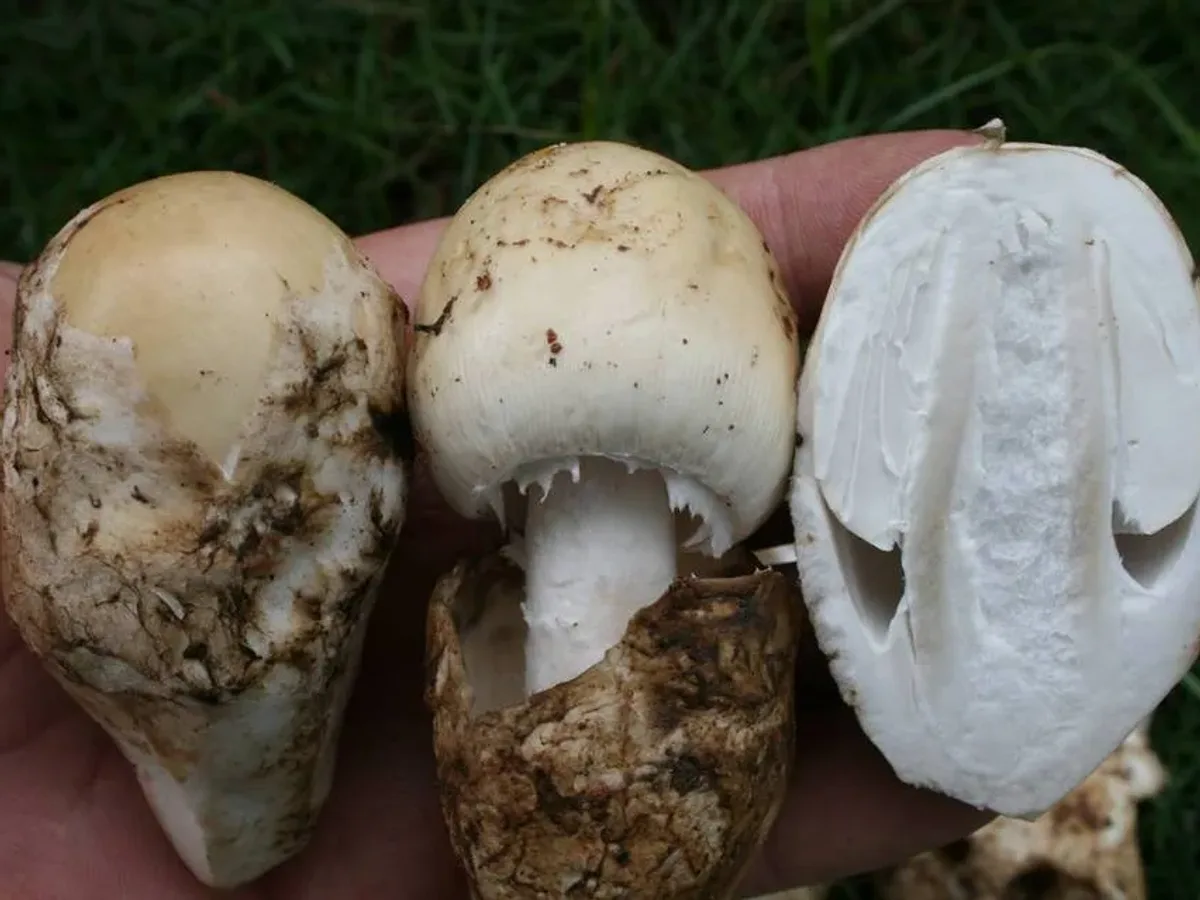 © Britt Bunyard (Fungi magazine) (CC BY-SA)
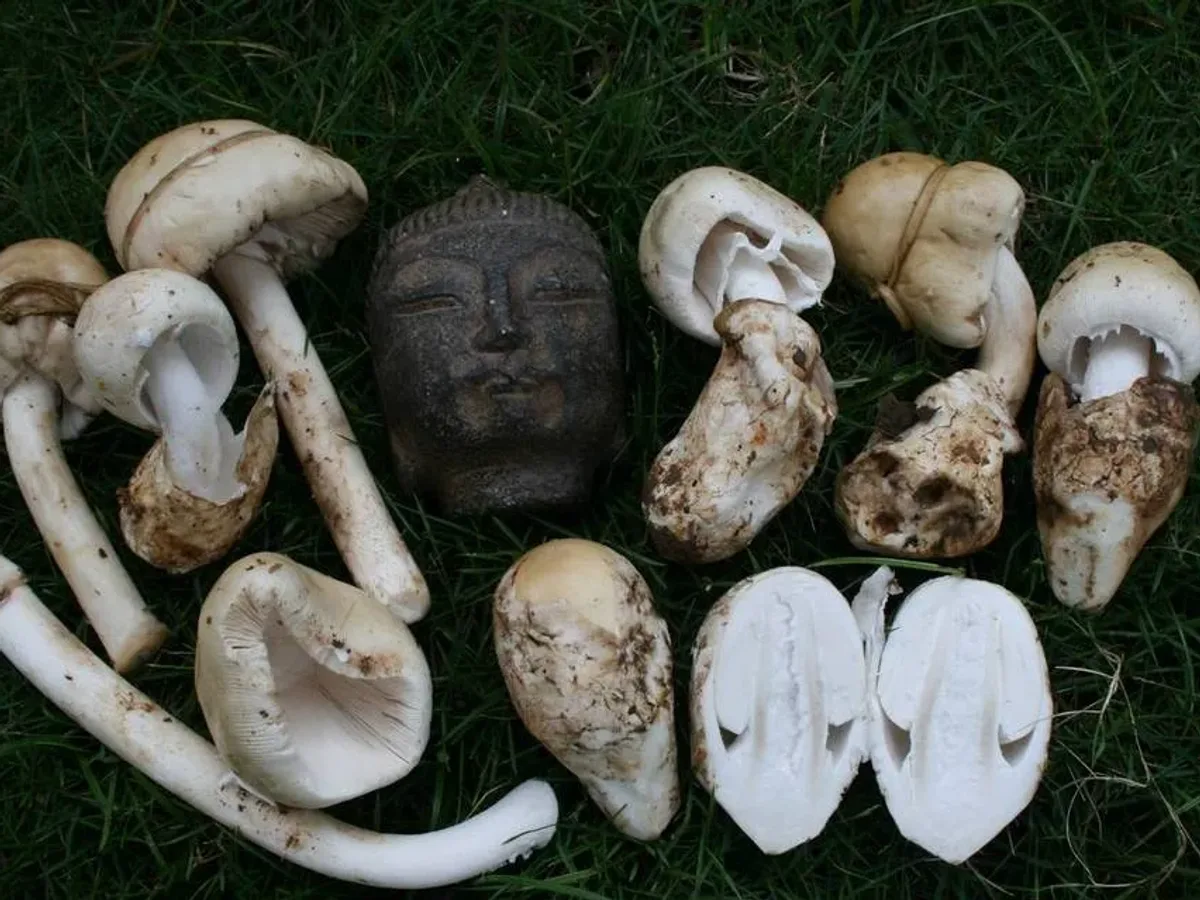 © Britt Bunyard (Fungi magazine) (CC BY-SA)© Britt Bunyard (Fungi magazine) (CC BY-SA)© Britt Bunyard (Fungi magazine) (CC BY-SA)
Good to eat, once you have identified it with certainty and cooked it through.
Never eat a mushroom you are not 100% sure of - check the look-alikes below, and always cook wild mushrooms.
How to recognise it
Amanita princeps is one of the more imposing edible mushrooms of the East Asian broadleaf forest - large, cream-white, and decorated with a suite of distinguishing characters that, taken together, give it a regal bearing.
Cap
The cap starts broadly domed and expands to a wide, nearly flat disc of 80-200 mm, carrying a pattern of firm, grey-brown to brown, pyramid-like warts distributed across a white to ivory background.
These brownish, pointed warts are the most immediately distinctive feature of A. princeps, and they separate it from both the pure-white-warted deadly species of section Phalloideae and from the orange-tinged edible Caesars.
In good dry conditions the warts persist well, giving the cap surface a textured, almost architectural quality. Heavy rain can dislodge or flatten them, leaving the cap looking plainer and more ambiguous - a reminder that wart condition alone cannot be relied on in wet weather.
Gills
The gills are free, white, and crowded.
Stem
The stem is stout and white, densely clothed in cottony white scales from below the ring to the base. The pendant ring is broad, membranous, and white.
At the base, a free white sac-like volva encloses the stem and is partly buried in the soil. Excavate it gently to confirm - this is a non-negotiable step.
Flesh
Flesh is pure white and does not discolour when cut.
Where & when it grows
Habitat
A mycorrhizal specialist of warm-temperate to cool-temperate broadleaf and mixed forest, forming long-term partnerships with oaks, chestnuts, beeches, and stone oaks across Japan, Korea, and southern China.
In Japan it is most often encountered in the rich deciduous and evergreen broadleaf forests of Honshu, Shikoku, and Kyushu, where it emerges from well-drained, humus-rich, acidic soils.
It tends to occupy mature forest interior or shaded forest edge under closed-canopy Fagaceae woodland rather than disturbed roadsides or open secondary scrub.
The mycorrhizal network connecting this species to its host trees can persist for many years below ground, meaning that once a productive site is found - near a particular mature oak or chestnut - it is worth returning to.
Growth is solitary or in small scattered groups, never in dense clusters.
When
The main fruiting season in Japan and Korea runs from July to September, with the earliest fruit bodies occasionally appearing in June and the last ones extending into October.
This timing aligns with the post-rainy-season warmth and residual summer moisture of the warm-temperate East Asian climate - conditions that follow Japan's baikyu (plum rains) and coincide with the traditional autumn mushroom season.
In southern Chinese localities the season can start in May.
The predictable trigger is a substantial rainfall event of 25 mm or more, followed by continued warm temperatures. Fruit bodies typically emerge five to twelve days after triggering rain.
How it grows
Emerges singly or in scattered small groups, each fruit body arising from a buried sac-like volva.
Young specimens can still be enclosed in the universal veil, presenting as a rounded white to cream egg on the soil surface. This egg stage must never be collected without slicing the specimen open, as it is externally indistinguishable from eggs of deadly Amanita species that share the same forest.
As the cap expands, the universal veil ruptures, leaving behind the characteristic brownish pyramidal warts on the cap surface and the free basal sac below.
The mycorrhizal network that underpins this above-ground display is established slowly over years. Productive spots near mature host trees can be revisited reliably across seasons, making this a species that rewards patient, local knowledge.
Fruiting conditions
Warm-season mycorrhizal fruiter in temperate East Asia; flushes follow substantial summer or early-autumn rainfall (25 mm or more over one to two weeks) when soil temperature is 18-28 °C. Peak July-September in Japan and Korea, tightly coupled to post-rainy-season warmth. In southern China fruiting can begin in May.
Look-alikes
The most dangerous potential confusions involve all-white or pale Amanita species with both a ring and a volva in the same forests of Japan, Korea, and southern China.
- Amanita virosa and related destroying angel species (Amanita verna, Amanita exitialis) are deadly amatoxin-containing species that are white throughout. They lack the distinctly brownish warts of A. princeps and typically have a smoother cap surface (or very fine white warts), but in wet conditions where A. princeps warts have washed off the two can appear superficially similar.
- Amanita subjunquillea, a deadly pale-yellow to whitish species from East Asia, lacks the brownish pyramidal warts.
- Amanita pseudoprinceps, a closely related large pale-white edible species of subtropical Southeast Asia and southern China, has white rather than brownish warts. Confusing the two is not toxicologically significant since both are reportedly edible, but the similar appearance underscores why wart colour must be confirmed carefully.
- Amanita spissa and Amanita excelsa are European and Eurasian grey-warted species with some visual resemblance but are geographically distinct and ecologically different in detail.
At the egg stage, all white Amanita eggs look alike - cutting the egg to expose the interior is the only safe approach.
Amanita virosa is entirely white at all stages - white cap, pure white warts (if present), white gills, white ring, white stem, and white volva. It completely lacks the grey-brown to brown pyramidal warts that characterise A. princeps. A. virosa tends to have a more conical cap that retains a pointed apex at maturity, a shaggy cottony stem, and a grooved or striated upper ring surface. However, in wet weather when warts have washed off A. princeps, the two can look superficially similar. A. virosa contains lethal amatoxins. Treat any all-white, de-warted Amanita with ring and volva in East Asian forest as potentially deadly.
Amanita subjunquillea is a deadly amatoxin-containing species distributed across temperate East Asia including Japan, Korea, and China. Its cap is pale yellowish to cream or whitish, often with a faint straw-yellow centre, and carries white to pale universal veil remnants rather than brownish pyramidal warts. Gills are white, ring is white and pendant. The absence of distinctly brownish warts is the key separating character from A. princeps. Fatal poisonings attributed to A. subjunquillea have been recorded in Japan and Korea - it occupies the same warm-temperate broadleaf forests as A. princeps.
Amanita exitialis is a lethal amatoxin-containing species from southern China (primarily Guangdong Province and adjacent areas) responsible for numerous mass poisoning fatalities. It is white throughout - white smooth cap, white gills, white ring, white volva - and lacks brownish pyramidal warts. It is typically smaller (cap 40-80 mm) than A. princeps, but size alone is not reliable. The geographical overlap in southern China, where A. princeps also occurs, makes this comparison important. Any white ring-and-volva Amanita in subtropical southern China should be considered a potential A. exitialis until proven otherwise.
Amanita pseudoprinceps is a large, pale-white to cream edible Amanita of subtropical Southeast Asia and southern China, closely related to A. princeps and named for the resemblance. The most reliable separating character is wart colour: A. pseudoprinceps bears white to cream cottony-powdery warts, whereas A. princeps has distinctly grey-brown to brown, more pyramidal and pointed warts. A. pseudoprinceps occurs predominantly in tropical and subtropical Southeast Asian forests (Thailand, Vietnam, southern China) at lower latitudes and elevations than the more temperate A. princeps. Confusing the two is not dangerous since both are reportedly edible, but the visual similarity reinforces why wart colour and overall character confirmation are essential.
Amanita spissa (also known as Amanita excelsa var. spissa) is a European and Eurasian species with grey-brown pyramidal warts on a pale grey-brown cap - the warting pattern is visually similar to A. princeps but the cap itself is grey-brown rather than cream-white. Geographically, A. spissa is centred in Europe and does not significantly overlap with A. princeps in East Asia. It is regarded as inedible or mildly toxic and should not be eaten. The visual resemblance to A. princeps in wart form and colour illustrates how wart characters alone are insufficient for safe identification; the pale cream (not grey-brown) cap background colour of A. princeps is the separating feature.
In the kitchen
Picking & cleaning
Only collect fully expanded, mature specimens where all identification characters are simultaneously confirmed:
- Cream-white cap with persistent grey-brown to brown pyramidal warts
- Free white crowded gills
- Stout white shaggy-scaled stem
- A broad white pendant ring
- A free sac-like white volva at the base - excavated and examined
The brownish wart colour is the single most important character distinguishing A. princeps from the pure-white-warted deadly white Amanita species that share its forest. Even so, the full character suite must be confirmed before collecting.
Do not collect egg-stage specimens.
In wet conditions when warts may have washed off, exercise maximum caution or abandon collection - a de-warted A. princeps is visually very close to deadly white species.
Carry specimens intact in a basket, re-examine at home, and if any doubt exists discard the specimen. Co-occurring deadly species make these rules non-negotiable.
Cooking
Amanita princeps is consumed in Japan and Korea as a seasonal edible of broadleaf forest, valued for its mild, pleasant flavour and firm, substantial texture. It is used in clear soups, sautéed in butter or oil, and incorporated into stir-fries.
Always cook it thoroughly before eating - eating raw Amanita species is inadvisable regardless of reported edibility.
Clean specimens carefully to remove warts and soil, and trim the base.
When trying this species for the first time, eat a moderate portion and wait before consuming more, in keeping with sound practice for any wild mushroom.
Good to know
Amanita princeps has a documented tradition of edibility in Japan and Korea, where it has been consumed after cooking for many years without significant reported incidents. It is not known to contain amatoxins or other significant toxins, and mycological literature treats it as an edible species.
Nevertheless, every collection of A. princeps demands the same rigorous identification process applied to all Amanita species. The combination of ring, volva, and white flesh means that any error in identification could be fatal if a deadly species is mistaken for it.
The brownish pyramidal warts are the critical diagnostic anchor. In wet conditions where warts have washed away, the visual similarity to deadly all-white species increases substantially, and collection should be abandoned.
Never collect any white or pale Amanita with ring and volva in East Asian forest without confirming the brownish (not pure white) wart colour and all other characters.
Cook thoroughly before eating. As with any wild mushroom, start with a moderate portion when eating for the first time to monitor individual tolerance.
A reference guide - never an edibility guarantee. When in doubt, leave it out.