American Caesar's Mushroom
Amanita jacksoniisyn. Amanita caesarea sensu auct. amer., Amplariella jacksonii
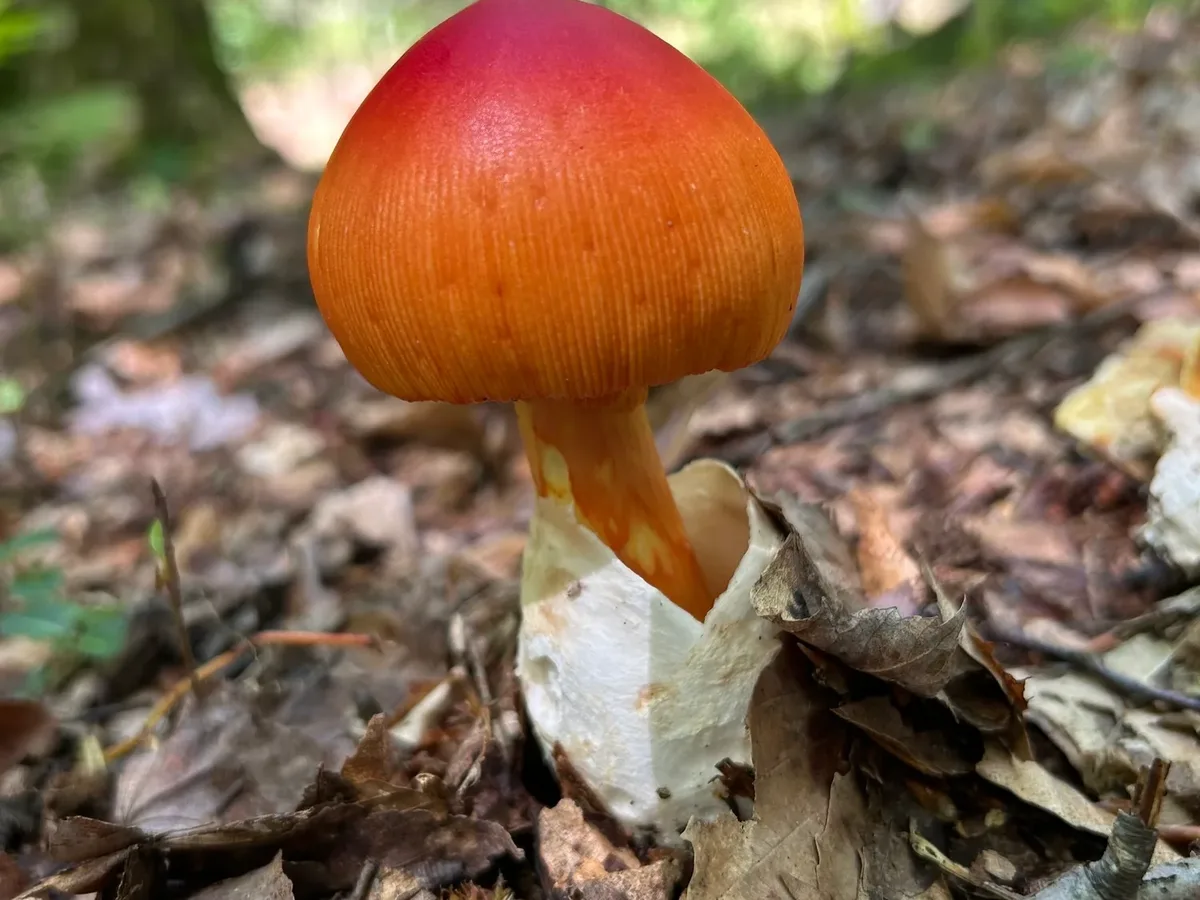 Andrea Kautz (CC0)
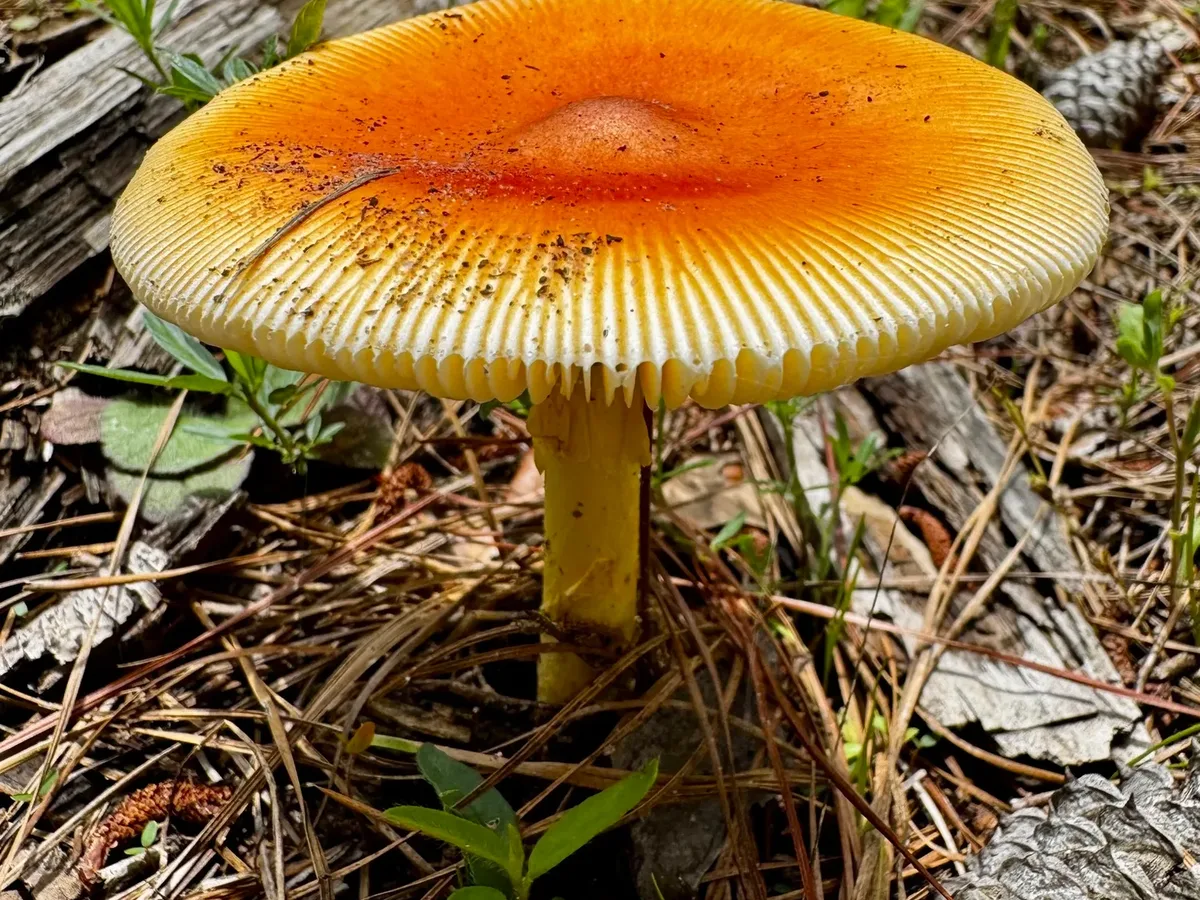 © Laura Clark (CC BY)
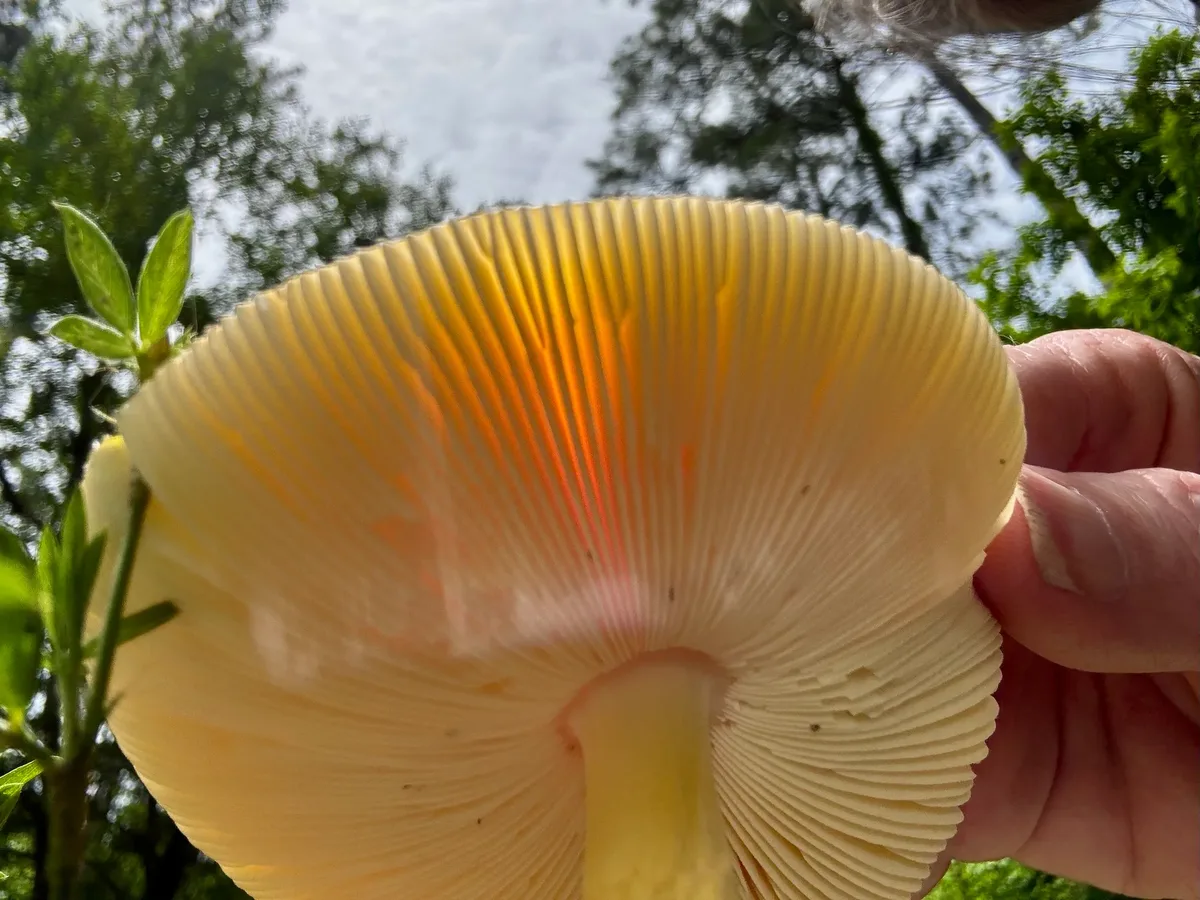 © Laura Clark (CC BY)
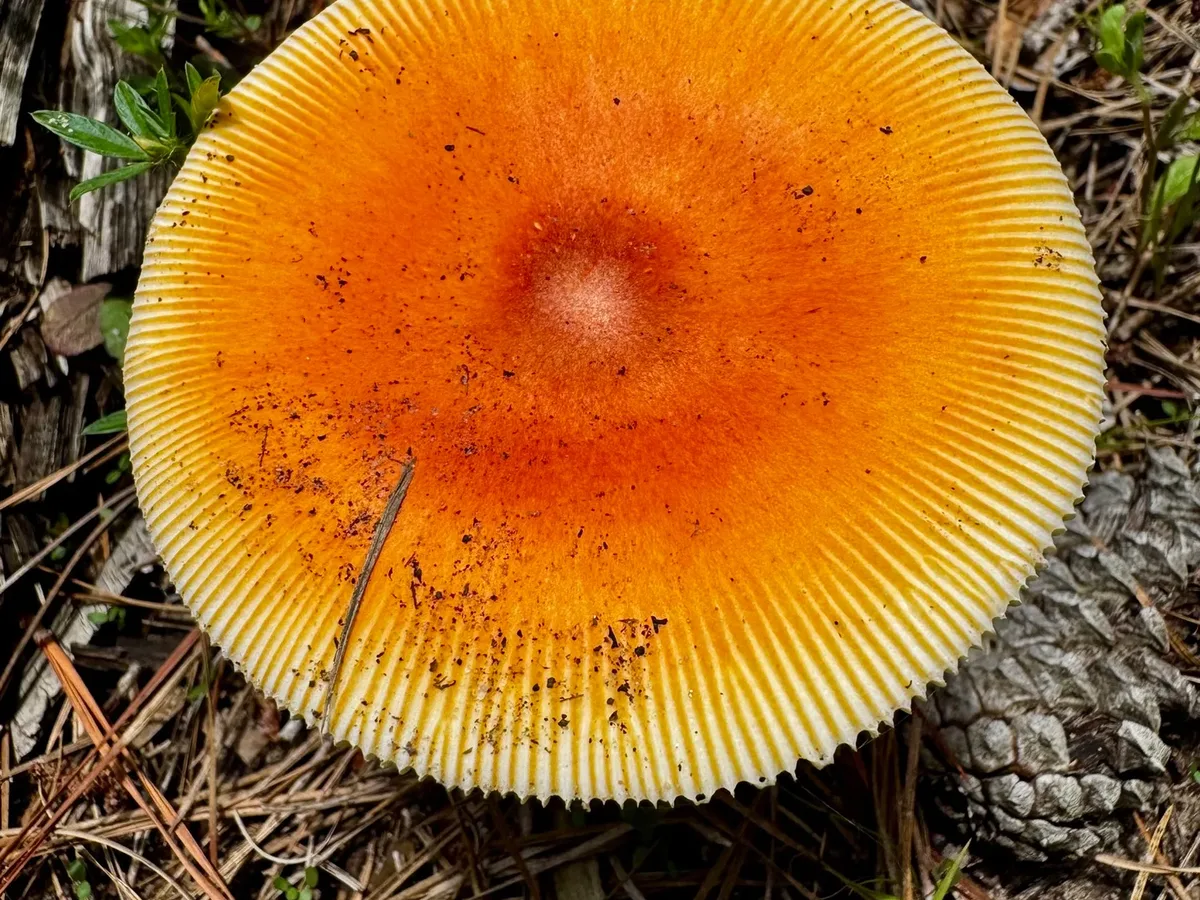 © Laura Clark (CC BY)
 decaturjosh (CC0)
 laneneely (CC0)
 © brettaugust (CC BY)
 © brettaugust (CC BY)
 Andrea Kautz (CC0)Andrea Kautz (CC0)© Laura Clark (CC BY)
One of the best mushrooms you can bring home - once you are certain of the identification.
Never eat a mushroom you are not 100% sure of - check the look-alikes below, and always cook wild mushrooms.
How to recognise it
Amanita jacksonii is one of the most beautiful mushrooms in eastern North America - bold and easy to read once you know its signature.
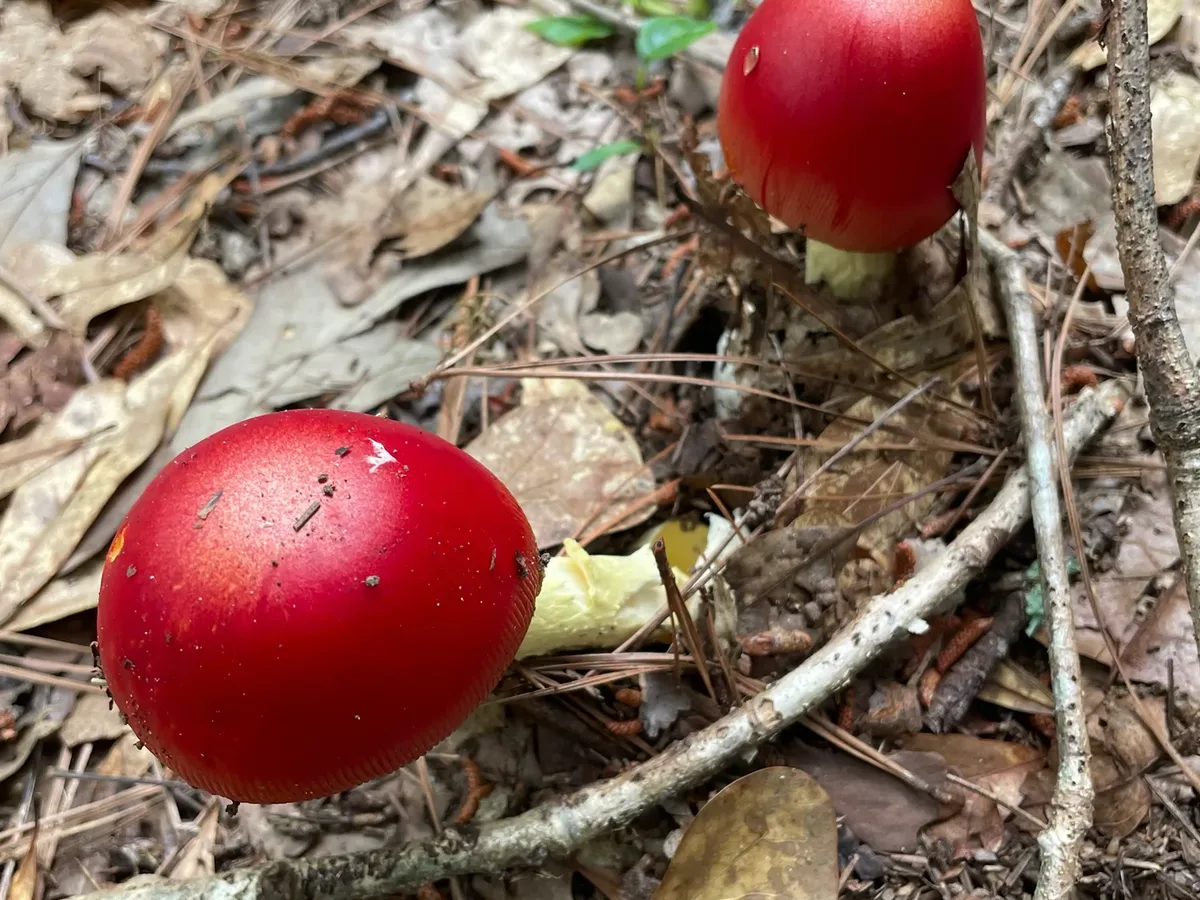
In youth it presents as a smooth white oval egg nestled in the leaf litter, sometimes half buried, looking almost placed rather than grown.
Slice that egg in half and inside you will find the scarlet-orange cap primordium already perfectly formed, wrapped in yellow-tinged flesh - a stunning preview of the finished fruit body, and the key field cut that rules out deadly egg-stage lookalikes, which show only undifferentiated white or pale flesh inside.
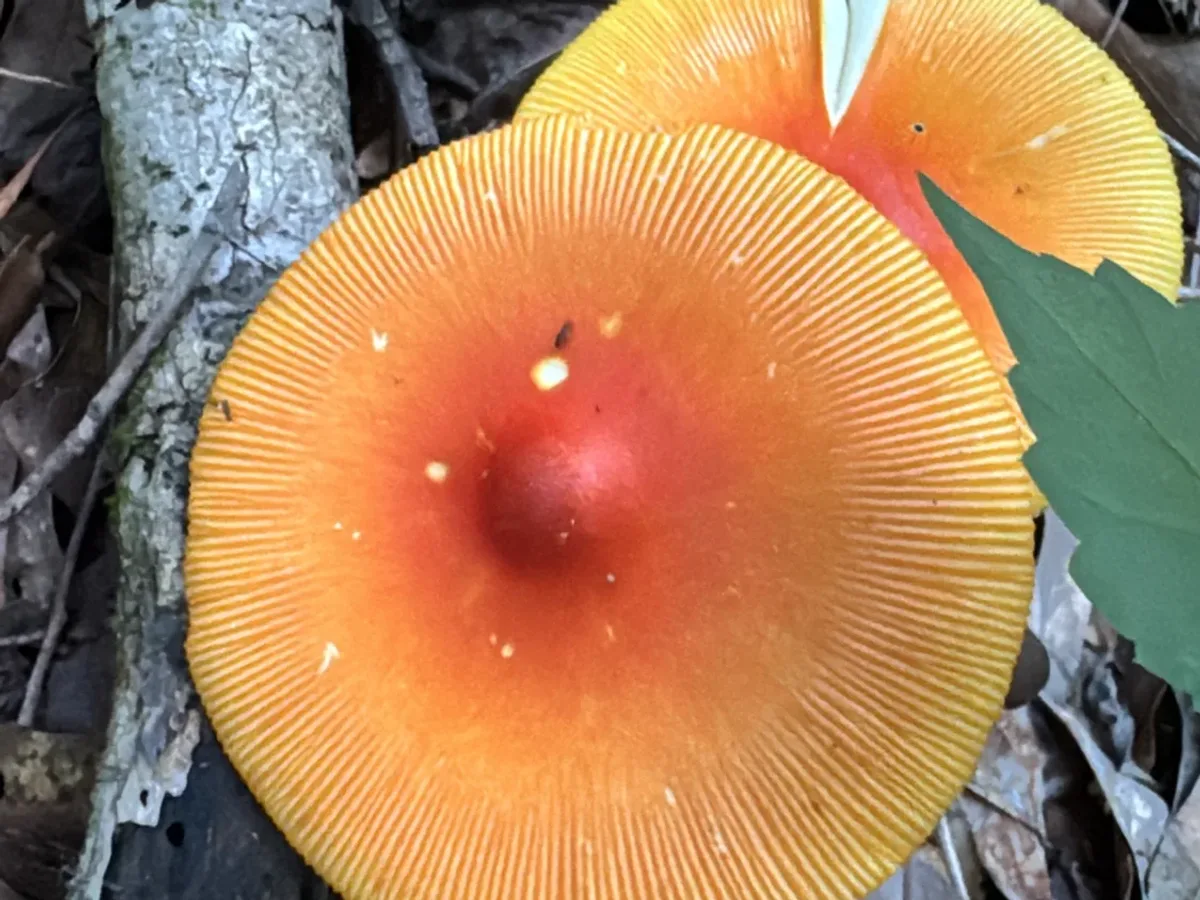
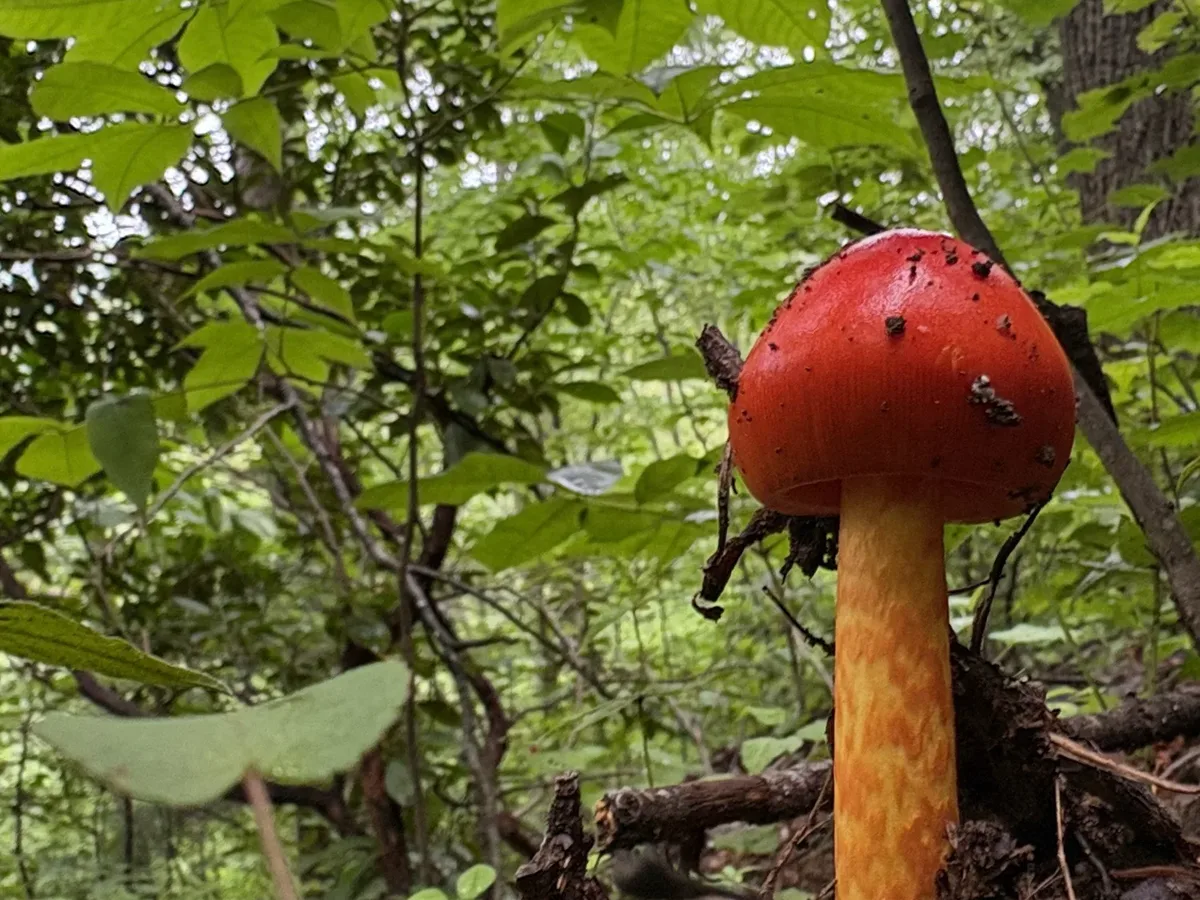
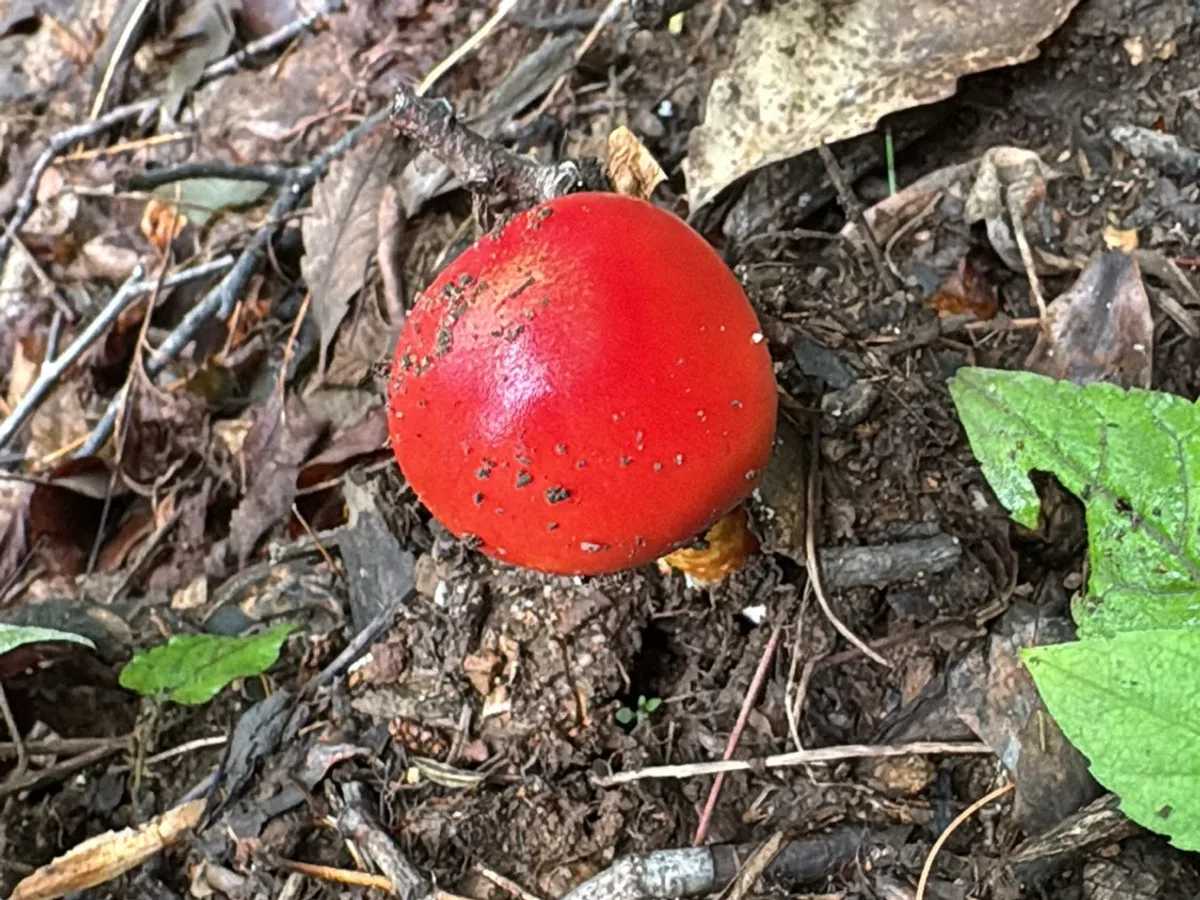
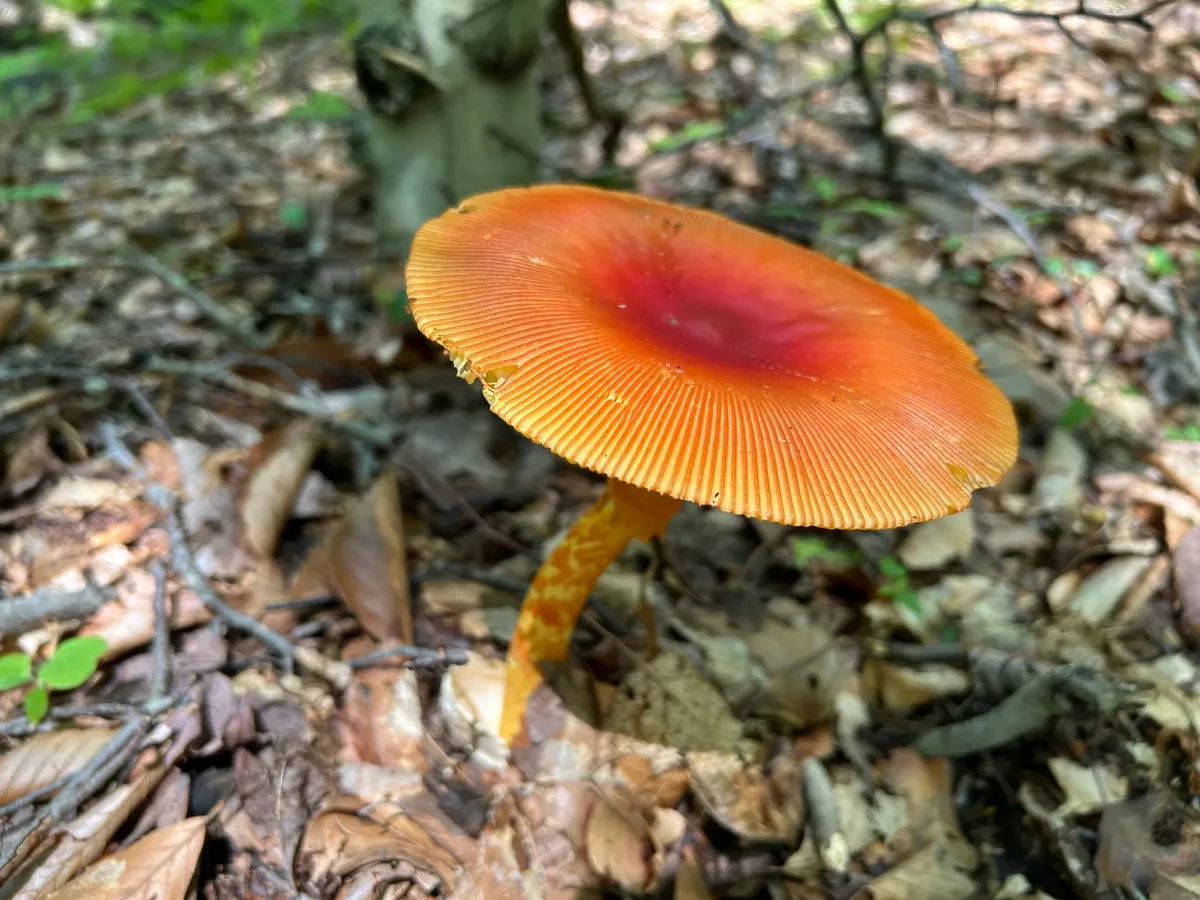
As it expands, the orange cap emerges from the torn veil base and broadens to 60-160 mm, bright scarlet-orange to orange-red, smooth and slightly shiny, with distinctly striate (grooved) margins.
Beneath it, the gills are a saturated chrome-yellow - free, crowded, and consistent from button to old age.
The stem matches: bright yellow, often 8-18 cm tall, carrying a large, pendant, skirt-like yellow ring that resembles a fancy ruffle.
At the base, the white sac-like volva - sometimes half-buried - anchors the stem and is the final confirming feature to check.
The overall three-colour palette of the mature mushroom - scarlet cap, yellow gills and stem, white volva - is unmistakable at full development and separates it immediately from every deadly Amanita sharing its forest.
Where & when it grows
Habitat
A mycorrhizal species of warm, humid deciduous woodland, Amanita jacksonii is quintessentially an oak-country mushroom.
Its underground mycelium intertwines with the fine root tips of oaks, beeches, and chestnuts in a partnership that both organisms depend on - the fungus delivers soil minerals and water, the tree provides sugars. This tight bond explains why productive spots reliably reappear near the same trees year after year.
It favours well-drained, mildly acidic soils under mature canopy and is most abundant in the Southeast, where hot, humid summers under open oak woodland make it a reliable summer find from the Carolinas to Texas. In the mid-Atlantic and New England states it thins out considerably.
When
The season runs from June through October in most of the range, with the heart of fruiting in July, August, and early September.
- In the Gulf states and Florida, fruitings can begin in late May after the first summer warmth.
- In New England and New York, the window narrows to July through mid-September.
The trigger is warmth plus water: a summer thunderstorm that delivers 20-30 mm of rain after a period of dry warm weather typically produces a flush 5-10 days later.
Look for eggs pushing up from the soil a few days after such an event, expanding to full glory within three to five days of emergence.
How it grows
Grows singly or in small loose groups, never in dense clusters.
Each fruit body begins as a subterranean egg formed within the universal veil. The first sign aboveground is a white or cream oval swelling in the leaf litter.
Over the following days the egg splits at the base and the scarlet cap emerges on its yellow stem. The full fruit body matures and collapses within a week; egg-stage specimens can be encountered alongside fully expanded and already decaying caps when conditions are right.
Because the mycelium persists for many years, finding one egg or one mature cap near a particular oak is a strong predictor of where to look in subsequent seasons - the mushroom is, in a very real sense, the annual expression of a much older underground organism.
Fruiting conditions
Warm-season mycorrhizal fruiter of eastern North American oak woodland. Flushes follow summer rainfall events (thunderstorms typical in the Southeast) when soil temperatures are firmly above 18 °C. Peak fruiting July-September; earlier in the Gulf states, later in New England. Productive spots near the same trees recur reliably in successive years.
Look-alikes
The egg stage is the greatest danger: the white egg of Amanita jacksonii is externally indistinguishable from the eggs of the eastern destroying angel (Amanita bisporigera) and related deadly white Amanitas that share its forest.
The mandatory field test at the egg stage is bisection: slice the egg cleanly from top to bottom through the centre.
- A. jacksonii shows a vivid orange-red cap outline inside.
- The destroying angel shows uniform white or pale undifferentiated flesh.
Never eat an uncut egg.
At maturity, the five-character combination - orange-red striate cap, yellow free gills, yellow stem, yellow pendant ring, white sac volva - is unique in eastern North America and not shared by any deadly species.
- Death cap (Amanita phalloides), introduced in the eastern states: greenish to olive-yellow cap, white gills, and a white ring, quite different in colouration.
- Spring egg mushroom (Amanita volvata): an inflated volva but no ring and white colouring.
- Amanita flavoconia (yellow patches): much smaller, with loose orange powder on the cap rather than a striate margin, and no yellow gills or sac-like volva.
- Jack-o'-lantern (Omphalotus illudens): the primary confusion at a distance - orange, but grows in clusters at tree bases or roots, has true gills (not yellow), no volva, no ring of this type, and no striate margin; it causes severe gastrointestinal poisoning.
Now established in the eastern United States (particularly the mid-Atlantic region), A. phalloides has a cap that ranges from pale greenish-yellow to olive-brown with radial fibres, white to pale gills (never yellow), a white to pale ring, and a prominent sac-like white volva. It lacks any of the orange colouration on the cap or the yellow gills and yellow stem of A. jacksonii. At the egg stage, the bisection test applies: the interior shows pale greenish or white, not orange-red. Contains amatoxins; responsible for the majority of fatal mushroom poisonings worldwide.
At the egg stage the eggs of A. bisporigera and A. jacksonii are externally indistinguishable - both are white smooth ovals in the leaf litter. Bisect any egg: A. jacksonii shows a vivid orange-red cap interior; A. bisporigera shows only white uniform flesh inside. At maturity A. bisporigera is entirely white from cap to gills to stem to ring to volva, with a shaggy stem, and contains lethal amatoxins. There is no orange colouration whatsoever. Fatal poisonings are well documented from this species in North America.
The yellow North American fly agaric has a yellow to yellow-orange cap covered in white to pale yellow warts (not a smooth, striate cap), white gills (not yellow), a white to pale stem, and a basal bulb with concentric volval ridges rather than a free white sac. Much more orange-yellow than scarlet, never with the clean three-colour signature of A. jacksonii. Contains ibotenic acid and muscimol; causes psychoactive toxicity and should not be consumed.
The European Caesar's mushroom is the closest relative of A. jacksonii and virtually identical in the five-character signature (orange-red striate cap, yellow gills, yellow stem, yellow pendant ring, white sac volva). A. caesarea is restricted to Europe and North Africa (under oaks and chestnuts in Mediterranean-type woodland) and does not occur in North America. The two species are taxonomically distinct but both choice edible. Confusing the two is not a safety concern - both are safely edible when correctly identified.
The eastern jack-o'-lantern is orange and might catch the eye from a distance in a similar habitat, but the differences are immediate on close inspection: it grows in dense clusters at the base of trees or from buried roots (never singly from a volva), has sharp true gills (not yellow and free - they may glow faintly in the dark), no volva, no sac at the base, no striate cap margin, and a much more uniform tangerine-orange lacking the scarlet cast of A. jacksonii. Causes severe gastrointestinal poisoning but is not lethal.
In the kitchen
Picking & cleaning
Only collect specimens where the full combination of five features can be confirmed:
- 1Scarlet-orange striate cap
- 2Bright yellow free gills
- 3Yellow stem with a yellow pendant ring
- 4White sac-like volva at the base
- 5Non-staining white flesh
Dig up the full base - never snap the stem at ground level - to expose and verify the volva.
Egg-stage specimens should only be collected if sliced in half to confirm the orange interior; any white-fleshed egg must be discarded.
- Carry specimens in an open basket to prevent crushing.
- Before cooking, lay each mushroom on a clean surface and verify all five features again.
- Discard any specimen where a feature is absent or ambiguous.
Cooking
American Caesar's Mushroom is a genuinely delicious, firm-fleshed edible with a mild, nutty flavour and a texture that holds up well to heat.
Trim and clean the caps - the stem is slightly tougher but perfectly edible.
- Sauté in butter or olive oil until golden; it pairs well with garlic, thyme, or a splash of white wine.
- Grill whole over charcoal, the scarlet cap holding its shape and developing a slight char that suits its character.
- Use in cream sauces, risotto, or pasta, contributing body and a mild earthiness.
As with all wild mushrooms (and as a sensible precaution with any Amanita), cook it thoroughly rather than serving it barely wilted. When trying it for the first time, start with a modest portion to check individual tolerance.
Good to know
Amanita jacksonii is a safe and choice edible with no known toxin, and is the closest North American ecological equivalent of the celebrated European Caesar's mushroom (Amanita caesarea).
However, it grows in the same forest as some of the world's most dangerous fungi, and the egg stage is morphologically identical to the eggs of the eastern destroying angel. There are documented fatalities in North America from collecting and eating egg-stage Amanitas without confirming the interior colouration.
The rules are absolute:
- Always excavate the full base to see the volva.
- Always bisect any egg before considering it.
- Never collect an Amanita in any stage of development if the identification is not completely certain.
When properly identified and well cooked, this mushroom is excellent - but the cost of a mistake is catastrophic.
A reference guide - never an edibility guarantee. When in doubt, leave it out.