Half-dyed slender Caesar
Amanita hemibaphasyn. Amanita hemibapha subsp. hemibapha, Amanitopsis hemibapha, Amanita caesarea var. hemibapha
 © Kim, Hyun-tae (CC BY)
 © Kim, Hyun-tae (CC BY 4.0)© Kim, Hyun-tae (CC BY)© Kim, Hyun-tae (CC BY 4.0)
Good to eat, once you have identified it with certainty and cooked it through.
Never eat a mushroom you are not 100% sure of - check the look-alikes below, and always cook wild mushrooms.
How to recognise it
Amanita hemibapha begins its life completely hidden - a smooth white to cream ovoid egg, 30-60 mm tall, sitting in the soil as if placed there.
Cap
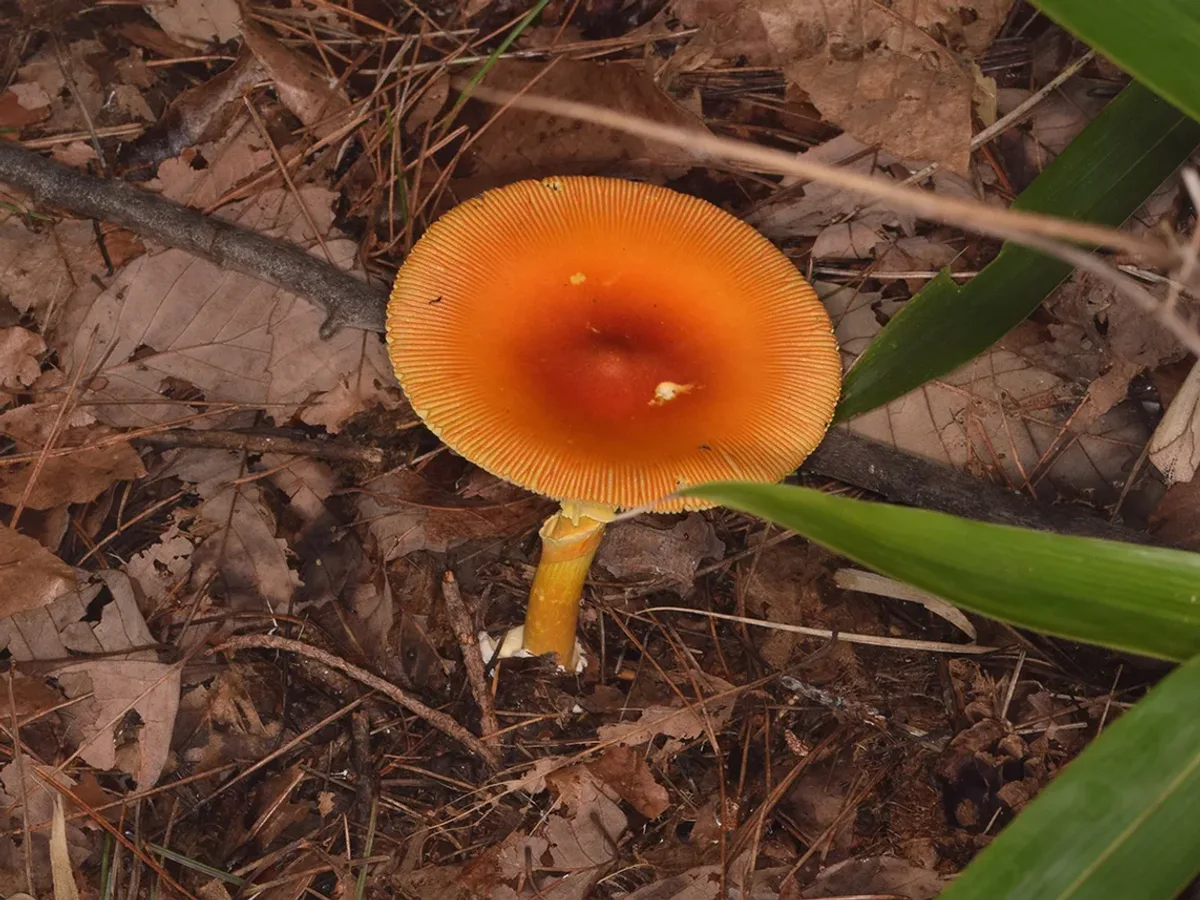
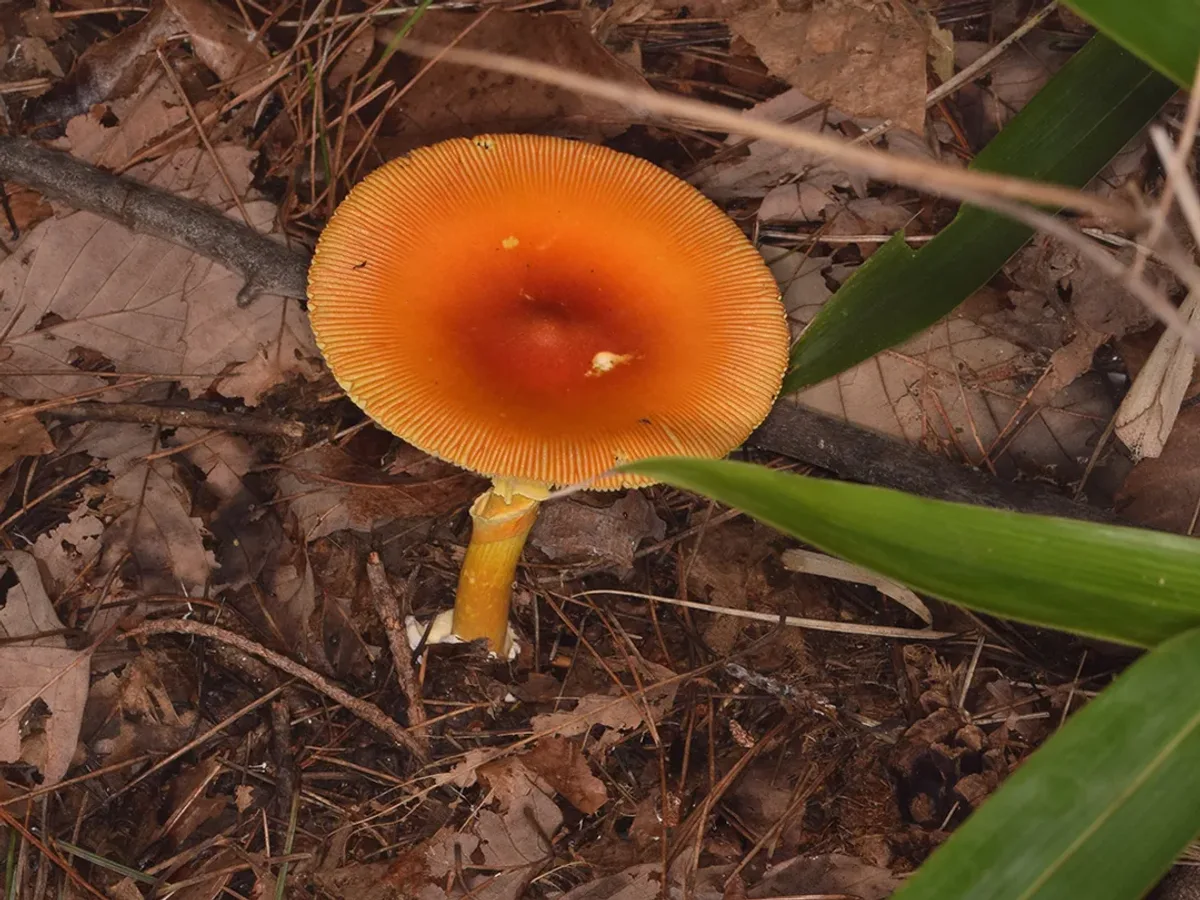
When warmth and moisture arrive, the veil splits and a vivid orange-red to scarlet cap pushes out and expands to 50-150 mm across, eventually settling nearly flat with a subtle broad umbo. The cap margin is distinctly striate, lined with 10-20 short grooves that give the edge a fine, pleated look.
Gills
Beneath the cap, the gills are free, crowded, and bright yellow - a crucial detail that separates this species from the deadly white-gilled Amanita species sharing the same forests.
Stem
The stem reaches 80-200 mm and is notably slender for its cap size (the origin of the name 'slender Caesar'), yellow to orange-yellow, carrying a pendant membranous ring of the same warm colour. Excavate the base carefully: a thick white sac-like volva is usually buried there, and confirming it is essential.
Flesh
Flesh is white to pale yellow, pleasant in odour, mild in taste.
At full maturity the three-colour signature - orange-red striate cap, yellow gills, yellow-orange stem and ring, white volva - is unmistakable.
Where & when it grows
Habitat
A mycorrhizal forest species of warm-temperate and subtropical broadleaf woodland throughout East and Southeast Asia. Most commonly found with Fagaceae (oaks, chestnuts, chinquapins, and stone oaks) on well-drained acidic soils.
It appears along forest margins, on hillsides, and in mixed secondary forest where appropriate host trees are present.
In Japan it is known as tamagotake ('egg mushroom') and is a beloved summer find in warm broadleaf woodland; in Yunnan Province, China, it is sold in markets.
The wide host range and warm-season fruiting pattern mean it can appear wherever the right combination of tree partner, monsoon moisture, and high summer soil temperatures align.
When
Summer to early autumn in most of the range, broadly June-October in the Northern Hemisphere, peaking July-September when monsoon rains and high soil temperatures coincide.
In tropical parts of Southeast Asia fruiting can extend more broadly through the warm wet season.
It is a characteristic July-August summer mushroom in Japan and Korea, and a monsoon-season fungus in much of mainland Southeast Asia and China.
How it grows
Grows singly or in small scattered groups, never in dense clusters. Each fruit body emerges from a buried volva, pushing through the soil first as a white egg before expanding.
Because the volva is often deeply buried, a mushroom can appear to rise from bare soil with no obvious anchor. Always excavate the base gently rather than pulling, to expose and confirm the sac below.
Beneath the surface, the mycelium has been quietly maintaining its partnership with the roots of oaks and chestnuts, sometimes for many years.
That long-running underground relationship is why productive spots recur reliably near the same trees season after season - once you find the right tree and the right conditions, the eggs have a way of reappearing.
Fruiting conditions
Warm-season mycorrhizal fruiter; flushes follow substantial rainfall (monsoon or summer rain events) when soil temperatures are 18-30 °C. Peak fruiting July-September in temperate East Asia; broader wet-season window in tropical Southeast Asia.
Look-alikes
The egg stage is the critical identification challenge: the smooth white ovoid egg is externally indistinguishable from the eggs of deadly Amanita species.
Cutting the egg in half reveals the orange-red outline of the future cap in A. hemibapha - deadly Amanita eggs show white or yellowish-green undifferentiated flesh without orange colouring.
At maturity, the combination of orange-red striate cap, yellow gills, and yellow-orange ring is unmistakable among fully expanded specimens.
Deadly species to separate:
- Amanita phalloides - greenish-yellow to olive cap and white gills
- Amanita virosa - entirely white
- Amanita exitialis - a lethal Chinese species, white
Similar edible species:
- Amanita caesarea (European Caesar's mushroom) - the closest relative; more robust, with a deeper orange cap, and restricted to Europe and North Africa
- Amanita jacksonii - a similar edible species in Central America and the Caribbean, with a distinct range
The egg stage of A. phalloides is externally indistinguishable from A. hemibapha eggs - both are smooth white ovals. Slicing an A. phalloides egg through the centre reveals undifferentiated yellowish-green or white flesh with no orange primordium; A. hemibapha shows an orange-red cap outline inside. At maturity A. phalloides has a greenish-yellow to pale olive-brown cap with radial fibres, white gills (not yellow), and a white to pale ring - quite unlike A. hemibapha's orange-red cap and yellow gills. Both have a sac-like volva. Never collect white Amanita eggs without cutting to confirm the orange cap interior.
Amanita virosa is entirely white at all stages: white conical to broadly convex cap, white gills, white stem with a shaggy-cottony texture, and a white ring. It completely lacks orange or yellow colouring. Confusion is only possible in the egg stage. Found in cooler montane habitats in Asia where A. hemibapha also occurs at higher elevations. Any white egg in mountain forest must not be consumed without cutting to confirm an orange interior.
Amanita exitialis is a lethal amatoxin-containing species distributed in southern China (especially Guangdong) and potentially broader Southeast Asia. Its eggs are white and superficially similar to A. hemibapha eggs at the same stage. At maturity the cap is white to pale, gills are white - entirely lacking the orange-red cap and yellow gills of A. hemibapha. Fatal mass poisonings attributed to A. exitialis have occurred in Guangdong Province. The co-occurrence in subtropical Chinese and Southeast Asian forests where both might be collected makes this distinction critical.
The European Caesar's mushroom is the closest relative of A. hemibapha and is also choice edible. It is generally more robust with a deeper, more uniformly rich orange cap, a thicker and less slender stem, and is restricted to southern Europe and North Africa under oaks and chestnuts. A. hemibapha is the Asian ecological equivalent: slightly more slender, with a brighter to slightly more scarlet-orange cap, distributed across East and Southeast Asia. Confusing the two is not toxicologically significant since both are edible.
Volvariella volvacea also has a volva and at the egg stage produces a white to light brown oval. It completely lacks a ring on the stem at any stage; at maturity the cap is grey-brown to dark smoky grey (never orange-red), gills turn pink with maturity, and the spore print is pinkish-brown. Found in agricultural settings on decaying rice straw and compost - not in forest under trees. The egg-stage comparison is important because harvesters of paddy straw mushrooms and of A. hemibapha operate in overlapping regions of Asia; the critical rule is never to harvest any white egg from forest soil under trees without cutting it open first.
In the kitchen
Picking & cleaning
Only collect mature, fully-expanded specimens where all five characters are clearly visible and confirmed:
- Orange-red cap
- Yellow gills
- Yellow-orange stem
- Yellow-orange pendant ring
- White sac-like volva
Never collect egg-stage specimens - they are indistinguishable in the field from eggs of deadly Amanita species including Amanita phalloides, Amanita exitialis, and Amanita virosa, all of which co-occur in Southeast Asian and East Asian forests.
Carefully excavate the base to confirm the sac-like white volva; do not snap the stem at soil level. Carry specimens in a basket to preserve them intact, and re-examine each specimen at home before cooking.
If any character cannot be confirmed, do not eat the specimen.
Cooking
Amanita hemibapha is a genuinely prized edible across East and Southeast Asia, not just tolerated but sought out.
In Japan the tamagotake is a celebrated summer delicacy:
- Sautéed in butter
- Floated in clear soups
- Cooked simply in rice
In Yunnan it appears on market stalls alongside other cherished wild mushrooms. The flavour is mild, slightly sweet, and pleasant, with a firm texture that holds up well to heat.
Cook it through rather than eating it raw, a sensible precaution with any Amanita. As with any newly tried wild mushroom, start with a moderate amount to test individual tolerance.
Good to know
Amanita hemibapha is a well-established edible species widely and safely consumed across East and Southeast Asia, particularly in Japan, China, and Southeast Asian countries.
However, the most serious danger is collecting specimens before full expansion - the egg stage is externally identical to the eggs of several deadly Amanita species. Fatal poisonings have occurred in Southeast Asia and China when foragers collected eggs of deadly species believing them to be edible tamagotake or related egg-stage mushrooms.
Rule: never collect a white Amanita egg in an Asian forest unless you cut it open and confirm an orange-red cap primordium inside.
Only collect fully expanded specimens with all five characters confirmed:
- Orange-red striate cap
- Yellow free gills
- Yellow-orange pendant ring
- Yellow-orange slender stem
- White sac-like volva at the base
A reference guide - never an edibility guarantee. When in doubt, leave it out.