Concentric-Veil Amanita
Amanita concentrica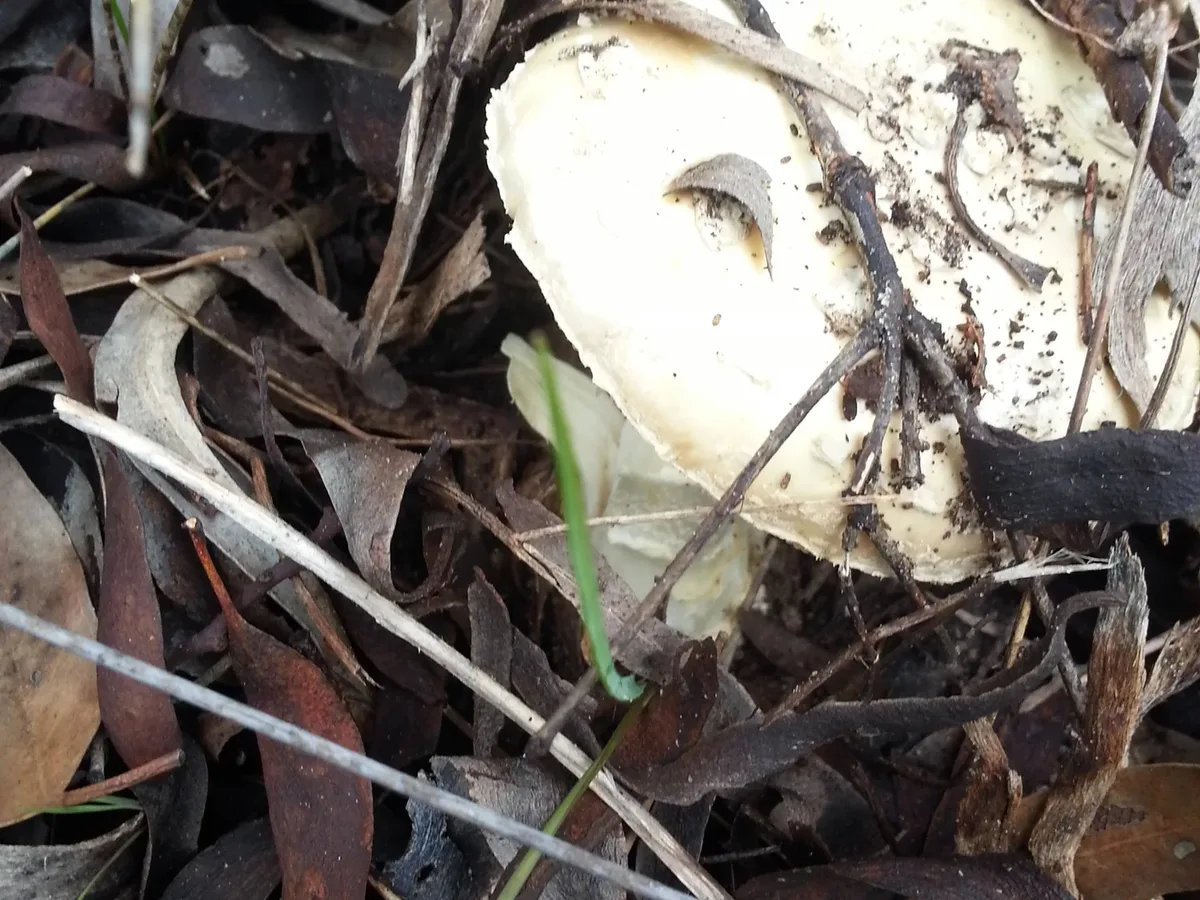 Atlas of Living Australia (CC0)
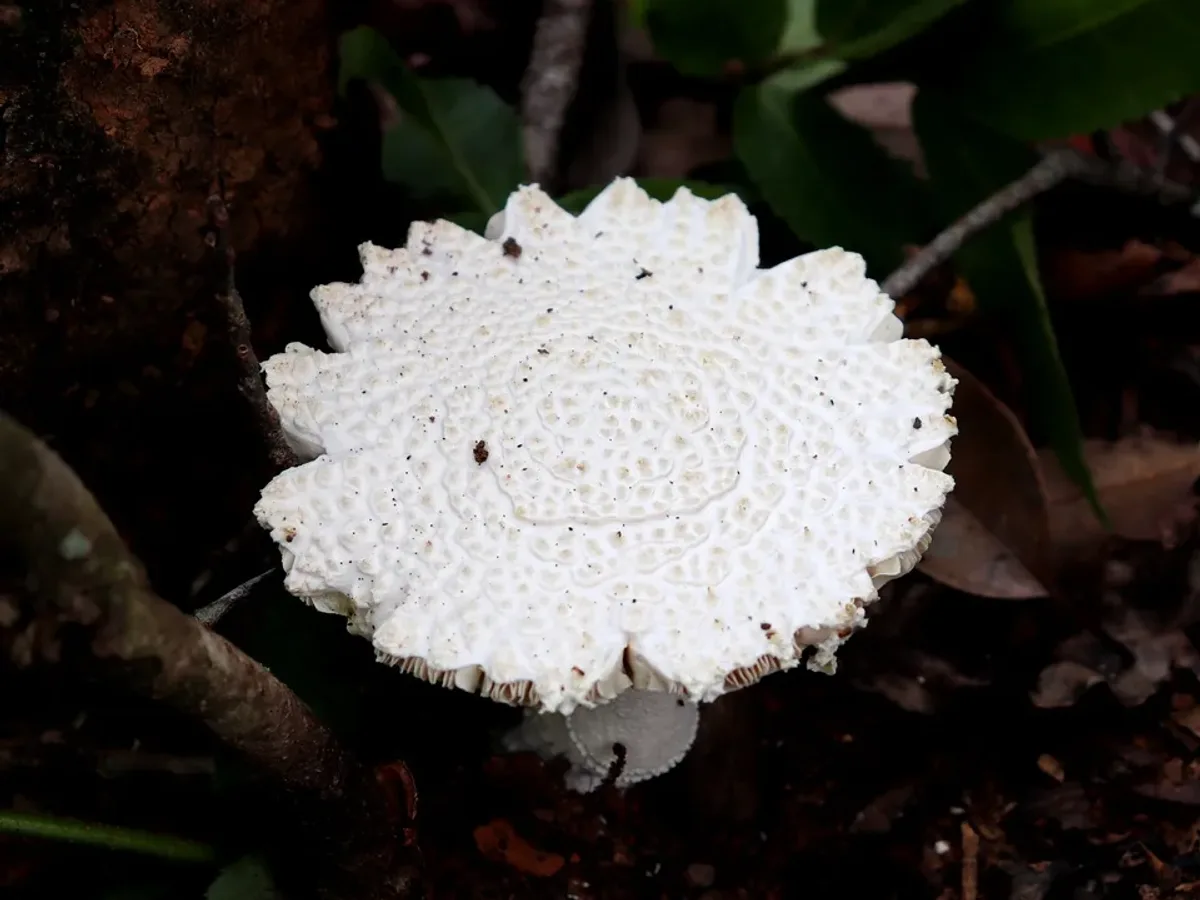 © Vihane (CC BY-SA)
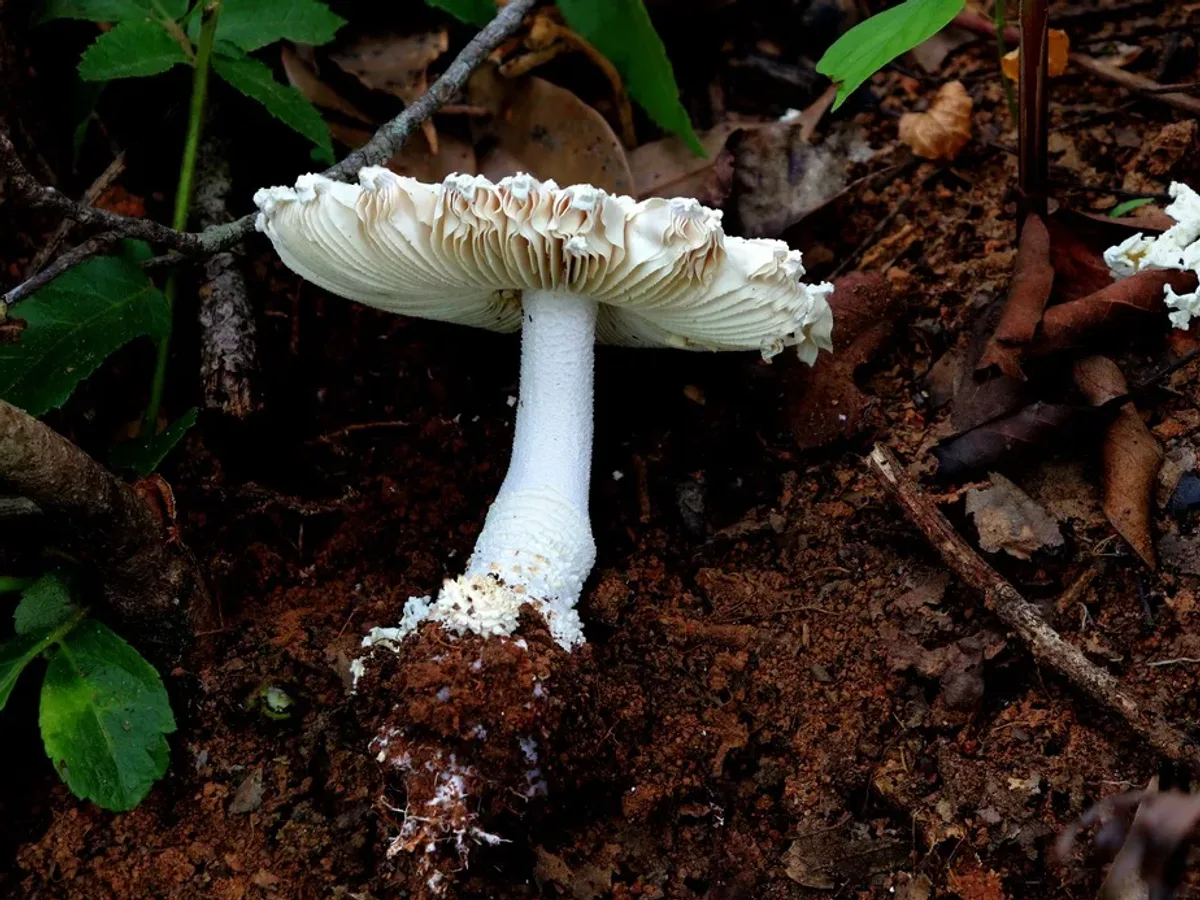 © Vihane (CC BY-SA)Atlas of Living Australia (CC0)© Vihane (CC BY-SA)
Toxic - and the most serious cases can be fatal. Never eat it, and wash your hands after handling.
Never eat a mushroom you are not 100% sure of - check the look-alikes below, and always cook wild mushrooms.
How to recognise it
Amanita concentrica is a medium to fairly large, entirely white or pale ivory mushroom, with a characteristic feature that sets it apart from most of its deadly relatives.
Cap
The universal veil - the tissue that wraps the entire young fruit body - breaks apart across the cap surface in concentric rings or zones rather than as scattered random warts. This gives the cap a faintly tiered or banded appearance, as if the surface had been ringed like a target; on fresh, dry specimens, these pale rings of soft granular scale material can be unmistakable.
As the mushroom ages or becomes wet, however, the concentric patterning wears away, leaving the cap smooth, clean white, and utterly unremarkable - a surface that offers no warning whatsoever of the toxins inside.
The cap begins as a broad oval, 50-110 mm across, and opens out to nearly flat with age.
Gills
Gills are crowded, free from the stem, and white throughout life, yielding a white spore print.
Stem
The stem (60-140 mm) is white and solid, widening toward a distinctly swollen or bulbous base. Critically: a membranous white ring hangs from the upper stem, and at the base of the stem sits a white sac-like volva, often buried in the soil.
This triad - white gills, pendant ring, and basal volva - places this species firmly in the most dangerous section of the most dangerous fungal genus known.
Why it's dangerous
Amanita concentrica is a confirmed lethal amatoxin species occurring in East Asian forests where active mushroom foraging is a widespread traditional practice.
Its white appearance - unremarkable, clean, and entirely un-threatening after the concentric velar zones are washed away - removes the visual cues that might otherwise alert an inexperienced forager.
In Japan and China, multiple edible white-capped mushrooms are gathered seasonally, and market-bought mushrooms reinforce the idea that white mushrooms are benign. The risk of confusion is real.
The species must not be tasted or eaten under any circumstances.
Rule: in East Asian and Southeast Asian forest, any white mushroom with both a ring and a volva at the stem base must be treated as a potential amatoxin source and left well alone.
Toxin
Amanita concentrica has been confirmed to contain amatoxins, principally alpha-amanitin.
Alpha-amanitin is a cyclic octapeptide - a small, ring-shaped protein-like molecule - that fits with extraordinary precision into the active site of RNA polymerase II, the enzyme responsible in all eukaryotic cells for reading DNA and transcribing it into messenger RNA. By blocking this enzyme irreversibly, alpha-amanitin halts the continuous protein synthesis that living cells require to maintain themselves.
Hepatocytes (liver cells) and renal tubular epithelial cells (kidney) are most sensitive because of their high protein-synthesis demands and efficient uptake of the toxin.
The lethal dose in humans is estimated at approximately 0.1 mg of alpha-amanitin per kilogram of body weight - a figure that a single medium-sized fruit body may easily exceed.
A particularly insidious pharmacokinetic feature is enterohepatic recycling: amatoxins are excreted in bile, reabsorbed by the intestine, and recirculated to the liver, prolonging toxic exposure well beyond the time the mushroom material itself has been digested. This is why inducing vomiting after the fact does little to prevent liver damage.
Symptoms
Amatoxin poisoning from Amanita concentrica follows the same three-phase clinical course as all amatoxin-containing species.
- 1Phase 1 - Latent phase: no symptoms for 6 to 24 hours (occasionally up to 48 hours) after ingestion. During this phase the toxin is being absorbed and RNA polymerase II in liver and kidney cells is already being inhibited, but the cell death is not yet clinically apparent. This latency is the most dangerous feature: patients and bystanders believe nothing is wrong.
- 2Phase 2 - Gastrointestinal phase: sudden onset of severe colicky abdominal pain, profuse and often watery diarrhoea (sometimes with blood), nausea, and intractable vomiting, typically beginning 6-24 hours after ingestion and continuing for 1-3 days. Severe dehydration and electrolyte disturbance occur and may be life-threatening in themselves.
- 3Phase 3 - Hepatorenal failure: following a deceptive period of apparent improvement at 24-72 hours, progressive liver and kidney failure develops. Jaundice, clotting failure (with bleeding from mucosal surfaces), rising liver enzymes, encephalopathy, confusion, then coma, and cessation of urine production follow in series.
Death from multi-organ failure typically occurs 4-10 days after ingestion in untreated or inadequately treated cases.
Even with aggressive modern medical care including intravenous silibinin, N-acetylcysteine, and early consideration of liver transplantation, serious amatoxin poisoning carries meaningful mortality.
Staying safe
Amanita concentrica belongs to the amatoxin-producing members of Amanita, the single deadliest group of fungi in the world. Amatoxins have been confirmed in this species.
There is no antidote to amatoxin poisoning.
The defining danger of this species - shared with all amatoxin Amanitas - is that a person who eats it will typically:
- feel well for the first 6-24 hours after ingestion;
- feel suddenly ill with violent gastrointestinal symptoms;
- then seem to improve briefly before suffering rapid and potentially irreversible liver and kidney failure.
By the time the full picture is clear, the window for the most effective interventions may have passed.
If you have any reason to believe you or another person has eaten this species, do not wait for symptoms to appear - go directly to emergency hospital care and state clearly that Amanita poisoning is suspected.
The characteristic clean-white, harmless-looking appearance - especially once the concentric wart-zones have been eroded by rain - means this mushroom will not look dangerous to anyone who encounters it without prior knowledge of Amanita toxicology.
Where & when it grows
Habitat
This species lives as an ectomycorrhizal partner of broadleaved forest trees, principally members of the oak family (Fagaceae), in Japan and the broader subtropical and warm-temperate zone of East Asia.
The underground mycelium forms an intimate exchange network with the fine roots of oaks, chestnuts, chinquapins, and stone oaks, passing minerals and water to the tree in exchange for photosynthetically fixed carbon - a symbiosis that can persist silently for years without producing a single above-ground fruit body, then respond rapidly to the right combination of warmth and rain.
Look on well-drained, slightly acidic mineral soils in forest interiors and along edges, often where foot-traffic paths run through or beside oaks and mixed deciduous-conifer woodland.
In Japan it is found in the lowland and low-mountain belt where summer temperatures are high and monsoon rains are reliable. In subtropical China and Southeast Asia the habitat shifts to evergreen and semi-evergreen broadleaf forest at moderate elevations.
When
Like most mycorrhizal Amanitas of the warm-temperate zone, this species fruits in the Northern Hemisphere summer through early autumn - broadly June to October, with the main flush concentrated in July-September when monsoon or seasonal rains combine with high soil temperatures.
Individual fruit bodies push up within days of substantial rainfall events once the soil is warm (above 18 °C), then decay rapidly in the summer heat.
Because its fruiting season overlaps almost exactly with the period when foragers are most active in East Asian forests collecting summer mushrooms, identification accuracy here has direct safety consequences.
How it grows
Grows singly or in small loose groups, not in clusters.
Like all Amanitas, the fruit body begins as an underground 'egg' - a rounded white structure where the entire developing mushroom is enclosed within the universal veil.
As it elongates and the cap expands, the universal veil tears across the cap surface, leaving those concentric velar remnants, while the base of the veil remains at the stem base as the volva.
The stem then elongates and the ring develops from the partial veil that was draped across the gills.
Always excavate the soil carefully around the base of any suspected specimen: the volva is often largely buried, and confirming it is present is essential. Never snap a stem at soil level when identifying Amanitas.
Fruiting conditions
Warm-season mycorrhizal fruiter; flushes follow substantial rainfall (monsoon or late-summer rain events) when soil temperatures are sustained at 18-28 °C. Peak fruiting July-September in the warm-temperate zone of Japan and subtropical East Asia.
Look-alikes
The most serious lookalike risk is confusion with other edible or presumed-edible white-capped mushrooms collected in the same East Asian forests.
- The edible horse mushroom (Agaricus arvensis) and button mushroom (Agaricus bisporus) have gills that are pink when young, turning chocolate-brown, and a brown-black spore print - they completely lack a volva.
- The paddy straw mushroom (Volvariella volvacea) has a volva but no ring, pink gills at maturity, and a pink spore print.
Most importantly: in the young egg stage, Amanita concentrica is externally indistinguishable from other white Amanita eggs, including the deadly Amanita phalloides (death cap), A. virosa (destroying angel), A. exitialis, and A. suballiacea.
Among other white Amanitas with ring and volva, Amanita concentrica is separated primarily by the concentric arrangement of velar remnants on the cap when these are present - but this character is insufficient when specimens are wet or old.
The ring, volva, white gills, and white spore print identify the genus; only expert mycological examination determines the species.
Any all-white mushroom with ring and volva in East Asian forest must be treated as potentially lethal.
The death cap shares ring, volva, white free gills, and white spore print with A. concentrica; typical A. phalloides has a greenish-yellow to pale olive-brown cap with faint radial fibres and lacks the concentric wart-zones of A. concentrica. White-form death caps are effectively indistinguishable macroscopically. Both are deadly amatoxin species - the distinction is academic from a safety standpoint but relevant for documentation. A. phalloides is also present in East Asian forests, primarily associated with introduced exotic oaks.
Pure white throughout with a more conical cap that rarely fully flattens, a strongly pendant or grooved ring, and a firm white volva. Found in cooler boreal and montane forests. Both species are white with ring and volva and are equally lethal amatoxin Amanitas. Cannot be safely distinguished in the field without expert examination and often molecular confirmation.
A lethal amatoxin species documented primarily in southern China (Guangdong and adjacent provinces), responsible for mass poisoning incidents. White to pale throughout; at maturity the cap becomes almost plane. Like A. concentrica, it has a white membranous ring and a white sac-like volva. Field separation between the two species is not reliably possible without microscopy; both are lethal and must be avoided in any form.
Agaricus species are superficially white when young but have pink gills at the button stage that turn chocolate-brown to near-black with age, and produce a dark brown-black spore print. Critically, they have no sac-like volva at the stem base. The gills-never-white-throughout and no-volva combination reliably rules out lethal Amanita species.
Has a prominent volva and produces white-to-grey eggs in its early stage, but at maturity has NO ring on the stem, gills that turn pink to salmon, and a pinkish-brown spore print. Grows on compost, rice straw, or decaying wood - not in forest soil under trees. The absence of a ring and the pink mature gills are reliable distinguishing features. Fatal confusion in Asia has resulted from harvesting Amanita eggs - including those of lethal species - in the belief they were paddy straw mushroom eggs.
Amanita pantherina has a brown to grey-brown cap with scattered white warts and a white volva that typically forms one or more concentric rim-like ridges at the stem base rather than a sac. It is toxic (ibotenic acid and muscimol) but generally not lethal in adults unless large quantities are consumed. The brown cap colour and non-saccate volva with basal rim reliably distinguish it from A. concentrica.
A reference guide - never an edibility guarantee. When in doubt, leave it out.