Chatamagotake
Amanita chatamagotakesyn. Amanita hemibapha var. chatamagotake
 © Garry Lydon (CC BY)
 © Garry Lydon (CC BY)
 © Garry Lydon (CC BY)© Garry Lydon (CC BY)© Garry Lydon (CC BY)
Good to eat, once you have identified it with certainty and cooked it through.
Never eat a mushroom you are not 100% sure of - check the look-alikes below, and always cook wild mushrooms.
How to recognise it
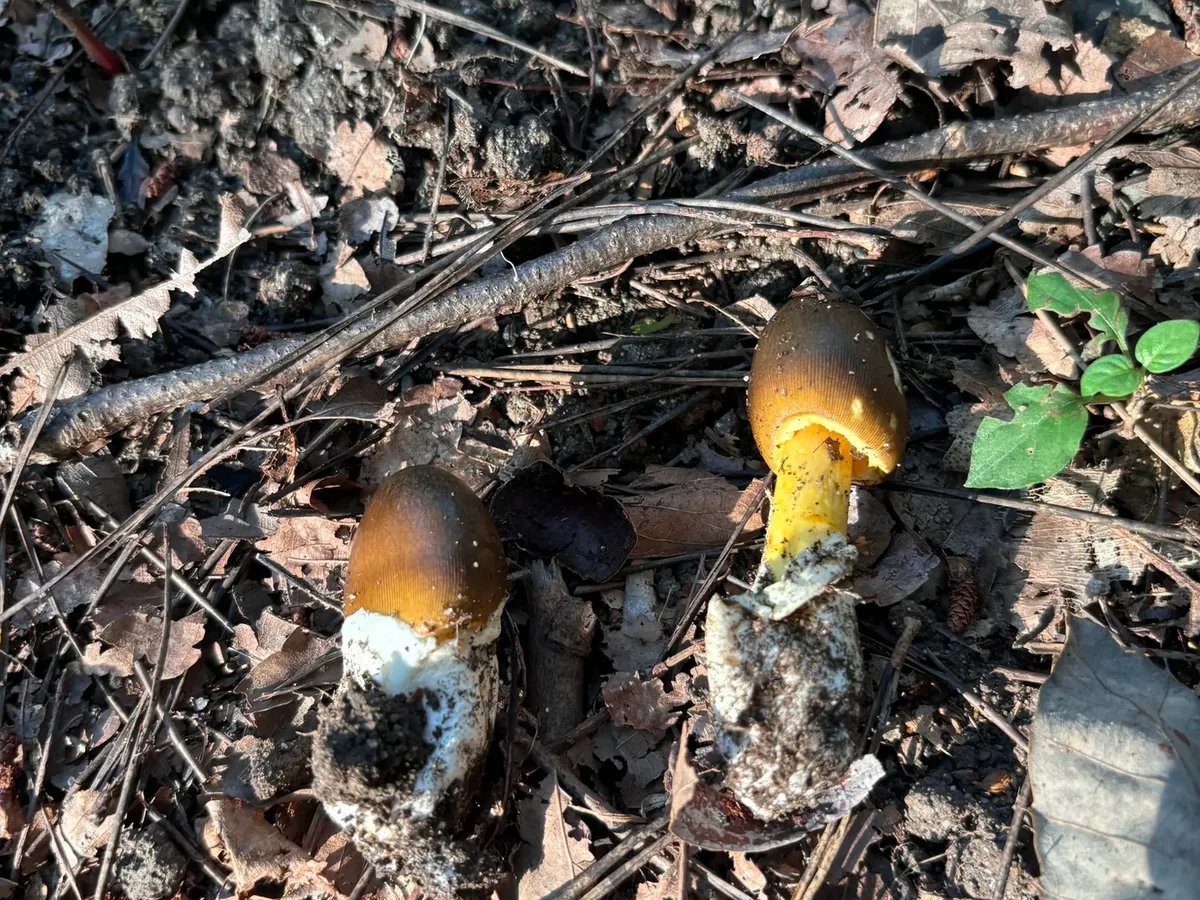
Amanita chatamagotake shares the life history of all Caesar-group amanitas. It begins as a smooth white to cream ovoid egg, 30-60 mm tall, sitting in the leaf litter or mineral soil before warmth and rain trigger expansion.
Cap
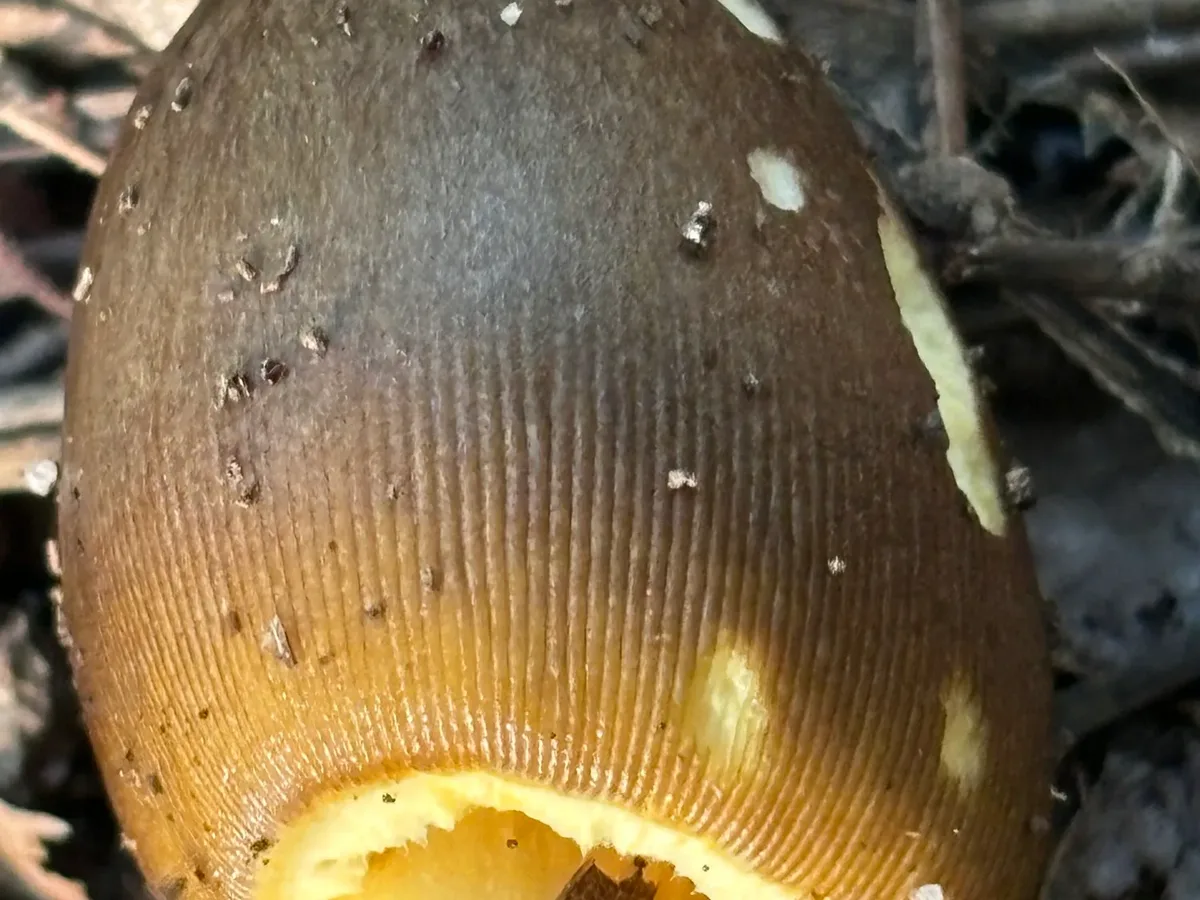
As the veil splits, the cap pushes out and broadens to 50-130 mm, eventually settling nearly flat with a subtle broad umbo.
The critical character that gives this species its Japanese name - 'cha' meaning tea-coloured or brown - is the cap colour: brown to reddish-brown or chestnut-brown at the centre, fading to tawny-ochre toward the striate margin.
This brownish colouration separates it immediately from Amanita hemibapha, whose cap is vivid orange-red to scarlet.
Gills
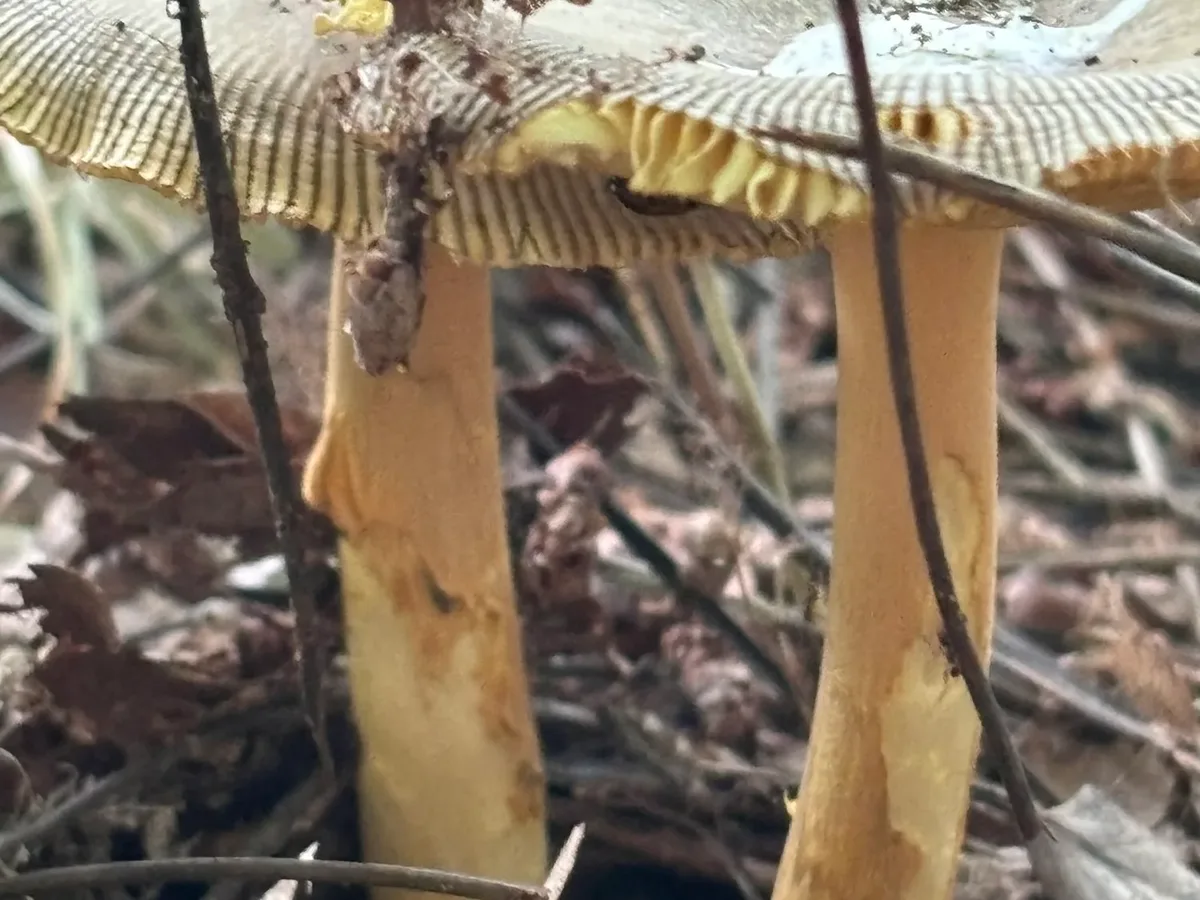
The gills are free, crowded, and pale yellow - a crucial feature distinguishing any Caesar-group Amanita from the deadly white-gilled species that share the same forest.
Stem
The stem, 80-180 mm, is pale yellow to yellow-orange and carries a pendant, membranous ring of similar colour.
Excavating the base is mandatory for any positive identification: a thick white sac-like volva is present, usually partially buried.
Flesh
Flesh is white to pale yellow, firm, with a mild pleasant odour.
The overall combination - brown striate cap, pale yellow gills, yellow to pale yellow-orange stem and ring, white volva - is distinctive among expanded specimens.
Where & when it grows
Habitat
An ectomycorrhizal species of warm-temperate and subtropical broadleaved woodland, principally associated with the Fagaceae family.
In Japan it is most commonly encountered in mixed oak, chestnut, and chinquapin forest at low to mid elevations on Honshu, Shikoku, and Kyushu, growing on well-drained, mildly acidic mineral soils in the forest interior or along shaded margins.
Its range and habitat closely overlap with Amanita hemibapha, and the two species may co-occur under the same trees.
Like all Caesar-group Amanitas, it depends entirely on living tree roots rather than dead organic matter, which is why it appears in the same patches year after year near the same host trees - the underground mycorrhizal network is perennial even when above-ground fruit bodies are absent.
Productive spots near specific oaks or chestnuts are reliable season after season once found.
When
The fruiting season runs June-October in Japan and South Korea, peaking during and after the summer monsoon period in July and August.
The combination of high soil temperatures (18-28 °C) and substantial monsoon or summer rainfall drives flushing. Individual fruit bodies appear quickly after heavy rain events, and the season's peak often follows the end of the tsuyu (rainy season) in late June or July.
By October, cooling temperatures bring the season to a close. In the warmer southern Japanese islands and the subtropical parts of its range, the fruiting window may extend slightly longer through warm wet periods.
How it grows
Grows singly or in small scattered groups, never in dense clusters.
Each fruit body develops from a buried white volva and first appears at the surface as a white oval egg - a stage that all Caesar-group Amanitas share with several deadly species.
The mycelium forms a long-running underground partnership with its host trees, threading through the mineral soil and exchanging mineral nutrients for photosynthate. This relationship is why a productive site near a specific oak or chestnut tree tends to produce fruit bodies reliably for many seasons.
When you find a healthy specimen, note the tree association carefully: that information is as important as the mushroom itself for building a reliable mental map of a foraging spot.
Fruiting conditions
Warm-season mycorrhizal fruiter. Flushes follow substantial rainfall - monsoon rain events or summer thunderstorm precipitation - when soil temperatures are sustained at 18-28 °C. Peak fruiting July-September in Japan and Korea; aligns with and follows the tsuyu rainy season. Individual fruit bodies emerge rapidly after trigger rainfall, completing development within days.
Look-alikes
The most critical identification challenge is the egg stage: the smooth white oval egg is externally indistinguishable from the eggs of amatoxin-containing Amanita species.
The only safe field check is cutting the egg vertically through the centre to reveal the cap primordium inside - A. chatamagotake should show a brownish outline, while deadly A. phalloides eggs reveal yellowish-green to white undifferentiated tissue. Even this cut-egg check is unreliable for confident species-level ID and should not be used as the basis for eating any egg.
Among expanded specimens, the closest visual relative is Amanita hemibapha: that species has an orange-red to scarlet cap rather than the brown or reddish-brown of A. chatamagotake, but both have pale yellow gills, a yellow-orange ring, and a white volva. Both are edible, so confusion between them is not toxicologically significant.
Deadly species - Amanita phalloides, Amanita exitialis, Amanita virosa - have white gills and are entirely different in colour at maturity, making them easy to separate from expanded A. chatamagotake if field characters are systematically checked.
At the egg stage, A. phalloides eggs are smooth white ovals externally identical to A. chatamagotake eggs - fatal confusion is possible. Slicing an A. phalloides egg through the centre reveals undifferentiated yellowish-green or white flesh without a brownish or orange cap primordium. At maturity, A. phalloides has a pale greenish-yellow to olive cap with radial fibres, white gills (not pale yellow), and a white to cream ring - very different from the brown cap and yellow gills of A. chatamagotake. Both have a white sac-like volva. Never collect white Amanita eggs from forest soil without cutting them to check the interior.
Amanita virosa is entirely white at all stages: white conical cap, white gills, white stem with cottony texture, white ring. At maturity it is easily separated from A. chatamagotake by the brown cap and yellow gills of the latter. However, in the egg stage, both produce a smooth white oval. Occurs at higher elevations and cooler montane forest zones in Japan and parts of mainland East Asia, sometimes overlapping with A. chatamagotake habitat.
Amanita exitialis is a deadly amatoxin-bearing species of southern China and potentially broader East and Southeast Asian subtropical forest. Its eggs are smooth white ovals indistinguishable from A. chatamagotake eggs at that stage. At maturity the cap is pure white to pale white, gills are white - entirely unlike A. chatamagotake's brown cap and yellow gills. Fatal mass poisonings in Guangdong Province have been attributed to this species. The co-occurrence in subtropical Asian oak and chestnut woodland makes egg-stage confusion a real risk.
The closest relative of A. chatamagotake and co-occurring across much of Japan and East Asia. Amanita hemibapha has a vivid orange-red to scarlet cap, whereas A. chatamagotake has a brown to reddish-brown or chestnut-brown cap. Both have pale yellow gills, a yellow to yellow-orange pendant ring, and a white sac-like volva. Both are edible, so confusing them is not a safety risk - the difference is academic from a poisoning standpoint. Distinguishing the two reliably requires a fully expanded, mature specimen.
Also has a sac-like volva and at the egg stage produces a white to pale brown oval egg - visually similar to A. chatamagotake in the egg stage. Critically, it completely lacks a ring on the stem at any stage; at maturity, gills turn pink to salmon and the spore print is pink, not white. Grows on decaying rice straw, compost, and agricultural organic matter rather than in forest soil under trees. These ecological and morphological differences reliably distinguish it from A. chatamagotake, but the egg-stage risk in agricultural-edge or mixed-habitat situations (where paddy straw mushroom harvesters work near woodland) is real and has caused fatalities when eggs of deadly Amanita species were collected by mistake.
In the kitchen
Picking & cleaning
Only ever collect fully expanded specimens of Amanita chatamagotake, where the brown striate cap, pale yellow gills, yellow to pale yellow-orange pendant ring, and white sac-like volva are all clearly confirmed.
The egg stage is absolutely off-limits for harvesting: at that stage, A. chatamagotake eggs are externally indistinguishable from eggs of deadly Amanita species including Amanita phalloides, Amanita exitialis, and Amanita virosa.
Fatal poisonings in Japan and across East Asia have resulted from collecting white Amanita eggs without making this verification. If you must cut an egg to check, look for a brownish outline of the cap primordium inside - but identifying the species from the egg alone is not reliable enough to justify collection.
- Always dig gently at the base rather than snapping the stem at soil level, so the volva is preserved for examination.
- Carry specimens in a basket rather than a bag to avoid crushing.
- Re-examine every specimen at home before cooking.
If any character is unclear or the full diagnostic set cannot be confirmed, do not eat the specimen.
Cooking
Amanita chatamagotake is a prized edible in Japan, appreciated for its mild, pleasant flavour and firm, satisfying texture.
It is most often cooked simply - sautéed in butter or oil, added to soups, or cooked with rice - in ways that let the flavour come through without masking it.
As with Amanita hemibapha and all Caesar-group Amanitas, cooking thoroughly before eating is strongly recommended. As with any wild mushroom being tried for the first time, start with a modest portion to test individual tolerance. Avoid consuming raw.
Good to know
Amanita chatamagotake is a well-regarded edible species consumed in Japan and is not known to contain toxins.
However, its most serious danger is the egg stage: before expansion, the white oval egg is visually identical to the eggs of deadly amatoxin-containing Amanita species that fruit in the same habitats and season.
Fatal mushroom poisonings in Japan and East Asia involving Caesar-group Amanita species typically trace back to collection of unidentified white eggs from forest floor.
The rule is absolute: never collect a white Amanita egg in woodland unless you cut it open and confirm a brownish or orange-tinged cap primordium inside - and even then, egg-stage identification is not safe enough to guarantee edibility without seeing the fully expanded fruit body.
Only collect mature, fully expanded specimens with all five characters confirmed:
- brownish striate cap
- pale yellow free gills
- pendant yellow-toned ring
- pale yellow stem
- white sac-like basal volva
A reference guide - never an edibility guarantee. When in doubt, leave it out.