Southeast Asian Caesar's mushroom
Amanita caesareoidessyn. Amanita caesarea var. caesareoides
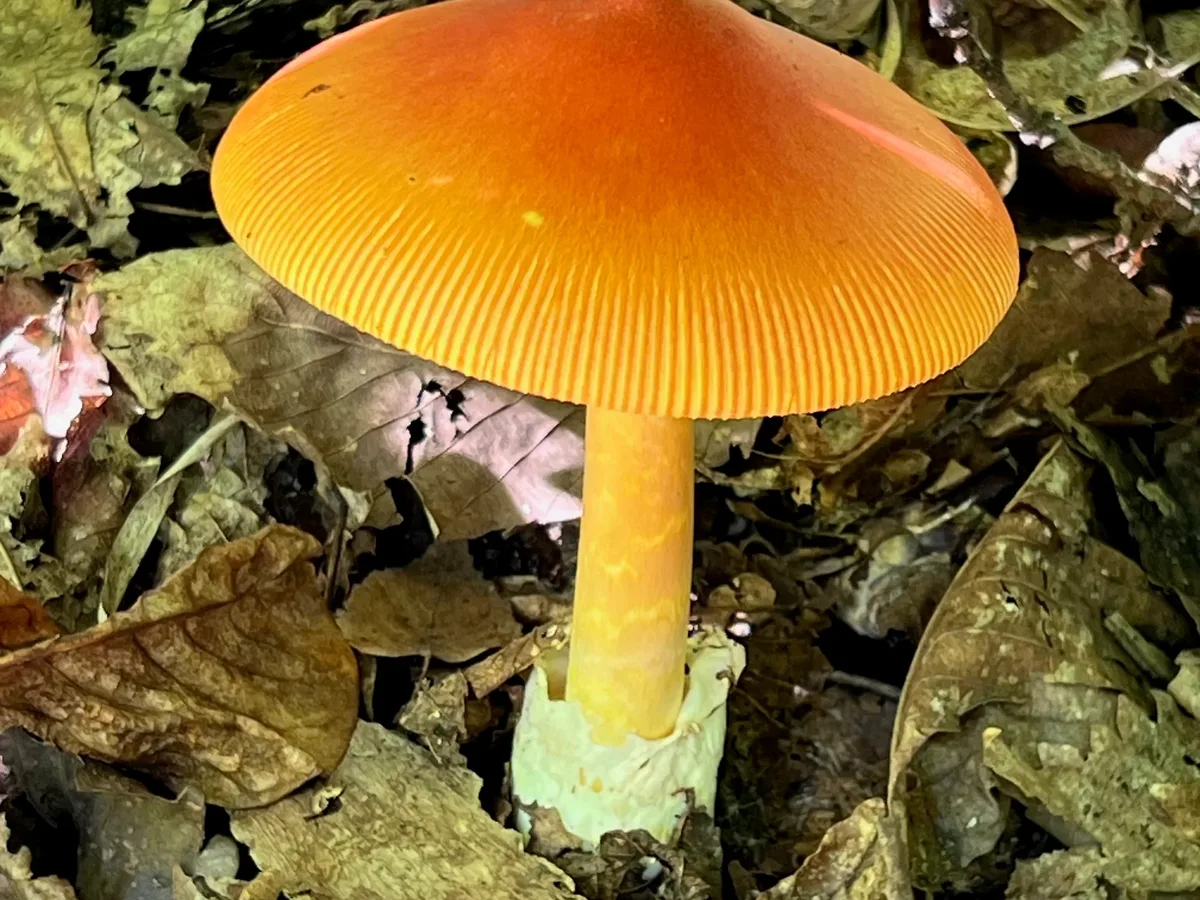 © ITÔ, Hiroki (CC BY)
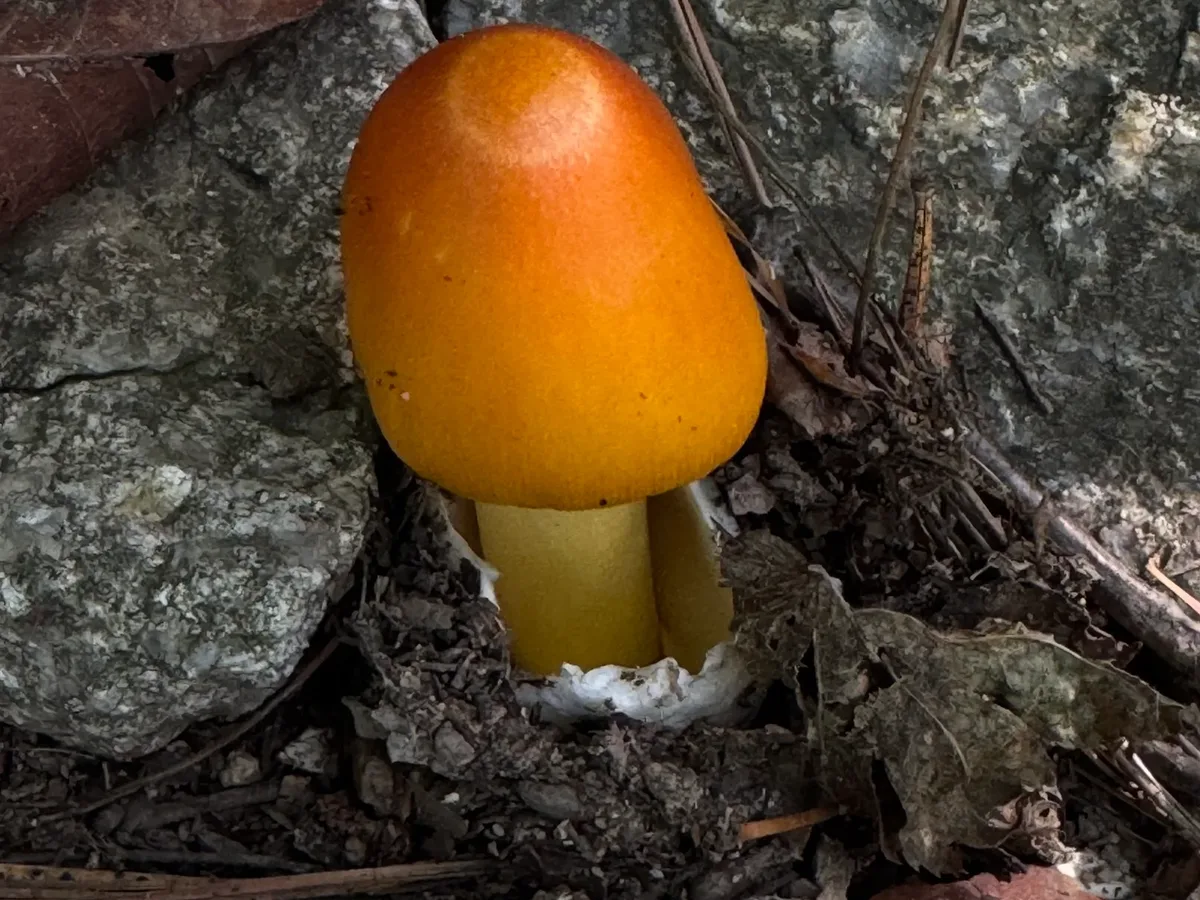 © nayeonyooo (CC BY)
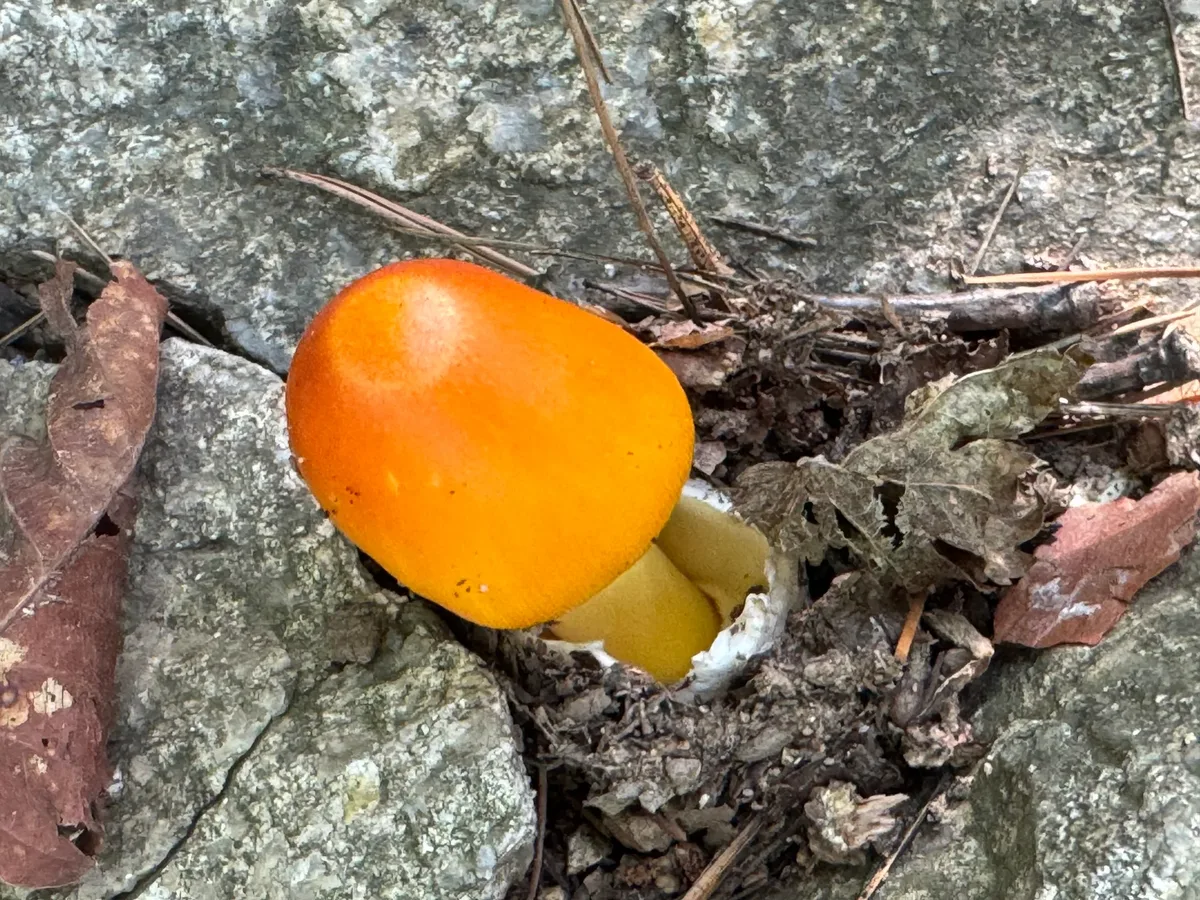 © nayeonyooo (CC BY)
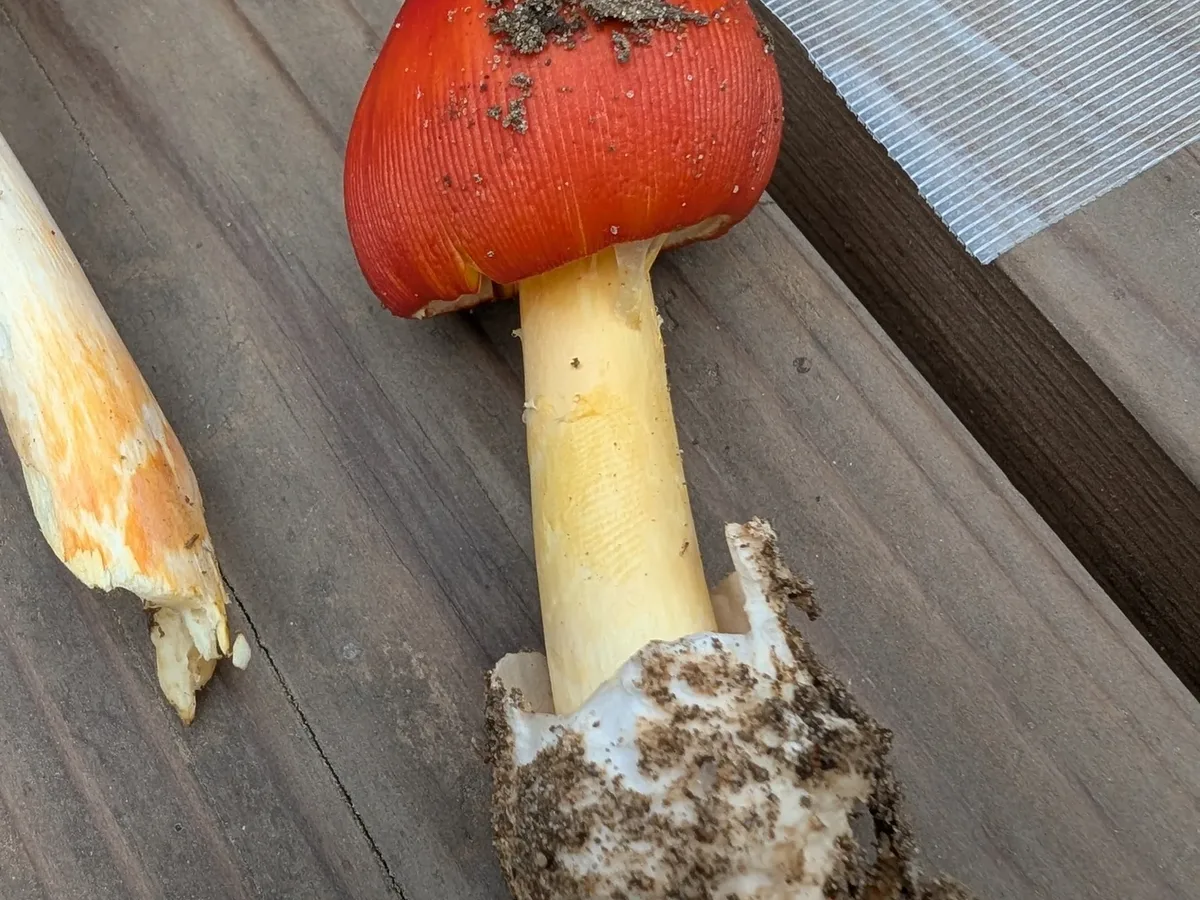 © Atsushi Nakajima (CC BY)
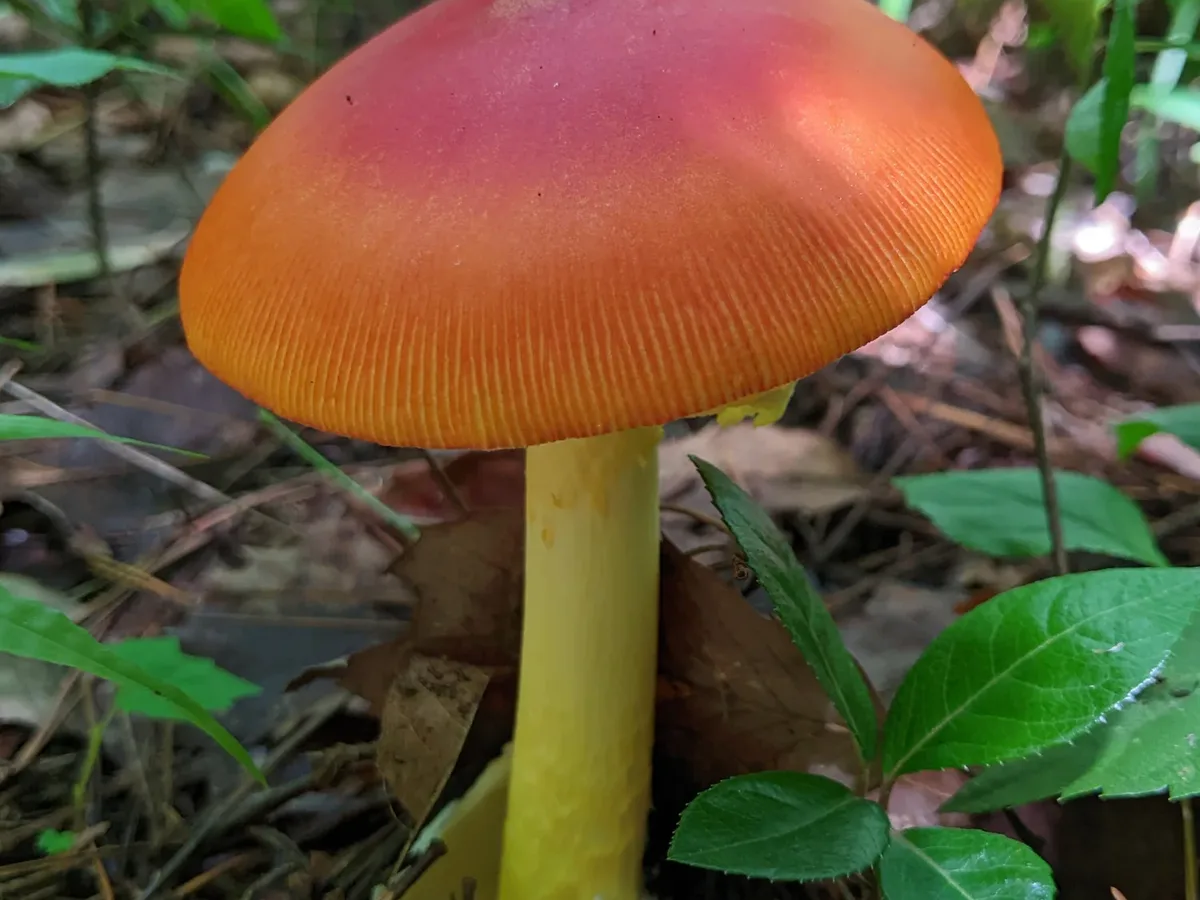 © Timur Kalininsky (CC BY)
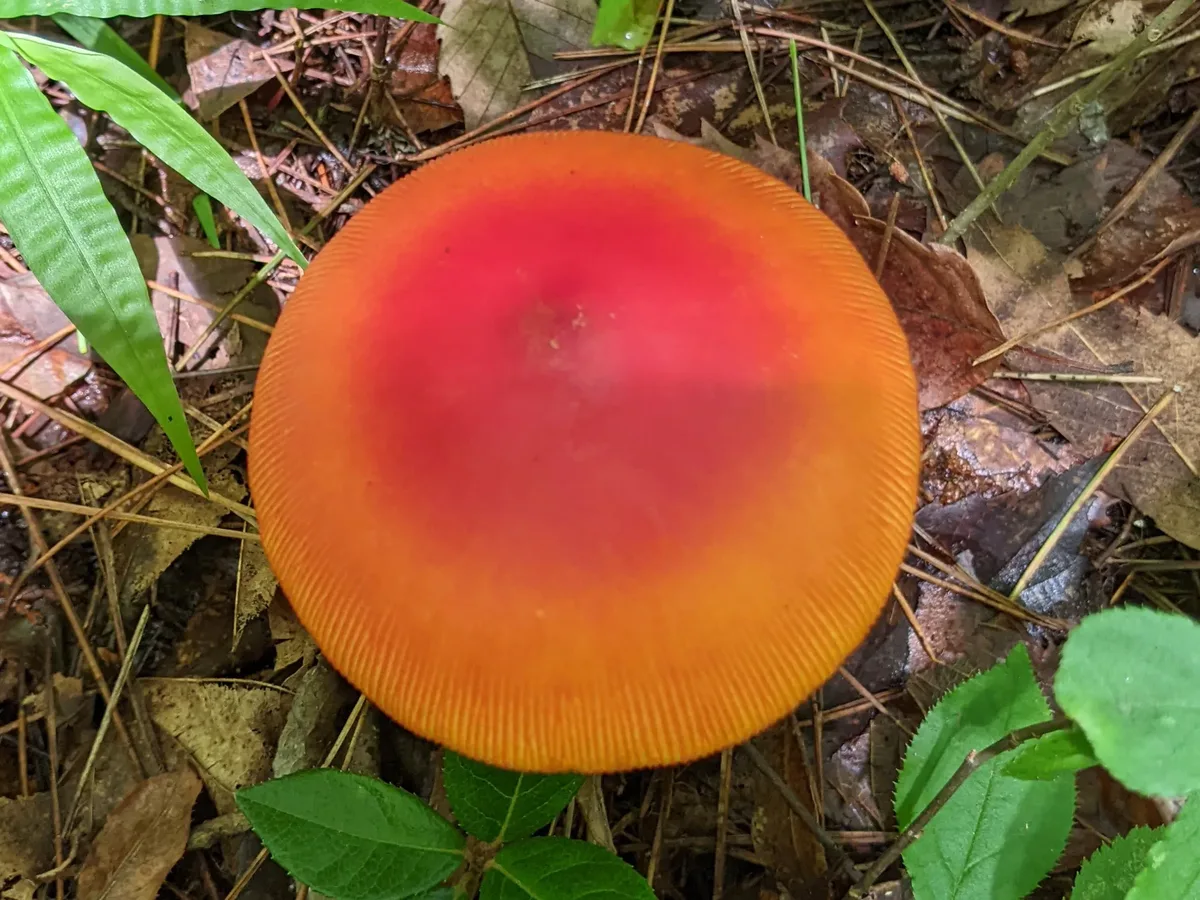 © Timur Kalininsky (CC BY)
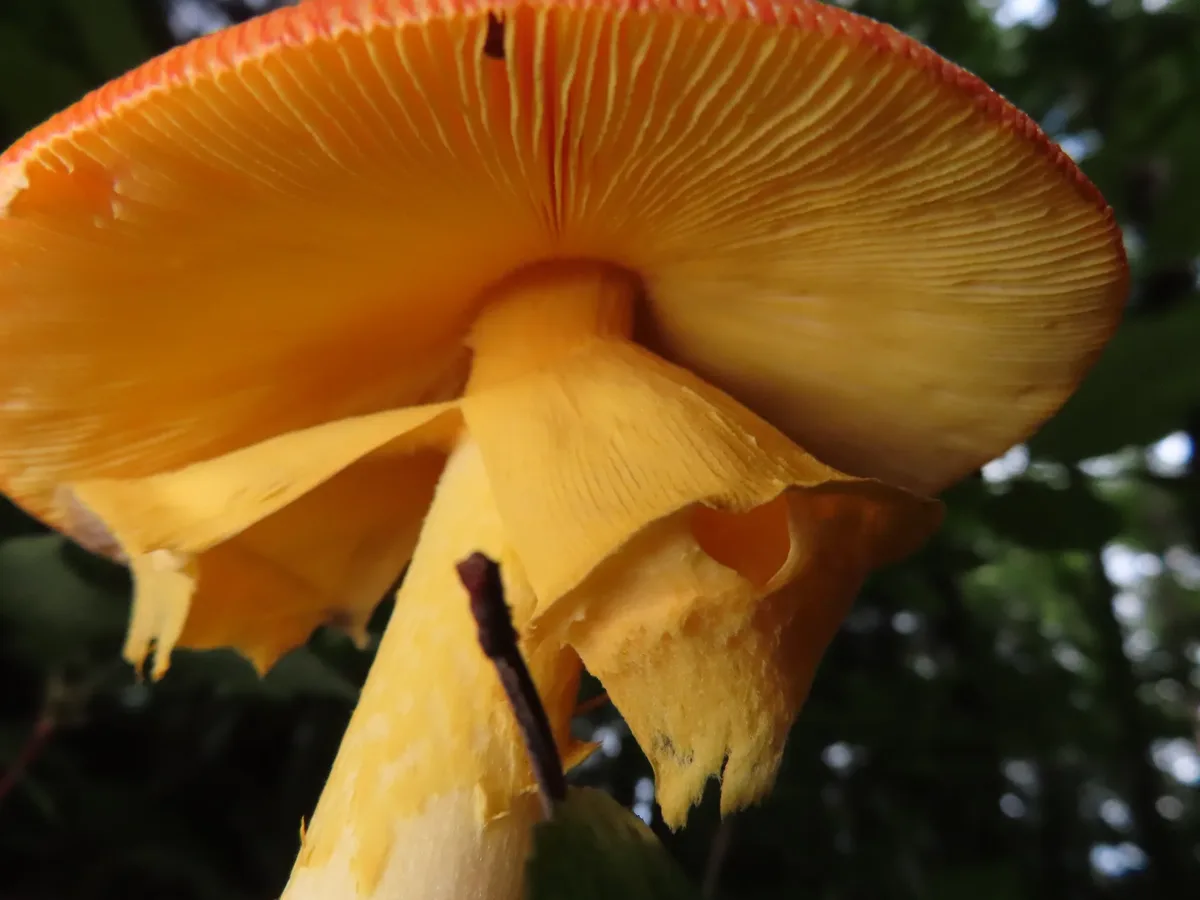 © Timur Kalininsky (CC BY)
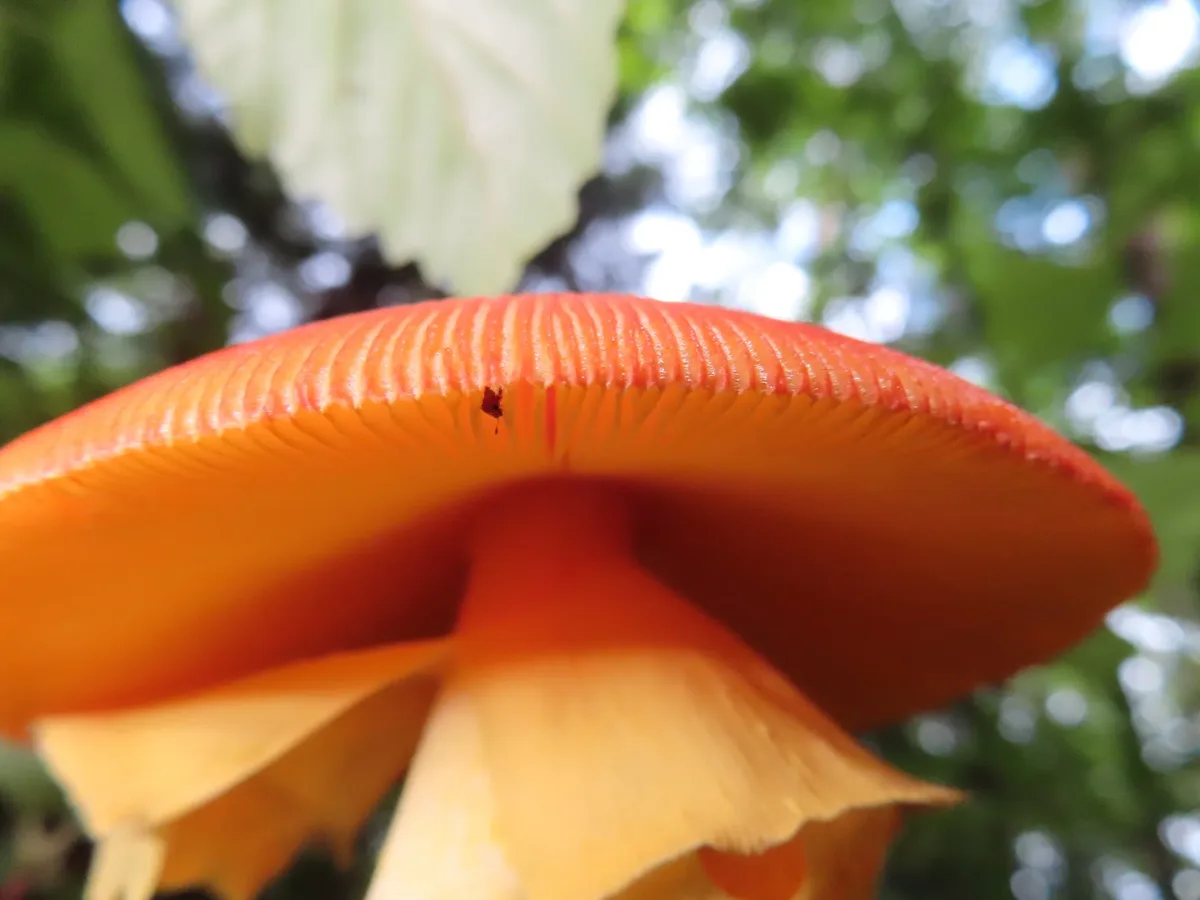 © Timur Kalininsky (CC BY)© ITÔ, Hiroki (CC BY)© nayeonyooo (CC BY)
One of the best mushrooms you can bring home - once you are certain of the identification.
Never eat a mushroom you are not 100% sure of - check the look-alikes below, and always cook wild mushrooms.
How to recognise it
Amanita caesareoides announces itself through a striking colour arrangement shared by the entire Amanita section Caesareae - the Caesar's mushrooms of the world. At every stage the fruit body is worth pausing over.
The process begins underground: a smooth white to cream egg, 40-70 mm tall, sits in the soil as if placed there, the entire future mushroom compressed and already coloured inside the volva. As warmth and moisture arrive, the stem extends, the veil splits, and a yellow-orange to golden-orange cap pushes free and unfurls to 60-160 mm across.
Cap
At full expansion the cap is nearly flat, distinctly striate at the margin, and coloured in the warm golden-orange that is characteristic of this species - slightly more golden and less scarlet than the vivid red-orange of Amanita hemibapha, though the boundary between the two is not always sharp.
Gills
Gills beneath are consistently bright yellow, free from the stem, and crowded.
Stem
The stem is 90-200 mm tall and relatively robust, yellow to orange-yellow, carrying a pendant membranous ring of the same warm yellow. Excavate the base carefully: a thick white sac-like volva is buried there and confirming it is essential to identification.
Flesh
Flesh is white to pale yellow, firm, pleasantly mild.
The critical combination to confirm before any handling decision:
- yellow-orange to golden-orange cap with striate margin
- yellow free gills
- yellow pendant ring
- yellow-orange stem
- white sac-like volva
All five characters must be present to support identification as an edible member of section Caesareae.
Where & when it grows
Habitat
A mycorrhizal forest species deeply embedded in the ecology of Southeast Asian tropical and subtropical forest.
Its most important tree partners are the dipterocarps - the towering Dipterocarpus, Shorea, and Hopea trees that form the dominant canopy across much of lowland Southeast Asia - together with oaks and related Fagaceae on higher ground. This dual partnership with two ecologically dominant tree families gives the species a wide habitat footprint across the region.
The mycorrhizal bond is obligate: A. caesareoides cannot fruit without its tree partner, and its presence in a forest reflects the health and age of the tree community.
In well-established dipterocarp-dominated forest with uncompacted acidic soils and a full canopy, productive spots recur season after season beneath the same trees. In southern China and at higher elevations, the species shifts toward oak-dominated forest.
When
Fruiting broadly across the tropical wet season in Southeast Asia, roughly May through November, with the peak typically running June through October when monsoon rainfall and high soil temperatures align.
- In Thailand and mainland Southeast Asia the main flush coincides with the southwest monsoon.
- In the Indonesian archipelago and the Philippines the wet-season window shifts with local climate; in some areas near-year-round fruiting is possible during particularly wet years.
- In southern China fruiting is concentrated June-October.
The trigger is consistent: a substantial rain event - 20 mm or more over one to three days - followed by sustained soil temperatures above 20 °C. Under these conditions the first eggs may appear within five to ten days.
A classic pattern in Thailand and Vietnam is a series of post-monsoon flushes, each following a major rain event by roughly one week, continuing until soil temperatures drop in November.
How it grows
Grows singly or in small scattered groups, never in dense clusters. Each fruit body emerges from a buried volva, pushing up through the soil as a smooth white egg before the stem elongates and the cap expands.
This egg stage is the species' most photographed and, paradoxically, its most dangerous moment - it is when the fruit body is externally indistinguishable from the eggs of deadly Amanita species sharing the same tropical forest.
The mycelium maintains its mycorrhizal partnership underground with dipterocarp or oak roots for years between visible fruiting seasons, accumulating the resources needed to produce the large, fleshy fruit bodies that emerge after each monsoon flush.
The same trees tend to host productive spots year after year, and experienced local foragers know exactly which trees in their area to check after a good rain.
Fruiting conditions
Tropical wet-season mycorrhizal fruiter; flushes follow significant rainfall events (monsoon rains, 20 mm or more over one to three days) when soil temperatures are 20-32 °C. Peak fruiting June-October across Southeast Asia; timing shifts with local wet-season patterns. In southern China concentrated June-October.
Look-alikes
The most consequential lookalike issue is at the egg stage: the smooth white volva-enclosed egg is externally identical to the eggs of several deadly species, and this confusion is the cause of fatal mushroom poisonings in Southeast Asia.
At maturity, the yellow-orange cap, yellow gills, yellow stem, and yellow ring create a distinctive visual pattern that eliminates the deadly white Amanitas (which are entirely white at all stages).
The most important mature-stage comparison is with Amanita hemibapha - the two are morphologically very similar and ecologically overlapping. A. caesareoides tends to have:
- a more golden-orange to yellow-orange cap (less scarlet-red)
- slightly broader spores
- a generally more robust fruit body
In practice, both are edible members of section Caesareae and confusion between them is not toxicologically significant.
The deadly Amanita phalloides has a greenish-yellow to olive cap with white gills. Amanita exitialis and related SE Asian destroying-angel-type species are white at all stages with white gills.
Any orange-capped amanita with yellow gills, yellow stem and white volva is in section Caesareae and is edible - the identification challenge is not within the Caesar group itself but between the egg stage of Caesar mushrooms and the egg stage of deadly species.
The egg stage of A. phalloides is externally indistinguishable from A. caesareoides eggs - both are smooth white ovals buried in soil. Slicing an A. phalloides egg through the centre reveals undifferentiated white or faintly greenish-white flesh without an orange primordium; A. caesareoides shows a golden-orange cap outline clearly visible inside. At maturity A. phalloides has a greenish-yellow to pale olive-brown cap (sometimes whitish in pale forms), white gills, white ring, and white volva - never orange or yellow. Introduced to Southeast Asia and southern China with exotic tree plantings; occurs in pine and oak forests in the region.
Various Southeast Asian and East Asian destroying-angel-type Amanita species (related to A. virosa) are white throughout at all stages: white egg, white conical cap, white gills, white ring, white volva. They completely lack orange or yellow colouring at any stage. In mountain forests of Southeast Asia these may grow in proximity to A. caesareoides. Any white Amanita egg in SE Asian forest must not be consumed without confirming the orange interior by cutting.
A lethal amatoxin-containing species native to southern China (Guangdong and adjacent provinces) and likely present more broadly in subtropical Southeast Asia. White at all stages: white egg, white cap, white gills, white ring, white volva. The egg externally resembles a Caesar mushroom egg. Fatal mass poisonings attributed to A. exitialis occur regularly in Guangdong. At maturity the white gills and white cap immediately distinguish it from A. caesareoides. Never collect any white-capped Amanita in SE Asian or southern Chinese forest.
The European Caesar's mushroom is the closest Old World relative; it has a deeper, richer orange to orange-red cap, thicker build, and is restricted to the Mediterranean basin and southern Europe. A. caesareoides is the ecologically analogous tropical Southeast Asian species. Ranges do not overlap; confusion is only academic. Both are choice edibles.
The closest relative and most frequent lookalike. A. hemibapha is also a choice edible member of section Caesareae with the same orange-cap, yellow-gills, yellow-stem, white-volva combination. It tends toward more vivid scarlet-orange to orange-red cap colouring and is somewhat more slender; A. caesareoides tends toward golden-orange to yellow-orange and is slightly more robust. The ranges overlap broadly and the two may co-occur. Both are edible, so confusion between them is not toxicologically significant.
Volvariella volvacea also produces a white to brownish egg-like volva at the immature stage, found in agricultural settings on decomposing rice straw and compost - not in forest soil under trees. At maturity the cap is grey-brown to dark smoky grey (never orange), gills turn pink with age, and there is no ring at any stage. The different ecology (agricultural vs. forest), non-orange cap, pink gills at maturity, and absence of a ring distinguish it reliably.
In the kitchen
Picking & cleaning
Only collect specimens where the cap has fully emerged and the complete identification set is confirmed:
- yellow-orange to golden-orange cap with a distinctly striate margin
- yellow free gills
- yellow pendant ring
- yellow-orange stem
- a white sac-like volva excavated from the soil base
Never collect at the egg stage - the smooth white eggs of A. caesareoides are externally indistinguishable from the eggs of deadly Amanita species including Amanita phalloides, Amanita exitialis, and other lethal Southeast Asian white Amanita species.
If you must evaluate an egg, cut it in half: A. caesareoides will show an orange-yellow cap primordium clearly visible inside the white veil; deadly Amanita eggs show undifferentiated white or greenish-white flesh with no orange colouring.
- Carry intact specimens in a wide basket; carry each specimen separately to prevent bruising that could obscure colour.
- Examine every specimen individually at home before cooking - never batch-check.
- Wash hands thoroughly after handling any Amanita.
Cooking
Amanita caesareoides is genuinely prized across Southeast Asia, not merely tolerated as edible.
In Thailand it is sold in forest-edge markets alongside other wild fungi and prepared in curries, soups, and stir-fries with coconut milk, chilli, lemongrass, and galangal - companions that complement rather than mask its mild, slightly sweet flavour. In Vietnam and southern China it appears in broths and hotpots.
The texture is firm and holds well in high-heat cooking. As with all wild Amanita species, cook it thoroughly rather than eating raw, a sensible precaution.
The flavour is mild, slightly sweet, and pleasant - it accepts strong aromatic treatments well without losing its own character.
Start with a moderate portion the first time you try this or any new wild mushroom, to check individual tolerance.
Good to know
Amanita caesareoides is a well-regarded edible species consumed widely across Southeast Asia and southern China, treasured in local markets and traditional cuisine, and carrying no known toxins.
The safety risk is entirely a question of identification, specifically at the egg stage. Fatal poisonings occur in Thailand, Vietnam, and southern China every year when foragers collect white Amanita eggs from forest soil without confirming that the orange cap primordium is present inside.
The golden rule is absolute: never harvest a white egg-stage Amanita from tropical or subtropical forest soil without cutting it open and confirming an orange or yellow-orange cap inside.
At full maturity, confirm the five-character identification pattern on every specimen, not assumed:
- orange-yellow striate cap
- yellow gills
- yellow ring
- yellow stem
- white volva
Do not pick damaged, partial, or waterlogged specimens where colour might be obscured.
Beginners should collect with an experienced regional guide before collecting independently.
A reference guide - never an edibility guarantee. When in doubt, leave it out.