Eastern North American destroying angel
Amanita bisporigera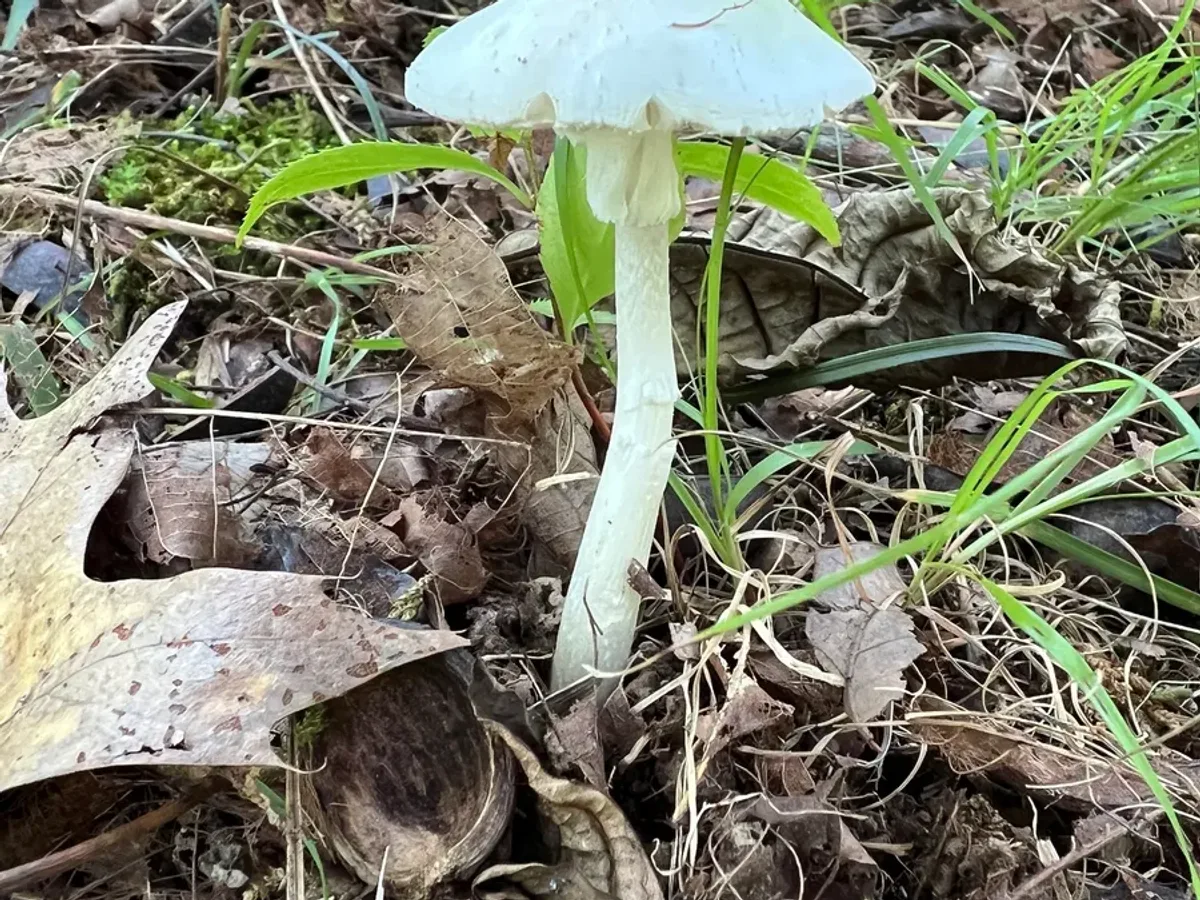 © Brian C. Hunt (CC BY)
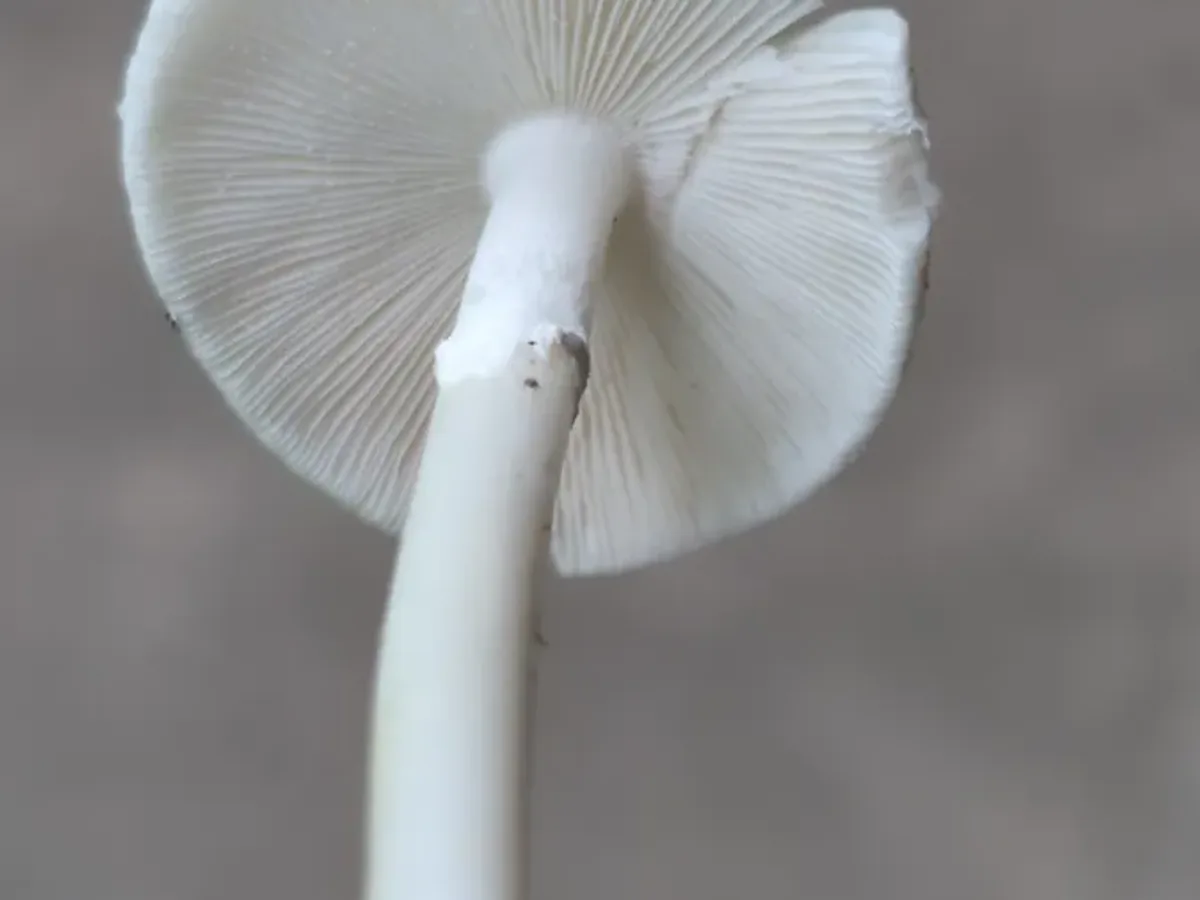 Sean Radcliffe (CC0)© Brian C. Hunt (CC BY)Sean Radcliffe (CC0)
Toxic - and the most serious cases can be fatal. Never eat it, and wash your hands after handling.
Never eat a mushroom you are not 100% sure of - check the look-alikes below, and always cook wild mushrooms.
How to recognise it
Amanita bisporigera is pure white from cap to volva - no blush of colour anywhere on a fresh specimen.
Cap
The cap begins as a smooth egg-shaped button, then expands to a broadly convex or nearly flat disc up to 10 cm across, remaining white and bald throughout. The surface is dry to slightly tacky in wet weather, and the margin carries no striations.
Gills
Beneath the cap, the free, crowded gills never touch the stem; they are white, closely spaced, and stay white through all stages of development.
Stem
The stem is slender to moderately stout, 5-14 cm tall, with a slightly bulging base that widens into a prominent, sac-like volva - a membranous white cup that clasps the base and is often partially buried in the soil.
High on the stem sits a thin, delicate, skirt-like ring (annulus) that hangs downward; in older specimens it may be torn or missing, but the attachment zone remains visible as a slightly tattered collar.
Spore print & tests
A white spore print is obtained reliably from mature caps.
One diagnostic test: a drop of 10% KOH solution on the cap surface turns it yellow within seconds - a reaction not shared by the similarly white Amanita virosa complex in Europe.
The species name refers to the two-spored basidia found microscopically (most Amanita have four-spored basidia), a detail that helps distinguish it from close relatives under the microscope.
Why it's dangerous
Amanita bisporigera is one of the most acutely toxic organisms on the eastern North American continent. It is responsible for a disproportionate share of fatal mushroom poisonings in the region, and has been described by the North American Mycological Association as North America's deadliest mushroom.
NAMA records indicate at least four confirmed deaths attributable to A. bisporigera over a thirty-year reporting period; the true number of poisonings is likely higher due to underreporting and misattribution.
A single cap contains enough amatoxin to kill an adult human. Children and individuals with pre-existing liver or kidney disease are at higher risk of fatal outcome at lower doses.
Because the latency period is 6-24 hours, patients often present to medical care late, after significant toxin absorption has already occurred.
Any suspicion of amatoxin ingestion is a medical emergency. The patient should be transported immediately to an emergency department and the Poison Control Center contacted (1-800-222-1222 in the United States).
Time from ingestion to medical intervention is the most critical factor in outcome.
Toxin
The primary toxins are amatoxins - specifically alpha-amanitin and beta-amanitin - which are bicyclic octapeptides. They act by inhibiting RNA polymerase II, the enzyme responsible for transcribing DNA into messenger RNA.
Without functioning RNA polymerase II, cells cannot produce new proteins. Rapidly dividing cell populations - particularly hepatocytes in the liver and cells of the kidney tubules - are most affected.
The toxins are absorbed through the gastrointestinal tract, pass through the liver via the enterohepatic circulation (which extends the period of hepatocyte exposure), and are excreted in bile and urine.
A. bisporigera also contains phallotoxins (phallacidin, phalloidin), which disrupt actin polymerisation in cell membranes. These are less well absorbed orally and contribute less to systemic toxicity than the amatoxins.
The cyclic peptide structure of amatoxins makes them highly resistant to heat, acid, and enzymatic breakdown, which is why no cooking process inactivates them.
Symptoms
The clinical course of amatoxin poisoning follows a characteristic four-phase pattern.
- 1Phase I (latency): a delay of 6 to 24 hours - sometimes as long as 36 hours - during which the patient may feel entirely well. This delay is medically significant because by the time symptoms appear, substantial toxin has already been absorbed.
- 2Phase II (gastrointestinal): sudden onset of severe, cholera-like vomiting and watery diarrhoea, with accompanying cramps, lasting 24-48 hours; dehydration and electrolyte disturbance are common and may require hospitalisation.
- 3Phase III (apparent improvement): symptoms subside and the patient may feel better, sometimes for 12-24 hours; liver enzyme levels are already rising during this phase.
- 4Phase IV (systemic organ failure): jaundice, coagulopathy (failure of blood clotting), and progressive liver failure develop over days two through five; renal failure may accompany or follow hepatic failure.
Without aggressive medical treatment, death occurs from hepatic encephalopathy and multi-organ failure, typically between day four and day eight after ingestion. Survivors of severe poisoning sometimes require liver transplantation.
Staying safe
Amanita bisporigera is deadly, and there is no antidote reliably available outside of liver transplantation in severe cases.
The key safety practice for all eastern North American foragers is to learn the white Amanita's four diagnostic features so thoroughly that they are checked automatically:
- 1A sac-like volva at the base - always dig to find it.
- 2Free white gills that never run down the stem.
- 3A white spore print.
- 4A skirt-like ring high on the stem.
None of these features alone is sufficient. All four together, combined with the habitat (forest floor near broadleaf trees) and season (summer-early autumn), should produce an immediate identification of a white Amanita and a decision not to eat it.
The KOH yellowing reaction on the cap is a useful confirmatory test, but requires a chemical reagent.
Crucially, none of the following are reliable safety checks:
- Smell (it has an unremarkable mild odour).
- Flavour (tasting even a small amount is dangerous).
- Cooking (heat does not destroy amatoxins).
Any unidentified white mushroom collected from eastern North American forest must be treated as potentially A. bisporigera until all four structural features have been examined.
Where & when it grows
Habitat
Amanita bisporigera is an obligate mycorrhizal partner of broadleaf and mixed trees, found most consistently beneath oaks across its range, though it associates with other hardwoods and occasionally with conifers in mixed stands.
Its presence tracks the distribution of mature forest with undisturbed soil horizons: it is a forest-interior species, rarely appearing at woodland edges or in disturbed ground.
The range spans eastern North America from the Canadian Maritimes and southern Quebec south through the entire eastern seaboard, across the Midwest and Appalachian highlands, and continues into Mexico; it is rare or absent west of the Great Plains. Within that range, it occurs from lowland river-bottom forest to mid-elevation hardwood ridges.
Because the mycelium forms a living network around tree root tips, Amanita bisporigera is effectively attached to the forest itself - it cannot survive without its host trees, and the trees gain mineral nutrients, particularly phosphorus and nitrogen, in return.
This mutual dependency means the fungus is a permanent, if invisible, resident of mature eastern forests, persisting in the soil between fruiting events for years or even decades.
When
Fruiting runs from early June through September, with peak activity in July and August across most of the range.
In the southernmost parts of its distribution - the Gulf states and Mexico - fruitbodies can appear earlier in the year, when warm, humid conditions establish themselves ahead of the main summer season.
The critical trigger is a combination of sustained soil warmth above roughly 12 °C and meaningful rainfall that penetrates the leaf-litter horizon and wets the upper mineral soil.
After a soaking rain in warm weather, fruitbodies can push through the duff within a matter of days; the visible mushroom represents only the final act of a developmental process that has been building in the mycelium for some time.
Cool, dry spells suppress fruiting even in midsummer. Early autumn sometimes brings a secondary flush if September rains follow a warm late-summer period.
The fruitbodies are relatively ephemeral - a typical cap matures and begins to decay within five to seven days in warm conditions.
How it grows
The underground life of Amanita bisporigera is a partnership that may be older than the individual trees involved. The mycelium colonises the fine root tips of oaks and other compatible hosts, wrapping them in a sheath of fungal tissue (the Hartig net) through which nutrients and carbohydrates are exchanged.
The tree supplies sugars fixed by photosynthesis; the fungus extends mineral uptake far beyond what the roots alone could reach, particularly in the thin organic layers of eastern forest soils.
This arrangement is not a recent adaptation - the Amanita genus and its ectomycorrhizal habit predate the radiation of the angiosperms, and the partnerships are geologically ancient.
Fruitbodies emerge singly or in small scattered groups, never in tight clusters, and push up through the leaf litter as closed white eggs before the cap expands.
The egg stage is the phase most dangerous to misidentify, because the entire developing mushroom is wrapped in a universal veil. As the egg ruptures, this white membrane becomes the volva at the base and leaves white patches on the cap that can weather off.
Between fruiting events the mycelium persists in the soil, waiting out dry months and winters while the forest above continues its own cycles.
Fruiting conditions
Warm-season ectomycorrhizal Amanita; fruits in summer and early autumn following rainfall when soils are warm. Not foraged - values are conservative standard-mycology estimates.
Look-alikes
Three categories of confusion account for most dangerous misidentifications.
- 1Egg stage: fully enclosed young fruitbodies are rounded white objects in the leaf litter that visually resemble puffballs (Calvatia and related genera). This is the most consequential error. The reliable test is to cut the suspected object in half vertically - a true puffball is uniformly solid white inside with no internal structure; a destroying angel egg reveals the outline of a developing cap, gills, and stem encased in a white veil. Never eat any white ball-shaped fungus from the forest floor without making this cut.
- 2Young expanded buttons: white Agaricus species (button mushrooms) grow in similar habitats and can appear similar before the cap fully expands. Agaricus species develop pink-to-chocolate-brown gills as they mature and produce a brown spore print; they also lack a volva entirely. A. bisporigera has white gills at all ages, a white spore print, and a sac-like volva at the base.
- 3Mature white-capped gilled mushrooms: a range of edible white or pale mushrooms can superficially resemble a mature destroying angel, particularly to foragers who do not examine the base.
The combination of free white gills, white spore print, a skirt-like ring high on the stem, and a sac-like volva is unique to white Amanita species and should immediately signal caution in eastern North America.
Young white buttons are confused with young Agaricus. Agaricus develops pink-to-brown gills and a brown spore print and lacks a volva, while this species has white gills, a white spore print and a sac-like volva at the base.
White young buttons of the destroying angel resemble puffballs. Always cut suspected puffballs in half - a developing cap, gills and stem inside reveal an Amanita, whereas a true puffball is uniformly solid white inside.
Mature specimens are confused by inexperienced foragers with white edible gilled mushrooms; check for the high skirt-like ring and the sac-like volva at the bulbous base, and use the KOH test (cap yellows).
A reference guide - never an edibility guarantee. When in doubt, leave it out.