Blue-pored polypore
Albatrellus flettiisyn. Polyporus flettii Morse ex Murrill, Scutiger flettii (Morse ex Murrill) Pouzar
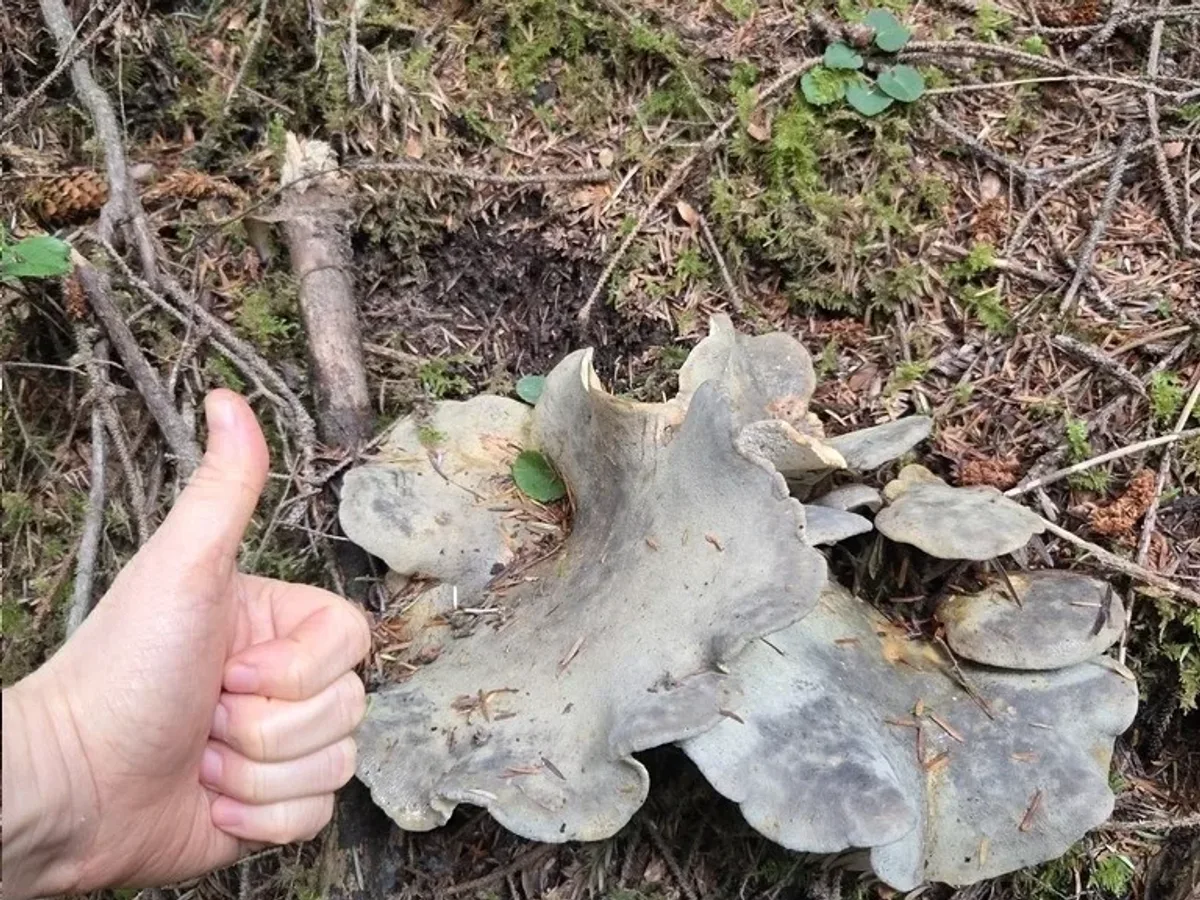 © Mandy Hackney (CC BY)
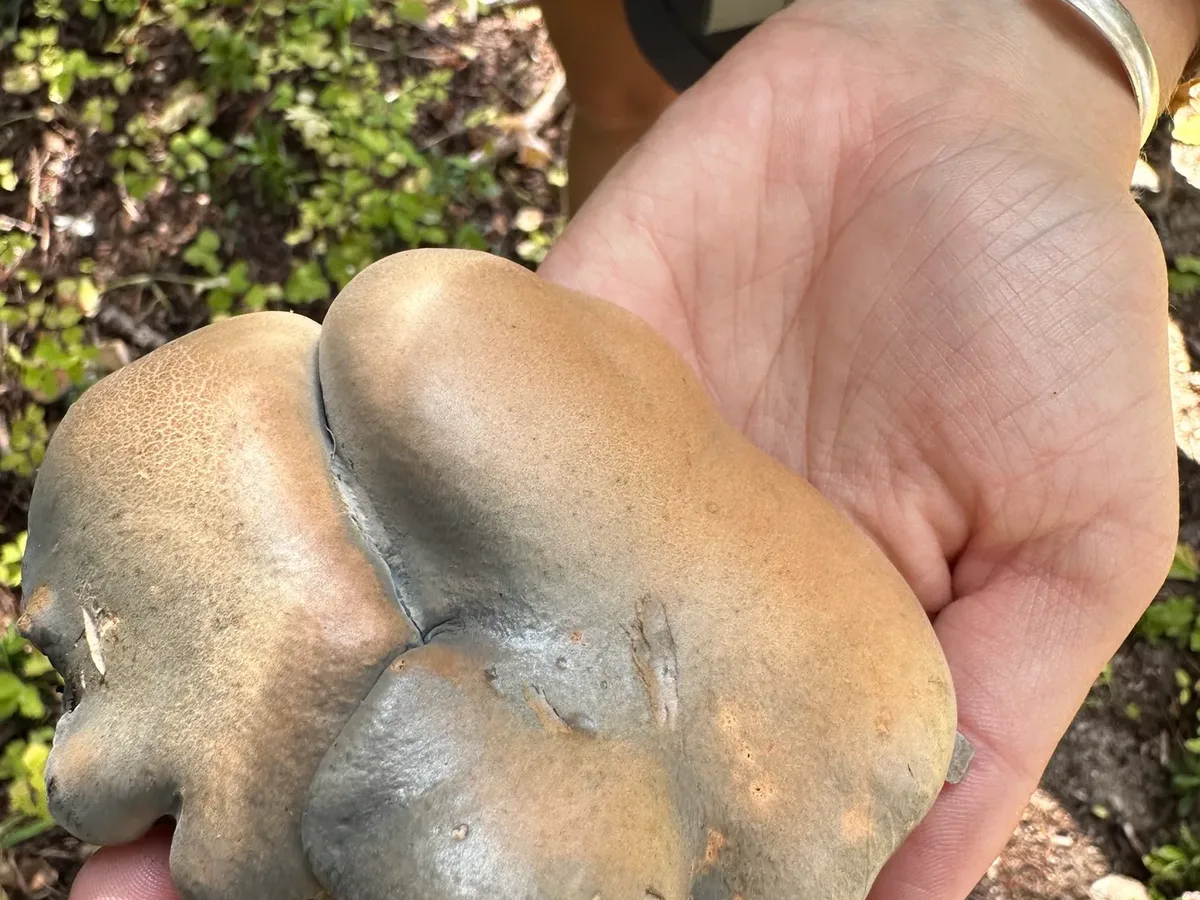 Leah Gardner (CC0)
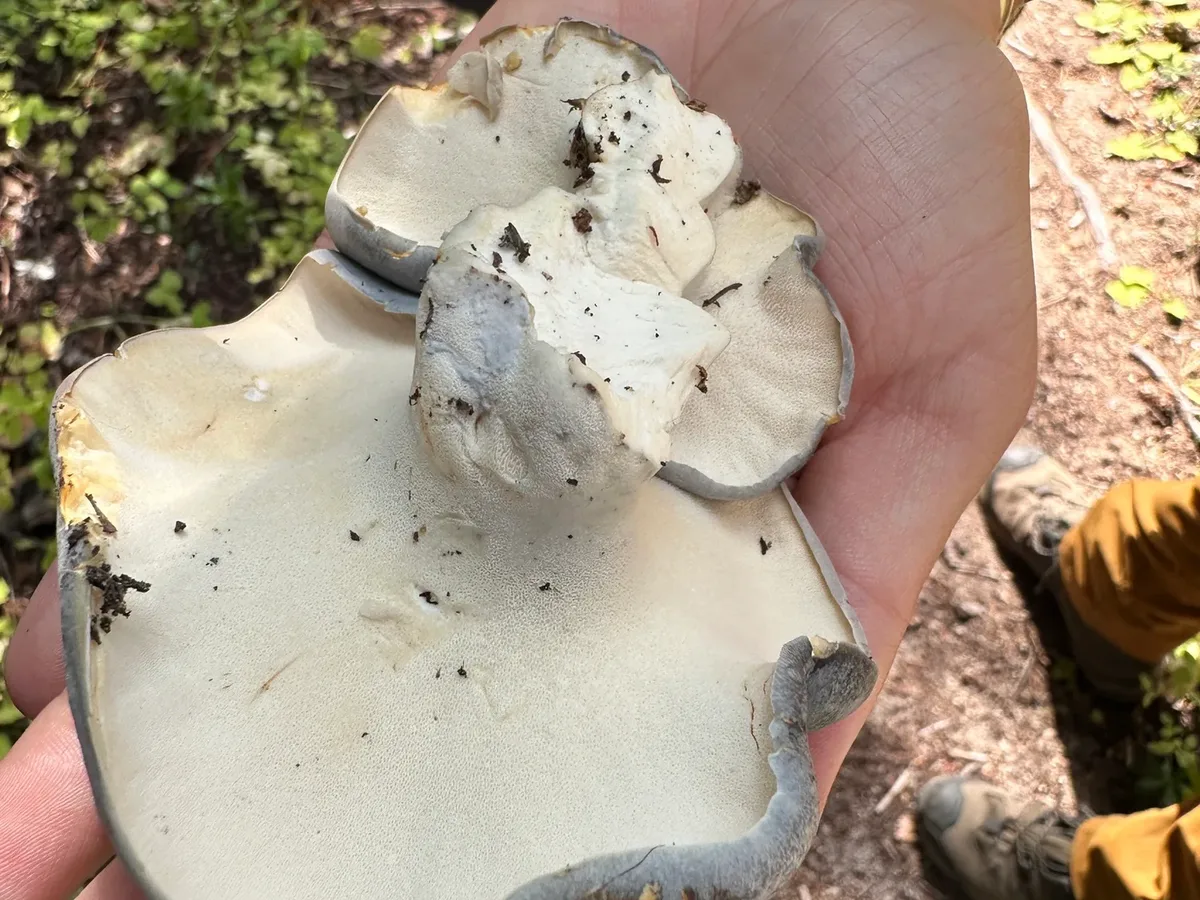 Leah Gardner (CC0)
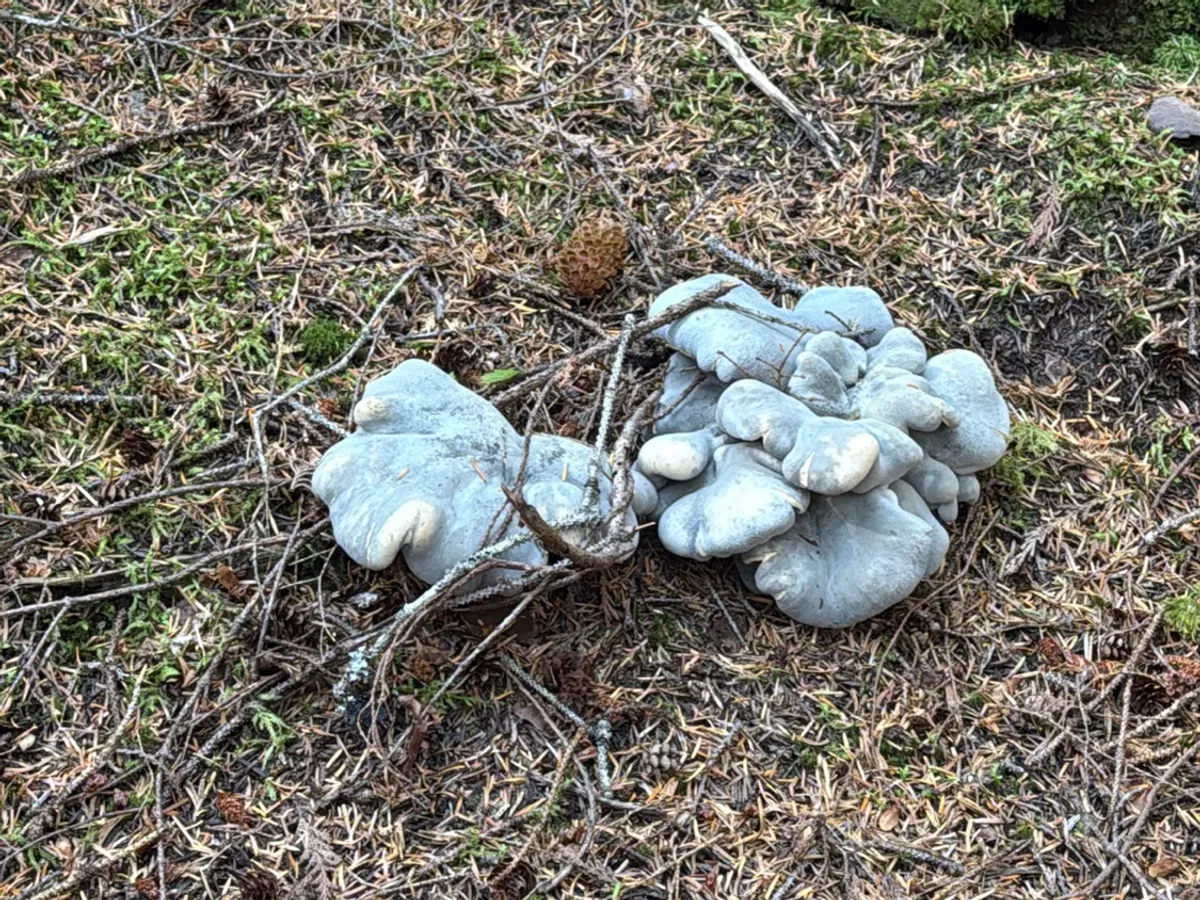 © Noah How (CC BY)
 © Mandy Hackney (CC BY)
 © Mandy Hackney (CC BY)© Mandy Hackney (CC BY)Leah Gardner (CC0)
Good to eat, once you have identified it with certainty and cooked it through.
How to recognise it
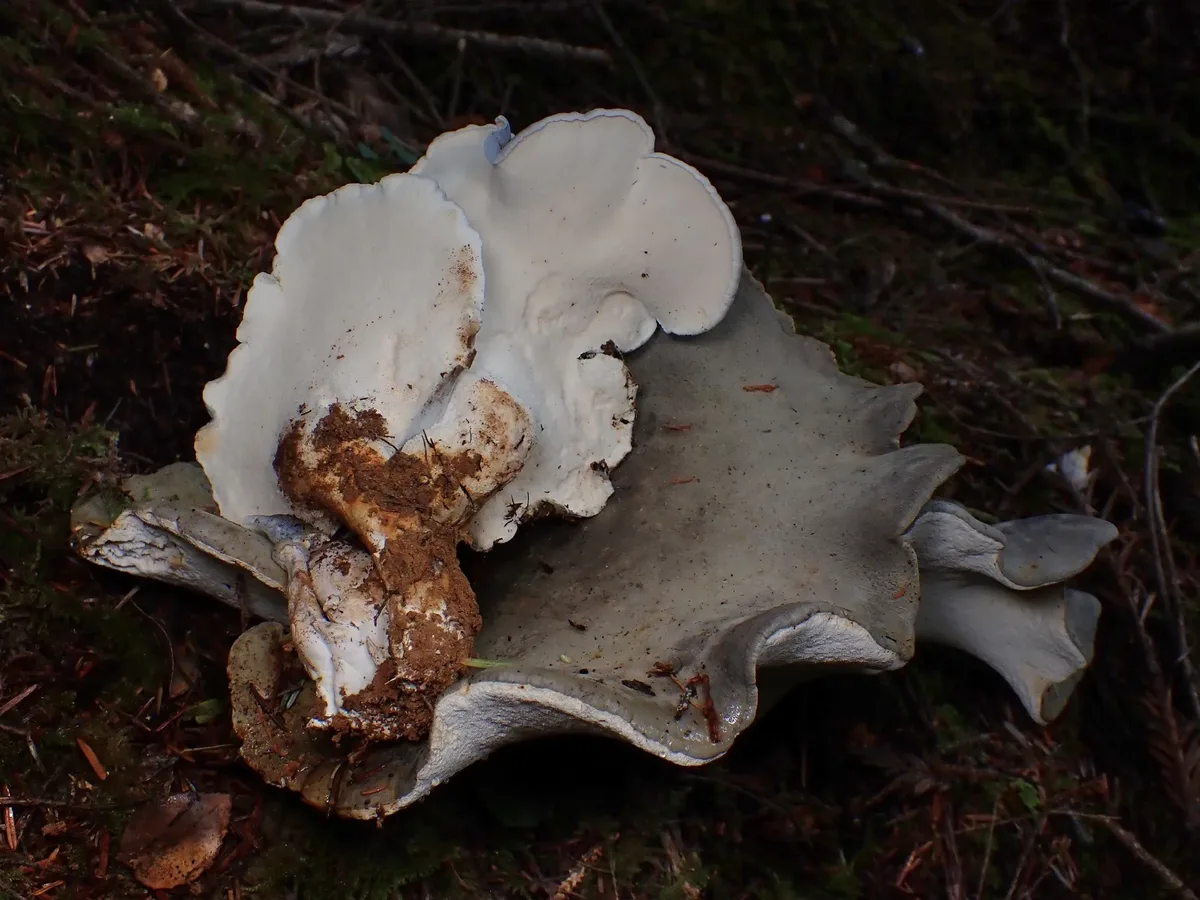
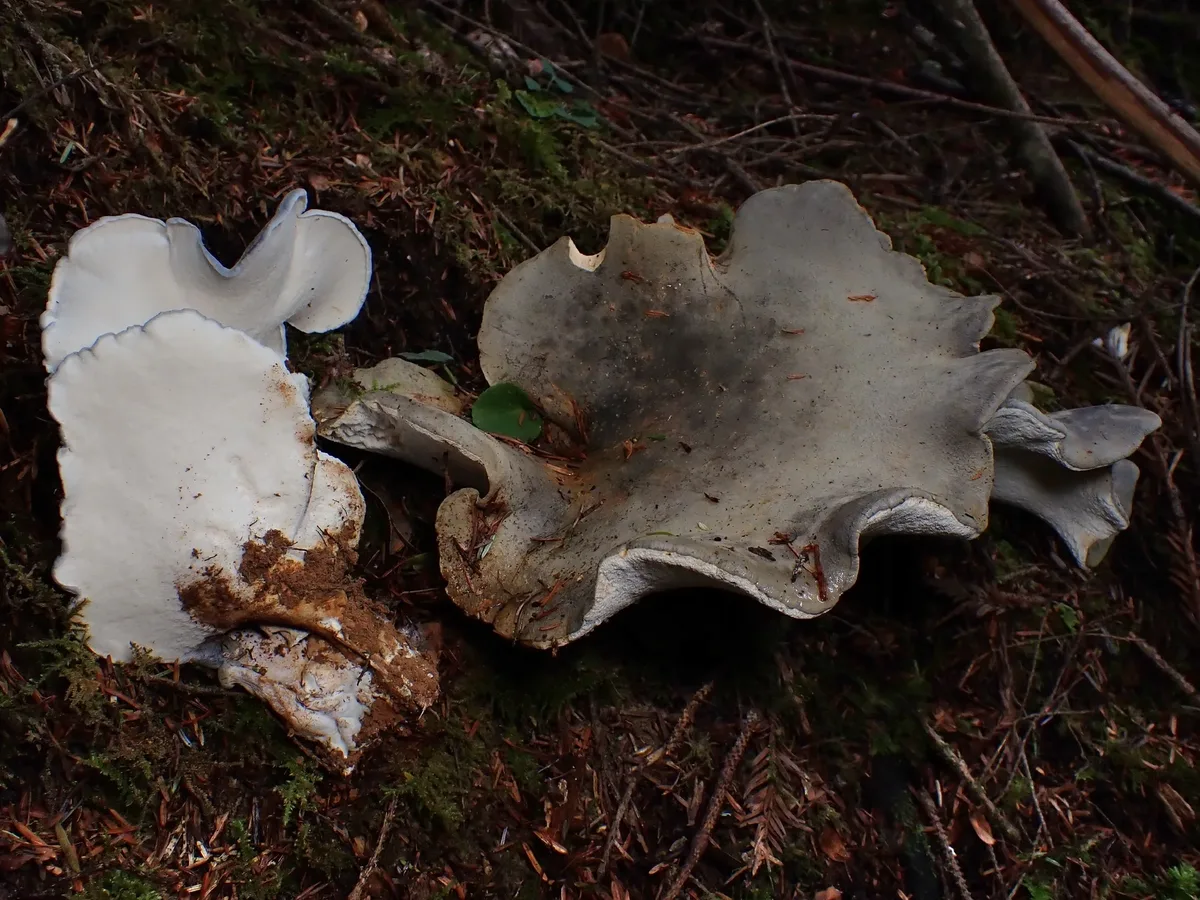
Albatrellus flettii announces itself with a character almost no other mushroom can claim in the Pacific Northwest: a bright, true blue to steel-blue pore surface. When you flip a fresh specimen and see those small, angular, unmistakably blue pores, the identification is essentially made.
Cap
The cap is broad and fleshy - 5-20 cm across - convex to irregularly wavy or centrally depressed in maturity, with a dry, smooth to finely felty surface that runs from clean white through pale cream to greyish-white; in age it picks up faint blue-grey or lilac-grey overtones, sometimes cracking in dry periods.
The margin stays inrolled in youth and then opens irregularly.
Gills / Pores
Underneath, the pore layer is fine (2-4 pores per mm), angular, and distinctly blue - most vivid in young specimens, fading to pale grey-lavender or near-white in old, dry ones.
Stem
The stem is stout, solid, 3-8 cm tall, white to pale blue-grey, often a little off-center.
Flesh
Flesh throughout is white, thick, firm, unchanging when cut - no blueing, no colour shift. Spore print white.
The combination of white cap + blue pores + terrestrial habit in conifer forest is unique in this region.
Where & when it grows
Habitat
This is a mushroom of high, cool, conifer forests - the silver-fir and mountain-hemlock zone of the Pacific Northwest, from roughly 500 m elevation up into the subalpine belt.
It fruits from the deep needle duff and mossy humus beneath mature fir and hemlock, and while it looks like a standard terrestrial polypore, its tight site fidelity and the presence of living host roots below it are consistent with ectomycorrhizal biology.
The same patches can produce fruit bodies for years in succession, and experienced foragers in Washington's Olympics and Cascades, British Columbia's coast ranges, and Oregon's high Cascades maintain 'blue polypore spots' they return to each late summer.
Lower-elevation records with Douglas-fir and Sitka spruce do exist, particularly in Oregon and northern California, broadening the altitudinal window. The forest floor here is characteristically cool, often shrouded in cloud or mist, and carpeted with mosses - conditions that suit A. flettii perfectly.
When
The season runs July through October, with the peak flush in August and September across most of the range.
Subalpine populations emerge as late snowpack melts away and soils warm above roughly 8 °C, often firing in earnest in late July and August. Lower-elevation populations track late-summer rainfall events more closely and may flush heavily in September.
An individual crop can persist and expand over one to two weeks in cool, moist conditions. By late October, hard frosts at altitude and advancing autumn rains at lower elevations mark the end of reliable fruiting.
The blue colour fades in older and dried-out specimens, so vibrant pore colour is a useful proxy for freshness.
How it grows
Fruits in troops, clusters, or scattered individuals from the humus and needle duff of its host-tree forest. Multiple fruit bodies often emerge simultaneously from the same ground patch, suggesting that a single mycelial network is releasing a coordinated flush.
Individual caps push up as convex white buttons and expand steadily, the cap surface cracking in drier spells into irregular tiles.
The perennial underground mycelium means productive patches are reliably revisited - local site knowledge is a more reliable guide to finding this species than searching randomly.
Fruiting conditions
Responds to cool, moist conditions after snowmelt (subalpine) or late-summer rainfall (lower elevations). Soil temperatures between 6-15 °C appear optimal; the species is adapted to the cool, high-humidity conditions of Pacific Northwest mountain and subalpine conifer forest. A flush-lag of 7-18 days after significant rainfall is typical.
Look-alikes
No deadly species closely mimics Albatrellus flettii. The blue pore surface is a highly distinctive and practically diagnostic character in Pacific Northwest terrestrial fungi, and once that feature is recognized the risk of a dangerous misidentification is very low.
Within Albatrellus, the most likely confusions are with A. ovinus (sheep polypore) and A. confluens. Both are benign confusions.
- Albatrellus ovinus has white to cream pores that do not take on blue tones; its cap is similarly white and terrestrial in conifer forest, but the pore colour distinction is clear.
- Albatrellus confluens has caps that merge and overlap, often with an ochre-buff to pinkish-buff coloration and white to cream pores without the blue character; it is also edible.
- Polyporus species growing from wood differ by their wood-based habit and lack of blue pore colouration.
- The rare Scutiger pes-caprae has a scaly brown cap and lacks blue pores.
None of the North American Albatrellus species are known to cause serious poisoning, and none resemble deadly species closely enough to constitute a realistic danger with minimal attention to the blue pore feature.
Forms overlapping, merged, multiple caps with ochre-buff to pinkish or salmon-orange tinges (not white-grey) and white to pale cream pores without blue colouration. The merged, fused cap habit and warm buff or pinkish coloration are distinctive. Also edible; confusion is harmless.
A terrestrial conifer-forest polypore with a scaly, brown to chestnut-brown cap surface and white to cream pores - no blue tones anywhere. The brown, rough-scaly cap is completely unlike A. flettii's smooth white-grey cap. Generally considered edible but tough.
Also a white-capped, terrestrial polypore of conifer forests, but the pore surface is white to cream - never blue or blue-grey. Check the pore colour carefully; A. flettii's vivid steel-blue pores are unmistakable in fresh specimens. Both species are edible, so confusion carries no health risk, but the field distinction is easy once you know to look for it.
In the kitchen
Picking & cleaning
Harvest young to mid-aged specimens when the pore surface is still clearly blue and the flesh is firm and resilient. Old specimens with pale, faded pores and soft or waterlogged flesh are not worth taking.
Cut at the stem base with a knife, leaving the mycelium undisturbed in the duff. Because multiple fruit bodies often arise from the same patch, selective harvesting of the freshest individuals allows the remaining ones to mature and spore.
The firm flesh is robust in transit; a basket or paper bag works well. The caps are free of grit in most forest settings but check the pore surface for debris.
Use within 2-3 days or dry promptly.
Cooking
The firm, white flesh of Albatrellus flettii has a mild, pleasant flavour that suits simple preparations.
Slice thin and sauté in butter with garlic and fresh herbs until golden - the firm texture holds its shape well and does not dissolve into the pan as softer fungi do. It suits pasta sauces, risotto, and soups where a meaty-textured mushroom is an asset.
- The pore layer can be left on in young specimens or trimmed in older ones where it becomes soft.
- Older, tougher stems can be fibrous; trim these away and use the caps.
- Drying works reasonably well and extends storage; dried pieces rehydrate to a firmer texture than most gilled mushrooms.
The flavour is mild rather than intense, so use it in dishes where texture is valued or pair it with more strongly flavoured ingredients.
Good to know
Albatrellus flettii has no known deadly lookalikes and is not itself poisonous. The blue pore surface is a vivid and memorable field mark that makes misidentification to anything dangerous extremely unlikely in practice.
The species is recorded as edible in Pacific Northwest field guides. As with any edible polypore, cook thoroughly rather than consuming raw, as the raw flesh of most fleshy polypores is indigestible.
Individuals who are particularly sensitive to wild mushrooms may wish to try a small portion first; mild gastrointestinal discomfort from unfamiliar fungi is always possible in sensitive individuals even with confirmed edible species.
Collect from pristine forest away from roadsides, logged areas with chemical treatment, or industrial contamination.
A reference guide - never an edibility guarantee. When in doubt, leave it out.