Blushing Wood Mushroom
Agaricus sylvaticussyn. Psalliota sylvatica, Agaricus haemorrhoidarius var. sylvaticus, Pratella sylvatica
 Татьяна Горбушина (CC0)
 © Lucian Clanet (CC BY)
 Татьяна Горбушина (CC0)
 Татьяна Горбушина (CC0)
 Татьяна Горбушина (CC0)
 Татьяна Горбушина (CC0)
 Татьяна Горбушина (CC0)Татьяна Горбушина (CC0)© Lucian Clanet (CC BY)
Edible only with the right preparation - or safe for some people but not others. Learn the caveats first.
Never eat a mushroom you are not 100% sure of - check the look-alikes below, and always cook wild mushrooms.
How to recognise it
The Blushing Wood Mushroom is a medium to moderately large Agaricus of woodlands - more refined in its habitat than the open-pasture Field Mushroom, and bearing a set of characters that, once learned, make it one of the more reliably identified members of a genus that otherwise demands close checking.
Cap
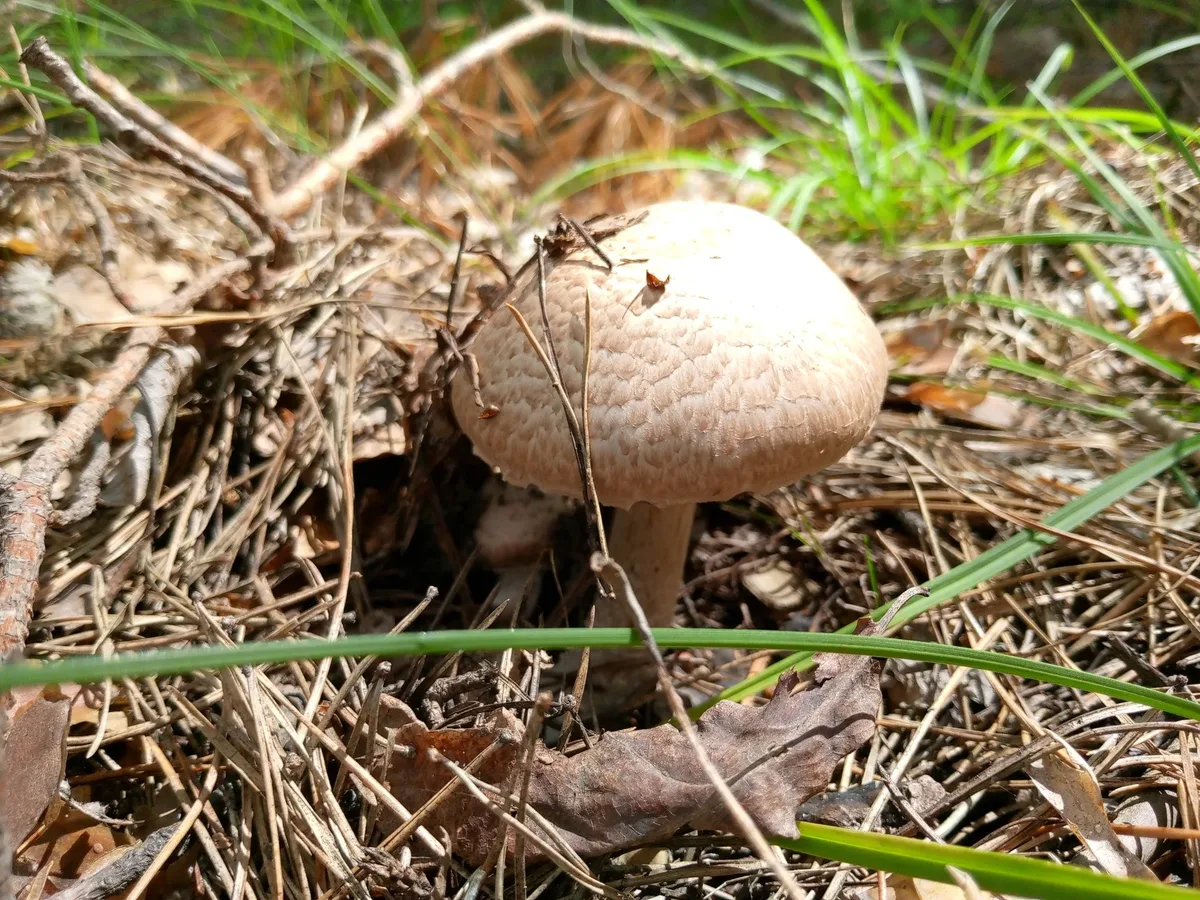
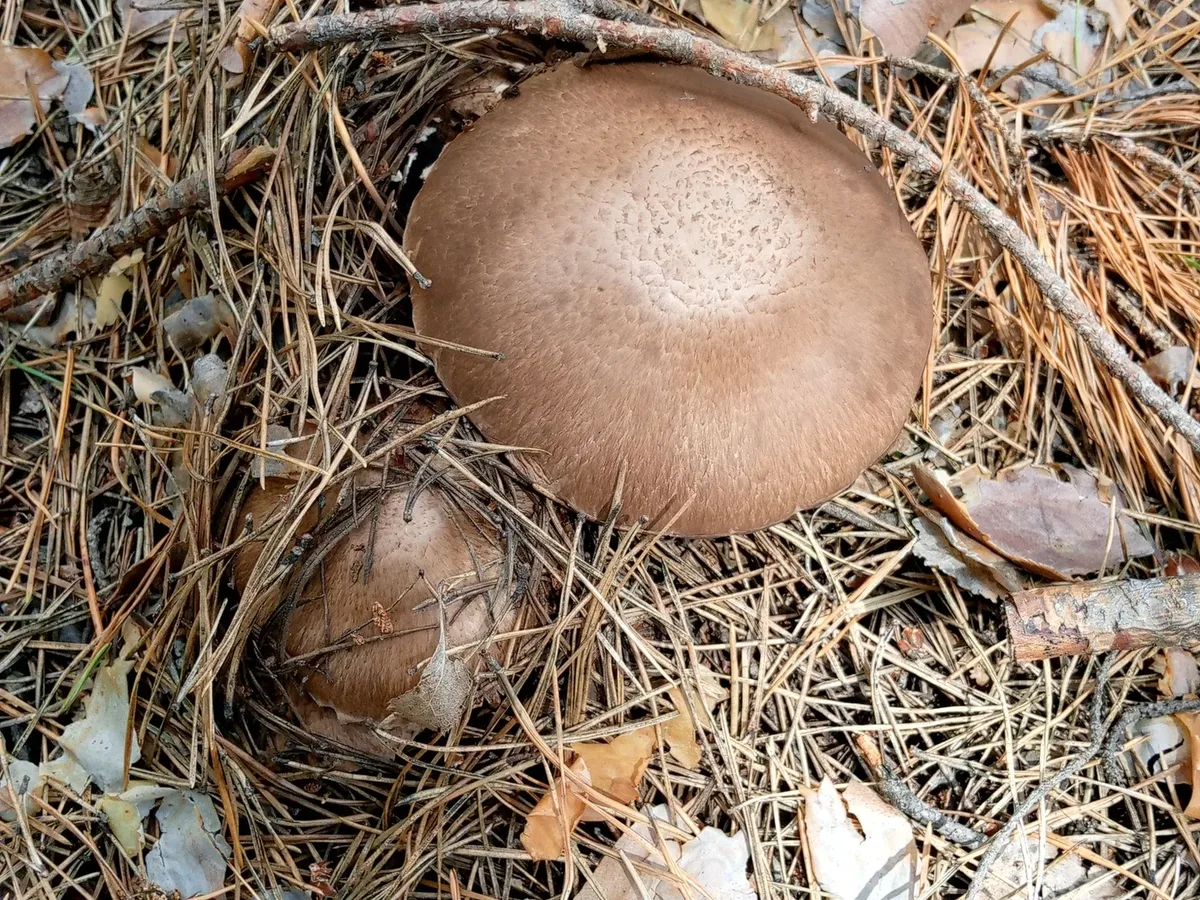
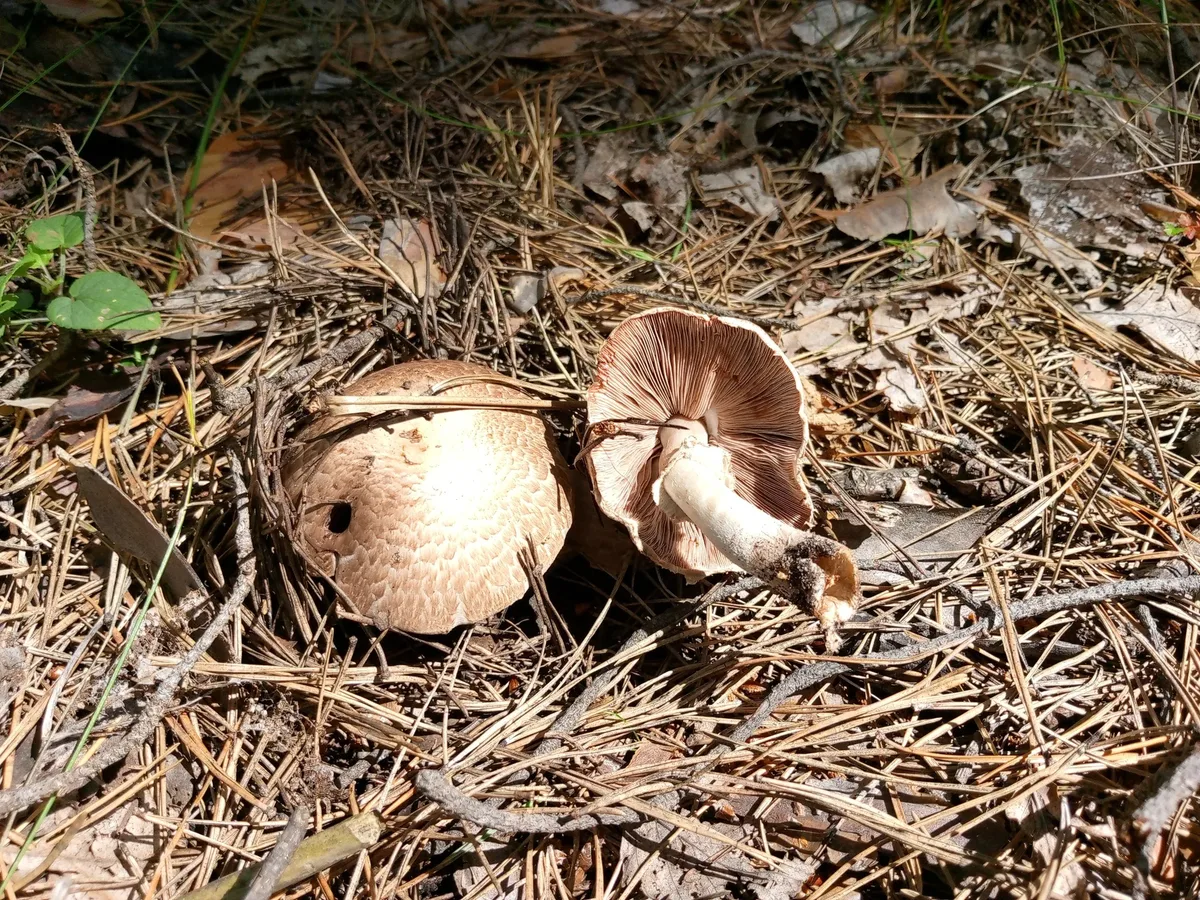
The cap is 5-12 cm across, starting broadly convex in the button stage and flattening to almost plane with age.
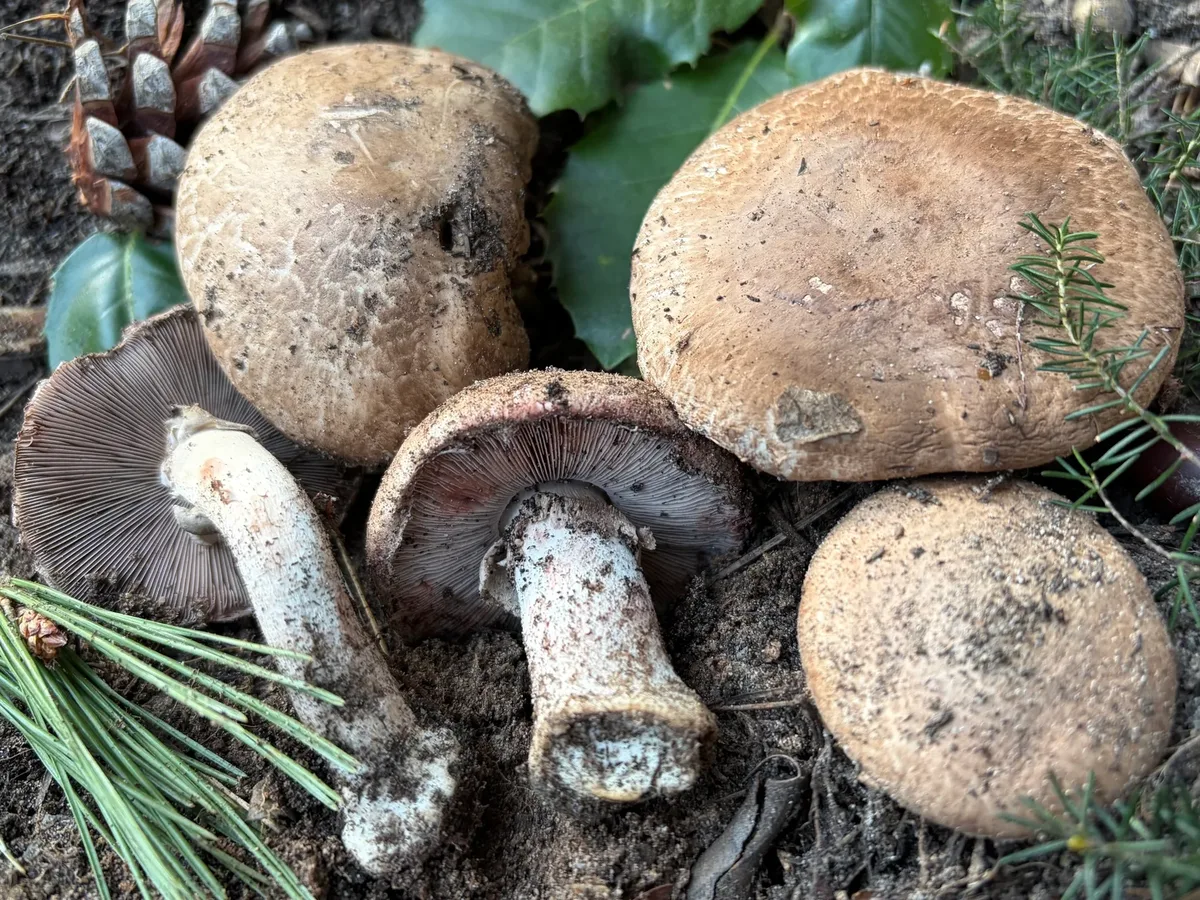
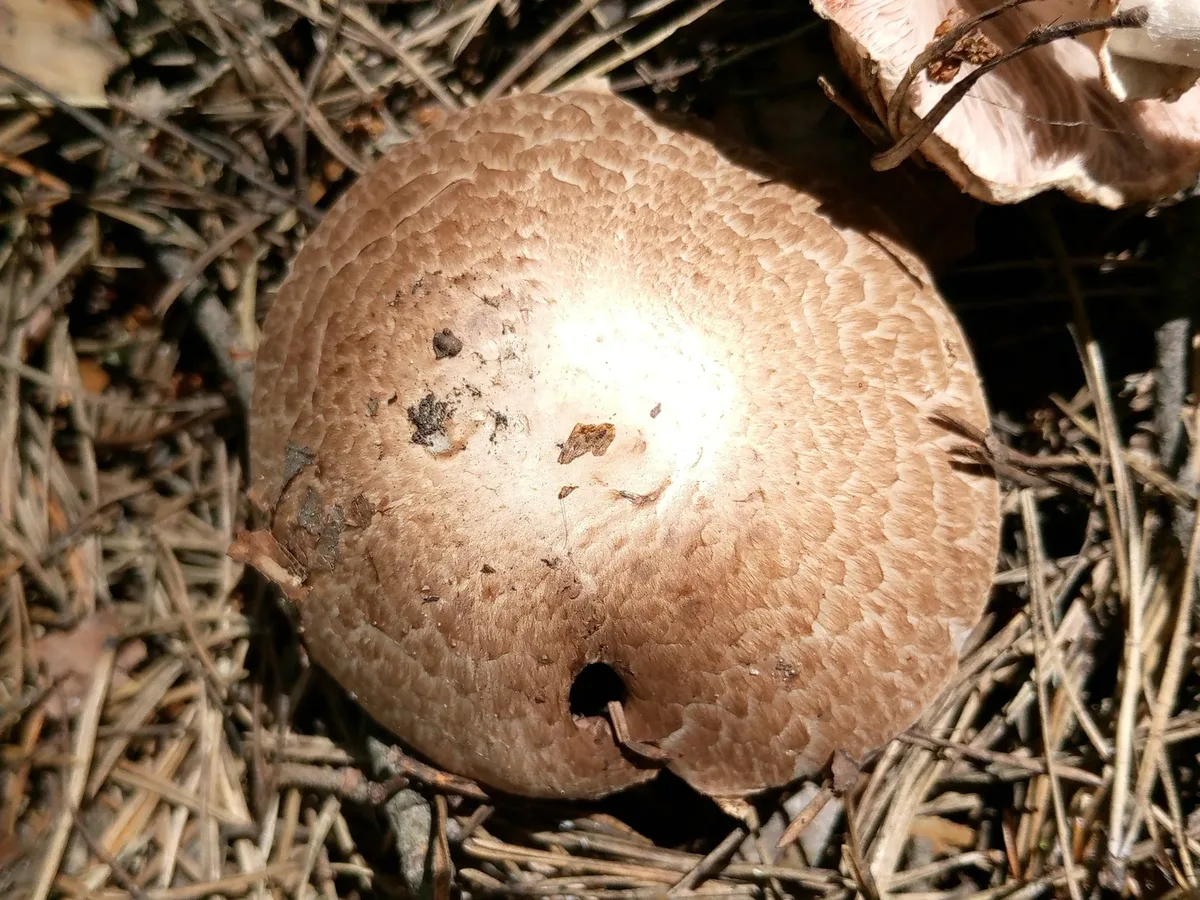
What sets it apart at a glance from the pale, smooth field mushroom is its colouration and texture: the cap background is a warm buff to pale grey-brown, overlaid with dense, concentrically arranged fibrous scales in shades of reddish-brown to chestnut, with the scales most compact and darkest at the centre and gradually thinning toward the pale margin.
The effect is of a rough, slightly felty or shaggy surface - reminiscent of the Prince (A. augustus) in texture, though more sombre in colour.
Gills
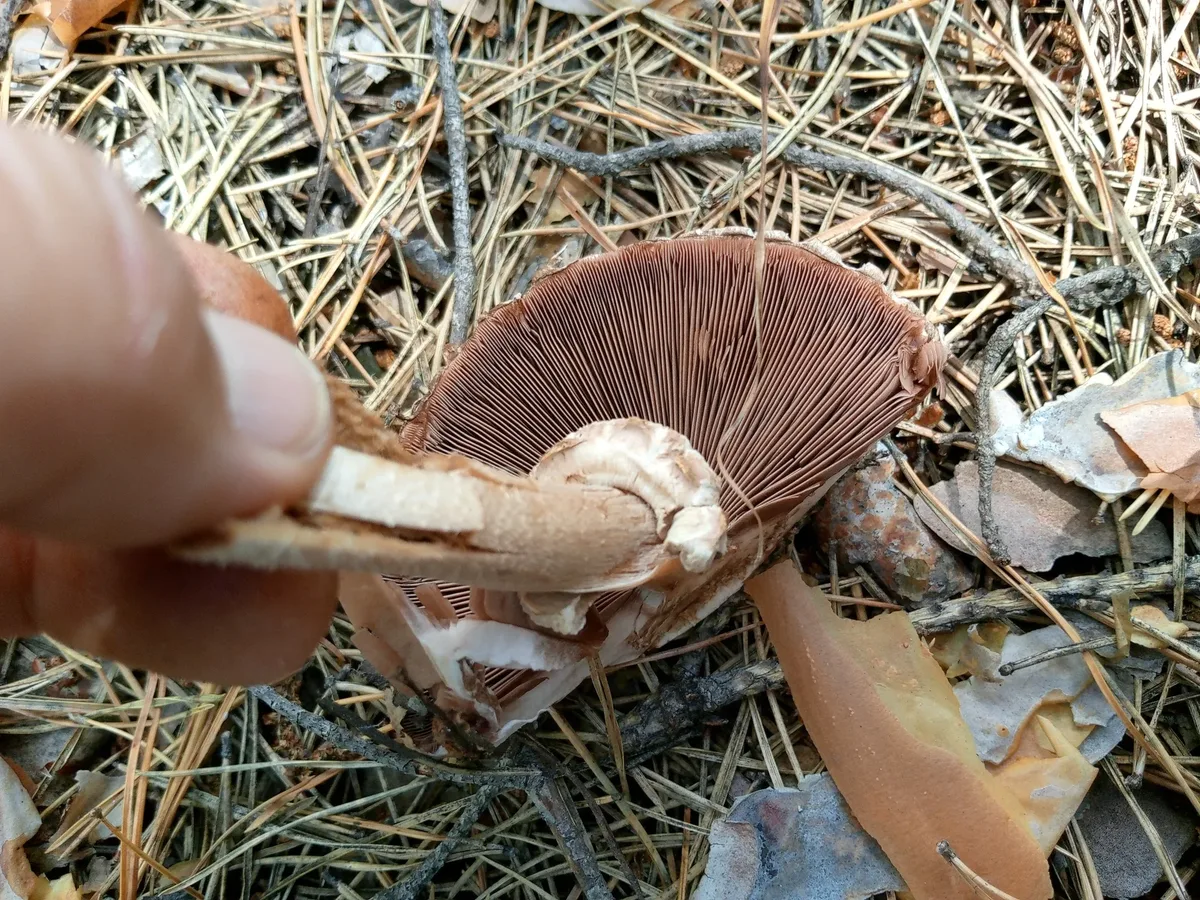
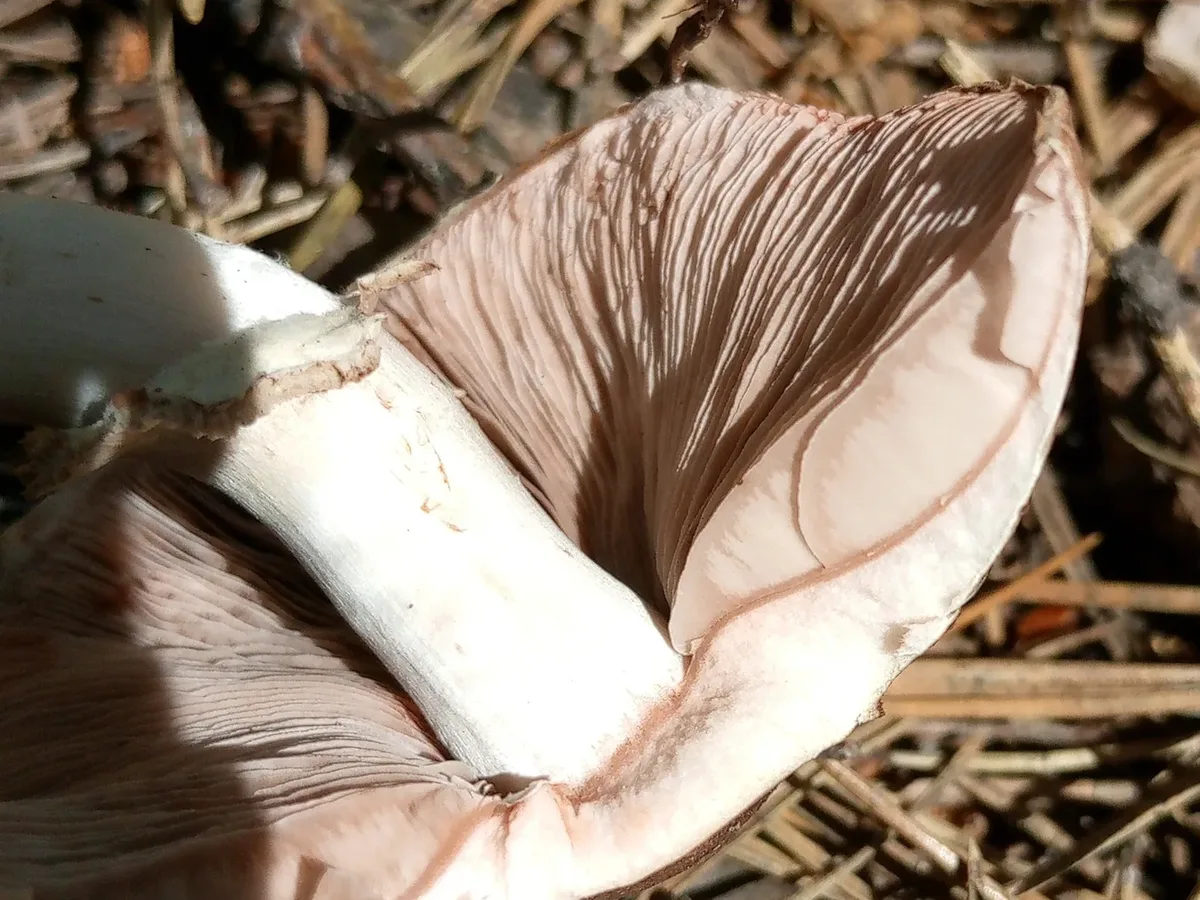
The gills are free from the stem and densely packed; even in quite young specimens they show a greyish-pink to pinkish-buff tone, quickly deepening through reddish-brown to the dark chocolate-brown of spore maturity.
This progressive darkening of the gills is shared by all Agaricus species, and it is important: a specimen whose gills stay pure white must never be eaten, as it indicates a potentially deadly Amanita.
Stem
The stem is white, smooth or finely fibrous, often slightly thickened at the base, and carries a thin but distinct membranous ring in its upper third. Below the ring the stem may have faint fibrous zones.
The stem base sits directly in the litter with no cup or sac (volva) of any kind - this must always be confirmed by gently excavating the base.
Flesh
The single most diagnostic character of this species - the feature that earns it the name 'Blushing' - is what happens when you break or cut the flesh. Within seconds the white flesh turns a vivid reddish-pink to wine-red or blood-red, most strongly in the stem and around the base of the cap. This colour change is rapid and unmistakable.
Smell & taste
The smell is pleasant, faintly earthy-mushroomy, sometimes with a gentle almond or slightly sweet note; it emphatically does not smell of phenol, ink, or chemicals.
Where & when it grows
Habitat
Agaricus sylvaticus is a creature of woodland, particularly the needle-carpeted floors beneath coniferous trees. In its native European range it is most commonly found in spruce and pine forests, often in the deep humus of old stands where needle litter has built up for decades.
In Australia and New Zealand, where neither spruce nor most native pines are indigenous, the species is most reliably encountered under introduced conifers:
- plantation pines (Pinus radiata is the dominant plantation species across both countries)
- park plantings of Pinus, Picea, and Douglas-fir (Pseudotsuga menziesii)
- occasionally in mature mixed woodland with a significant exotic conifer component
It grows saprotrophically - decomposing the deep humus of needle litter and woody debris - rather than forming mycorrhizal alliances, so it is the character of the soil and litter rather than the tree's physiology that governs where it fruits.
Look for it pushed up through dry, rust-brown needle beds or emerging from the edge of denser litter accumulations. It tends to fruit solitarily or in small loose groups, occasionally several specimens in a loose cluster; it does not form conspicuous rings in the way of grassland Agaricus species.
When
In Australia and New Zealand the season follows the Southern Hemisphere autumn: broadly March through June, with the peak in April and May when soil temperatures cool after summer and the first significant autumn rains penetrate the forest floor.
Fruiting responds to two aligned triggers - the soil cooling below roughly 18 °C, and sustained moisture reaching the duff layer. Pine needle litter is hydrophobic and can shed light rain without wetting the soil beneath, so the effective trigger rain for a conifer-floor species is somewhat higher than for a grassland species. Flushes typically appear five to twelve days after qualifying rain events.
In cooler, higher-elevation areas of Victoria, New South Wales, or the South Island of New Zealand, the season can push earlier into March and later into June; near sea level in warmer areas it tends to be more firmly confined to April-May.
How it grows
Agaricus sylvaticus is saprotrophic, a decomposer of forest-floor organic matter, primarily the needle litter and woody humus beneath conifers. It threads its mycelium through this deep, resinous substrate, breaking down cellulose and other organic molecules and cycling nutrients back into the system.
Because needle litter decomposes slowly and the organic layer in a mature pine stand can be many centimetres thick, the mycelium has an abundant, stable substrate - this is why the species tends to return to the same patch year after year when conditions are right.
Unlike the mycorrhizal woodland fungi (boletes, chanterelles, Amanita) that are physiologically tied to specific host trees, A. sylvaticus has no obligate plant partner; it is drawn to conifer woodland by the substrate and the microclimate rather than by biochemical necessity.
Fruitbodies develop and expand over five to twelve days after rain, producing spores that are wind-dispersed into the forest and may colonise fresh needle-litter many metres away.
Fruiting conditions
Conifer-floor saprotroph; fruiting triggered by autumn rain on cooling soils, roughly 5-12 days after qualifying rainfall penetrates the needle litter. Needle litter is hydrophobic - effective soil wetting requires heavier or more prolonged rain than open grassland. Season ends with the first hard frosts or when soil temperatures drop below roughly 7 °C.
Look-alikes
Three categories require attention, one deadly.
- 1Deadly Amanita species - the most important. The Death Cap (Amanita phalloides) and the Destroying Angel (Amanita virosa and related species) both occur in woodland - including areas near introduced conifers in Australia and New Zealand - and as young white buttons superficially resemble any young Agaricus. They are absolutely excluded by their permanently WHITE gills at every life stage (no pink or brown progression), a white spore print, and the presence of a membranous sac (volva) around the swollen stem base. The volva is often buried and must be physically dug out and inspected - it cannot be seen from above. A button-stage Amanita without an exposed volva and an immature Agaricus can both show pale gills, so gill colour at the button stage is not a safe screen on its own; always dig up the base.
- 2The Yellow Stainer (Agaricus xanthodermus), which also occurs under conifers and in nearby gardens and lawns. It does not blush red when cut - it turns bright chrome-yellow at the cut stem base instantly, and it smells of phenol or ink. The reddening flesh test is therefore a powerful discriminator, but always add the smell test as well.
- 3The closely related Bleeding Wood Mushroom (Agaricus haemorrhoidarius), which also blushes red when cut and grows in similar woodland; it is edible and a harmless confusion, being distinguished by its typically larger size, darker colouring, and more strongly expressed reddening.
- 4The edible Red Staining Mushroom (Agaricus langei / A. langei sensu lato) also reddens and grows in similar habitats; likewise edible and harmless in itself, though the same Amanita and Yellow Stainer exclusion checks must always be applied.
Deadly. As a button it can resemble a young Agaricus, but at every life stage the gills stay permanently WHITE (never pink or brown), the spore print is white, and there is a membranous sac-like volva cupping the swollen stem base - always buried, always requiring physical excavation to confirm. Additionally, A. phalloides typically shows a greenish-yellow or olive cast to the cap, though pale specimens can be nearly white. No red-blushing of the flesh when cut. In Australia and New Zealand, A. phalloides has become established near introduced oaks and exotic broadleaf trees in the same regions where conifers occur. The volva is the decisive check - never skip it.
Deadly. Pure white at every stage, permanently white gills, white spore print, and a membranous sac (volva) at the buried stem base. No red-blushing of the flesh. The absence of any greenish pigment (unlike A. phalloides) makes destroying angels harder to visually dismiss - their pure-white appearance can superficially suggest a pale Agaricus button. Excavate the base every time.
Edible. A close relative and harmless confusion; also blushes red or blood-red when cut, grows in similar woodland. Generally larger and darker, with more pronounced reddening and sometimes more strongly fibrous-scaly cap. The standard Amanita exclusion checks (volva, gills, yellow-stain test) must still be applied before eating either species.
Edible. Another woodland Agaricus that reddens when cut; grows in similar conifer and mixed forest habitat. Distinguished by its typically brighter and more uniform reddening and more slender stature. Harmless confusion; same exclusion protocol applies.
Edible. A white-capped, anise-scented woodland Agaricus that yellows (not reddens) when cut. Confused with A. sylvaticus at a glance in the same woodland habitat, but lacks the reddish-brown cap scales, lacks the red-blushing of flesh, and smells strongly of aniseed. Harmless confusion if the standard checks are applied.
Poisonous (gastrointestinal, not lethal). Also occurs under conifers and at woodland edges. Distinguished by the cut flesh at the stem base turning immediately bright chrome-yellow (vs. red in A. sylvaticus) and by a strong unpleasant phenol/ink/chemical smell. The Blushing Wood Mushroom never turns yellow and never smells of phenol. Perform both the cut-stem and smell test on every specimen.
In the kitchen
Picking & cleaning
The Blushing Wood Mushroom is a worthwhile edible, and the correct identification technique is straightforward but must be applied without shortcuts, because its woodland habitat overlaps with potentially deadly species.
Before lifting any specimen:
- 1Check the habitat - if you are under or very near conifers (pines, spruces), this supports A. sylvaticus; if you are in a fully open field or under broadleaf trees with no conifers present, reconsider the identification.
- 2Gently excavate the whole stem base to confirm the absolute absence of a volva or cup. Any cup or sac disqualifies the specimen instantly (Amanita).
- 3Cut the flesh and observe it for one minute: A. sylvaticus blushes red or wine-red rapidly, a positive identification character; flesh that turns bright chrome-yellow indicates a Yellow Stainer and is a reject.
- 4Smell the cut flesh - a pleasant or faintly almond-like odour is consistent with A. sylvaticus; any phenol, ink, or chemical smell is a reject (Yellow Stainer or A. moelleri).
- 5Confirm gills are not permanently white at every stage (an Amanita never transitions from white).
Collect young to middle-aged specimens whose flesh is firm and whose gills have darkened to pink-brown but not completely collapsed. Use a basket or breathable container.
Do not collect from sites that may be contaminated by pesticides, herbicides, or industrial runoff - forest floor litter in plantation settings can carry residues.
Cooking
The Blushing Wood Mushroom has a pleasant, mild, earthy mushroom flavour that is good but not exceptional - a reliable woodland find rather than a coveted prize. The flesh firms well on cooking and holds its shape satisfactorily.
Note that the red-blushing of the raw flesh fades on cooking and the cooked mushroom becomes a standard brownish colour, so there is no alarming colour in the cooked dish.
It suits all standard preparations:
- sautéed in butter with garlic and herbs
- added to sauces, soups, and pasta dishes
- incorporated into risotto or omelettes
The cooked flavour integrates well into autumnal preparations - wild mushroom pasta, risotto with woodland herbs, cream sauces for game. It dries reasonably well, concentrating its flavour; rehydrate in warm water before use.
Always cook thoroughly; raw Agaricus species are not recommended.
Good to know
The Blushing Wood Mushroom is a safe edible for correctly identified specimens, but it grows in woodland habitat that is shared by some of the most lethal fungi known - chiefly Amanita phalloides (the Death Cap) and destroying angel species.
The three non-negotiable safety checks are:
- 1Dig up the entire stem base and confirm the total absence of any volva or cup. This is the single most important rule for any Agaricus picked in woodland.
- 2Cut the flesh and confirm it blushes RED (not yellow). The immediate red-blushing is a positive identifier for A. sylvaticus; the absence of yellow staining is equally important.
- 3Confirm the gills are not pure white at full maturity - Amanita gills stay white throughout, whereas A. sylvaticus gills progress from pale greyish-pink to dark brown.
A white spore print is also a red flag and must be excluded. The smell should be pleasant; any phenol or chemical odour means immediate rejection.
As with all Agaricus species, it should be cooked before eating - raw consumption is not recommended. Some individuals have personal sensitivities to Agaricus species; try a small amount from a new patch before consuming larger quantities.
A reference guide - never an edibility guarantee. When in doubt, leave it out.