Flat-topped Wood Mushroom
Agaricus placomycessyn. Psalliota placomyces Peck, Agaricus placomyces var. placomyces, Agaricus meleagris sensu Peck
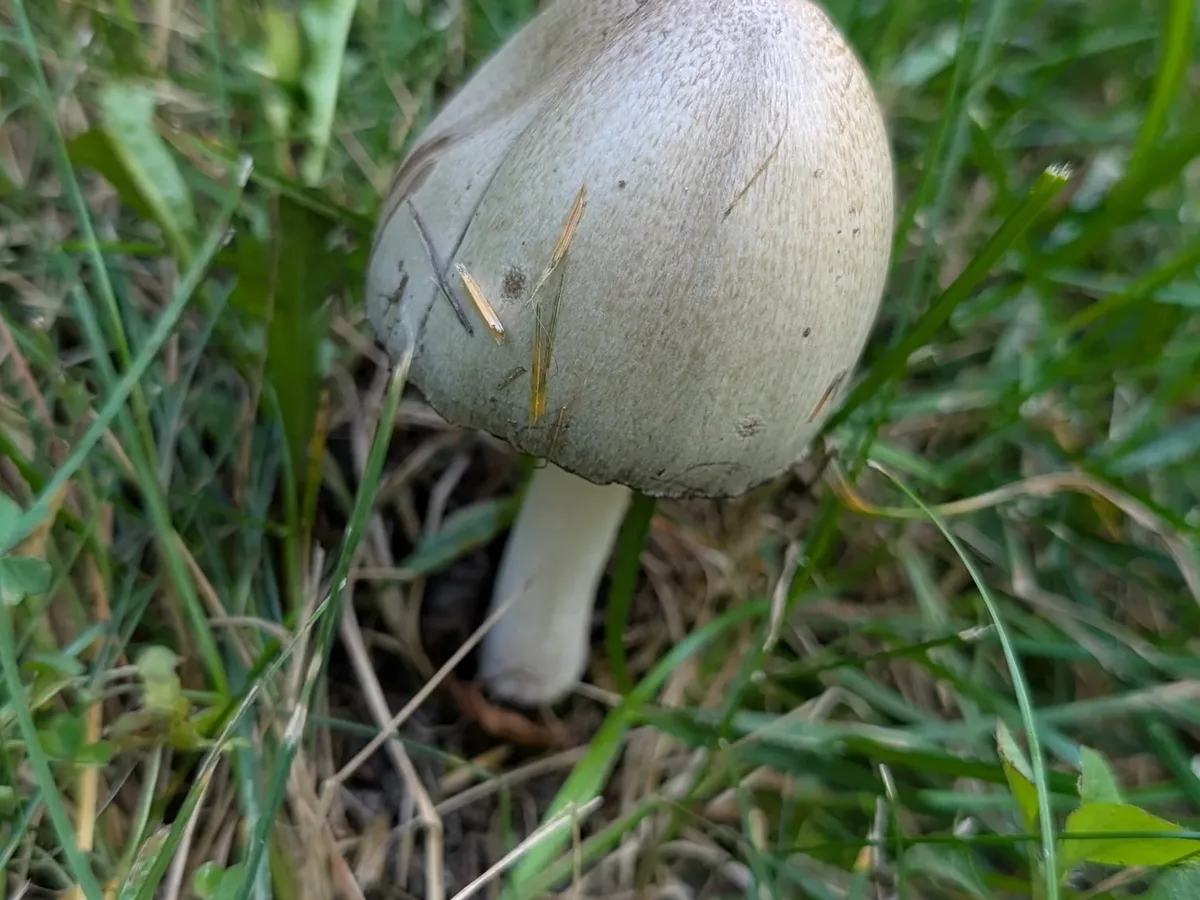 © Martin Tremblay (CC BY)
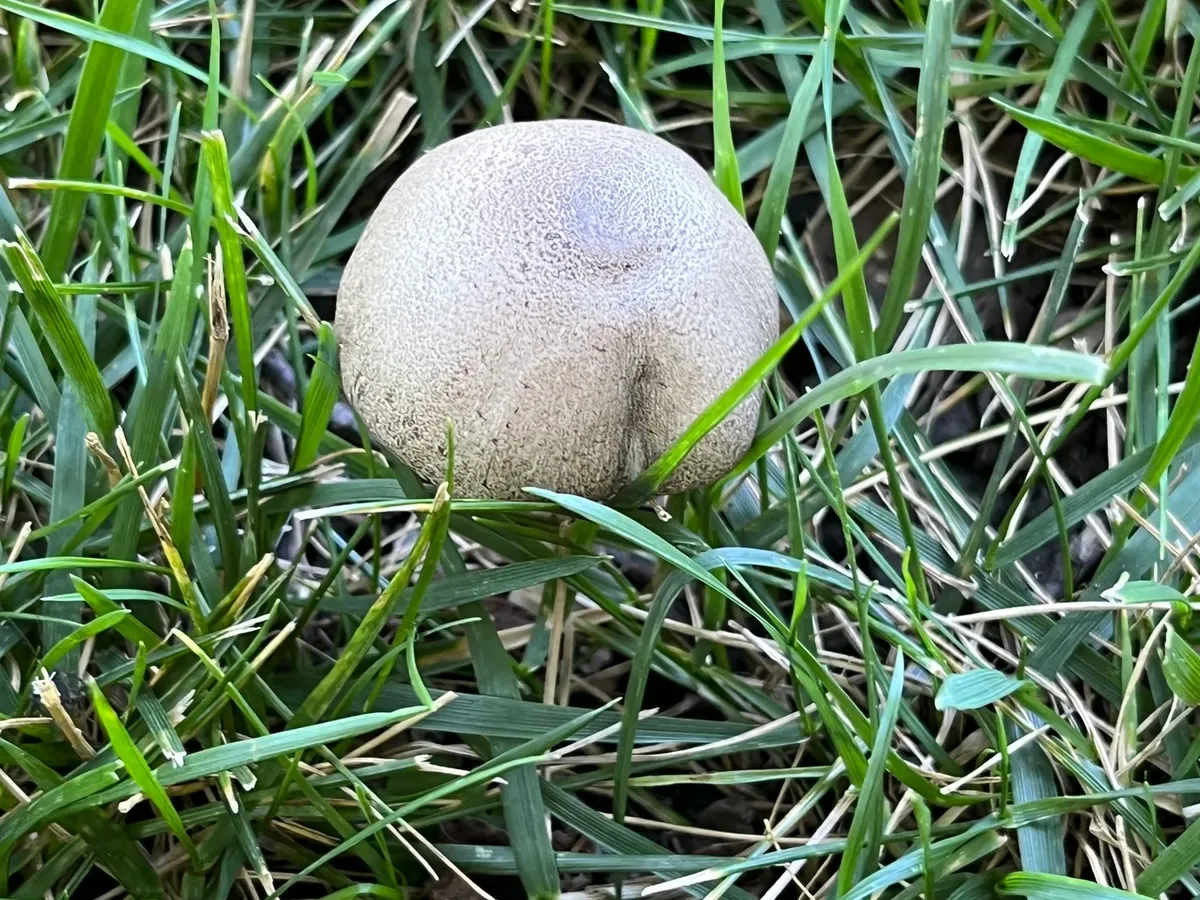 © Julie Travaglini (CC BY)
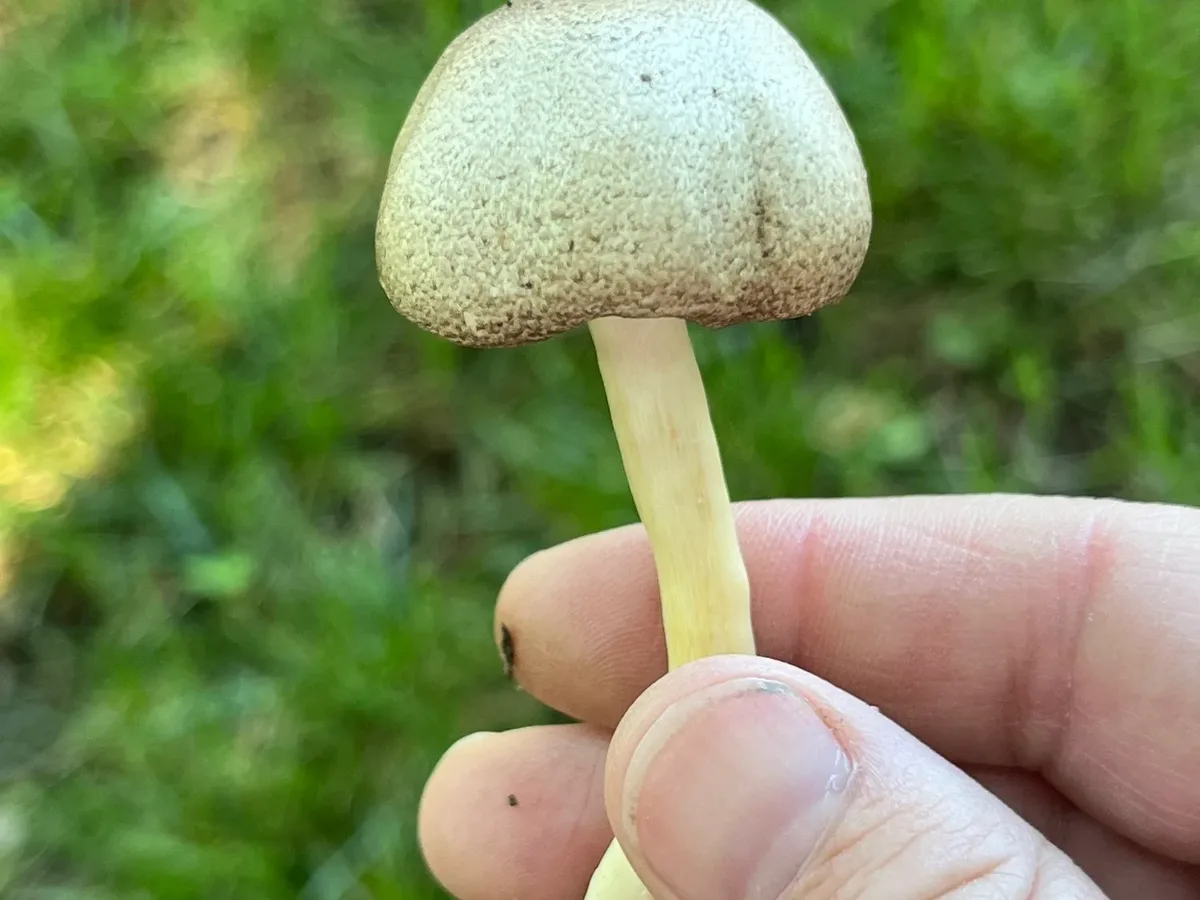 © Julie Travaglini (CC BY)
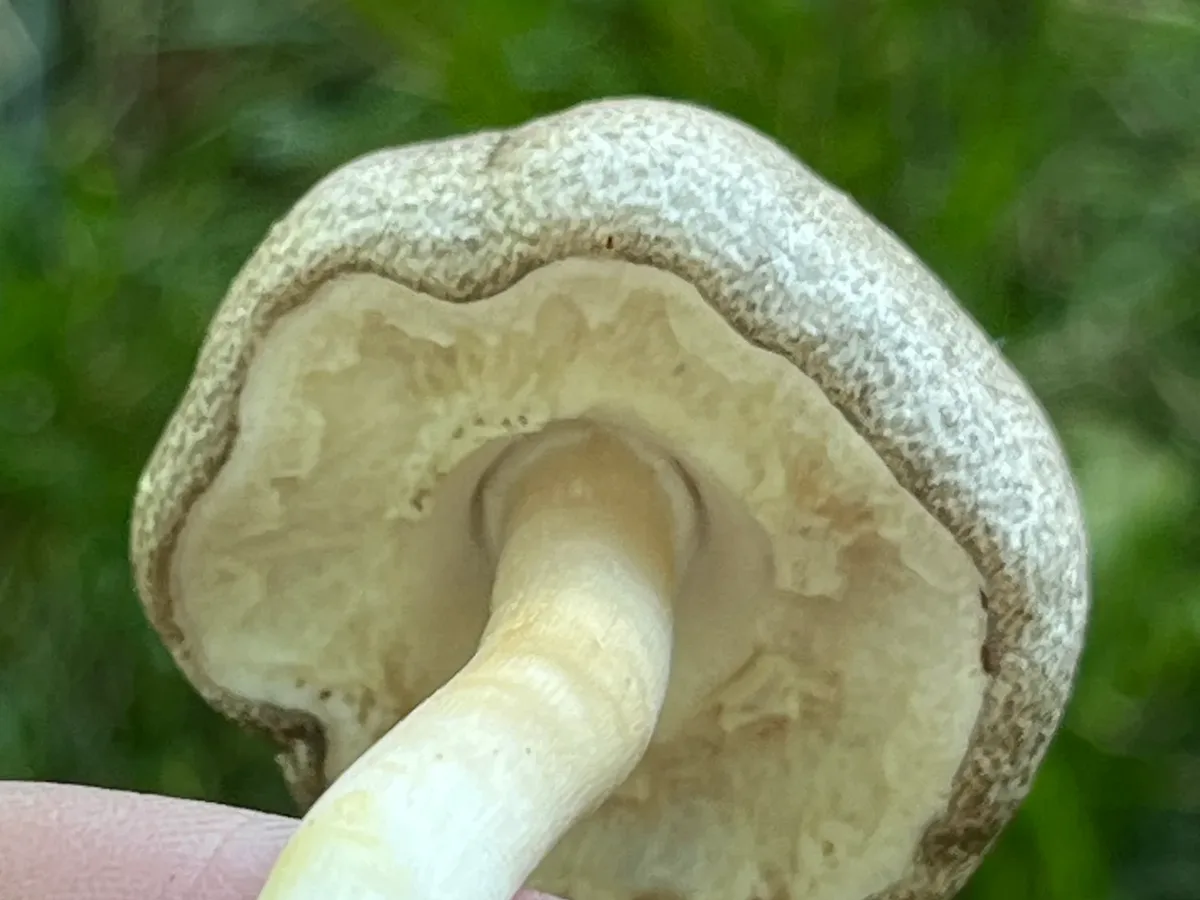 © Julie Travaglini (CC BY)
 © Julie Travaglini (CC BY)
 © Julie Travaglini (CC BY)
 © Julie Travaglini (CC BY)
 © Julie Travaglini (CC BY)
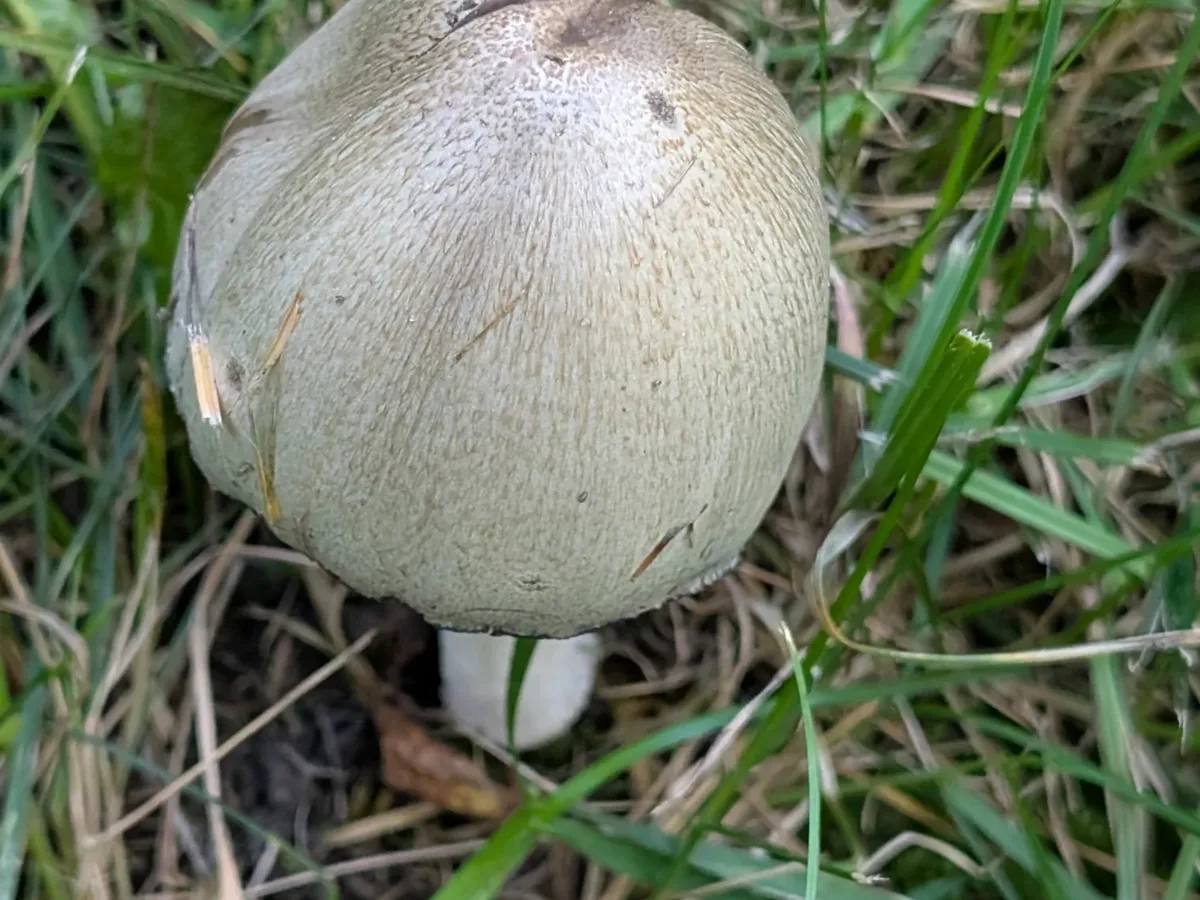 © Martin Tremblay (CC BY)© Martin Tremblay (CC BY)© Julie Travaglini (CC BY)
Edible only with the right preparation - or safe for some people but not others. Learn the caveats first.
Never eat a mushroom you are not 100% sure of - check the look-alikes below, and always cook wild mushrooms.
How to recognise it
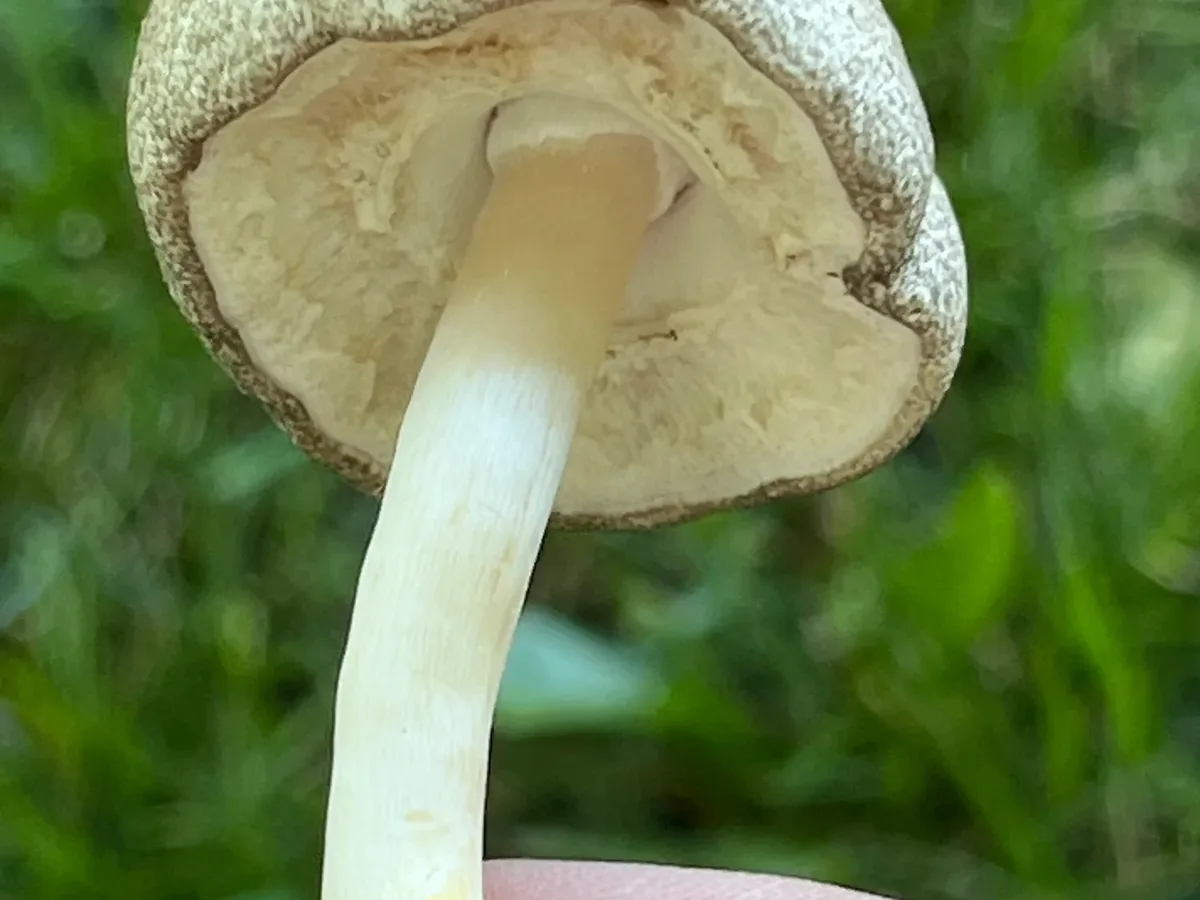
Agaricus placomyces stands out among eastern North American woodland mushrooms by its combination of a remarkably flat cap and a pattern of dark fibrous scales over a pale background - a character set that catches the eye in the dappled light of a mixed hardwood forest, particularly for anyone expecting the smooth white dome of a field mushroom.
Cap
The cap starts broadly convex in the button stage but flattens very quickly to nearly plane, often displaying a conspicuously flat top even before the specimen has fully expanded. This habit is so reliable that the flat disc is considered one of the primary recognition features of the species.
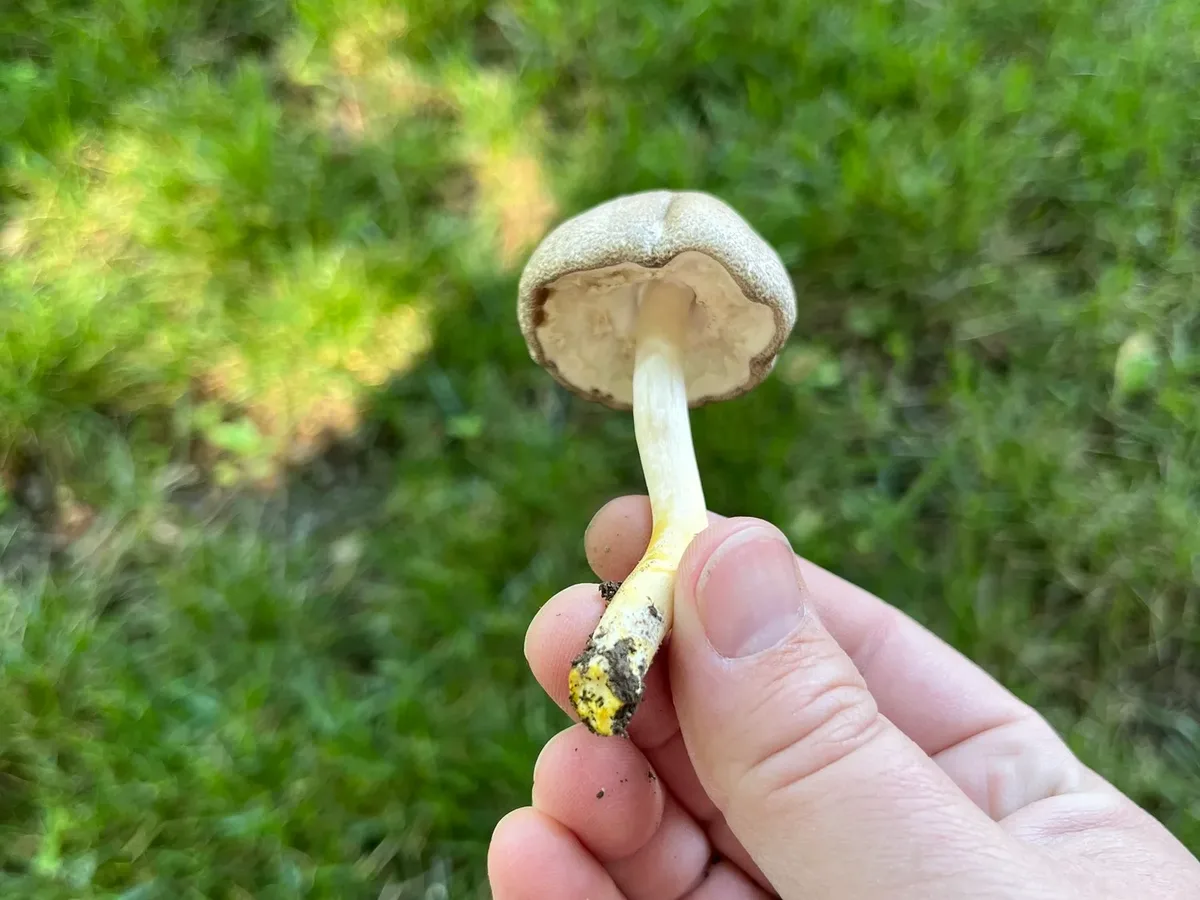
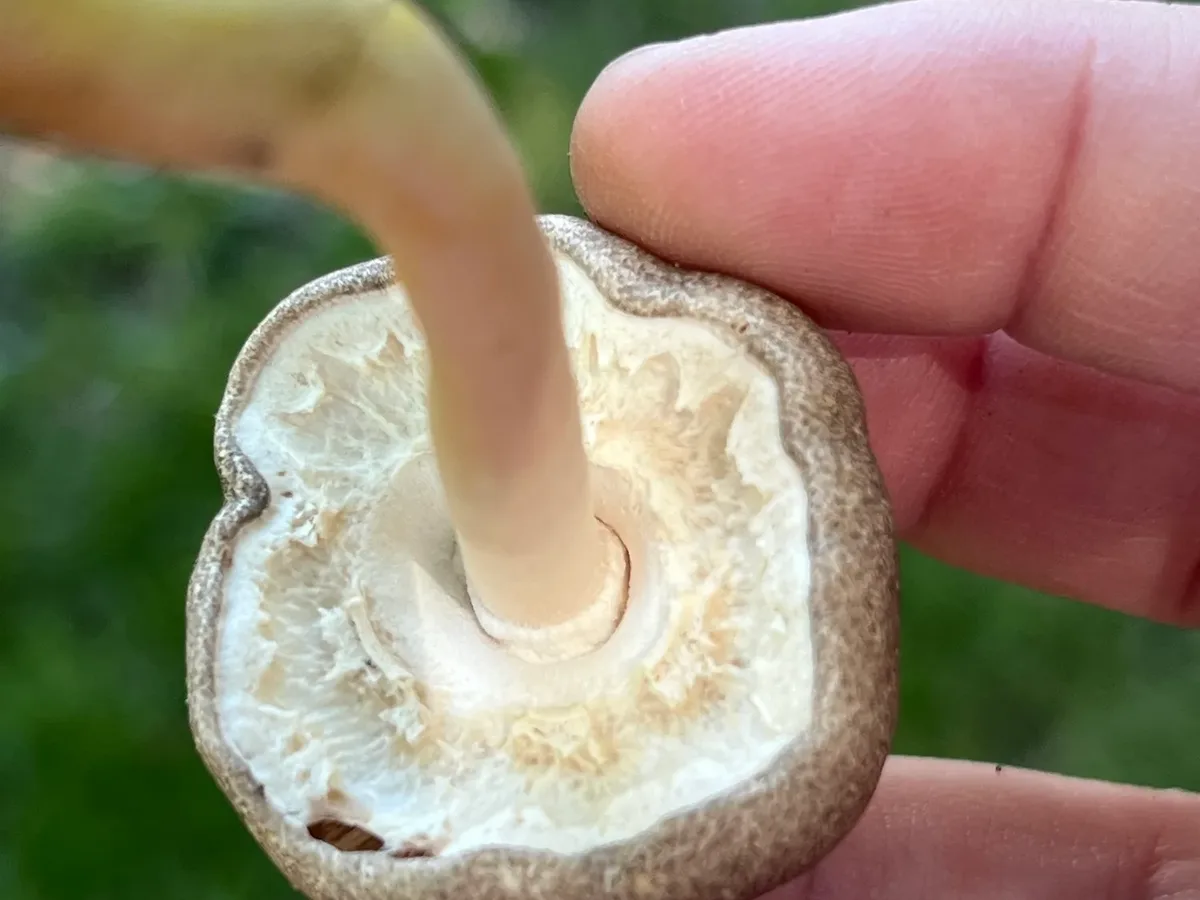
The cap surface is pale greyish-white to buff, overlaid with concentrically arranged, dark grey-brown to sooty fibrous scales that are densest and blackest at the flat centre, thinning as they radiate outward so that the margin looks considerably paler and less patterned. This mottled look gives the cap a distinctly 'mousy' or tessellated quality.
Gills
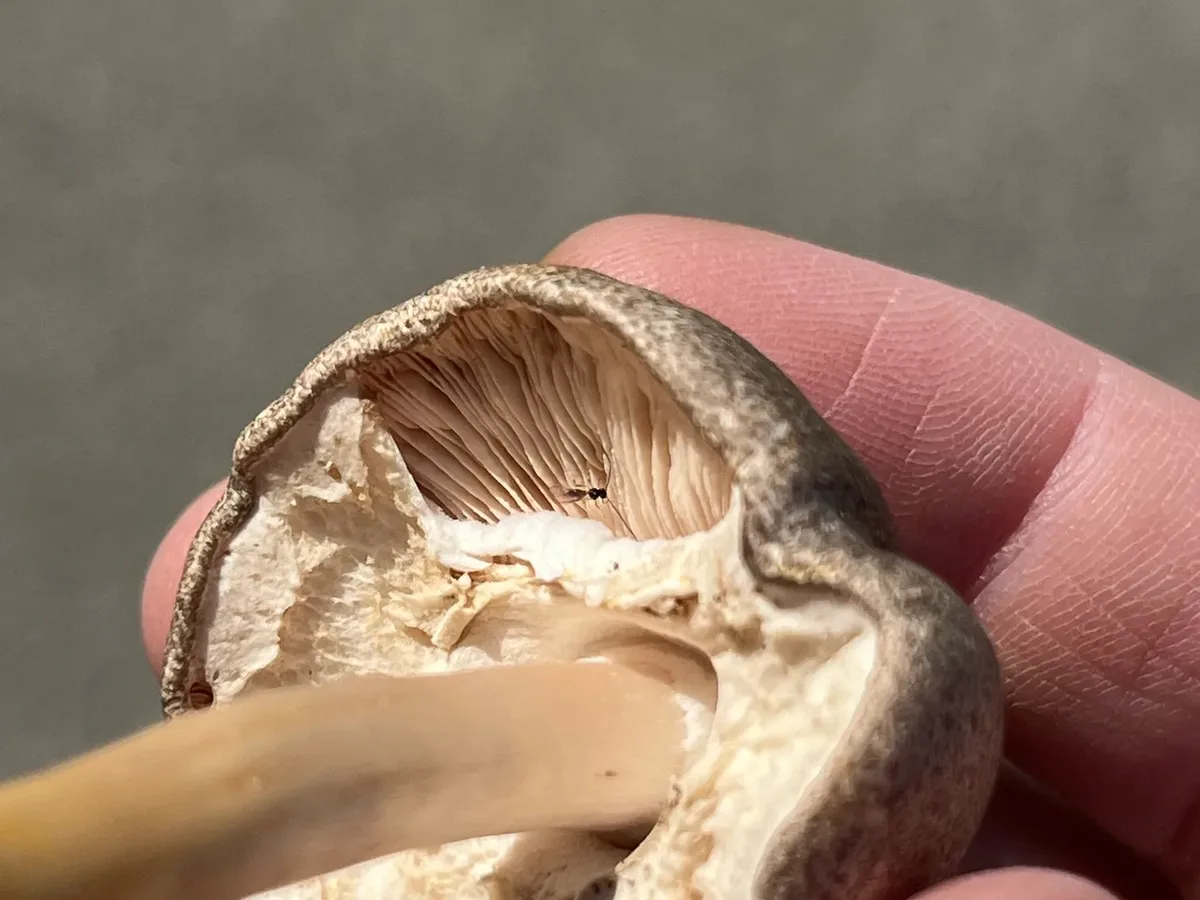
The gills, visible when you lift the cap or slice the button, are clearly PINK even in the youngest stages - never the persistent pure white of a deadly Amanita - and deepen progressively through pinkish-brown to chocolate-brown as the spores mature.
Stem
The stem is white, cylindrical, and bears a single, skirt-like membranous ring. The base is slightly thickened but firmly lacks any volva or cup of any kind.
Flesh
The flesh is white and firm throughout.
The two decisive diagnostic tests are the cut-and-watch test and the smell test. For the first, cut through the base of the stem and hold the white flesh exposed to air for 15-20 seconds - in A. placomyces it will stain a vivid, unambiguous chrome-yellow, most rapidly at the very cut surface.
Smell & taste
Simultaneously, the raw mushroom emits a distinctly chemical, phenolic smell - inky, astringent, reminiscent of coal tar or India ink - that intensifies dramatically and nauseatingly when the mushroom is cooked.
These two reactions together constitute a definitive rejection signal that takes no equipment and less than a minute.
Why it's dangerous
The direct danger from Agaricus placomyces is gastrointestinal illness - unpleasant, occasionally severe, but not typically life-threatening for a healthy adult consuming a single mushroom.
The broader danger is contextual. This species fruits in eastern hardwood forest alongside Amanita bisporigera (Destroying Angel), North America's most lethal native mushroom.
A forager working a woodland patch who collects what they believe to be Agaricus placomyces without applying the volva check to every individual specimen runs the risk of including a Destroying Angel button in the basket - a confusion that would have fatal consequences.
The phenolic species' distinctive diagnostic reactions (yellow staining, ink smell) are easy and fast to apply, but they screen only for other phenolic Agaricus species; they do not distinguish a non-phenolic Agaricus from an Amanita.
For that, the volva inspection remains the only reliable field test. Every woodland Agaricus must have its base dug up and examined in the open before it is collected.
Toxin
The principal toxic constituents are phenolic compounds - primarily phenol, p-cresol (4-methylphenol), and related catechols - concentrated in the cap cuticle and flesh. These volatile aromatic molecules are directly irritating to the gastrointestinal mucosa.
They are not metabolically detoxified by cooking. Heating the mushroom volatilises phenols into the cooking environment (producing the characteristic noxious smell) and may redistribute rather than reduce the irritant burden in the consumed tissue.
The chrome-yellow staining reaction that appears within seconds of cutting the flesh is caused by the oxidative enzymatic reaction of these phenolic compounds on exposure to air, catalysed by tissue polyphenol oxidases. This is the same class of reactions that cause apple or avocado flesh to brown, but driven by a different substrate and producing a vivid yellow oxidation product rather than melanins.
Total phenol content varies with fruitbody age and developmental stage. Older specimens and those fruiting from wood-chip or particularly organic substrates may carry higher loads.
Symptoms
Gastrointestinal symptoms typically begin 30 minutes to 2 hours after ingestion: nausea, abdominal cramping, vomiting, and diarrhoea. Sweating and dizziness may accompany the gastrointestinal phase.
Most episodes in healthy adults are self-limiting, resolving within several hours as the irritant compounds are expelled. Children, elderly individuals, and anyone who consumed a large quantity or a particularly phenol-rich specimen may experience more severe or prolonged illness.
No fatalities attributable specifically to Agaricus placomyces are on record. However, anyone who has ingested a suspected specimen - or who has consumed wild mushrooms collected in eastern North American woodland and becomes ill - should seek medical assessment promptly.
The clinical importance of doing so goes beyond the direct effect of the phenols. The symptom onset of Amanita bisporigera poisoning is delayed 6-24 hours, symptoms then superficially resemble GI illness, and victims enter acute liver failure after an apparent brief recovery.
Any mixed-collection scenario where an Amanita could have been inadvertently included - possible if the full base of every woodland specimen was not carefully examined - represents a life-threatening emergency requiring emergency toxicology involvement.
Staying safe
Do not eat this species. It causes gastrointestinal poisoning - nausea, cramping, vomiting, and diarrhoea - in most people who consume it, typically beginning 30 minutes to 2 hours after ingestion.
The illness is not usually life-threatening in healthy adults, but the phenolic compounds responsible are not destroyed or inactivated by cooking. If anything, the volatilisation of phenols during frying or boiling intensifies the irritant dose delivered to the gut.
Beyond its own toxicity, A. placomyces is embedded in a habitat where the Destroying Angel (Amanita bisporigera) also fruits, often in the same patch of leaf litter.
The practical safety consequence is that the cut-and-smell protocol used to reject A. placomyces must be executed rigorously on every woodland Agaricus - not because A. placomyces itself is fatal, but because the habitual discipline of checking every specimen for yellow staining and phenolic odour reinforces the broader practice of examining each mushroom individually rather than bulk-harvesting by rough appearance.
In addition, digging up the full stem base and confirming the absolute absence of a volva must be a non-negotiable step for any white woodland button, regardless of how confident you feel about the Agaricus genus.
The chrome-yellow staining and ink smell of A. placomyces make it, to its credit, an unusually easy poisonous species to recognise and reject - a property that should be used as a teaching moment, not as a licence to relax identification discipline on related species.
Where & when it grows
Habitat
Agaricus placomyces is a woodland and woodland-edge species, a habit that firmly distinguishes it from the grassland species most people learn to eat first.
It is at home in the humus-rich leaf litter of eastern North America's deciduous and mixed forests. Look for it under maples, oaks, beeches, and hemlocks, where decades of decomposing leaves have built a deep, moist, nutrient-rich duff layer.
It appears anywhere a well-shaded, organically rich soil develops under mature trees:
- at the edges of woodlots
- along shaded forest paths and trails
- in suburban parks with substantial tree cover
- occasionally under ornamental trees in gardens
Fruiting bodies push up through or beside leaf litter, often partially buried at first.
This woodland ecology matters for a second reason beyond the species itself. The same habitat in eastern North America hosts the Destroying Angel (Amanita bisporigera) and the Death Cap (Amanita phalloides, increasingly established in introduced-tree landscapes), both of which fruit in woodland and can superficially resemble a young Agaricus button.
Understanding where A. placomyces grows means understanding that the most dangerous mushrooms in North America are nearby.
When
In eastern North America, Agaricus placomyces is primarily a mid-summer to autumn species. The season opens in July in warmer parts of its range and runs through September into October, with the main flush concentrated in August and September.
This is the period when:
- soils are warm from the summer
- post-drought summer thunderstorms provide the moisture pulse
- the organic-rich woodland floor holds humidity under the tree canopy
Individual fruiting events are flush-driven: a qualifying rainfall event of roughly 20 mm or more in a two-week window, falling on soils warm enough to sustain mycelial growth (above about 14 °C), typically produces visible fruiting bodies 5-12 days later.
The season truncates sharply with the first significant autumn frosts and the cooling of soils below about 10 °C.
In the northern parts of its range (New England, Maritime Canada, Quebec) the effective season is July through early September. From the mid-Atlantic states southward the season runs fuller and may extend into October in warm autumns.
How it grows
Like all Agaricus species in this habitat, A. placomyces is a saprotroph - a decomposer of dead organic matter - rather than a plant symbiont. Its mycelium spreads through the humus and decomposing leaf litter of the forest floor, breaking down cellulose, lignin, and other complex organic molecules and cycling their constituent nutrients back into the ecosystem.
Because eastern hardwood leaf-litter layers are rich, deep, and renewed each autumn, the substrate is stable. A well-established mycelium can persist for many years, reliably fruiting from roughly the same location when conditions are right.
Fruiting bodies develop quickly once triggered: a button formed after rain can expand to full size within four to seven days under warm, humid conditions. The cap inflates and opens, the gills darken progressively as spores mature, and the fruitbody then deteriorates within another few days.
Spores are wind-dispersed from the exposed gills and can colonise fresh leaf litter at new sites.
Fruiting conditions
Saprotrophic deciduous and mixed-woodland species; fruiting triggered by warm-season rainfall (≥20 mm over 14 days) on soils between roughly 14-25 °C. Season runs July-October in eastern North America, peaking August-September. Fruiting ceases when soil temperatures drop below ~10 °C with autumn frosts. Flushes typically appear 5-12 days after qualifying rainfall; the leaf litter of hardwood forest retains moisture well and sustains fruiting longer than exposed substrates.
Look-alikes
Several species - some harmless confusions, some genuinely dangerous - share its woodland habitat or superficial appearance.
The most urgent concern is not mistaking A. placomyces for an edible Agaricus, but rather the reverse risk: novice foragers who are not familiar with the species might mistake a deadly Amanita button for a young Agaricus and attempt these field-tests too casually.
- Destroying Angel (Amanita bisporigera) - pure white, grows in the same eastern hardwood woodland, and among the most lethal mushrooms in North America. Excluded definitively by its permanently white gills at every stage and the presence of a volva (membranous sac) at the buried stem base.
- Yellow Stainer (Agaricus xanthodermus) - functionally identical in its toxicity and diagnostic reactions (the same chrome-yellow staining and phenolic odour), making both species identified and excluded by the same tests.
- Agaricus moelleri (the Inky Mushroom) - shares the dark fibrous scaly cap and phenolic character but is more an urban and European species; in eastern North America A. placomyces occupies the equivalent ecological and morphological niche.
- Agaricus silvicola (Wood Mushroom) - an edible woodland species with a pale smooth cap and aniseed smell; clearly different smell and no dark scales.
- Agaricus augustus (The Prince) - an edible woodland species, much larger, with rich brown scales and pleasant almond aroma.
- Lepiota or Chlorophyllum species - the scaliness of A. placomyces can cause superficial confusion with these, both separated by gills remaining white rather than turning chocolate-brown, and by Chlorophyllum's green spore print.
DEADLY. Introduced to North America with European ornamental trees (oaks, beeches, birches) and now spreading into eastern North American landscapes. Separated from A. placomyces by the same absolute characters as A. bisporigera: permanently white gills, a buried volva at the stem base, white spore print, and no phenolic smell or chrome-yellow staining. Typically shows a greenish-yellow to olive cast on the cap - but pale specimens can approach white and must not be identified by colour alone. Always excavate the base.
DEADLY - one of the most lethal mushrooms in North America, responsible for the majority of fatal mushroom poisonings in eastern North America. As a button it can look superficially like a young Agaricus pushing up through woodland leaf litter. Separated absolutely by: (1) gills that are PURE WHITE at every stage and remain white into maturity - never pink or brown; (2) a membranous sac-like VOLVA enclosing the swollen stem base, often buried, requiring physical excavation to confirm; (3) WHITE spore print; (4) NO chrome-yellow staining of the cut flesh; (5) NO phenolic or inky smell. Agaricus placomyces has pink-progressing-to-brown gills, no volva, a dark brown spore print, stains bright chrome-yellow when cut, and smells strongly of phenol or ink. These are opposite in every safety-relevant character. Dig out the stem base of every white woodland button and inspect it in the open before collecting.
Edible. Primarily a species of open grazed pasture rather than woodland, so habitat alone reduces the confusion significantly. Cap smooth and white, without dark fibrous scales. Flesh does not stain chrome-yellow. Smells pleasantly earthy, not phenolic. The cut-and-smell protocol clearly excludes A. campestris as safe and A. placomyces as not.
Poisonous - phenolic gastrointestinal irritant; functionally equivalent to A. placomyces. Very similar in appearance: dark fibrous scales on a pale background cap, chrome-yellow staining of cut flesh, and phenolic inky smell. A. moelleri is primarily a European species that has been introduced to North America in urban settings; A. placomyces is the native North American woodland equivalent. Both are excluded by the same cut-and-smell tests. Their shared appearance means they are more likely to be confused with each other than with edible species, but since both are toxic and identified by the same field protocol, distinguishing one from the other has no practical safety consequence.
Edible and choice. Also produces scaly caps, but the scales are rich tawny-brown to golden-brown and the cap background is similarly warm buff rather than pale grey-white. Much larger (cap typically 12-25 cm), with a robust stout stem bearing recurved scales below the ring. The flesh slowly yellows (not vividly chrome-yellow) and has a strong almond-marzipan rather than phenolic smell. The smell distinction is decisive.
Edible. Also a woodland Agaricus but with a smooth, pale ivory to white cap lacking the dark fibrous scales of A. placomyces. The flesh yellows faintly and slowly (not immediately and vividly) and smells pleasantly of aniseed or almonds rather than phenol or ink. The contrast in both smell and staining reaction clearly separates the two species.
Poisonous - causes the same gastrointestinal phenol poisoning as A. placomyces. Functionally similar in toxicity and field reactions: the cut stem base turns immediately vivid chrome-yellow and the mushroom smells strongly of ink or phenol. Separated from A. placomyces morphologically by its smooth, clean white cap without the dark fibrous scales; A. xanthodermus lacks the 'mousy' dark scaling. Both are excluded by the cut-and-smell protocol, so the distinction matters mainly for academic accuracy rather than safety.
A reference guide - never an edibility guarantee. When in doubt, leave it out.